

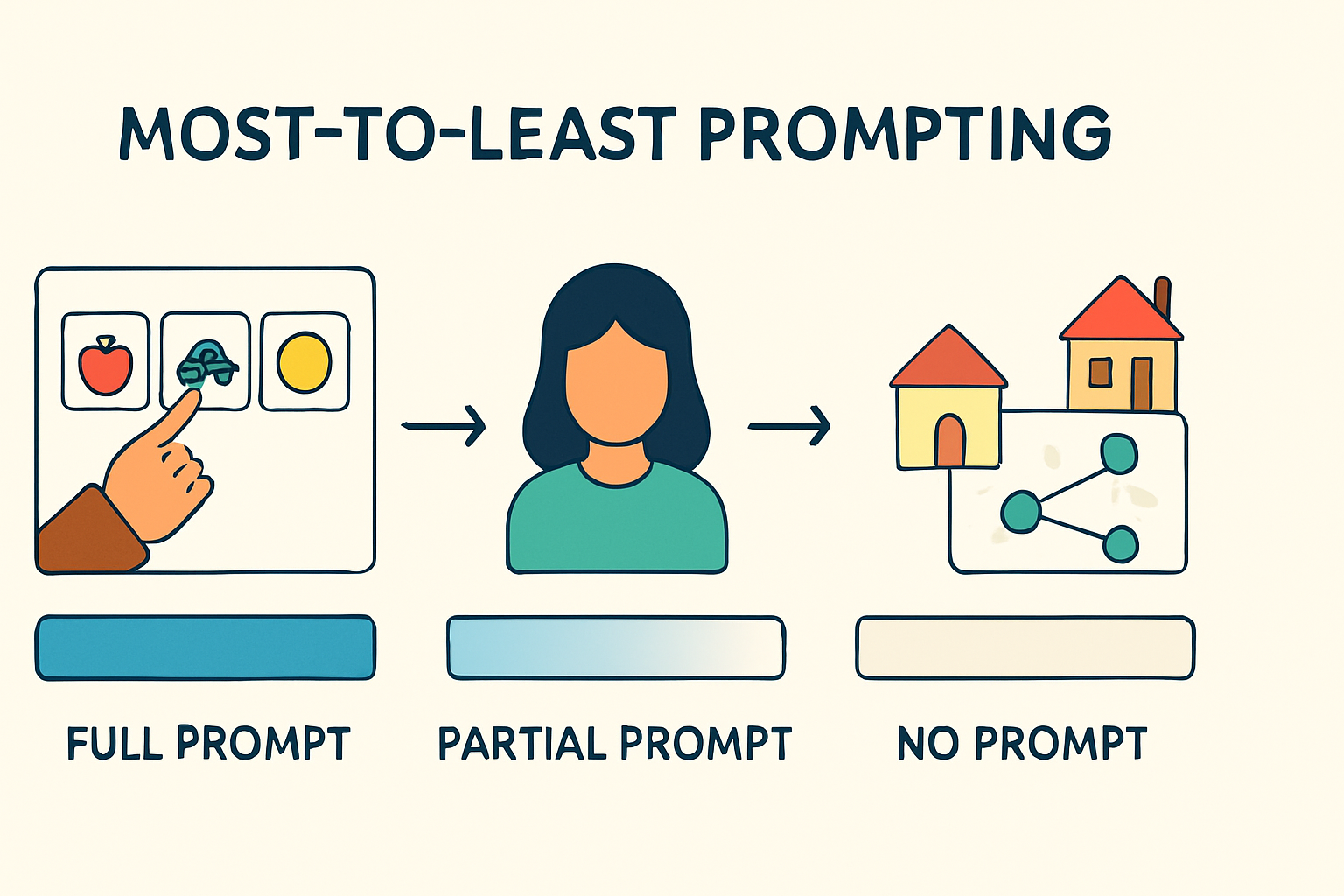
Most-to-least prompting is a systematic teaching procedure that begins with the most intrusive prompt needed to ensure correct responding and gradually fades to less intrusive prompts. This approach is grounded in errorless learning principles and is particularly effective for teaching new skills where errors could be frustrating or dangerous.
Table of Contents
- What is Most-to-Least Prompting in ABA?
- Implementing Most-to-Least Prompting: A Step-by-Step Protocol
- Most-to-Least Prompting in Action: Worked ABA Examples
- BCBA Exam Focus: Common Traps and Ethical Considerations
- Quick-Reference Implementation Checklist
- Summary and Key Takeaways for Your Study
What is Most-to-Least Prompting in ABA?
This procedure represents a structured approach to skill acquisition. The practitioner starts with maximum assistance and systematically reduces support as the learner demonstrates competence.
Core Definition and Rationale
Most-to-least prompting is defined as a prompting hierarchy where the initial prompt level provides complete assistance to ensure correct performance. The underlying theory is errorless learning, which minimizes errors during acquisition. Starting with the most intrusive prompt prevents incorrect responses and builds initial success, reducing frustration and establishing correct response patterns.
When to Choose This Prompting Hierarchy
Select most-to-least prompting when teaching:
- Novel skills completely new to the learner
- Complex behaviors with multiple steps or components
- Skills where errors could be dangerous or cause injury
- Behaviors that might lead to high frustration if errors occur
- Tasks where prompt dependency is less concerning than initial errors
This differs from least-to-most prompting, which is better for skills already in the learner’s repertoire needing independence. For more on systematic teaching approaches, see our guide on behavior skills training.
Implementing Most-to-Least Prompting: A Step-by-Step Protocol
Follow this structured protocol to implement most-to-least prompting effectively in clinical practice.
Step 1: Task Analysis and Baseline
Begin by breaking the target skill into discrete steps through task analysis. Conduct a baseline assessment to determine current performance levels. This identifies which steps require prompting and establishes a starting point for intervention.
Step 2: Selecting and Sequencing Prompts
Choose appropriate prompt types and sequence them from most to least intrusive:
- Full physical guidance – hand-over-hand assistance
- Partial physical – gentle touch or guidance
- Verbal instruction – specific verbal cues
- Model prompt – demonstration of the behavior
- Gestural prompt – pointing or visual cue
Select prompts based on the learner’s characteristics and task requirements.
Step 3: Fading Prompts Systematically
The critical component is systematic fading of prompts. Move to a less intrusive prompt only after the learner achieves predetermined criteria, typically 3-5 consecutive correct responses at the current prompt level. Monitor data closely to make data-based decisions about when to fade.
Most-to-Least Prompting in Action: Worked ABA Examples
These concrete examples demonstrate how most-to-least prompting works in practice with real-world applications.
Example 1: Teaching a Child to Wash Hands
Task analysis: (1) Turn on water, (2) Wet hands, (3) Get soap, (4) Rub hands, (5) Rinse, (6) Turn off water, (7) Dry hands.
Initial trials use full physical guidance for all steps. After 5 consecutive correct trials, fade to partial physical prompts. The hypothesized function of initial resistance is escape from task demands. Successive prompt fading builds independence while maintaining correct performance.
Example 2: Teaching an Adult to Use a New Voting Machine
This community living skill requires careful prompting to maintain dignity. Sequence begins with full physical plus verbal instruction, then fades to model plus gesture, and finally to gesture alone. Consider social validity by ensuring prompts are minimally intrusive in public settings. This approach respects the learner’s autonomy while ensuring task completion.
BCBA Exam Focus: Common Traps and Ethical Considerations
Understanding these common pitfalls will help you navigate exam questions and ethical practice.

Exam Trap #1: Confusing Most-to-Least with Least-to-Most
The key distinction lies in the starting point and purpose. Most-to-least begins with maximum assistance for new skill acquisition, while least-to-most starts with minimal prompts to promote independent responding for existing skills. Remember: most-to-least prevents errors; least-to-most tests independence.
Exam Trap #2: Failing to Fade Prompts
A major risk is creating prompt dependency. The procedure is incomplete without a systematic fading plan. Always include criteria for moving to less intrusive prompts and monitor for response maintenance without prompts. For more on avoiding prompt dependency, see our prompt dependency guide.
Linking to Client Dignity and Choice
Starting with intrusive prompts raises ethical considerations regarding client dignity and autonomy. Mitigate this by:
- Obtaining informed assent when possible
- Pairing prompts with positive reinforcement
- Using the least intrusive effective prompt
- Fading prompts as quickly as competence allows
- Considering social validity of procedures
These practices align with the BACB Ethics Code requirements for respectful treatment. For comprehensive ethics guidance, review our ethics in ABA practice guide.
Quick-Reference Implementation Checklist
Use this checklist to ensure proper implementation of most-to-least prompting:
- Conduct task analysis of target skill
- Establish baseline performance data
- Select appropriate prompt hierarchy (most to least)
- Define prompt fading criteria (e.g., 5 consecutive correct)
- Implement initial most intrusive prompt
- Collect continuous data on prompted and unprompted responses
- Fade prompts according to predetermined criteria
- Monitor for prompt dependency and adjust as needed
- Program for generalization and maintenance
- Evaluate social validity of procedures
Summary and Key Takeaways for Your Study
Most-to-least prompting is an evidence-based procedure for teaching new skills through errorless learning. Key points to remember:
- Start with the most intrusive prompt needed for correct responding
- Use for novel or complex skills where errors are problematic
- Always include a systematic fading plan to prevent prompt dependency
- Make data-based decisions about when to fade prompts
- Consider ethical implications of intrusive prompting
- Differentiate clearly from least-to-most prompting on exams
For authoritative information on prompting procedures, refer to the BACB Ethics Code and research on errorless learning procedures. Mastery of this procedure requires understanding both the technical implementation and the ethical considerations surrounding prompt use in ABA practice.



