
Short answer: The best behavior intervention plan for tantrums examples start with a functional assessment, not with the word “tantrum.” Tantrum is a common descriptive label for an episode such as crying, yelling, dropping, or refusing. The same topography can have different functions, so an effective example must show the context, the likely maintaining consequence, the replacement response, the reinforcement arrangement, the adult response, and the data used to review progress.
Table of Contents
- What is a BIP for tantrum-labeled behavior?
- Why does the function matter more than the label?
- What are behavior intervention plan examples for tantrums?
- What should every example include?
- How do the examples differ by function?
- How should the team review a tantrum-related BIP?
- What are common BCBA exam traps?
- Behavior intervention plan for tantrums examples FAQ
- Take the Free BCBA Mock Exam
The examples below are educational BCBA study scenarios. They are not copy-and-use treatment plans, diagnoses, or instructions for handling a specific learner. A real plan must be individualized by qualified professionals, account for safety and consent requirements, and be implemented with appropriate supervision. Table of Contents
What is a BIP for tantrum-labeled behavior?
A behavior intervention plan translates assessment information into coordinated prevention, teaching, reinforcement, response, and monitoring procedures. When a referral uses the word “tantrum,” the BIP should convert that broad label into an observable target definition. For example, the definition might specify crying above a given volume, yelling, dropping the body below a standing position, or pushing materials away for a defined duration. It should also state what does not count.
This precision matters because “tantrum” does not identify function. An episode can occur when a task is presented, when attention is unavailable, when a preferred item is removed, during a difficult transition, or under another arrangement. The BACB BCBA Test Content Outline emphasizes operational definitions, behavior assessment, measurement, intervention selection, and data-based decisions. A study answer should therefore describe the evidence and decision process rather than assume that all tantrums have the same cause.
It is also useful to keep terminology separate from diagnosis. The site’s meltdown versus tantrum guide covers the language distinction. This article focuses on what changes inside a BIP when assessment suggests an escape, attention, tangible, or transition-related pattern.
Why does the function matter more than the label?
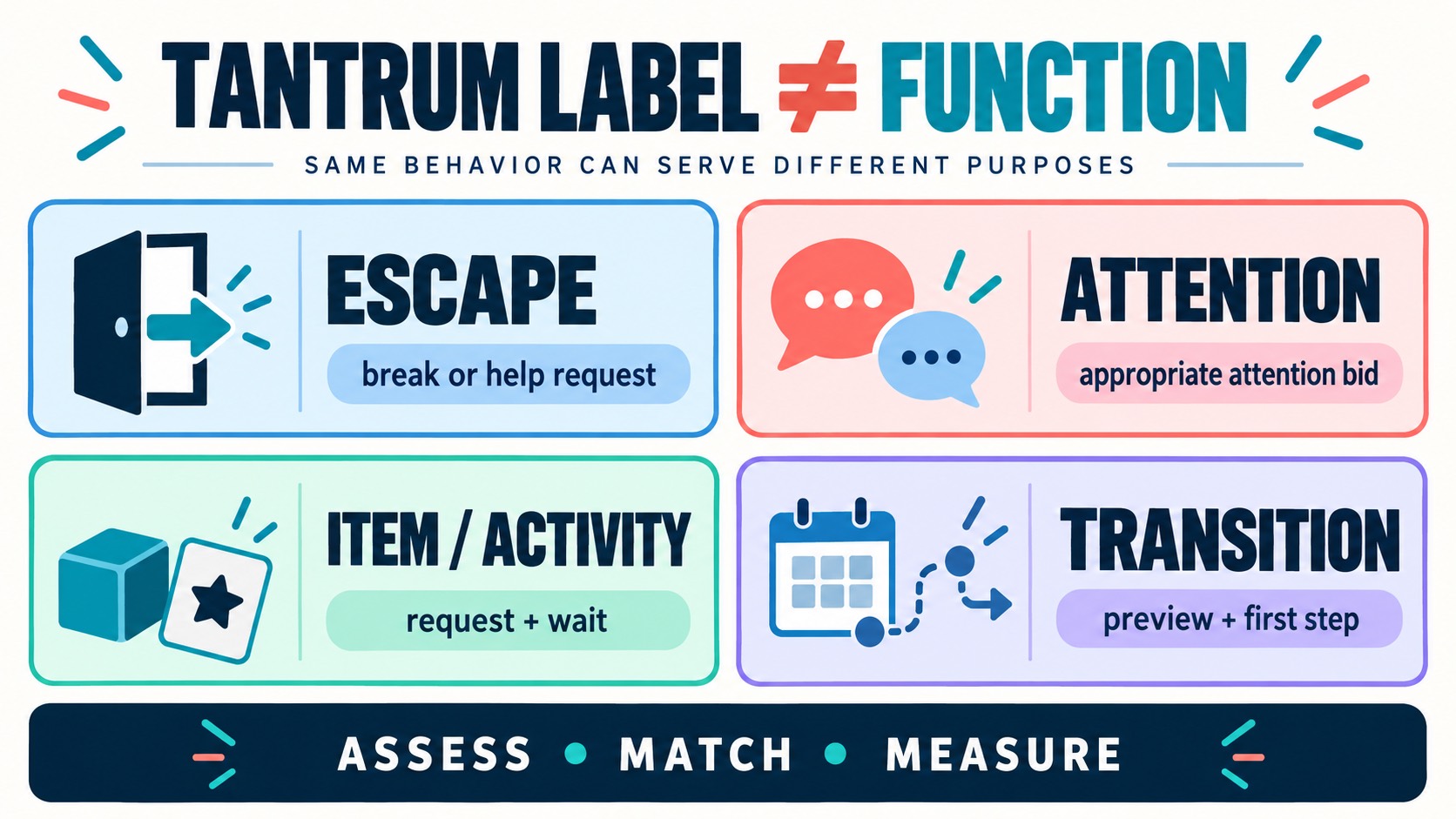
Function changes the consequence the learner is trying to access and therefore changes what the replacement behavior must accomplish. A replacement response is not functionally matched simply because it is socially preferred. It must be possible for the learner, efficient enough to use in the moment, and connected to the relevant outcome.
- Escape or avoidance: the episode may reliably produce a delay, removal, or reduction of a demand. The plan may teach a break or help request while arranging achievable work and reinforcing task engagement.
- Attention: the episode may produce immediate interaction, negotiation, or emotional reactions. The plan may teach an attention request and arrange frequent reinforcement for appropriate bids before escalation.
- Access to a tangible or activity: the episode may produce a toy, food, screen time, or return to a preferred activity. The plan may teach a request, waiting, turn-taking, or transition response while keeping the access rule predictable.
- Transition or mixed context: the behavior may occur when an activity changes, the environment becomes noisy, or expectations shift. The plan may combine previewing, choice, a clear first-then sequence, and a functionally relevant communication response.
These are hypotheses, not conclusions created by the label. A descriptive ABC pattern, interview, or record review can inform the next step, but it does not automatically prove a causal function. If data are inconsistent, the correct branch may be more assessment, clearer measurement, or supervision before a new intervention is selected.
What are behavior intervention plan examples for tantrums?
Each scenario below uses the same planning frame: context and target, assessment hypothesis, prevention, replacement teaching, reinforcement, response, and measurement. The details are intentionally generic so they illustrate BCBA reasoning without pretending to prescribe a plan for an actual learner.
Example 1: tantrum-labeled behavior during difficult work: Pattern: After a lengthy writing task is presented, the learner cries, pushes the worksheet away, and drops to the floor. Staff frequently remove the task. Across comparable observations, the behavior is more likely after difficult demands and often ends when work is removed. The working hypothesis is an escape-related pattern, but the team should continue checking whether other consequences are involved.
Possible BIP logic: Preview the task, reduce unnecessary response effort, offer a choice of two equivalent starting items, and use a clear work-then-break arrangement. Teach a short help or break request before the task and practice it when the learner is calm. Reinforce the request with the planned, brief break and reinforce returning to an achievable amount of work. During an episode, follow the written response procedure and safety plan; do not improvise a negotiation that accidentally makes the episode the fastest way to end all work.
Measure: Record the frequency or rate of episodes, completed work opportunities, independent versus prompted break requests, and the duration of episodes when duration is part of the concern. Add fidelity checks for task presentation, prompting, break delivery, and reinforcement. A decrease in episodes without any increase in functional communication would require careful interpretation.
Example 2: tantrum-labeled behavior when attention is delayed: Pattern: During group instruction, the learner yells, cries, or falls beside the adult when the adult attends to another student. The adult immediately provides extended conversation and reassurance. The team’s hypothesis is attention-related, but it must be tested across people and activities rather than inferred from one incident.
Possible BIP logic: Arrange predictable attention before group instruction, teach an appropriate attention bid such as raising a hand or using a communication response, and provide brief, specific reinforcement for waiting or participating. Practice the replacement response with gradually longer delays, using a clear signal for when attention is available. Staff should follow the plan’s response rules consistently and avoid delivering long, high-intensity attention only after the episode unless the safety procedure requires immediate support.
Measure: Record independent attention bids, prompted bids, appropriate waiting intervals, and episodes per comparable group period. Note the adult response and fidelity. If the replacement response occurs but attention is still delayed unpredictably, low performance may reflect a weak reinforcement arrangement rather than a learner deficit.
Example 3: tantrum-labeled behavior after a preferred item is removed: Pattern: When a tablet or favorite toy is unavailable, the learner screams, cries, and reaches toward the item. Adults sometimes return it to stop the episode and sometimes remove it for the rest of the day. The inconsistent outcome makes the pattern harder to interpret and may create a variable reinforcement history.
Possible BIP logic: Establish a visible, predictable access rule; provide a warning before the activity ends; teach a request for more time, a turn, or “when can I have it?”; and practice waiting with a short, clearly signaled interval. Reinforce the communication and waiting response according to the plan. Adults should follow the agreed access boundary and keep the response calm, while using any individualized safety procedure when risk is present.
Measure: Track independent requests, waiting duration, successful transitions away from the item, episodes after the removal cue, and the adult’s fidelity to the access rule. A simple count of episodes may miss the most important change if the learner is still upset but is beginning to request and transition successfully.
Example 4: tantrum-labeled behavior around transitions: Pattern: The learner cries, drops, and refuses when a preferred play activity ends and a new routine begins. The pattern is strongest when the transition is sudden or the next activity is unclear. The function may involve escape from the next demand, access to the preferred activity, uncertainty, or more than one variable.
Possible BIP logic: Use a consistent preview, visual or verbal countdown, a first-then statement, a small transition choice, and an efficient request for help or a brief break. Teach the routine outside the crisis moment and reinforce walking to the next activity, beginning the first step, and using the replacement response. Program gradual changes in people, settings, and activity types instead of assuming that success with one transition will generalize automatically.
Measure: Record transition opportunities, independent completion, prompt level, latency to begin, episode frequency or duration, and relevant context such as activity, person, time, and warning delivered. Review the whole pattern rather than treating every refusal as the same event.
What should every example include?
A useful example shows the relationship among the parts of the plan. A short list of “tips” is not enough for a BCBA study question because it does not show why a procedure was selected or what would count as progress.
- Observable target: define the topography, onset, offset, examples, and nonexamples.
- Assessment basis: describe the observed context and state the function as a working hypothesis, not a fact created by the label.
- Prevention: change the antecedent arrangement in a way that makes the appropriate response more likely and the problem response less efficient.
- Replacement: teach a response that is functionally relevant, feasible, observable, and reinforced.
- Reinforcement: specify what response contacts what outcome, how quickly, and how prompts or fading are handled.
- Response: describe what adults do during the target behavior, including safety boundaries and what they should not accidentally reinforce.
- Measurement: track the target, replacement, relevant context, and implementation fidelity with a measure matched to the question.
- Review: set a decision rule for maintaining, adjusting, reassessing, generalizing, or fading components.
How do the examples differ by function?
The table below condenses the examples into a study comparison. It is not a universal treatment menu. The same topography can require a different plan when the assessment evidence changes.
| Working hypothesis | Teach | Reinforce | Review data |
|---|---|---|---|
| Escape from work | Help or break request, task-start response | Appropriate request plus achievable work completion | Episodes, work opportunities, request independence, fidelity |
| Access to attention | Attention bid and waiting | Appropriate bid and participation during planned delay | Independent bids, waiting, episodes, adult-response fidelity |
| Access to item/activity | Request, turn-taking, waiting, transition response | Communication and successful transition under the access rule | Requests, wait time, transitions, episodes, access-rule fidelity |
| Transition or mixed context | Transition routine, help/break response, first step | Moving, starting, and using the replacement across contexts | Opportunities, prompt level, latency, context, episodes, fidelity |
How should the team review a tantrum-related BIP?
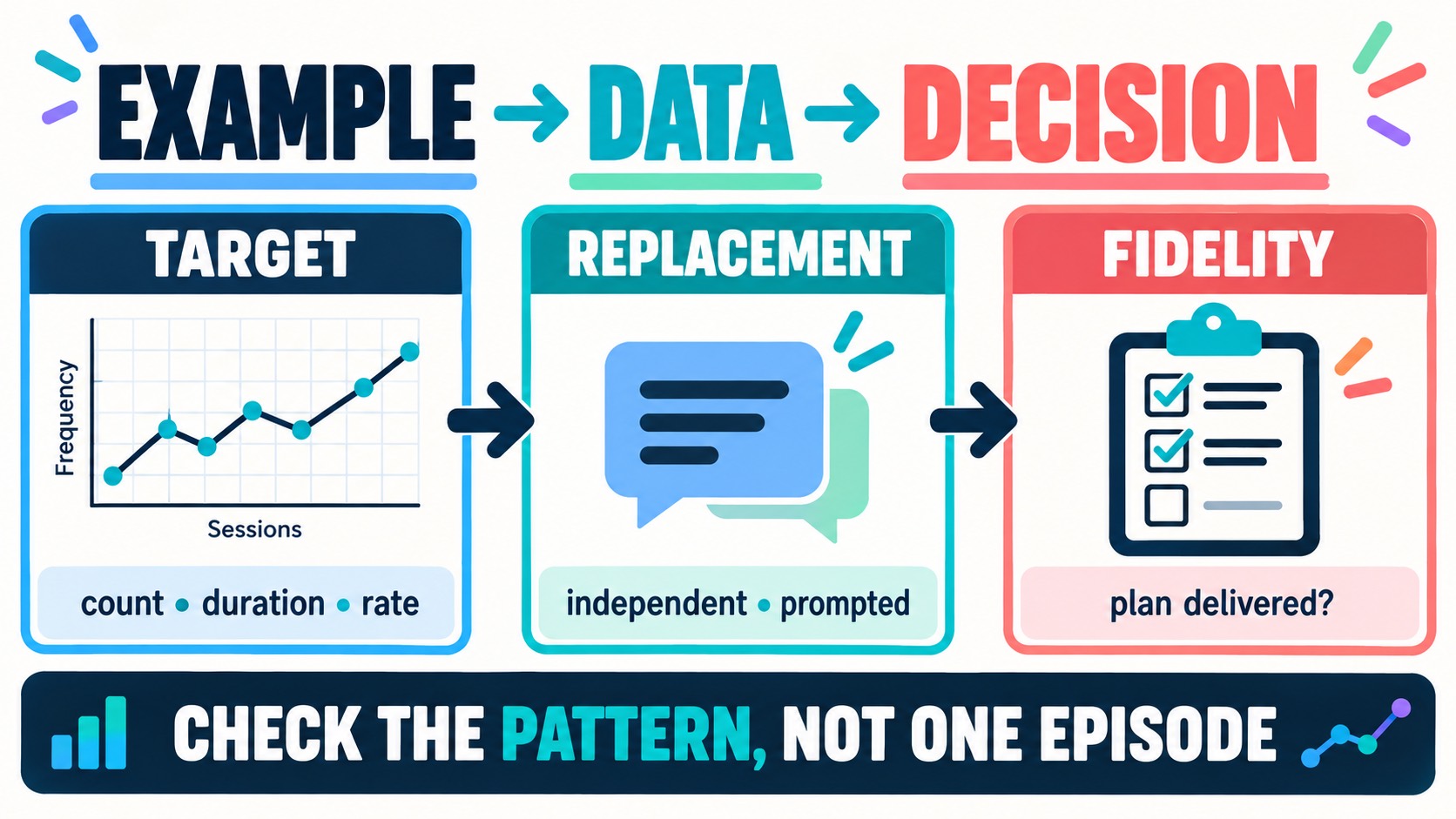
Review the target and replacement patterns together. A lower episode count may be meaningful, but the team should also ask whether the learner is communicating, completing activities, waiting, transitioning, or using another functionally relevant skill more independently. Review whether the same measurement rules and observation opportunities were used across sessions.
- Outcome: Is the target changing in the intended direction?
- Skill: Is the replacement occurring independently and contacting the relevant outcome?
- Context: Does the pattern hold across the people, activities, and settings that matter?
- Implementation: Were the plan components delivered consistently enough to interpret the result?
- Verify the record: check definitions, observation duration, opportunity count, missing values, and changes in staff or context.
- Inspect the trend: graph level, trend, variability, and phase changes for the target and replacement behaviors.
- Check fidelity: confirm that prevention, teaching, reinforcement, and response procedures were delivered as planned.
- Check social validity and dignity: consider whether the goals, procedures, effort, and outcomes are meaningful and respectful for the learner and stakeholders.
- Choose a bounded action: maintain, adjust one component, gather more assessment, provide training, consult, or plan generalization and fading.
Safety changes the order. If the behavior presents immediate risk, the team follows the applicable emergency and individualized safety procedures and seeks qualified support. A web article cannot replace a safety plan, crisis protocol, or clinical supervision.
The site’s broader behavior intervention plan for tantrums examples context explains the larger BIP concept, while this page focuses on comparing function-based examples. For the visual process, see the behavior intervention plan flow chart; for measurement details, see the behavior intervention plan data collection overview.
What are common BCBA exam traps?
- Assuming all tantrums are escape: the same form can contact attention, tangibles, automatic outcomes, or a mixed consequence.
- Treating the label as an operational definition: crying, yelling, dropping, and refusal need observable boundaries.
- Calling an antecedent a function: a transition or denied item may set the occasion for behavior; it does not by itself prove why the response persists.
- Teaching an unrelated replacement: “calm down” is not a measurable, functionally matched response unless the plan defines what it means and what outcome it produces.
- Using extinction automatically: the team must consider function, safety, reinforcement of replacement behavior, feasibility, and the risk of an escalation pattern before selecting a procedure.
- Measuring only the target: replacement behavior, prompt level, context, and implementation fidelity may be necessary to interpret progress.
- Ignoring inconsistent adult responses: variable access or attention can become part of the maintaining pattern and should be documented.
- Presenting a sample as a prescription: an example demonstrates reasoning; it does not replace assessment or supervision.
Quick review: Define what happened, assess why it may be happening, teach a usable alternative, reinforce the alternative, respond consistently and safely, measure comparable opportunities, and review both outcomes and fidelity. For scenario practice on assessment and intervention decisions, try the free BCBA mock exam. It is a study resource and does not claim to reproduce official BACB questions.
Behavior intervention plan for tantrums examples FAQ
Does a tantrum always mean the learner wants something? No. A label does not identify function. Assessment should examine context, consequences, skill history, setting events, and relevant safety factors. What is the first step in writing a BIP for tantrum behavior? Define the target behavior and gather assessment information. Do not choose a replacement or consequence from the label alone.
What replacement behavior is best for a tantrum? It depends on the function and learner. A break request may fit an escape pattern, an attention bid may fit an attention pattern, and a request or waiting response may fit access to an item. The response must be taught, feasible, and reinforced. Should a BIP example include data collection? Yes. A useful example names what will be measured for the target and replacement behaviors, the observation opportunity, and how implementation fidelity will be checked.
Can I copy one of these examples for a student or client? No. These are study examples. A qualified professional must individualize assessment, procedures, safety boundaries, training, consent, and review criteria for the actual learner and setting.
Take the Free BCBA Mock Exam
When you are ready to apply the idea, use the free practice resource below for additional feedback. Take the Free BCBA Mock Exam



