
Short answer: A proximity prompt ABA procedure changes the location or placement of a stimulus so the correct response option is closer, more salient, or easier to contact than the alternatives. In a field of choices, the correct item might be placed nearer to the learner than the distractors. The prompt helps evoke a correct selection, but the goal is to fade the location advantage so the natural discriminative stimulus controls responding.
Table of Contents
- What is a proximity prompt in ABA?
- How does a proximity prompt work?
- What are proximity prompt ABA examples?
- How is a proximity prompt different from other prompts?
- How should a proximity prompt be faded?
- What data should be collected?
- What are common BCBA exam traps?
- Proximity prompt ABA FAQ
- Take the Free BCBA Mock Exam
Do not confuse this definition with moving the instructor physically closer to the learner. Teacher proximity can be an antecedent arrangement or part of a broader intervention, but a proximity or positional prompt usually refers to manipulating the location of the stimulus or response option. The exact terminology can vary across training materials, so the exam question’s procedure and function matter more than the label alone. Table of Contents
What is a proximity prompt in ABA?
A proximity prompt is an added stimulus arrangement in which the location of the correct stimulus is manipulated to increase the likelihood of a correct response. For example, when a learner is asked to select the heavy object from a rock and a feather, the instructor might initially place the rock closer to the learner. When teaching picture identification, the target picture may be nearer than the distractors in the early trials.
Many training resources also use positional prompt for this idea. The common feature is not physical contact, a verbal model, or a gesture. It is the spatial relation between the learner and the relevant stimulus. The prompt is supplemental: it is added to help the learner respond before the natural arrangement of the task reliably controls the response.
The current BACB BCBA Test Content Outline connects stimulus control, behavior-change procedures, skill acquisition, prompting, measurement, and data-based interpretation. A good exam answer therefore identifies what stimulus was changed, what response it was intended to evoke, and how the practitioner will transfer control to the natural stimulus.
For a concise educational reference, this proximity prompt ABA explanation describes the procedure as altering the location or placement of a stimulus. That description should still be applied to the actual example in front of you: proximity of the correct item is different from proximity of the instructor, and the two arrangements may have different effects. When a BCBA exam scenario uses the term proximity prompt, check three details before choosing an answer:
- What moved? Identify whether the stimulus, the instructor, or the learner’s body position changed.
- What response should change? Connect the arrangement to the exact selection, match, request, or motor response being taught.
- What will be faded? Look for the plan to remove the location advantage and test responding under a neutral arrangement.
How does a proximity prompt work?
Think of the procedure as a temporary advantage given to the correct stimulus. The learner receives the instruction or discriminative stimulus, sees an array, and is more likely to contact the correct option because it is closer or positioned in a way that makes selection easier. The response contacts reinforcement, while the practitioner systematically reduces the positional advantage.
- Define the response: specify what the learner must select, match, point to, touch, or otherwise contact.
- Build the array: present the target and distractors that are appropriate for the learner’s current discrimination skill.
- Arrange the prompt: place the correct stimulus closer or in the position identified by the teaching plan, without adding an unnecessary verbal or gestural cue.
- Deliver the instruction: present the relevant cue consistently and allow an appropriate response interval.
- Reinforce and record: deliver the planned consequence for the response and record whether the response was independent, prompted, incorrect, or absent.
- Fade the location cue: gradually make the array more typical by reducing the distance difference, varying positions, or arranging equal access.
The procedure should be selected because it fits the learner, response, and teaching context. If the learner cannot scan an array, a different prompt or a simpler teaching arrangement may be needed first. If the correct item is always on the left, the learner may learn a location rule rather than the intended discrimination. Prompt selection is a programming decision, not a contest to use the least intrusive-looking technique in every situation.
What are proximity prompt ABA examples?
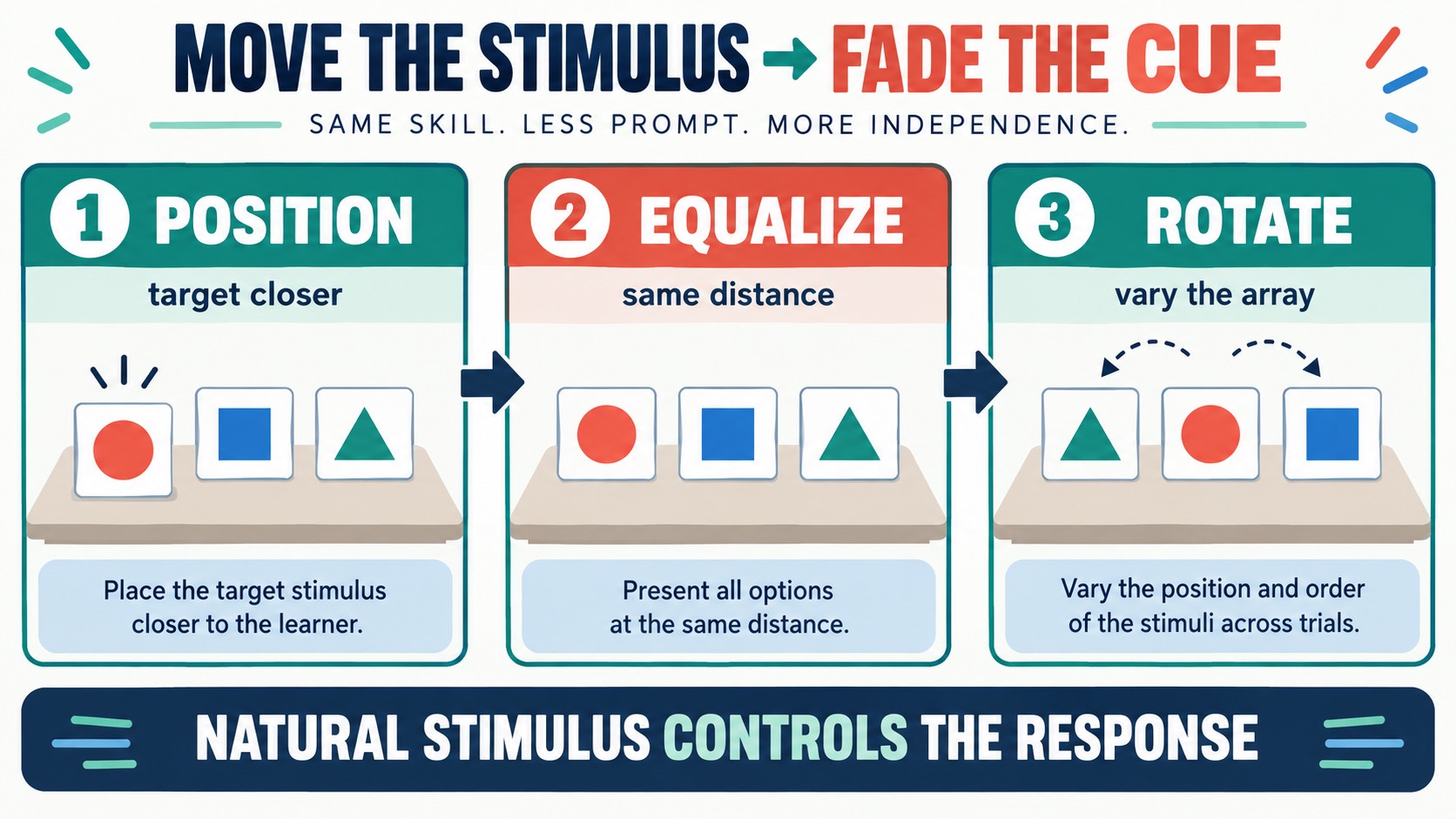
The following examples illustrate the stimulus-location manipulation. They are study examples, not client-specific protocols. In each case, the location advantage must eventually be faded and the target position must be varied. Example 1: receptive identification in an array: The instructor places a cup, a spoon, and a shoe on the table and says, “Touch cup.” During initial teaching, the cup is placed slightly closer to the learner than the two distractors. The learner touches the cup and receives the programmed reinforcement. Across trials, the instructor reduces the distance difference, rotates the cup among positions, and records independent selections.
The proximity arrangement is the position of the cup, not the instructor pointing to it. If the instructor points, that is an additional gestural prompt. If the instructor says “cup” after the instruction, that may be a verbal prompt. Combining prompts can be appropriate when specified, but the data should show which level of assistance was used.
Example 2: sorting by an attribute: To teach “heavy” versus “light,” the instructor presents two objects with clearly different weights. At the beginning, the correct object is closer to the learner when the instruction is delivered. The practitioner then equalizes the distance and varies the left-right arrangement so the learner must attend to the object’s relevant features instead of selecting whichever item is nearest.
In this example, proximity is only useful if the learner can eventually respond to the natural attribute. If the correct object remains in the near position, the procedure may create a position bias. A strong plan therefore includes probe trials in which neither object has a location advantage.
Example 3: matching a picture to a sample: The learner sees a sample picture of a cat and chooses among three comparison pictures. The matching picture is initially placed closer to the learner. After correct prompted selections are reinforced, the practitioner changes the distance and position of the comparison stimuli, adds varied exemplars when appropriate, and probes whether the learner can match without the positional arrangement.
The target of teaching is matching based on the relevant stimulus relation, not memorizing “choose the closest card.” That distinction is why prompt fading, position rotation, and generalization are part of the procedure rather than optional cleanup steps.
Example 4: selecting a functional item from a field: During a communication routine, the learner is taught to select a break card from two cards. The break card is initially placed nearer than the play card after the relevant motivating operation is present. The practitioner reinforces the functional selection according to the plan, then systematically varies the card positions and distance while checking that the learner still selects the correct card.
This example also shows an important boundary: the location prompt does not establish the function of the communication response. The plan must still specify what the card means, what outcome follows an appropriate request, and how the response will generalize across people and settings.
How is a proximity prompt different from other prompts?
Prompt names can overlap across textbooks and training programs, so examine what the practitioner actually changes. The table below focuses on the defining feature of each arrangement.
| Arrangement | What changes? | Example | Fading question |
|---|---|---|---|
| Proximity / positional | Location of the correct stimulus or response option | Place the target card closer than distractors | Equalize distance and rotate positions |
| Gestural | A pointing, nodding, or other movement indicating the response | Point toward the correct card | Reduce size, distance, or frequency of the gesture |
| Verbal | An added spoken cue, model, or partial response | Provide a word or initial sound | Fade the amount, delay, or presence of the spoken cue |
| Teacher proximity | Location of the instructor relative to the learner | Instructor moves within the planned support distance | Increase distance or transfer control to the natural routine |
| Physical | Contact or guidance through part or all of the response | Guide the hand toward the response | Reduce contact and assistance systematically |
How should a proximity prompt be faded?
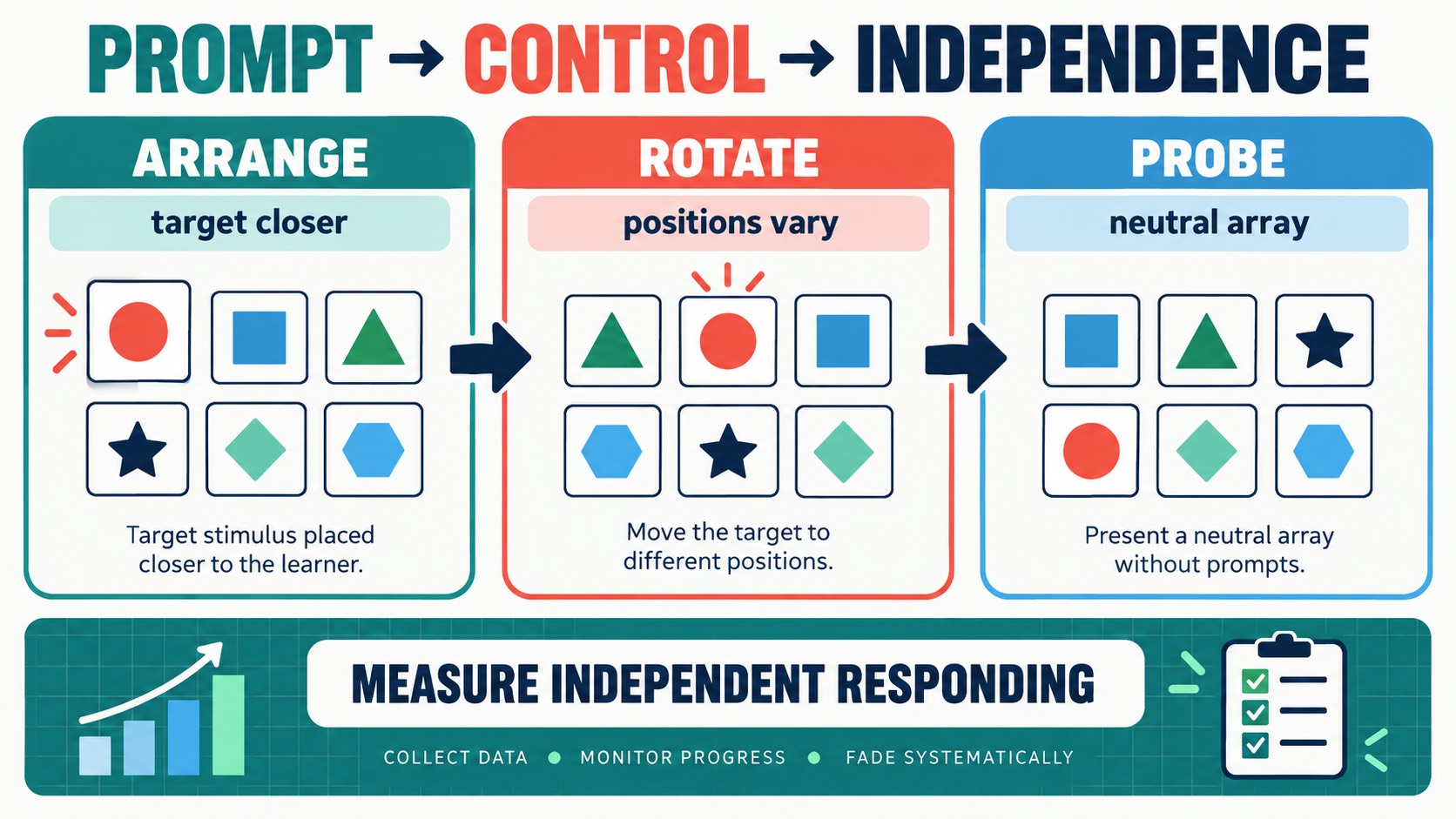
Fading should move control from the added location cue to the natural stimulus or instruction. The exact sequence depends on the learner and the skill, but the plan should say what changes, when it changes, and how independence is measured.
- Reduce the distance difference: move the target gradually toward the same distance as the distractors.
- Rotate positions: vary left, middle, and right positions so the learner does not learn a fixed-location rule.
- Increase array variation: use different exemplars, materials, and arrangements when the target skill requires generalization.
- Probe without the prompt: present the natural instruction and a neutral array to see whether the response remains accurate.
- Thin assistance carefully: if errors increase, return to a less difficult step, check the discrimination, and adjust the teaching plan rather than abruptly withholding all support.
Prompt fading is not simply moving the item farther away once. If the learner responds only when the target is nearest, the positional cue may have become prompt-dependent control. The practitioner should use planned trials and data to determine whether the natural stimulus is acquiring control.
What data should be collected?
At minimum, record the response opportunity and the level of assistance. A correct response on a prompted trial is not equivalent to an independent correct response when the goal is independence.
- Independent accuracy: correct responses when the array is neutral or the prompt has been faded.
- Prompted accuracy: correct responses after the proximity arrangement is provided.
- Errors and omissions: incorrect selections, no response, or position-based responding.
- Prompt level: distance difference, array position, added gestures, verbal prompts, or physical assistance.
- Latency: time from the instruction to the response when speed matters for the skill.
- Generalization: performance across people, materials, positions, settings, and array sizes.
The peer-reviewed proximity intervention case study is a useful reminder that an intervention may include multiple components and that on-task behavior, generalization, observer agreement, and treatment limitations all matter. Do not attribute an outcome to a proximity prompt alone when the procedure also includes a picture cue, teacher training, or other supports.
What are common BCBA exam traps?
- Confusing item proximity with teacher proximity: the correct stimulus being closer is not the same as the instructor standing closer.
- Calling a point a proximity prompt: pointing is a gestural prompt; moving the target stimulus is the positional manipulation.
- Leaving the target in one location: the learner may select “the near card” instead of discriminating the relevant feature.
- Counting prompted responses as independent: record the assistance level so the graph reflects actual stimulus control.
- Ignoring distractor quality: an array can be too easy, too difficult, or poorly arranged; prompt selection does not fix a faulty discrimination plan.
- Fading without generalization: equal distance in one array does not prove transfer to new people, materials, or settings.
- Assuming one prompt hierarchy fits every target: choose a prompt that can physically or functionally evoke the target response, then plan the fade.
Quick review: Identify what was moved, what response it was meant to evoke, what natural stimulus should eventually control responding, and how independence will be measured. For scenario practice on stimulus control, prompting, and data-based decisions, try the free BCBA mock exam. It is a study resource and does not claim to reproduce official BACB questions.
Proximity prompt ABA FAQ
What is the simplest definition of a proximity prompt? It is changing the location or placement of a stimulus so the correct response option is more likely to be selected. In an array, the target may initially be placed closer than the distractors.
Is a proximity prompt the same as a positional prompt? Many ABA training resources use the terms interchangeably because both describe a location-based stimulus arrangement. Read the procedure in the question and identify what changed.
Is moving closer to the learner a proximity prompt? Not necessarily. Moving the instructor closer is teacher proximity. A proximity or positional prompt usually refers to moving the relevant stimulus or response option closer within the task arrangement. How do you prevent prompt dependency? Fade the distance advantage, rotate positions, probe neutral arrays, and record independent responding. If accuracy collapses, check the discrimination, array, reinforcement, and teaching sequence.
Should a proximity prompt be used in every array task? No. It is one possible prompt. Select it only when the location manipulation is appropriate for the target response and can be faded without undermining the natural stimulus relation.
Take the Free BCBA Mock Exam
When you are ready to apply the idea, use the free practice resource below for additional feedback. Take the Free BCBA Mock Exam



