
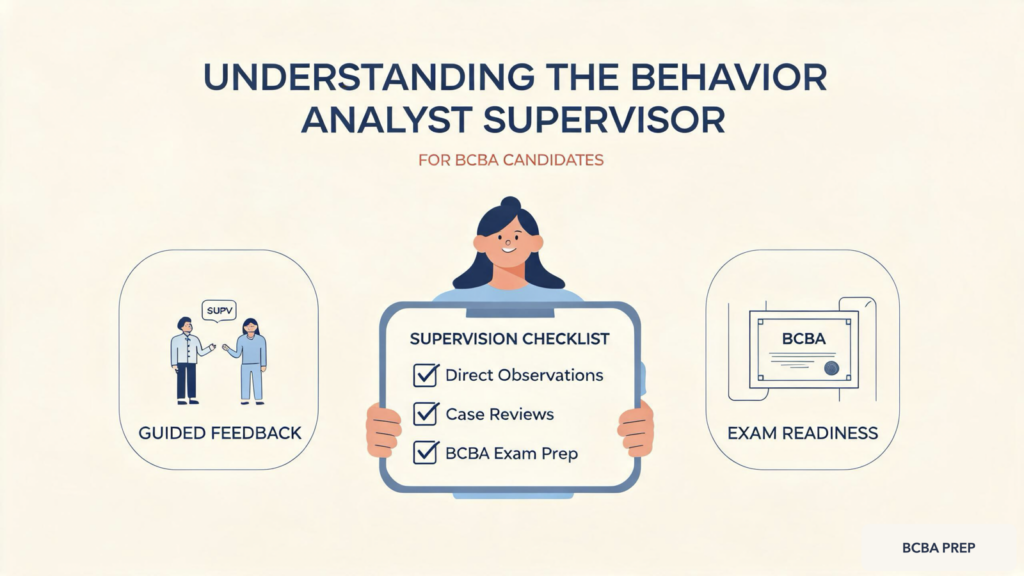
What is a Behavior Analyst Supervisor?
A behavior analyst supervisor is a BCBA or BCBA-D who oversees the professional development of trainees pursuing certification. This role is central to applied behavior analysis (ABA) because it ensures that services are delivered ethically and effectively. Supervisors are responsible for training the next generation of behavior analysts while maintaining high standards of practice.
Table of Contents
- What is a Behavior Analyst Supervisor?
- BACB Supervision Requirements Every Candidate Must Know
- Real-World Examples: Behavior Analyst Supervisor in Action
- Exam Relevance and Common Traps
- Quick Study Checklist for the BCBA Exam
- Summary: Mastering the Behavior Analyst Supervisor Role
Core Responsibilities in ABA Settings
Supervisors carry out a range of duties that directly impact client outcomes and trainee growth. Key responsibilities include:
- Overseeing BCBA/BCaBA trainees by reviewing behavior intervention plans and data collection systems.
- Reviewing data on client progress and providing corrective feedback to trainees.
- Ensuring ethical compliance by modeling the BACB Ethics Code and addressing violations promptly.
- Conducting periodic evaluations to assess trainee competence and progress toward fieldwork hours.
- Providing timely feedback on clinical skills, such as functional analysis implementation or parent training.
How the Role Differs from Other BCBA Positions
The behavior analyst supervisor is distinct from other BCBA roles. A clinical director may oversee multiple programs and staff, while a consultant provides targeted recommendations without direct supervisory authority. A case manager coordinates services but does not typically have the same training oversight responsibilities. Understanding these differences is crucial for BCBA exam questions.
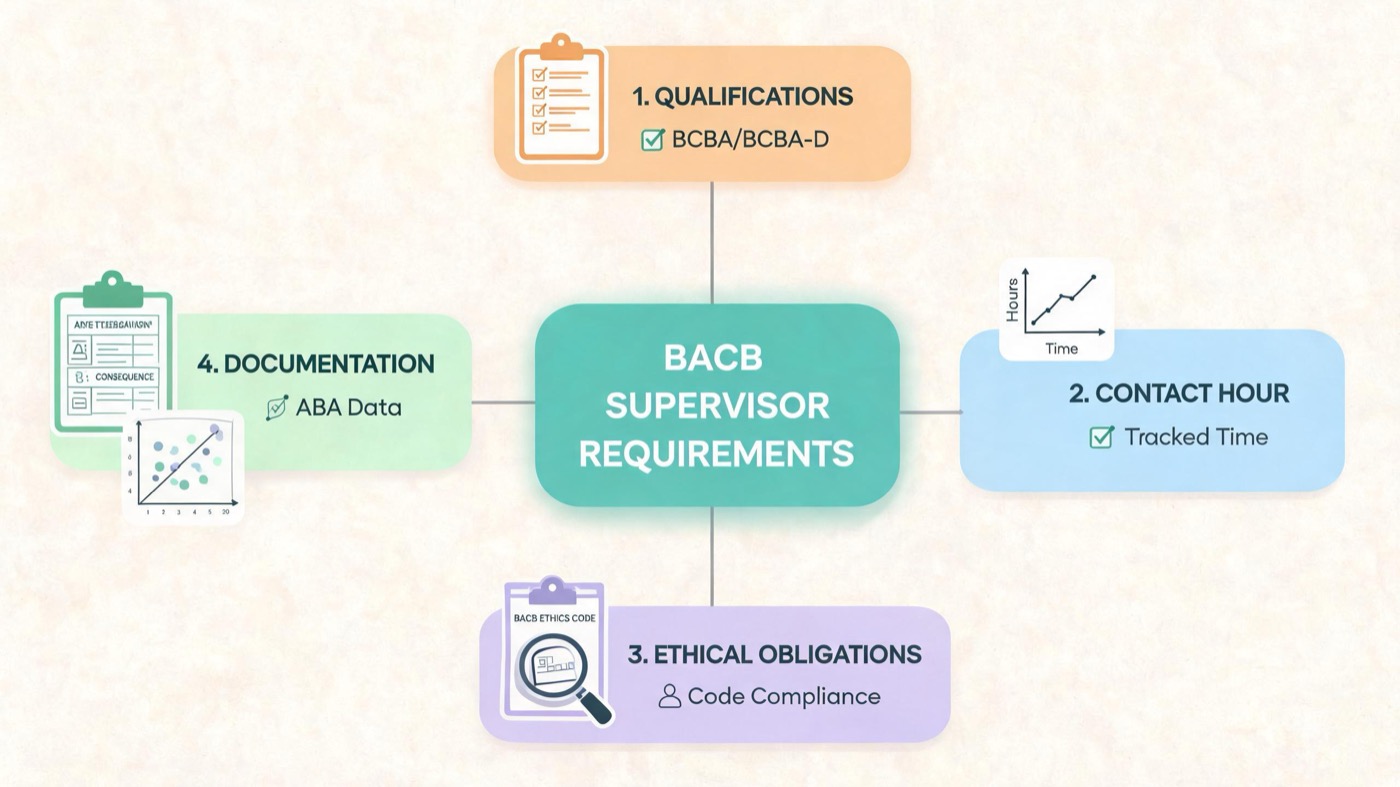
BACB Supervision Requirements Every Candidate Must Know
The BACB sets strict criteria for who can serve as a behavior analyst supervisor. Candidates must understand these requirements because they appear frequently on the exam. The key areas are qualifications, contact hours, and ethical obligations.
Supervisor Qualifications
- Must hold a current BCBA or BCBA-D certification in good standing with the BACB.
- Must complete an 8-hour supervision training based on the BACB Supervisor Training Curriculum (if providing supervision for certification).
- Must not have any disciplinary actions on record that restrict supervisory activities.
Supervision Contact Hours and Documentation
- Minimum contact hours per supervision period: at least 4 supervisor contacts per month (at least 2 must be individual).
- Supervision must include observation of the trainee delivering services (at least 1 per month individual).
- Documentation includes completed experience logs signed by both supervisor and trainee, and periodic evaluations (every 3–6 months).
Ethical Obligations of the Supervisor
The BACB Ethics Code outlines specific responsibilities. Supervisors must avoid multiple relationships, such as supervising a family member or close friend. They must provide competent supervision and ensure trainees adhere to ethical standards. If a trainee violates the code, the supervisor is obligated to report the issue.
Real-World Examples: Behavior Analyst Supervisor in Action
Applying the concept to real scenarios helps solidify your understanding. Below are two ABC (Antecedent-Behavior-Consequence) examples that illustrate the supervisor role.
Example 1: Supervising a Trainee’s Behavior Intervention Plan
- Antecedent: Trainee submits a behavior intervention plan (BIP) that omits antecedent modifications for a client with escape-maintained aggression.
- Behavior: Supervisor reviews the plan, identifies the gap, and schedules a feedback session.
- Consequence: Trainee revises the BIP to include antecedent strategies (e.g., non-contingent reinforcement). Client aggression decreases. The hypothesized function was skill acquisition of the trainee.
Example 2: Addressing a Supervisor’s Own Ethical Dilemma
- Antecedent: Trainee asks supervisor to falsify progress data to meet insurance requirements.
- Behavior: Supervisor refuses, explains the ethical violation, and reports the incident per BACB code.
- Consequence: Integrity is maintained, and the trainee receives additional training. The function was maintaining adherence to the ethics code.
Exam Relevance and Common Traps
The BCBA exam tests your ability to apply supervision concepts. Watch for these traps that confuse many candidates.
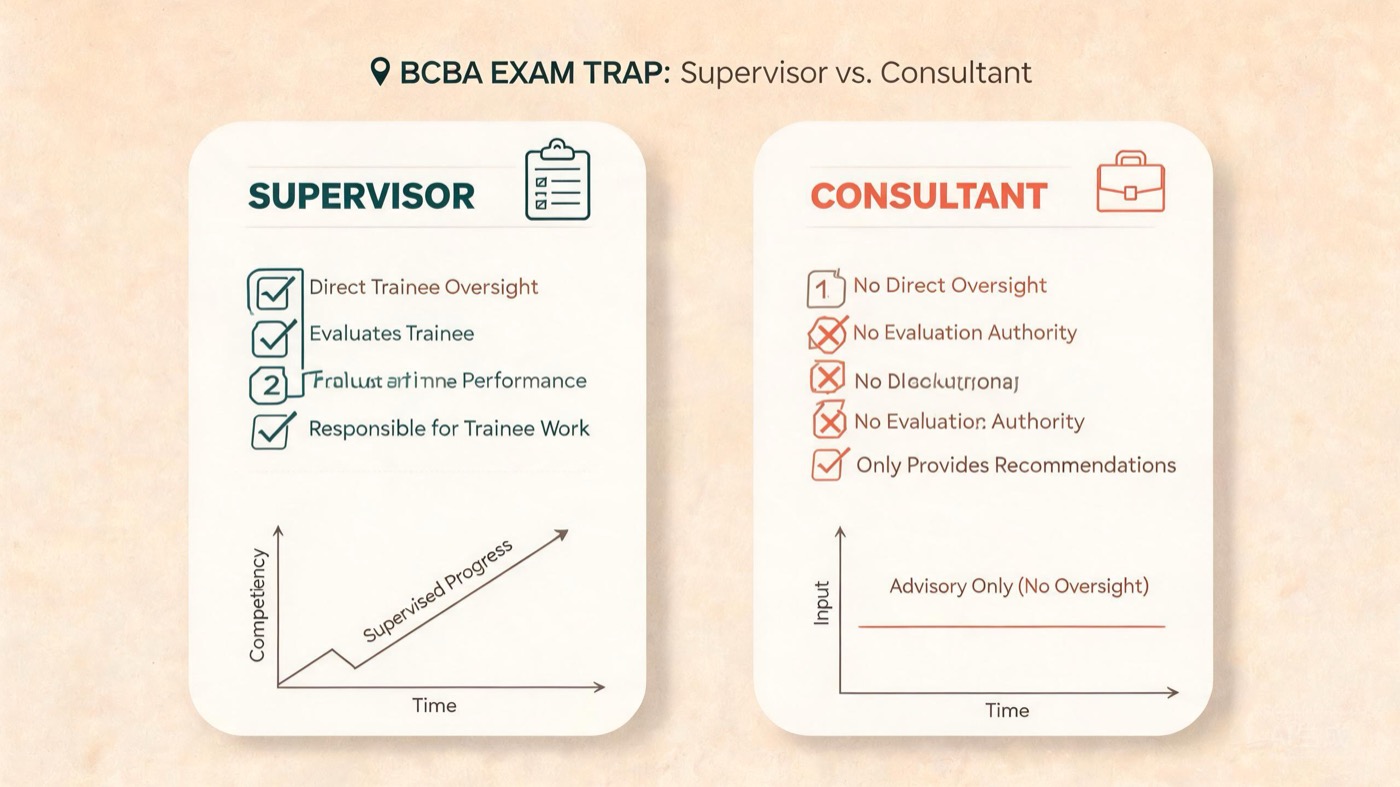
Trap 1: Confusing Supervisor with Consultant
A supervisor has direct oversight and responsibility for a trainee’s work. A consultant may provide recommendations but does not have the same authority to evaluate or sign off on hours. Exam questions often describe a consultant acting as a supervisor – that is a red flag.
Trap 2: Over- or Under-Estimating Contact Hours
Know exact numbers: at least 4 supervisory contacts per month, with at least 2 individual. One of the individual contacts must include observation of the trainee. Do not confuse these with total experience hours (e.g., 2000 hours for BCBA).
Trap 3: Misapplying Ethical Codes to Supervision
The BACB Code has specific sections. Code 1.0 (Responsibility as a Professional) includes competence and integrity. Code 2.0 (Responsibility in Practice) covers client welfare. For supervision, look at Code 3.0 (Responsibility to Supervisees) – this is where you find rules about feedback and boundaries.
Quick Study Checklist for the BCBA Exam
Use this checklist to review key points before test day:
- Know the supervisor qualifications: BCBA/BCBA-D, good standing, supervision training completed.
- Memorize contact hour requirements: 4 per month, 2 individual, 1 observation.
- Distinguish supervisor from consultant, clinical director, and case manager.
- Identify which BACB Ethics Code sections apply to supervision (especially Code 3.0).
- Practice ABC examples like those above to see how supervision affects client outcomes.
For additional study support, check out our BCBA Exam Prep Guide for more targeted resources.
Summary: Mastering the Behavior Analyst Supervisor Role
The behavior analyst supervisor is a pivotal figure in ABA, responsible for training, ethical oversight, and quality assurance. For BCBA candidates, understanding this role means knowing the BACB’s supervision requirements, ethical obligations, and common exam traps. Use the checklist above to reinforce your knowledge, and always connect theory to real-world examples. For official details, refer to the BACB website for the latest supervision standards.
Complete BCBA Exam Prep
Turn this topic into exam-day practice
Practice concepts in context with five full-length 6th Edition mock exams, two bonus practice exams, a 6th Edition study guide, and key-term flashcards—all in one $120 USD package.
Get the $120 All-in-One Prep Pack
Review everything included on the product page before ordering. No pass guarantee is implied.



