

Quick answer: The best ABA data collection software is not automatically the platform with the longest feature list. It is the system that lets your team collect the measurements in the treatment plan accurately, quickly, and consistently; turns those records into usable graphs; protects client information; and supports decisions without creating more documentation work.
Table of Contents
- What Is ABA Data Collection Software?
- How Do You Match Software to an ABA Measurement Plan?
- What Should an ABA Data Collection Workflow Feel Like?
- What Should Your ABA Software Demo Prove?
- How Do You Check Data Quality and Clinical Usability?
- What Privacy and Security Questions Should You Ask?
- Which Integrations and Reports Actually Matter?
- How Should You Compare Pricing and Vendor Claims?
- ABA Data Collection Software FAQ
- Key Takeaway
- Quick Review Checklist
- Take the Free BCBA Mock Exam
Before booking a demo, write down the programs, behaviors, recording methods, users, settings, devices, and reports you actually need. Then test each platform with the same realistic scenario. That process is more dependable than choosing from a generic “best software” ranking.
What Is ABA Data Collection Software?
ABA data collection software is a digital system for recording, storing, graphing, and reviewing behavior or skill-acquisition data. Depending on the product, it may include frequency, duration, latency, interval, rate, percentage, task-analysis, trial-by-trial, ABC, preference-assessment, or free-operant workflows. Some products focus on clinical data; others combine data collection with scheduling, billing, session notes, parent communication, or electronic records.
The software is not the measurement system itself. A BCBA still has to define the target response, select a measurement dimension, specify when data are collected, and decide how the data will guide treatment. The site’s ABA data collection guide covers the underlying methods. This article addresses the next decision: how to evaluate the tool that will carry out the plan.
That distinction matters because a polished app can still produce weak data if the program is vague, the response options do not match the operational definition, or staff cannot record what happened in the moment. Start with clinical requirements, then evaluate software.
How Do You Match Software to an ABA Measurement Plan?
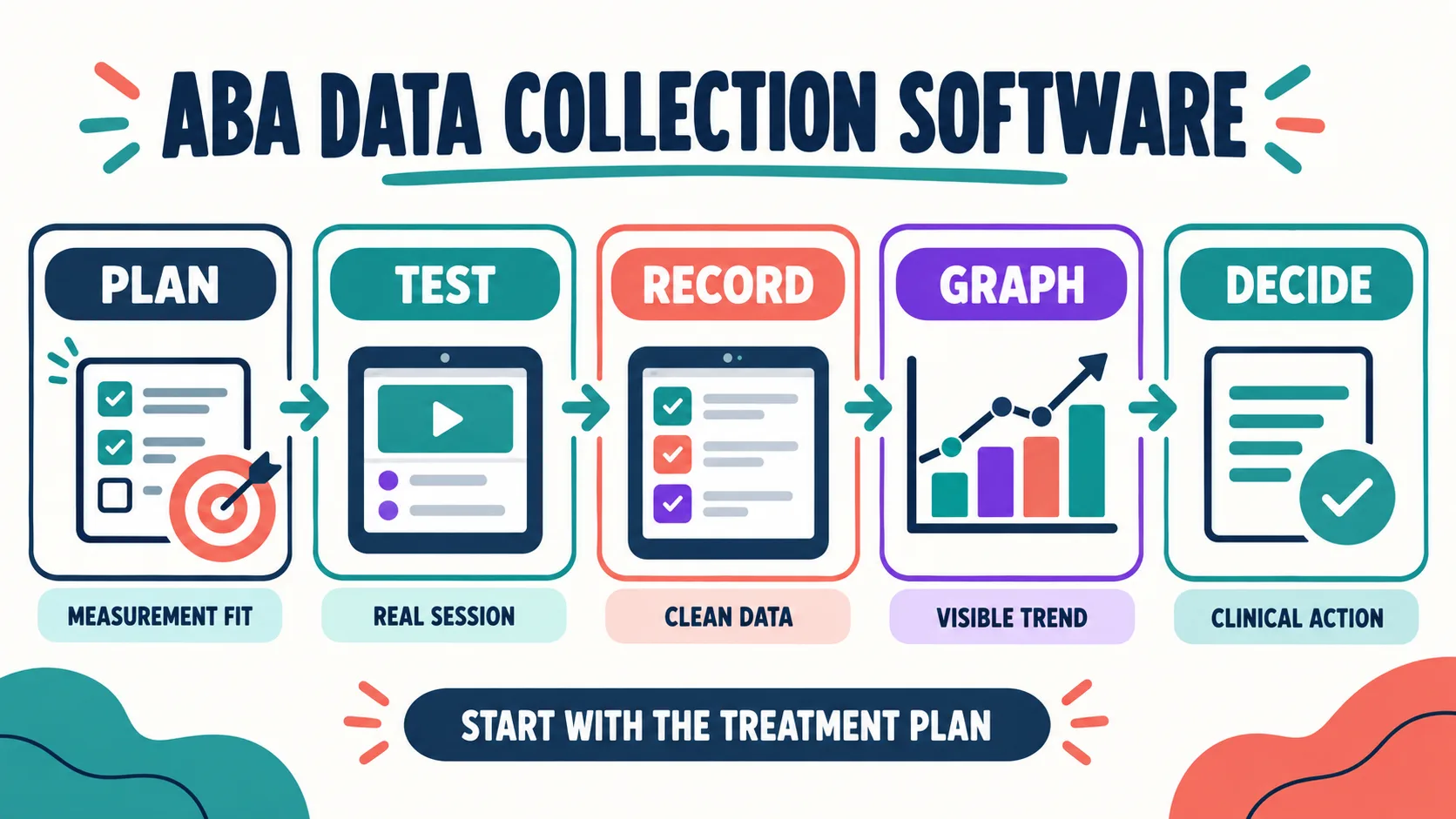
Begin with a small sample of real programs rather than a wish list of every feature a vendor offers. Include at least one skill-acquisition target, one behavior-reduction target, and one target that requires a less common recording method. Ask the team to describe the exact response, the opportunity or observation period, the prompt level, and the decision rule for changing treatment.
Then check whether the software can represent that plan without forcing staff to use a misleading proxy. For example, a frequency target should not be reduced to a vague “completed” button if the plan needs rate or opportunities. A duration target should make start and stop events practical. An interval procedure should identify the interval type and what counts as an occurrence. If the product cannot express the plan clearly, its attractive dashboard will not repair the measurement problem.
| Clinical requirement | What to verify | Demo test |
|---|---|---|
| Measurement definition | Can the target, dimension, opportunity, and mastery rule be written precisely? | Build one program from the current treatment plan without changing its definition. |
| Prompt and error data | Can staff record prompt level, error type, independence, or correction when clinically needed? | Score a short teaching sequence and review the record afterward. |
| Generalization and maintenance | Can context, materials, people, and probe conditions be separated? | Run the same target across two settings and compare the resulting data. |
| Decision-making | Can a supervisor see the trend, variability, and data gaps needed for a treatment decision? | Ask the vendor to create the graph from deliberately mixed data. |
Also test the “failure path.” What happens when the device loses connection, a staff member selects the wrong target, a session is interrupted, or a supervisor must correct an entry? A reliable system makes corrections traceable rather than silently replacing the original record.
What Should an ABA Data Collection Workflow Feel Like?
Data collection happens during busy sessions, not in a quiet software demonstration. Count the number of taps, screens, required fields, and decisions needed to record one event. Time a new user and an experienced user. If the workflow is fast only after extensive customization, include that training and setup time in the decision.
Check whether a technician can see the current target, definition, prompt options, and timing rule without leaving the recording screen. Confirm that the app prevents accidental double-entry but does not block a legitimate event. Look at how it handles multiple learners, overlapping sessions, shared devices, offline work, and synchronization after reconnecting. The existing digital-versus-paper comparison is useful for framing the tradeoff; software still has to work in the actual environment where services occur.
Accessibility is part of data quality. Ask about readable text, color contrast, screen-reader behavior, keyboard access, touch targets, language options, and whether the interface depends on color alone. A team member who cannot reliably read or operate the screen may skip data, guess, or postpone entry.
What Should Your ABA Software Demo Prove?
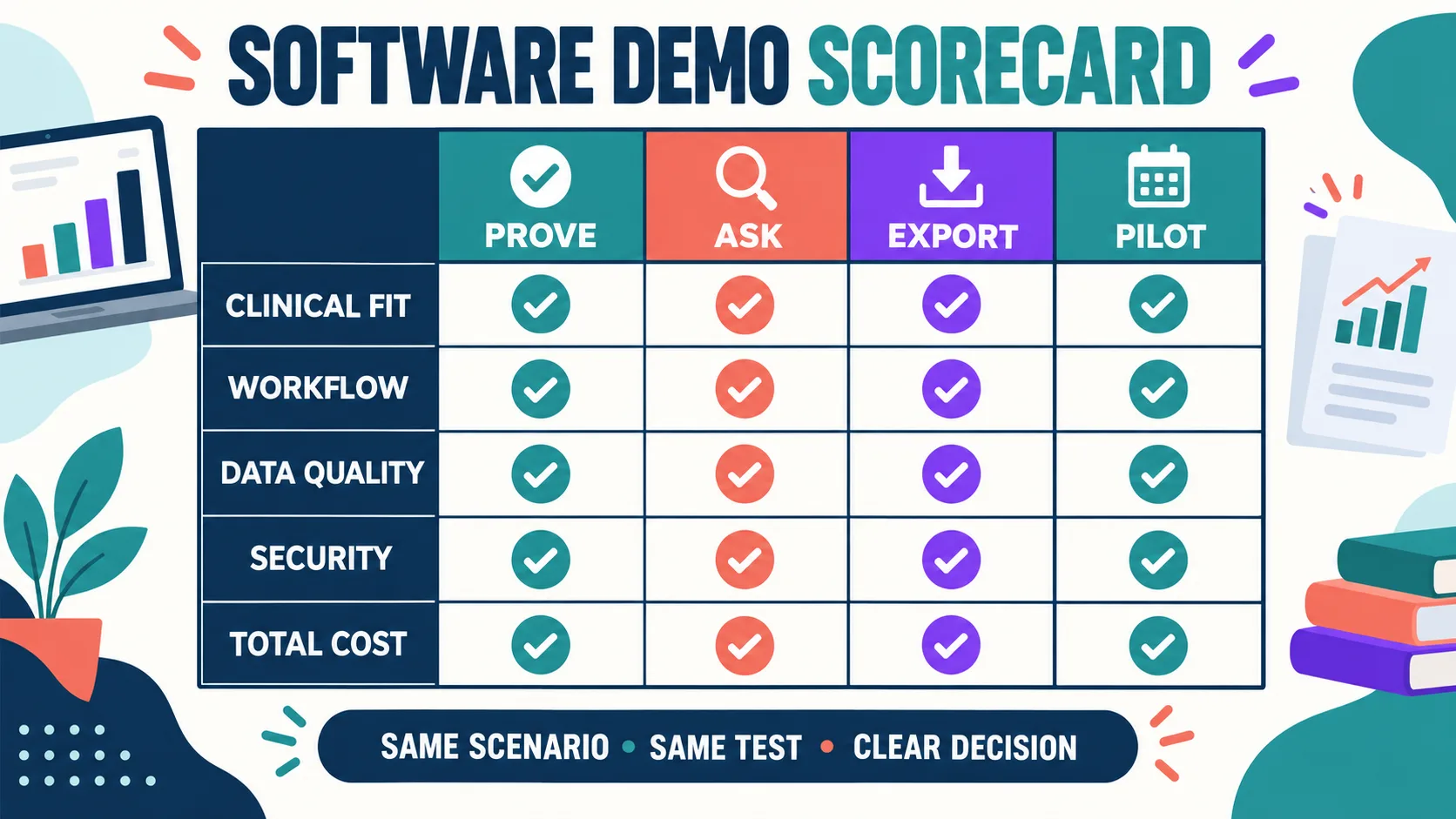
Use the same script for every vendor. Give each person a short scenario and ask them to complete it without a sales representative taking over the keyboard. A useful demo should show the path from a clinical plan to a recorded event, from that event to a graph, and from the graph to a documented decision.
- Set up a target. Enter an operational definition, measurement method, goal, prompt options, and mastery criterion.
- Collect imperfect data. Record correct responses, errors, prompts, missed opportunities, and an interrupted session so the team can see how exceptions work.
- Review the graph. Ask which data are included, how missing sessions are displayed, and whether the graph can be exported without losing labels or dates.
- Make a decision. Have the BCBA explain what change would be made from the displayed pattern and where that decision is documented.
- Audit a correction. Edit one entry and ask who can see the change, when it occurred, and whether the original value remains available.
Do not accept “the platform can do that” as the end of an answer. Ask to see the exact screen, role permission, export, or audit record. Features that exist only in a custom plan, a future release, or a separate module should be labeled as such in your comparison notes.
How Do You Check Data Quality and Clinical Usability?
A software platform should make good measurement easier, not make weak measurement look official. Review whether each data point keeps its date, time, observer, target, context, and measurement unit. Check whether the system distinguishes a true zero from a missed session or a blank field. Ask how it represents partial sessions, corrected entries, duplicate records, and late entry.
Look for a way to monitor reliability and treatment integrity when those checks are part of the plan. The software may support agreement calculations or side-by-side scoring, but the BCBA still determines the appropriate procedure and interpretation. Similarly, an automated trend line does not replace visual analysis. Your team should be able to inspect level, trend, variability, and changes in conditions.
Ask how data are exported. A useful export should preserve client or case identifiers in a controlled way, target names, dates, values, units, condition labels, and notes. Test a small export in a spreadsheet or reporting workflow before signing a contract. If the export is unreadable, incomplete, or locked behind an expensive tier, that is a clinical and operational risk.
What Privacy and Security Questions Should You Ask?
Do not treat a “HIPAA compliant” badge as a complete evaluation. The HHS Security Rule overview describes administrative, physical, and technical safeguards for electronic protected health information handled by covered entities and business associates. Whether a particular arrangement applies to your organization depends on the services, contracts, and information involved; involve the appropriate compliance or legal adviser.
Ask the vendor for concrete answers about encryption in transit and at rest, role-based access, multi-factor authentication, session timeouts, device management, backups, breach response, data retention, deletion, subcontractors, and the location of stored data. If a business associate agreement is relevant to your relationship, ask to review the process before implementation. Also ask whether a support representative can see client data and how that access is logged.
Professional ethics matter alongside regulatory requirements. Review the current BACB ethics codes and connect the software decision to client welfare, confidentiality, competence, and accurate documentation. Never upload identifiable information to a trial account until your organization has approved the arrangement. Use fictional or de-identified data for the first demo.
Which Integrations and Reports Actually Matter?
Integration is valuable only when it removes duplicate entry without hiding the source data. Map the path between scheduling, session notes, clinical programs, graphing, billing, authorizations, and family reports. Ask which system is the source of truth for each field and what happens when two systems disagree.
Confirm whether integrations are real-time, scheduled, one-way, or two-way. Find out whether a change to a target definition flows into old records or only new sessions. Ask whether an export includes raw data as well as summaries. A dashboard that looks convenient but cannot support a chart review, payer request, supervision meeting, or transition to another system may create future lock-in.
How Should You Compare Pricing and Vendor Claims?
Compare total cost, not just the advertised monthly number. Include implementation, data migration, training, support, extra users, additional clients, storage, custom reports, API access, electronic records, offline capability, and early termination. Ask whether prices change by client count, provider count, location, or module.
Separate “included,” “available at extra cost,” “requires configuration,” and “on the roadmap.” Record the date of every quote and feature statement. Product pages and comparison articles can become outdated, and a vendor’s claim is not independent validation. Ask for a short pilot with representative programs and written acceptance criteria.
| Category | Weight | Evidence to collect |
|---|---|---|
| Clinical and measurement fit | 30% | Completed test programs, recording methods, prompt/error options, and meaningful graphs. |
| Daily usability and accessibility | 20% | Timed session entry by representative users on the devices used in practice. |
| Data integrity and reporting | 20% | Audit trail, missing-data handling, export sample, correction history, and decision workflow. |
| Privacy, security, and governance | 15% | Security documentation, access controls, retention, incident response, and contract review. |
| Total cost and support | 15% | Written quote, implementation plan, support terms, migration path, and exit conditions. |
ABA Data Collection Software FAQ
Is ABA data collection software required?: No. A digital platform is a workflow choice, not a substitute for a valid measurement plan. Paper, spreadsheets, or another approved system may be appropriate in some settings. The question is whether the method supports accurate collection, review, security, and documentation for the services being delivered.
What features should a small ABA practice prioritize?: Prioritize the measures you use every week, fast and clear session entry, usable graphs, controlled access, reliable exports, responsive support, and a price that remains sustainable as clients or staff change. A smaller platform that the team uses correctly can be more valuable than a large platform with unused modules.
Does offline mode guarantee safe data collection?: No. Ask what is stored locally, how it is encrypted, how long it remains on the device, what happens after a failed sync, and whether the user can see which records are pending. Test the behavior in a controlled pilot rather than relying on a marketing statement.
Should a BCBA choose the software alone?: The BCBA should protect clinical requirements, but the selection team should include the people who will collect data, supervise, manage technology, and review contracts. A short trial with representative users usually reveals workflow problems that a leadership-only demo misses.
Key Takeaway
Choose ABA data collection software by testing the full path from operational definition to clinical decision. Verify measurement fit, daily usability, data integrity, privacy, integrations, accessibility, support, and total cost with the same scenario for every vendor. If you are preparing for the BCBA exam, reinforce the connection between measurement, graphing, ethics, and data-based decisions with the site’s free BCBA mock exam. For targeted review, use our aba data collection software practice questions to apply the concept in exam-style scenarios.
Quick Review Checklist
Use this final checklist to turn aba data collection software into exam-ready reasoning. The goal is not to memorize a label in isolation; it is to identify the relevant evidence and explain why the best answer fits the scenario. Key ideas to review:
- State the central definition or decision point for aba data collection software in your own words.
- Identify the detail that makes aba data collection software different from its closest related ABA term.
- Separate the observable facts in a scenario from assumptions that are not supported by the facts.
- Write one example and one nonexample so you can recognize the concept in a new setting.
Exam application checks:
- Ask what the question is actually requesting before comparing the answer choices.
- Mark the antecedent, response, consequence, or other evidence that supports the selected answer.
- Look for a distractor that describes a related process but does not answer the specific question.
Final self-check:
- Explain how you would verify the interpretation with clear observations or data.
- Change one detail in the scenario and decide whether your answer should change.
- Give a one-sentence rationale that a supervisor or study partner could evaluate.
Take the Free BCBA Mock Exam
If you want a low-pressure way to check your recall, use the free practice resource below. Take the Free BCBA Mock Exam



