

Quick answer: a strong BCBA resume makes three things easy to verify: what you are authorized to do, what behavior-analytic work you have actually performed, and what outcomes or responsibilities you handled. Employers do not need a list of vague traits. They need a readable record of assessment, intervention, data review, supervision, collaboration, documentation, and the setting in which you used those skills.
Table of Contents
- What Should a BCBA Resume Prove?
- How Do You Represent BCBA Certification Correctly?
- What Format Works Best for a BCBA Resume?
- What Sections Should You Include?
- How Do You Write the Professional Summary?
- How Should You Describe BCBA Experience?
- Which Skills Belong on a BCBA Resume?
- How Do You Show Supervision and Training?
- How Should You List Education and Fieldwork?
- What Changes for New, Mid-Career, and Senior BCBAs?
- How Do You Tailor a BCBA Resume to a Job Posting?
- How Can You Keep the Resume ATS-Friendly?
- What BCBA Resume Mistakes Should You Avoid?
- What Is the Final BCBA Resume Checklist?
- BCBA Resume FAQ
- Should I put my BCBA certification number on my resume?
- How do I show RBT experience after becoming a BCBA?
- How long should a BCBA resume be?
- Key Takeaway
- Take the Free BCBA Mock Exam
Build the document around the role you want. A newly certified BCBA applying for a clinical position needs a different emphasis from an experienced analyst pursuing a clinical-director role, a school-based position, utilization review, or a research job. The same rule applies to candidates moving up from RBT or BCaBA work: show the skills you have already demonstrated without implying that you held a credential before it was issued.
What Should a BCBA Resume Prove?
Your resume should help a hiring manager answer five questions quickly:
- What role and population can you support?
- Is your BCBA certification current, and is the job location subject to separate state licensure?
- Can you assess behavior, interpret data, design or revise interventions, and communicate decisions?
- Have you supervised, trained, coached, or collaborated with the people who implement services?
- Can you describe results without exposing protected client information or making unsupported clinical claims?
If a reader has to infer all five answers from a paragraph of generic adjectives, the resume is doing too much work for too little evidence. Use the top third of page one to establish your credential, target role, setting, and strongest behavior-analytic capabilities.
How Do You Represent BCBA Certification Correctly?
Use the credential exactly as it is currently held. If you are certified, write “Board Certified Behavior Analyst (BCBA)” after your name and include the certification status or number only when it is appropriate for the employer’s process and does not create a privacy or security concern. If you are pursuing certification, write that you are “seeking BCBA certification” or use a similarly accurate phrase. Do not write “BCBA” as if the credential were active before it was awarded. Use the current BACB BCBA Handbook and the board’s official resources when you verify the wording.
The BACB has guidance on representing certification status. Treat the BACB record and the current handbook as the controlling sources, not a resume template from a third-party website. A state license, employer credentialing status, NPI, and BCBA certification are different records. If a role requires state authorization, mention the state license separately and verify its current status before listing it.
What Format Works Best for a BCBA Resume?
For most clinical and operations roles, use a clean one-column format with standard headings, ordinary text, and reverse-chronological experience. Applicant-tracking software often reads a simple document more reliably than a heavily designed file with multiple text boxes, icons, charts, or sidebars. A polished resume can still have visual hierarchy: consistent spacing, one restrained accent color, clear dates, and bold role titles.
Use two pages when the additional evidence improves the hiring decision. A new graduate may need only one focused page; a senior BCBA with leadership, program development, presentations, and payer or compliance work may need two. The test is not a rigid page count. The test is whether every line supports the target role.
What Sections Should You Include?
| Section | Purpose | What to emphasize |
|---|---|---|
| Header | Identify the candidate and target location | Name, credential, city/state, professional email, phone, and optional LinkedIn |
| Summary | Give the reader a role-specific snapshot | Years or stage, populations, settings, strongest responsibilities, and target role |
| Credentials | Make eligibility and status clear | BCBA, state license where relevant, BCaBA/RBT history, dates, and education |
| Experience | Show behavior-analytic work and decisions | Assessment, treatment, data, supervision, training, caseload context, and outcomes |
| Skills | Support search and quick review | Measurement, FBA, graphing, caregiver training, systems, software, and languages |
Do not let the skills section replace evidence in the experience section. “Data analysis” is a claim; a bullet explaining how you reviewed a trend, changed a program, and monitored the result is evidence.
How Do You Write the Professional Summary?
Write the summary after you choose the job description you want to target. A useful pattern is: credential and experience stage + setting or population + two or three high-value responsibilities + the role you want next. For example: “Board Certified Behavior Analyst with four years of clinic and school collaboration experience, specializing in functional assessment, skill-acquisition programming, caregiver coaching, and data-based treatment revision. Seeking a senior BCBA role supporting consistent clinical systems and strong team supervision.” This is stronger than “hardworking professional with excellent communication skills” because it tells the reader what work you can perform.
How Should You Describe BCBA Experience?
Start each bullet with an action and identify the behavior-analytic task. Then add context and, when it is accurate and permitted, a measurable result. A practical formula is action + clinical or operational task + population or setting + evidence of effect.
- “Designed and monitored individualized skill-acquisition programs for learners ages 4–10 across clinic and home sessions, using weekly graphed data to adjust prompts and mastery criteria.”
- “Conducted functional behavior assessments with direct observation and caregiver interviews, then translated findings into function-matched intervention plans reviewed with the care team.”
- “Trained and coached 12 behavior technicians through modeling, rehearsal, observation, and feedback, improving treatment-integrity checks from the team’s baseline to the target standard.”
Protect confidentiality. Use a broad age range, setting, service model, or caseload size instead of a client’s name, address, school, diagnosis details that are not needed, or identifiable case story. If you cite a percentage, timeframe, or clinical result, be ready to explain how it was measured and what limitations apply.
Which Skills Belong on a BCBA Resume?
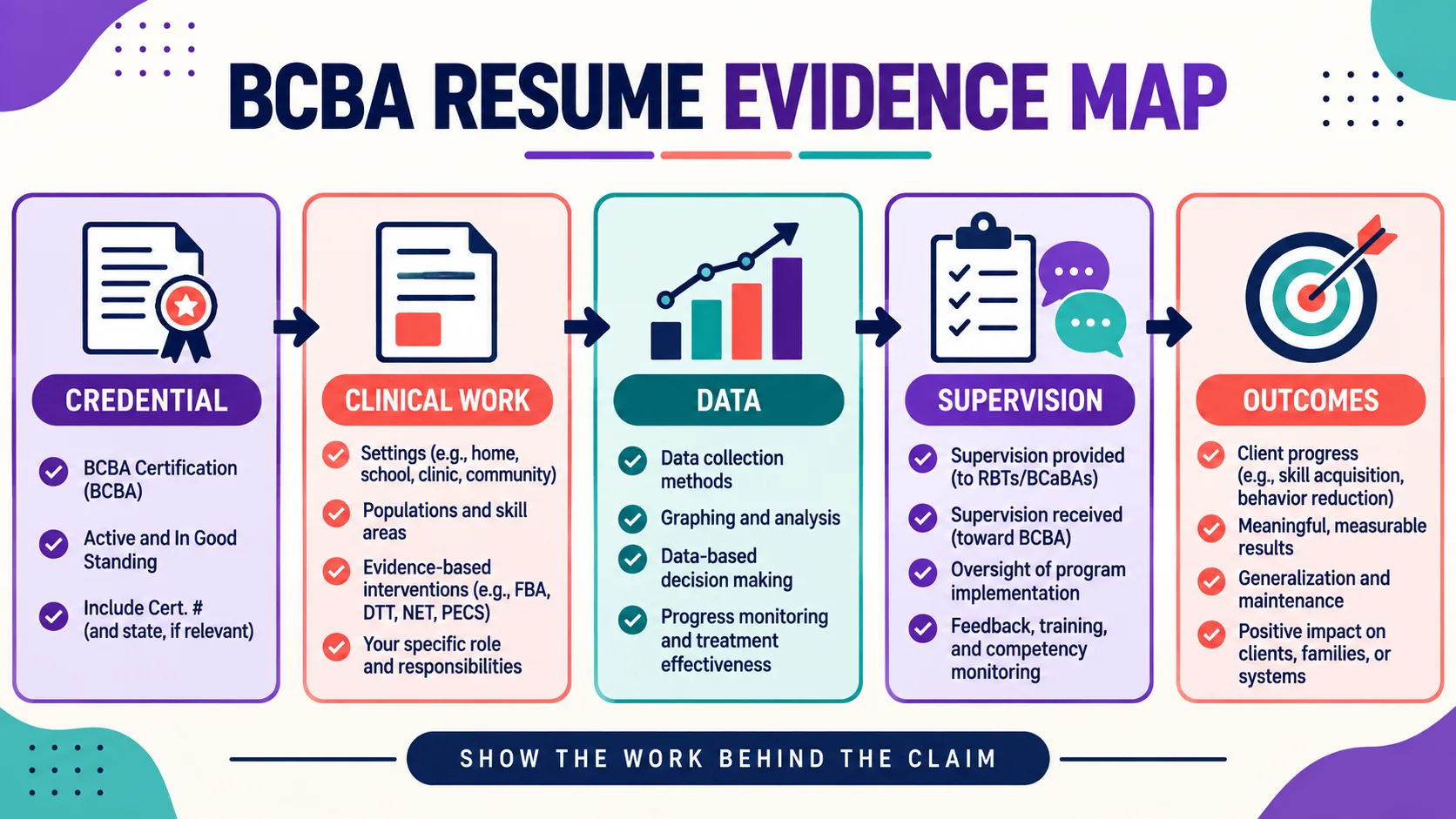
Prioritize skills that map to the target role and to real behavior-analytic decisions. Useful categories include measurement and graphing, preference or reinforcer assessment, functional behavior assessment, skill acquisition, behavior reduction, caregiver collaboration, staff training, treatment integrity, social validity, documentation, and ethical decision making.
Add tools only when you can use them competently. Examples may include electronic health records, data platforms, spreadsheet analysis, telehealth systems, and presentation software. A long software list is less persuasive than one bullet showing how you used a platform to review data, communicate a change, or audit documentation.
How Do You Show Supervision and Training?
Supervision is more than “supervised RBTs.” Explain the performance system: how you assessed a skill, modeled the procedure, arranged rehearsal, delivered feedback, monitored fidelity, and responded when performance or client outcomes did not improve. For trainee supervision, separate experience supervising employees from experience supervising individuals accruing fieldwork toward certification.
The BACB’s supervision resources describe different oversight roles and current training expectations. Use the wording that matches your actual role. Do not imply that you were responsible for a trainee’s certification requirements if you were only a line manager or if another BCBA signed the official records.
How Should You List Education and Fieldwork?
List the graduate degree, institution, location or online format when relevant, and completion date. If your program was designed around a specific BCBA eligibility pathway, you may note the pathway context, but avoid promising that the degree alone guarantees eligibility. Candidates should verify their own coursework and fieldwork against the current BACB rules and preserve official documentation.
For early-career applicants, fieldwork can be a central section. Describe the supervised experience you actually completed: settings, assessment or intervention exposure, data work, caregiver or team collaboration, and documentation responsibilities. If the hours were independent or concentrated, use the accurate terminology and follow the supervising BCBA’s documentation. A resume is not the official fieldwork verification form.
What Changes for New, Mid-Career, and Senior BCBAs?
A newly certified BCBA can make a credible resume by connecting earlier RBT or BCaBA work to the skills that transfer: accurate measurement, treatment implementation, data collection, communication, and responsiveness to feedback. Make the certification date clear and show the graduate program or fieldwork without inflating responsibility.
A mid-career BCBA should emphasize independent assessment, treatment planning, program revision, caregiver training, collaboration, and the complexity of the caseload or service model. A senior BCBA or clinical director should add systems-level evidence: quality assurance, onboarding, clinical audits, staff retention initiatives, payer or authorization workflows, program development, and outcomes across teams.
How Do You Tailor a BCBA Resume to a Job Posting?
Make a three-column note before editing:
- Posting language: the exact responsibilities and credentials the employer names.
- Your evidence: the role, project, or training where you performed that work.
- Proof point: the scope, method, frequency, outcome, or tool that makes the claim credible.
Then reflect the employer’s legitimate terminology naturally. If the posting asks for caregiver training, do not hide that experience under “stakeholder engagement.” If it asks for assessment and treatment-plan writing, move those duties above generic teamwork. Tailoring is not copying every keyword; it is making the most relevant evidence easy to find.
How Can You Keep the Resume ATS-Friendly?
Use standard headings such as Summary, Experience, Education, Certification, and Skills. Spell out important terms once and include the abbreviation where useful, such as “functional behavior assessment (FBA)” or “Board Certified Behavior Analyst (BCBA).” Avoid putting critical credentials in an image, header graphic, footer, or decorative sidebar. Export a searchable PDF only when the employer accepts PDF; otherwise follow the requested file format.
Read the final file as plain text. Check that dates are in a consistent order, bullets are complete, links work, and the credential line is not accidentally hidden by a text box. A resume that looks perfect on screen but extracts in the wrong order can fail before a human reads it.
What BCBA Resume Mistakes Should You Avoid?
- Using “BCBA” as a title before certification is active.
- Listing every ABA term without explaining what you did with it.
- Claiming clinical outcomes without naming the measurement or context.
- Confusing state licensure, BACB certification, NPI enrollment, and employer credentialing.
- Including protected client information, identifying case details, or unverified testimonials.
- Submitting the same document to clinical, school, research, and leadership roles without changing the evidence order.
What Is the Final BCBA Resume Checklist?
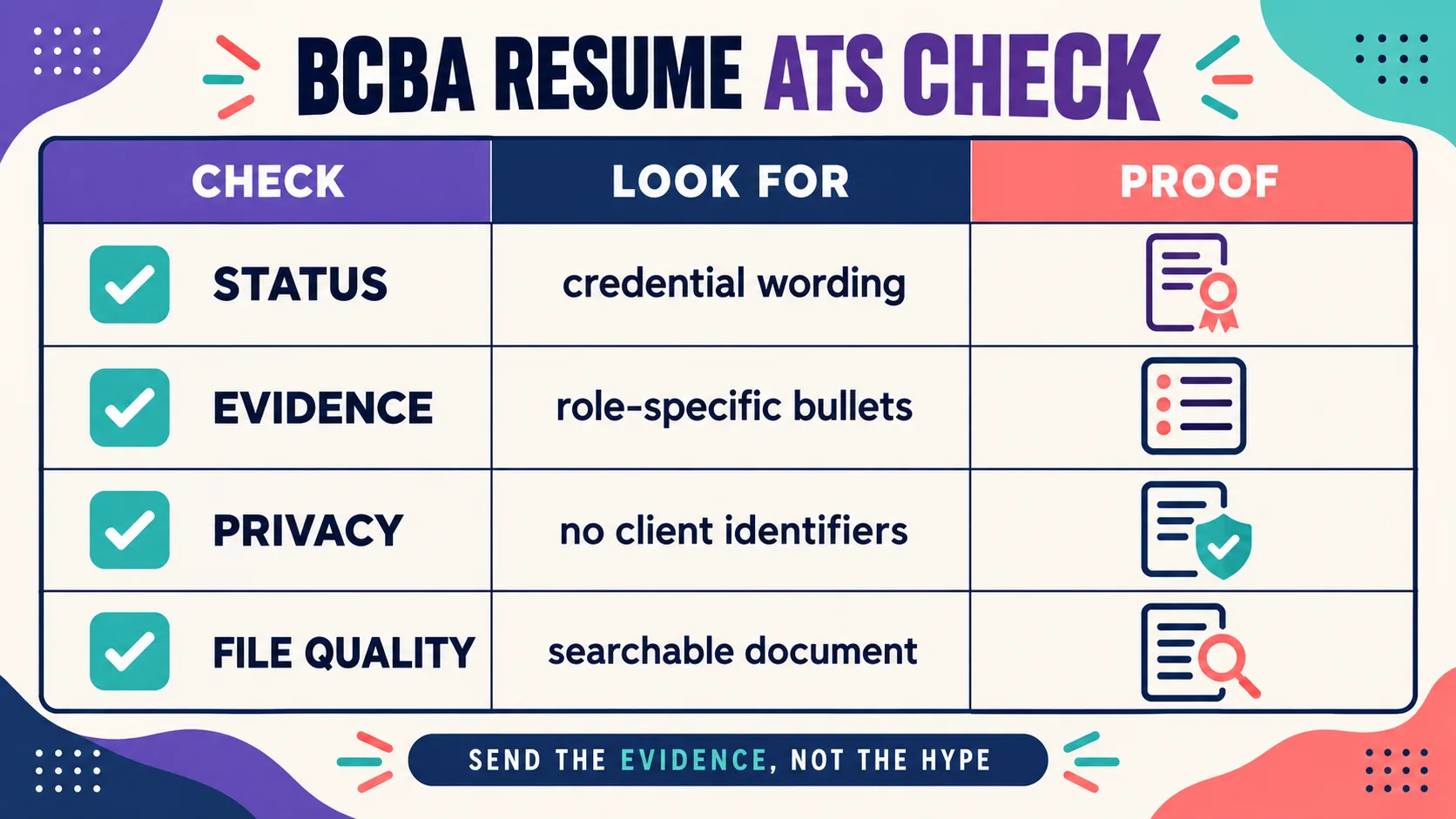
Before sending the document, confirm that:
- Your name, contact details, credential status, and location are accurate.
- Your summary matches the position instead of describing a generic ABA professional.
- Each recent role includes behavior-analytic responsibilities and evidence, not only duties.
- Education, certification, state license, and fieldwork language are precise and separately labeled.
- Skills and keywords appear in readable text and are supported by experience bullets.
- No client-identifying information or unsupported outcome claim remains in the file.
- The final PDF or document opens, searches, extracts, and displays correctly.
BCBA Resume FAQ
Should I put my BCBA certification number on my resume?
Follow the employer’s instructions and your privacy judgment. Some credentialing workflows request the number; others only need the certification status and an official verification step. If you include it, keep the format accurate and do not use a number that belongs to another credential or an expired status.
How do I show RBT experience after becoming a BCBA?
Keep the experience when it demonstrates relevant growth. Label the role and dates accurately, then describe the skills that transferred into assessment, data-based decisions, team communication, or supervision. Do not rewrite an RBT role as if it were independent BCBA practice.
How long should a BCBA resume be?
Use the shortest length that shows the evidence needed for the job. One page can work for a new BCBA; two pages may be appropriate for an experienced analyst or leader. Remove repetition before removing a distinct responsibility or result that the employer needs to evaluate.
Key Takeaway
A high-quality BCBA resume is an evidence map: it connects an accurate credential line to the assessments, interventions, data decisions, supervision, collaboration, and outcomes you can discuss in an interview. Tailor the map to the role, protect client privacy, distinguish national certification from state authorization, and verify current BACB language before you make a claim. After you identify the type of BCBA role you want, review the site’s BCBA jobs guide and use the free BCBA mock exam to keep the certification side of your preparation structured. For targeted review, use our bcba resume practice questions to apply the concept in exam-style scenarios.
Take the Free BCBA Mock Exam
If you want a low-pressure way to check your recall, use the free practice resource below. Take the Free BCBA Mock Exam



