

Quick answer: BCBA jobs are roles in which a Board Certified Behavior Analyst applies behavior analysis, designs or supervises services, interprets data, collaborates with families and other professionals, and works within the credential, license, payer, and employer rules that apply to the position. The best job is not automatically the one with the highest advertised salary or the largest caseload. It is the role whose clinical scope, supervision expectations, documentation load, schedule, support, and growth path match your current credential and the way you want to practice.
Table of Contents
- What Does a BCBA Job Usually Involve?
- What Types of BCBA Jobs Are Available?
- What Should You Verify Before Applying?
- How Should You Read a BCBA Job Posting?
- How Do You Evaluate Caseload and Workload?
- What Supervision and Support Should a BCBA Expect?
- How Should You Compare BCBA Pay and Benefits?
- What Should You Ask in a BCBA Job Interview?
- Are Remote BCBA Jobs a Separate Category?
- How Can You Choose Between Two BCBA Jobs?
- BCBA Jobs FAQ
- Where should I search for BCBA jobs?
- Can a BCBA work in any state after passing the exam?
- What is a good first BCBA job?
- Key Takeaway
- Quick Review Checklist
- Take the Free BCBA Mock Exam
A job title can hide major differences. One BCBA position may focus on direct clinical leadership in a clinic. Another may emphasize home or school services, caregiver coaching, consultation, quality assurance, staff training, or program development. Before applying, read the posting as a clinical document: identify what decisions you will own, who will support those decisions, how performance is measured, and whether the role gives you enough time and authority to do ethical work.
What Does a BCBA Job Usually Involve?
The Behavior Analyst Certification Board’s BCBA resource describes the credential as a graduate-level certification. BCBAs are independent practitioners who can provide behavior-analytic services and supervise the work of RBTs, BCaBAs, and other people who implement behavior-analytic interventions, subject to applicable rules. That scope is broader than a list of therapy tasks. A BCBA job commonly involves clinical judgment, assessment, intervention planning, data review, supervision, communication, and professional accountability.
The exact mix depends on the setting and the employer. A school-based BCBA may collaborate with educators around classroom participation and educational goals. A home-based BCBA may coordinate caregiver training, routines, and generalization across daily activities. A clinic BCBA may oversee several cases, design skill-acquisition and behavior-reduction programs, train direct staff, and review treatment data. A consultant may spend more time on assessment, staff development, or systems-level problem solving. Read the words responsible for, supports, caseload, billable, and travel carefully. They often reveal more about the real role than the first paragraph of the advertisement.
What Types of BCBA Jobs Are Available?
Search results for BCBA jobs can mix clinical roles, leadership roles, school positions, telehealth work, and recruiting pages. Grouping the roles by their main work helps you compare like with like:
- Clinical BCBA: assesses learners, writes or revises programs, reviews data, supervises implementation, and communicates with families and teams.
- Lead or supervising BCBA: supports other BCBAs or direct-care staff, reviews clinical quality, mentors team members, and may carry a smaller caseload.
- School-based BCBA: works with school personnel and families around participation, classroom routines, behavior support, and documentation within the educational system.
- Home or community BCBA: connects goals to family routines, daily living, communication, safety, and generalization across natural environments.
- Telehealth or remote BCBA: provides consultation, caregiver coaching, supervision, or selected clinical services through technology when the client, employer, state, and payer requirements allow it.
- Program, quality, or training role: develops systems, trains staff, audits documentation, supports compliance, or improves clinical processes rather than owning a traditional full caseload.
These labels are not standardized job categories. Two employers can use “clinical director” or “senior BCBA” for very different responsibilities. Ask what the title means inside that organization and whether the role includes clinical authority, personnel management, business development, or all three.
What Should You Verify Before Applying?
Start with credential and jurisdiction. Confirm whether the employer expects an active BCBA certification, a state behavior-analyst license or registration, a background check, payer enrollment, or another local requirement. The BACB’s current BCBA resource page points candidates to the handbook, ethics code, fieldwork, examination, and maintenance resources. A job posting is not a substitute for checking the current official rules.
Next, separate required qualifications from preferred qualifications. “Master’s degree in behavior analysis or related field” may be listed alongside experience with a particular population, electronic health record, assessment tool, or funding system. A preferred item may be trainable; an active credential or state license may be a condition of practice. If the posting is unclear, contact the recruiter or clinical leader before investing time in a long application.
Finally, check whether the role is truly a BCBA role or a technician, case-management, utilization-review, or administrative position carrying a BCBA-friendly title. The work can be valuable, but the title should not mislead you about clinical authority, supervision, or compensation.
How Should You Read a BCBA Job Posting?
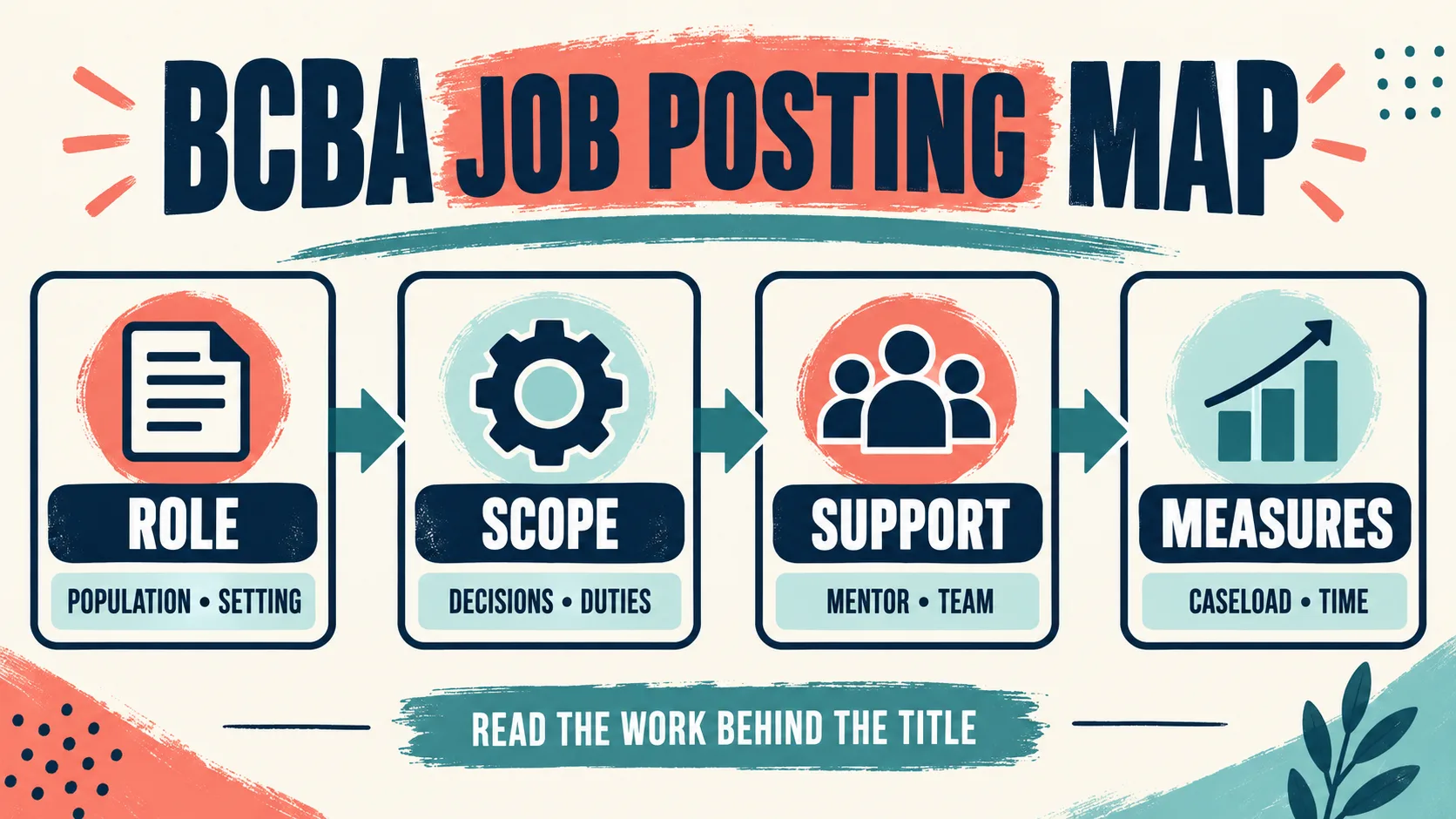
Use four passes when you read a posting. First, identify the role: population, age range, setting, and the decisions you will make. Second, identify the scope: assessment, treatment planning, caregiver work, supervision, staff training, documentation, travel, and crisis responsibilities. Third, identify the support: onboarding, mentorship, clinical consultation, administrative help, scheduling, and access to other disciplines. Fourth, identify the measures: billable hours, caseload size, authorization targets, client outcomes, staff retention, documentation turnaround, or a mixture.
Look for missing information as well as stated benefits. “Flexible schedule” may mean genuine autonomy, or it may mean evening and weekend availability. “Competitive caseload” may describe a manageable number, or it may avoid giving a number at all. “Growth opportunity” is more useful when the employer names the training, promotion criteria, and time frame.
How Do You Evaluate Caseload and Workload?
Caseload is not just a number of clients. Ask how many cases are active, how many are waiting for authorization, how often you are expected to see each case, how much travel is involved, and how much time is protected for assessment, programming, supervision, documentation, meetings, and indirect work. A caseload that looks reasonable on paper can become unmanageable when the geography is wide or the paperwork is fragmented across several systems.
Ask whether billable and nonbillable duties are clearly defined. Some employers count caregiver meetings, data review, supervision, and programming differently. You need to know how a normal week is expected to balance clinical quality with productivity. A role that rewards only face-to-face hours may leave too little time for the analysis and coordination that make those hours effective.
Also ask what happens when a case is high risk, a staff member calls out, a payer denies a service, or a family requests a plan change. The answer shows whether the organization has a real escalation pathway or expects one BCBA to absorb every problem alone.
What Supervision and Support Should a BCBA Expect?
BCBAs are responsible for practicing within their competence and following the applicable ethics and legal requirements. Support can include peer consultation, a clinical director, specialty supervision, case review, continuing education, and access to professionals such as speech-language pathologists, occupational therapists, educators, or medical providers. Support should be specific enough that you know who helps when the case exceeds your training or when an ethical question is complicated.
Do not assume that a job offers meaningful mentorship simply because the posting uses the word supervision. Ask how often clinical meetings occur, whether case review is structured, whether feedback is documented, and whether new BCBAs receive a reduced or staged caseload. The BACB’s supervision-and-training resources distinguish responsibilities across supervising fieldwork, supervising RBTs, assessing RBTs, and training RBTs. The employer should be able to explain which of those responsibilities belong to your role.
How Should You Compare BCBA Pay and Benefits?
Pay is important, but compare the whole package. Look at the base salary or hourly rate, bonus formula, paid documentation time, health coverage, retirement contributions, paid time off, professional-development funds, licensing support, mileage reimbursement, technology, and cancellation policies. If compensation depends on productivity, ask for a written definition of the target and an example of how it is calculated.
Use the site’s BCBA salary guide as a starting point for compensation questions, not as a promise for a specific employer or location. Pay varies with experience, specialty, state rules, setting, caseload, travel, and whether a role includes leadership. A lower headline number can be reasonable if the schedule, clinical support, and paid indirect time are materially better; a higher number can be a warning if it depends on an unrealistic workload.
| Offer area | What to compare | Question to ask |
|---|---|---|
| Clinical workload | Caseload, client hours, travel, documentation, and meetings | What does a normal week look like after the caseload is full? |
| Support | Mentorship, case review, admin help, and escalation coverage | Who reviews a complex case, and how quickly can I reach them? |
| Compensation | Base pay, productivity formula, benefits, PTO, and paid indirect work | Which activities are paid, and how is the target calculated? |
| Growth | Training, specialty pathways, leadership, and promotion criteria | What would success and progression look like after six and twelve months? |
What Should You Ask in a BCBA Job Interview?
Use the interview to test the organization’s clinical clarity, not just to demonstrate that you want the job. Useful questions include:
- What population, settings, and primary goals make up the typical caseload?
- How many active cases does a full-time BCBA usually carry, and how much travel is expected?
- How are assessment, programming, supervision, caregiver training, meetings, and documentation scheduled?
- What data does the clinical team review, and how often do BCBAs change goals or procedures?
- How does the organization respond to assent, distress, communication differences, and family disagreement?
- Who is available for an urgent safety, ethics, medical, payer, or staffing question?
- What training is provided for the electronic record, assessments, crisis procedures, and local requirements?
- Why is this position open, and what has the turnover been like on the team?
Listen for concrete answers. A strong employer can describe the work without treating every question as a challenge to its authority. If the interviewer cannot explain how clinical decisions are made, how performance is evaluated, or who supports the BCBA, that uncertainty belongs in your decision—not in a footnote after you accept.
Are Remote BCBA Jobs a Separate Category?
Remote and telehealth BCBA jobs deserve their own review because technology does not erase jurisdiction, supervision, privacy, or clinical-fit questions. Ask where the client is located, where you are located, which state rules apply, how caregivers or staff are coached, how privacy is protected, and what happens when a hands-on observation is needed. The site’s guide to BCBA remote positions covers those questions in more detail. A remote title may still include travel, in-person assessments, occasional site visits, or a productivity target. Confirm the actual arrangement in writing rather than relying on the word remote in a job-board filter.
How Can You Choose Between Two BCBA Jobs?
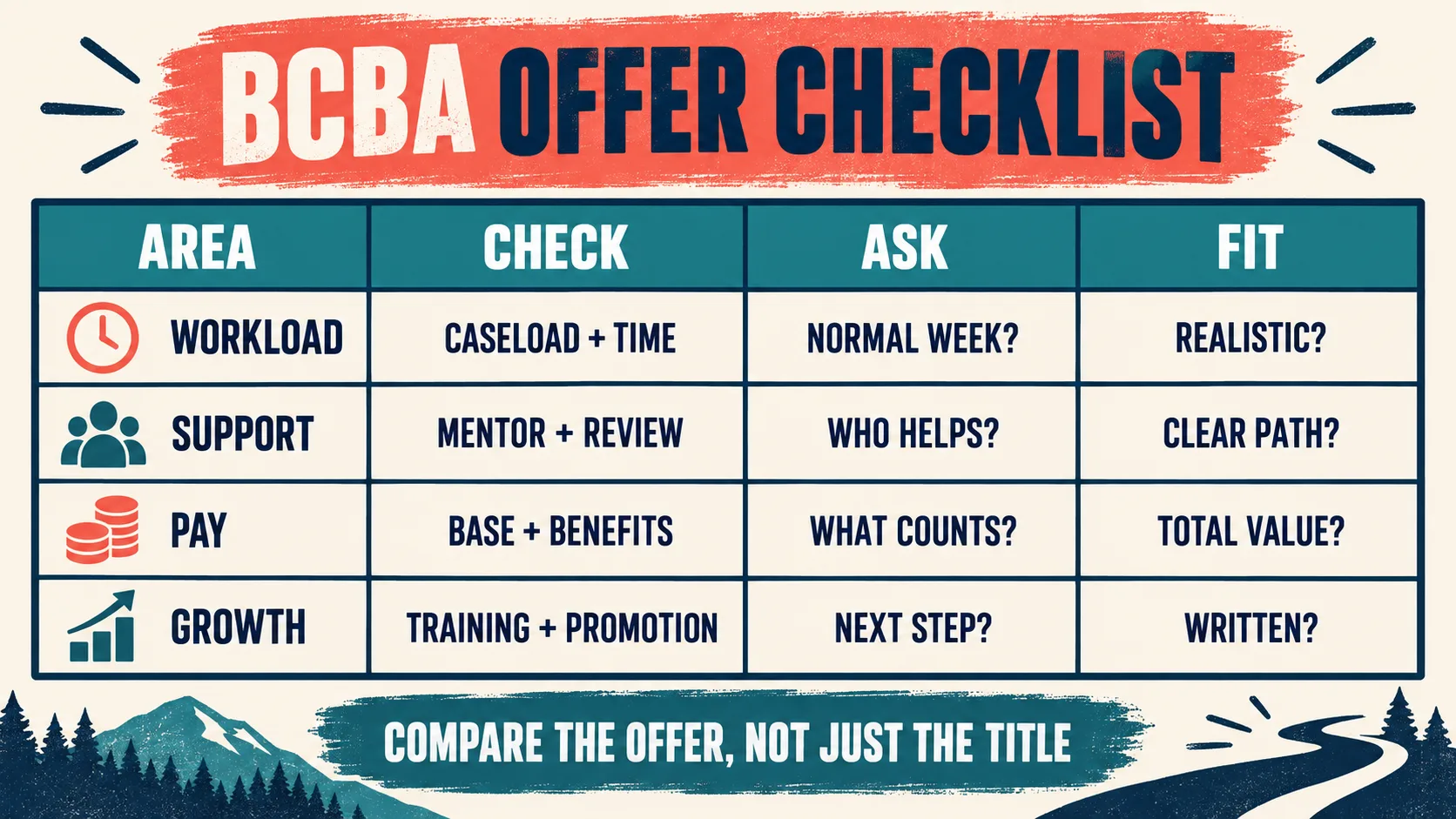
Make a side-by-side scorecard using the factors that matter to your practice. Rate each offer for clinical fit, population and setting, caseload realism, supervision, documentation time, schedule control, compensation, benefits, travel, ethical culture, and long-term growth. Add a notes column for what the employer promised and whether that promise appears in the written offer.
Then separate preferences from non-negotiables. A preferred population can change; a missing license, unsafe escalation path, or impossible productivity target may be a deal breaker. If the job is your first BCBA role, give extra weight to structured mentorship and case complexity. If you are experienced, ask whether the role actually gives you the authority and resources implied by its senior title.
BCBA Jobs FAQ
Where should I search for BCBA jobs?
Use a combination of the employer’s career page, reputable job boards, professional networks, state or local behavior-analysis associations, and the BACB’s employer resources. Search by setting and population as well as by title. “BCBA,” “behavior analyst,” “clinical supervisor,” “school behavior analyst,” and “telehealth BCBA” can return different role families. Verify the opening on the employer’s own site before sharing sensitive information.
Can a BCBA work in any state after passing the exam?
Not necessarily. BACB certification and state licensure or registration are separate questions in jurisdictions that regulate behavior analysis. The employer, state board, payer, and current BACB materials should be checked for the role and location. Do not assume that an active certification alone satisfies every practice or billing requirement.
What is a good first BCBA job?
A good first role gives you a clearly defined caseload, a named clinical mentor, regular case review, realistic documentation expectations, and access to help when a case is outside your experience. The setting matters less than whether you can learn sound clinical reasoning while protecting client welfare and your own professional boundaries.
Key Takeaway
BCBA jobs should be compared by the work behind the title: credential and license expectations, caseload, clinical authority, supervision, data review, documentation time, compensation, travel, and ethical support. Read the posting carefully, ask for concrete examples, and compare the written offer with the day-to-day reality described in the interview. If you are preparing for the analyst concepts that appear in interviews and practice, you can also use the site’s free BCBA mock exam for structured study. For targeted review, use our bcba jobs practice questions to apply the concept in exam-style scenarios.
Quick Review Checklist
Use this final checklist to turn bcba jobs into exam-ready reasoning. The goal is not to memorize a label in isolation; it is to identify the relevant evidence and explain why the best answer fits the scenario. Key ideas to review:
- State the central definition or decision point for bcba jobs in your own words.
- Identify the detail that makes bcba jobs different from its closest related ABA term.
- Separate the observable facts in a scenario from assumptions that are not supported by the facts.
- Write one example and one nonexample so you can recognize the concept in a new setting.
Exam application checks:
- Ask what the question is actually requesting before comparing the answer choices.
- Mark the antecedent, response, consequence, or other evidence that supports the selected answer.
- Look for a distractor that describes a related process but does not answer the specific question.
Final self-check:
- Explain how you would verify the interpretation with clear observations or data.
- Change one detail in the scenario and decide whether your answer should change.
- Give a one-sentence rationale that a supervisor or study partner could evaluate.
Take the Free BCBA Mock Exam
If you want a low-pressure way to check your recall, use the free practice resource below. Take the Free BCBA Mock Exam



