
Short answer: you may be able to become a BCBA with a master’s in counseling, but the counseling degree alone does not automatically satisfy the BACB’s behavior-analytic coursework, fieldwork, or examination requirements. If you searched “can i become a bcba with a masters in counseling,” the deciding questions are when you will apply, which BCBA eligibility pathway you can document, whether your graduate degree qualifies for that pathway, and how you will complete the required behavior-analytic education and supervised experience.
Table of Contents
- Can I Become a BCBA With a Masters in Counseling?
- Which Parts of the Counseling Degree Transfer?
- What Is the Current Route Before January 1, 2027?
- What Changes for Counseling Master’s Holders in 2027?
- How Do You Check Whether Counseling Courses Count?
- Is a Post-Master’s ABA Certificate Enough?
- Does a Counseling Practicum Count as BCBA Fieldwork?
- Which Counseling Backgrounds Can Be Useful?
- How Should You Map a Counseling Master’s to the BCBA Route?
- What Costs Should You Budget?
- What Mistakes Do Counseling-to-BCBA Candidates Make?
- What Is the Best Decision Before You Enroll?
- Counseling Master’s to BCBA FAQ
- Do I need a second master’s degree in ABA?
- Is a counseling degree the same as a psychology degree for BCBA eligibility?
- Can I work as an RBT while completing the bridge?
- Key Takeaway
- Take the Free BCBA Mock Exam
This is a common career-change question because counseling and behavior analysis both involve assessment, communication, and helping relationships. They are still separate professional routes. Treat your counseling degree as one part of the record, then audit the remaining BCBA requirements against the current BACB handbook and the official 2027 transition page.
Can I Become a BCBA With a Masters in Counseling?
Possibly, especially when your application can use a pathway that accepts a qualifying graduate degree plus behavior-analytic coursework and supervised fieldwork. A counseling master’s may meet the graduate-degree portion, but the degree title does not prove that you completed the required ABA content. A counseling curriculum might include one behavior course, several related courses, or no coursework that can be documented as behavior analytic.
Do not ask only whether counseling is a “related field.” Ask what evidence the BACB will require for your application date. You may need official transcripts, a program contact or attestation for behavior-analytic coursework, fieldwork verification forms, an active supervisor relationship, and an examination authorization. The answer belongs to the current BACB rules and your individual records, not to a general statement from a school advertisement.
Which Parts of the Counseling Degree Transfer?
Separate the question into four parts: the degree, the ABA coursework, the fieldwork, and the exam. Your counseling master’s can be relevant to the degree question while leaving the other three questions open.
| Requirement | What a counseling master’s may provide | What you still need to verify |
|---|---|---|
| Graduate degree | A completed master’s from a qualifying institution | Whether the degree satisfies the pathway and application-date rules |
| Behavior-analytic coursework | Possibly an introductory behavior or learning course | Every required content area, hours or credits, sequencing, and attestation |
| Supervised fieldwork | Counseling practicum may provide useful experience but is not automatically ABA fieldwork | Qualified BCBA supervision, contract, activities, monthly records, and final verification |
| Examination | Counseling exam preparation is not BCBA exam preparation | BACB application approval and preparation for the applicable BCBA exam |
This separation prevents a costly assumption: a counseling practicum can be valuable for counseling licensure and still fail to count as BCBA fieldwork if it does not meet the behavior-analytic requirements.
What Is the Current Route Before January 1, 2027?
For an application reviewed under the current requirements, start with the BCBA Handbook and identify the pathway you intend to use. Pathway 2 has historically allowed a qualifying graduate degree in any field together with specified behavior-analytic coursework, supervised fieldwork, and the examination. That description is not permission to infer that any counseling course or practicum counts. Your coursework and fieldwork still need to meet the applicable documentation rules.
If you hope to be reviewed under the current requirements, the BACB states that a complete application, including payment and required documents, must be received by December 31, 2026. A plan to finish “soon” is not the same as a complete application. Confirm the date and evidence requirements directly on the current BACB transition resources before making an expensive enrollment decision.
What Changes for Counseling Master’s Holders in 2027?
The BACB’s official 2027 BCBA Requirements page describes two eligibility pathways beginning January 1, 2027. Pathway 1 is tied to a master’s degree or higher from an APBA-accredited program or an ABAI-accredited or recognized behavior-analysis degree program. Pathway 2 combines a graduate degree, behavior-analytic coursework, practical fieldwork, and the examination.
That means the counseling degree question becomes more time-sensitive. A counseling master’s may fit the degree component of a Pathway 2 plan, but you must verify the behavior-analytic coursework and fieldwork requirements that apply in 2027. The official page also describes later changes, including the planned discontinuation of Pathway 2 in 2032. A student planning a multi-year bridge should look beyond the next application date. Use the current BCBA Handbook for the detailed rules. The transition summary is useful for orientation, but it does not replace the handbook sections on degree, coursework, fieldwork, application, and examination.
How Do You Check Whether Counseling Courses Count?
Collect the official transcript, course catalog, syllabi, credit or instructional-hour information, learning objectives, and the institution’s current Pathway 2 contact information if applicable. Then compare the evidence to the BACB coursework requirements. Course titles can be misleading. A counseling course called “behavior modification” may not cover the same content as a course in behavior assessment, intervention, measurement, ethics, or organizational behavior management. Ask a program or Pathway 2 contact to answer in writing:
- Which of my completed courses count toward each required behavior-analytic content area?
- Which courses must I take before the program can submit an attestation?
- Are the courses offered in the sequence and location I need?
- Will the program support an application date before or after the 2027 transition?
- Does the coursework plan leave fieldwork and examination requirements separate?
Keep the answer with your enrollment records. If a school will not identify the content areas or the person responsible for the attestation, treat that uncertainty as a decision risk.
Is a Post-Master’s ABA Certificate Enough?
A post-master’s ABA certificate can be one way to obtain behavior-analytic coursework, but it is not automatically a complete BCBA route. A certificate program may not provide a qualifying graduate degree, supervised fieldwork, application support, or examination eligibility by itself. A counseling master’s can supply the graduate-degree component while a separate ABA program supplies coursework, but the two programs must fit the same application timeline and documentation path.
Compare bridge programs by evidence rather than marketing language. Ask whether the institution has an active program contact, whether it can attest to the coursework for your application date, how fieldwork is arranged, whether your counseling degree is accepted for the intended route, and what happens if the rules change before you apply.
Does a Counseling Practicum Count as BCBA Fieldwork?
Not automatically. BCBA fieldwork must be behavior analytic and must be supervised, documented, and verified under the applicable BACB rules. A counseling practicum may involve client contact, case notes, assessment, and supervision, but those similarities do not establish that the activities meet BCBA fieldwork requirements.
Before counting an hour, confirm the supervision contract, supervisor qualifications, activity type, documentation method, and relationship to the behavior-analytic requirements. The BACB’s fieldwork resources warn candidates to double-check whether simulated or unrelated activities qualify. Save monthly records and resolve questions while the experience is current rather than after a supervisor or employer is no longer available.
Which Counseling Backgrounds Can Be Useful?
Counseling experience can be an advantage when it improves collaboration, interviewing, caregiver communication, trauma-informed awareness, group facilitation, or rapport. Those strengths still need to be used within behavior-analytic scope and supported by ABA training. A candidate who can communicate clearly with families and interdisciplinary teams may be valuable, but the BCBA credential is not awarded for communication skill alone.
Be careful with role boundaries. BCBA certification does not make a person a licensed mental-health counselor, and a counseling license does not make a person a BCBA. List the credentials separately and practice only within the authority, training, and supervision that apply to each role.
How Should You Map a Counseling Master’s to the BCBA Route?
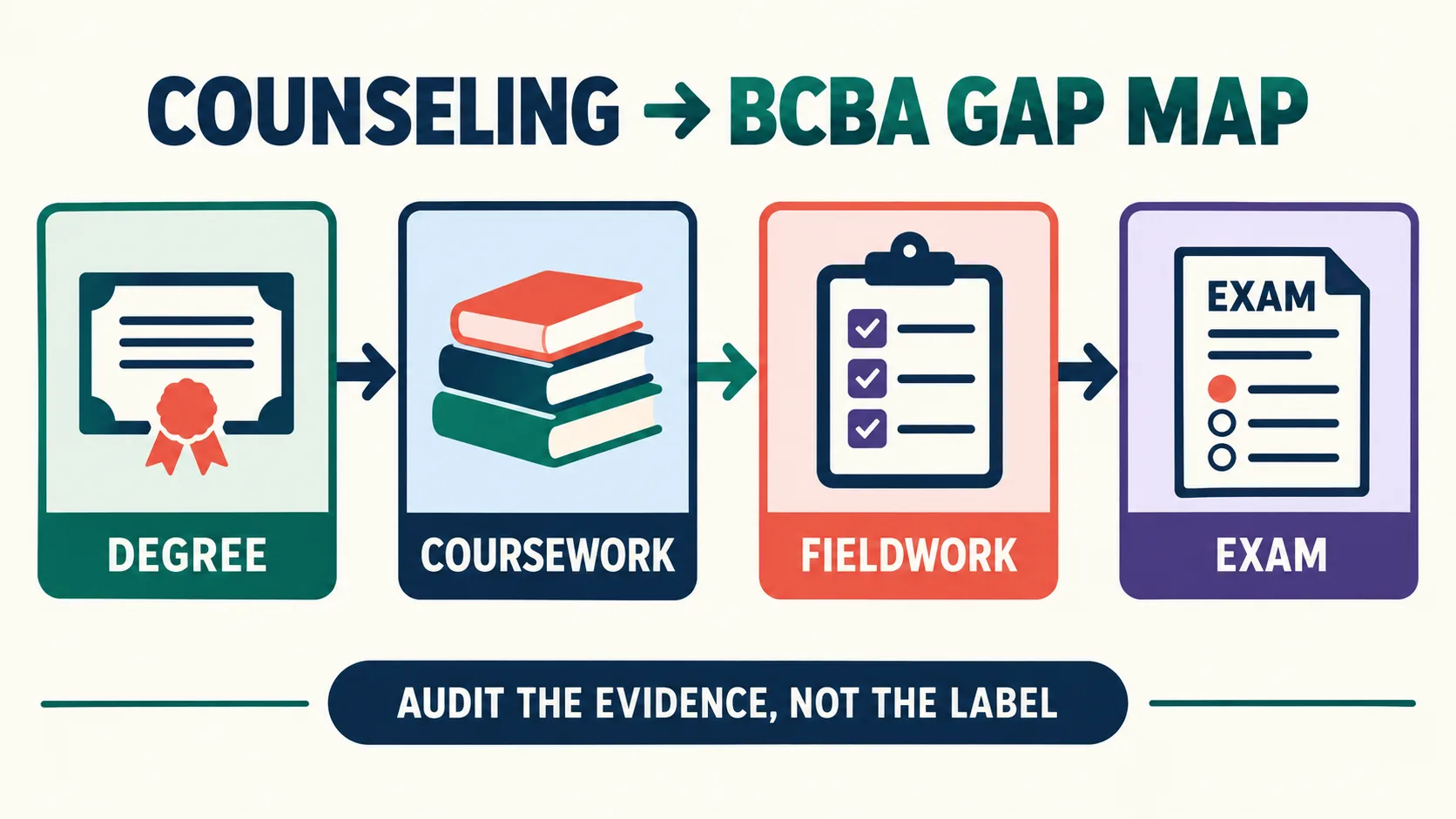
Build a personal gap map with five columns:
- Completed: degree, courses, experience, and credentials you can document now.
- Potentially transferable: courses or skills that need a program or BACB review.
- Missing: behavior-analytic content, fieldwork, or supervision not yet completed.
- Source: the handbook page, transcript, syllabus, contract, or official email that supports the item.
- Date: the application or transition date that determines which rule set applies.
This map is more useful than asking whether counseling is “accepted” in the abstract. It turns a broad career question into a file audit and shows you which answer you still need from a program contact or the BACB.
What Costs Should You Budget?
A counseling-to-BCBA bridge can cost more than a single new course. Budget for transcript evaluation, additional graduate coursework, tuition, books, technology, supervision or fieldwork support, background checks, application fees, examination fees, travel to an authorized testing site, and time away from work. Ask whether the program’s published tuition includes fieldwork support or whether practical supervision is separate.
Compare the cost of finishing the missing coursework with the cost of starting a new ABA degree. The cheapest route on paper may be slower or less certain if no program contact will attest to your record. A written pathway plan is part of the value you are buying.
What Mistakes Do Counseling-to-BCBA Candidates Make?
- Assuming a counseling master’s automatically meets ABA coursework requirements.
- Counting counseling practicum hours as BCBA fieldwork without a behavior-analytic supervision contract.
- Using an old VCS or forum explanation without checking the application-date rules.
- Confusing a graduate certificate with a qualifying graduate degree.
- Ignoring the 2027 transition and the longer-term Pathway 2 change.
- Listing counseling and BCBA credentials as if they grant the same scope of practice.
What Is the Best Decision Before You Enroll?
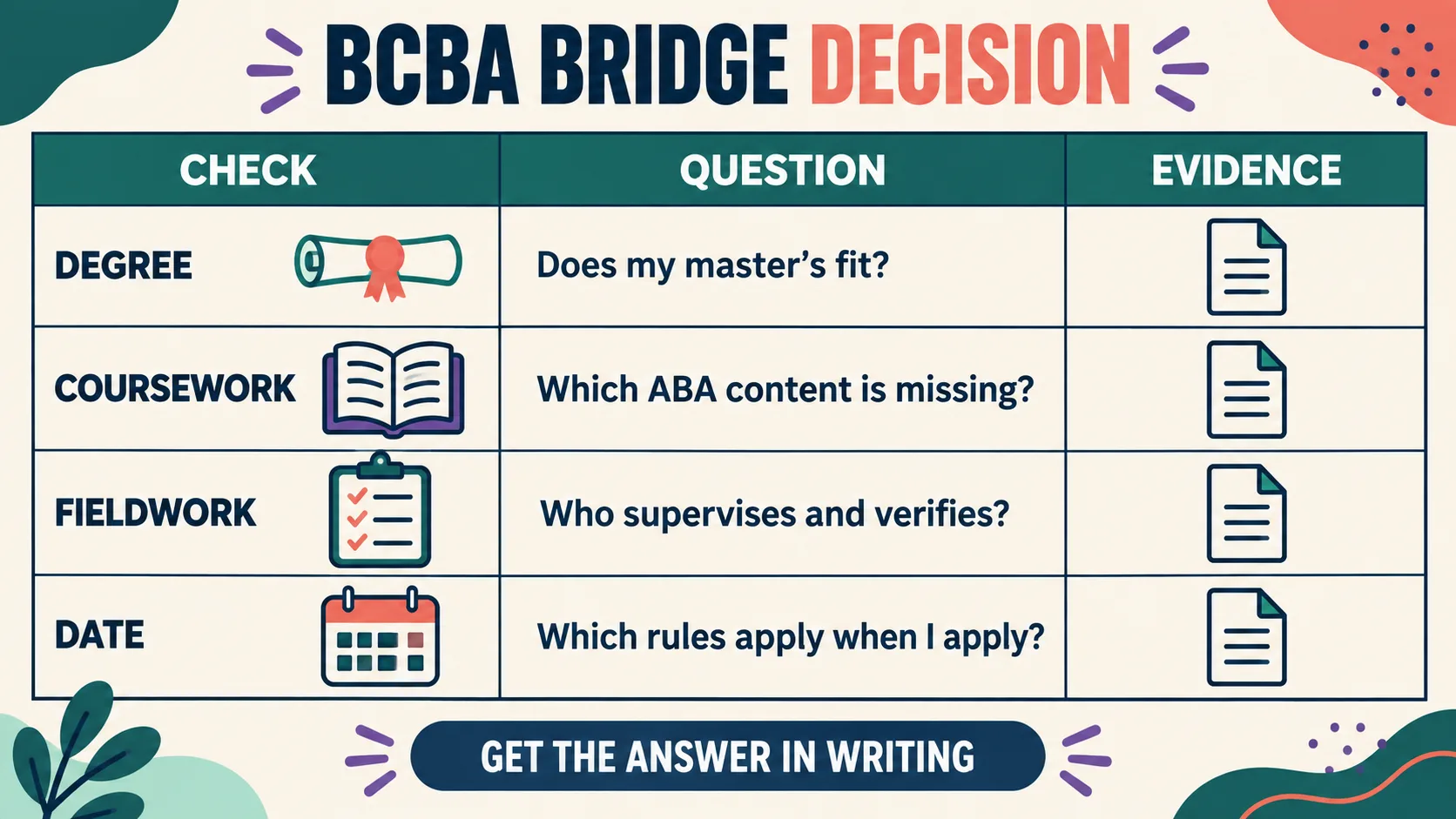
Do not enroll in a bridge program until you can answer these questions in writing:
- Which BCBA pathway will I use for the date I expect to apply?
- Does my counseling degree satisfy the degree component for that pathway?
- Who will confirm my behavior-analytic coursework and submit any required attestation?
- Where will I complete qualifying fieldwork, and who will supervise and verify it?
- What will change if I do not submit a complete application before the transition date?
- Which parts of the BCBA examination and application remain my responsibility?
Counseling Master’s to BCBA FAQ
Do I need a second master’s degree in ABA?
Not necessarily under every pathway and application date. A second master’s may be one option, but another route may combine your existing graduate degree with qualifying behavior-analytic coursework and fieldwork. The correct answer depends on the current BACB rules and whether a program can document your plan.
Is a counseling degree the same as a psychology degree for BCBA eligibility?
Do not assume the degree labels are interchangeable. The BACB evaluates the pathway and evidence that apply to your application. Compare the actual degree, coursework, accreditation or recognition, fieldwork, and attestation rather than relying on a major-name shortcut.
Can I work as an RBT while completing the bridge?
Many candidates work in ABA roles while completing education, but the job title alone does not make every hour qualifying BCBA fieldwork. Confirm the supervision contract, activity requirements, and documentation before counting the experience.
Key Takeaway
You may be able to become a BCBA with a master’s in counseling, but the counseling degree is the starting point for a gap analysis, not the finish line. Verify the application-date pathway, behavior-analytic coursework, fieldwork, supervision, examination, and 2027 transition directly against official BACB sources and written program answers. When your route is clear, the site’s Pathway 2 guide and free BCBA mock exam can support the coursework and exam-preparation side without replacing the handbook. For targeted review, use our can i become a bcba with practice questions to apply the concept in exam-style scenarios.
Take the Free BCBA Mock Exam
If you want a low-pressure way to check your recall, use the free practice resource below. Take the Free BCBA Mock Exam



