

Quick answer: a master’s in applied behavior analysis can be a strong route toward BCBA certification, but the degree title alone does not guarantee eligibility. If you are comparing masters in applied behavior analysis programs, confirm each program’s current relationship to the BACB eligibility pathway, behavior-analytic coursework, supervised fieldwork, degree-granting institution, examination preparation, total cost, and support for working students. An attractive curriculum can still leave you responsible for finding fieldwork, a qualified supervisor, or a separate attestation process.
Table of Contents
- What Is a Master’s in Applied Behavior Analysis?
- Does an ABA Master’s Make You Eligible for the BCBA Exam?
- What Is the Difference Between the Main BCBA Pathways?
- How Should You Compare Masters in Applied Behavior Analysis Programs?
- What Should the Curriculum Include?
- Is Fieldwork Included in an ABA Master’s Program?
- Is an Online ABA Master’s a Good Choice?
- How Should You Check the 2027 BCBA Changes?
- What Does an ABA Master’s Really Cost?
- What Should You Ask Before Applying?
- How Can You Check a Program Before Paying a Deposit?
- What Makes an ABA Master’s a Good Fit?
- Master’s in Applied Behavior Analysis FAQ
- Do I need a master’s specifically in ABA to become a BCBA?
- Can I complete an ABA master’s completely online?
- Is accreditation enough to prove a program is right for BCBA certification?
- Key Takeaway
- Quick Review Checklist
- Take the Free BCBA Mock Exam
The right question is not simply “Which ABA master’s program is best?” It is “Which program gives me a clear, verifiable route from graduate study to the requirements that apply when I plan to apply?” That question matters even more during the 2026–2027 transition, when program pages and older comparison articles may describe different terminology or processes.
What Is a Master’s in Applied Behavior Analysis?
A master’s in applied behavior analysis is a graduate degree focused on the science and practice of behavior analysis. Coursework may cover concepts and principles, measurement, assessment, intervention, research methods, ethics, organizational behavior management, and professional practice. Programs can lead to an M.S., M.A., M.Ed., or another graduate degree title, and the title does not by itself tell you whether the program is designed for BCBA eligibility.
Programs also differ in purpose. Some are built primarily for clinical practice and supervised experience. Some emphasize research or a thesis. Some are housed in special education, psychology, or human-services departments and add an ABA concentration. None of those formats is automatically good or bad. The practical issue is whether the curriculum, fieldwork, supervision, and documentation fit your credential goal and your state or employer context.
Does an ABA Master’s Make You Eligible for the BCBA Exam?
Not automatically. The BACB BCBA Handbook describes multiple eligibility pathways. Each pathway involves a qualifying degree or education route, behavior-analytic content, supervised fieldwork, and a passing examination. A master’s program may include some of those elements, all of them, or only the academic portion.
Ask the program to identify the exact pathway it supports and to explain which requirements are built into tuition. “BCBA track,” “exam preparation,” and “ABA concentration” are useful marketing phrases, but they are not a substitute for a current eligibility review. Request the program’s official curriculum, fieldwork plan, and explanation of who verifies coursework or attests to the requirements.
You should also separate certification from licensure. A BCBA certification is issued by the BACB; a state may separately regulate the practice of behavior analysis, use a licensed behavior analyst title, or apply rules to billing and service delivery. The program should tell you where to check state requirements, but you remain responsible for verifying the current rules where you plan to practice.
What Is the Difference Between the Main BCBA Pathways?
The pathway names and details can change, so use the current handbook and official requirements page as the controlling sources. At a high level, prospective students commonly compare a graduate degree from a qualifying behavior-analysis program with a graduate degree plus specified behavior-analytic coursework and an attestation or other documentation route.
| Question | Degree-centered route | Coursework route |
|---|---|---|
| What must be verified? | The degree program’s current qualifying status and included behavior-analytic content | The graduate degree, required content, program contact, and documentation or attestation process |
| Is fieldwork automatically included? | Sometimes, but confirm the hours, supervision, and recordkeeping | Often not; confirm whether you must arrange a separate site and supervisor |
| What is the biggest risk? | Assuming a school’s marketing language is still current | Finishing courses without complete, acceptable documentation |
This is a planning aid, not a replacement for the current BACB handbook. The program may use different language or combine elements. What matters is a written answer to the question: “After I complete this program, what exactly will I still need to document before I can apply?”
How Should You Compare Masters in Applied Behavior Analysis Programs?
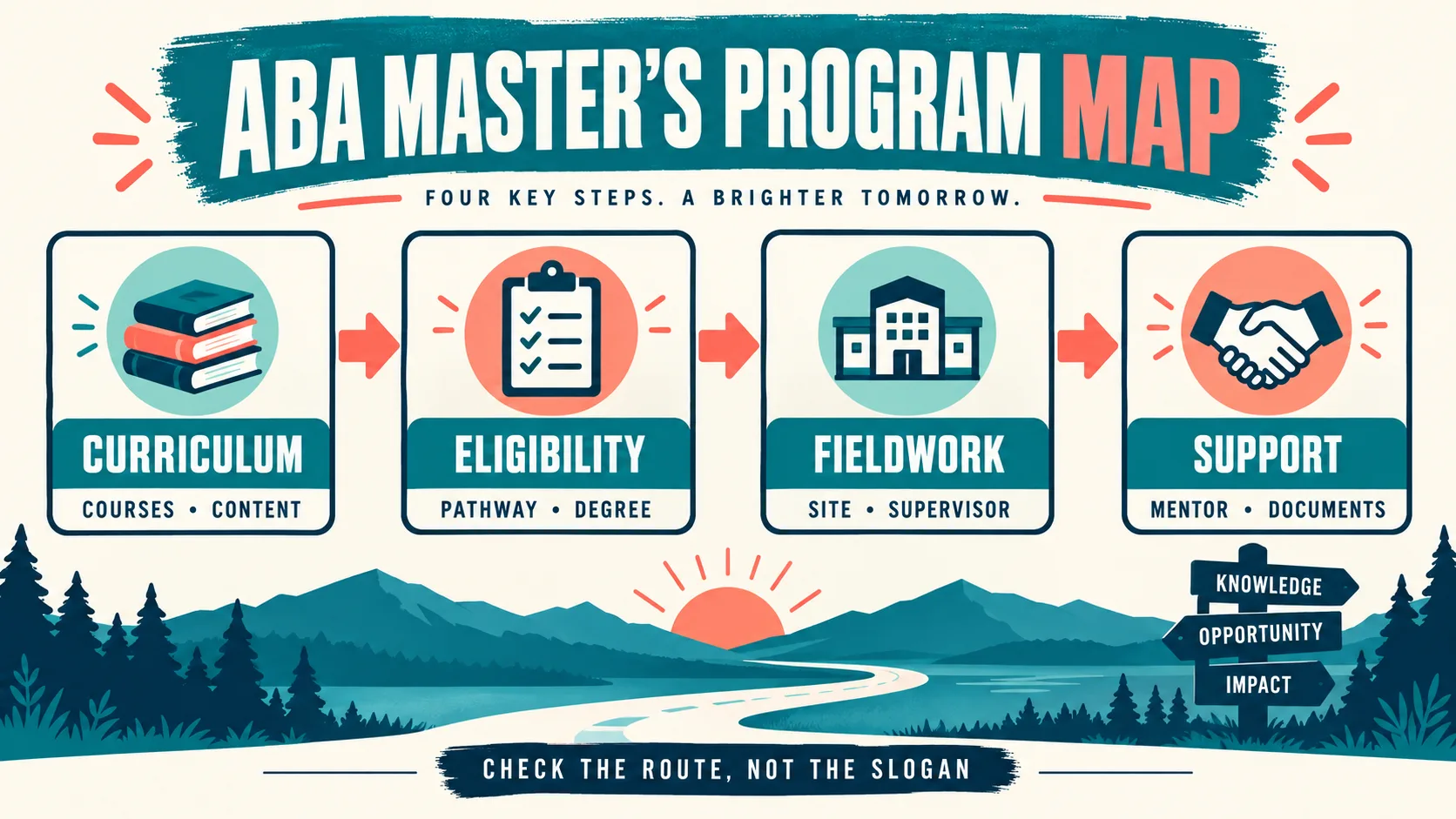
Compare programs across four connected areas: curriculum, eligibility, fieldwork, and support. A program with an impressive course list can still be a poor fit if its fieldwork arrangement is vague. A low-cost online program can still be expensive if you need to add unpaid travel, separate supervision, or extra coursework later.
Start by downloading the current catalog and degree map. Identify every behavior-analytic course, the number of credits or instructional hours, assessment and intervention content, ethics, research, and any capstone or thesis. Then ask whether those courses are the ones the current pathway recognizes—not merely courses that sound similar to a student.
Next, ask how the program supports practical experience. Is a practicum required? Does the school arrange sites, approve sites, employ supervisors, or simply provide a list of suggestions? Who signs the documentation? How are changes in employment, supervisor, location, or client population handled? These details may determine whether the degree remains on schedule.
What Should the Curriculum Include?
A solid curriculum should connect foundational concepts to professional decision making. Look for clear coverage of measurement and visual analysis, behavior assessment, skill-acquisition and behavior-reduction procedures, intervention selection, generalization, ethics, research design, and communication with clients and teams. Course titles vary, so read the descriptions and learning outcomes instead of counting only how many classes contain the letters ABA.
Ask whether assignments require students to interpret data, define behavior, evaluate an intervention, consider social validity, and explain ethical limits. A program can prepare you for a test while giving you too little practice with the messy judgment required in real cases. Conversely, a research-heavy program may be excellent for graduate study but require you to plan additional clinical experience.
Is Fieldwork Included in an ABA Master’s Program?
Sometimes. Some programs embed practicum or supervised fieldwork; others leave the student to find an employer and supervisor. “Hands-on experience available” is not the same as “fieldwork required, scheduled, supervised, and documented as part of the degree.” Ask for the exact number and type of hours, who qualifies as a supervisor, how observations and feedback are recorded, and what happens if a site cannot provide enough opportunities.
Fieldwork quality matters as much as the number. You need meaningful exposure to assessment, intervention, data review, caregiver or team collaboration, and ethical decision making within your scope. If a role gives you only repetitive implementation tasks, ask how the supervisor will create opportunities to develop analyst-level competencies and how those opportunities will be evaluated.
Is an Online ABA Master’s a Good Choice?
Online delivery can work well for students who need schedule flexibility, but online coursework does not make fieldwork virtual by default. A student may attend lectures online while completing supervised practical experience at a local clinic, school, home-based provider, or other approved setting. Confirm where required observations occur and whether your location is supported.
Evaluate the online program’s teaching model. Are classes live, asynchronous, or mixed? How quickly do instructors respond? Can you access office hours, data-analysis practice, role-play, research databases, and disability or accessibility services? Ask whether students receive help finding fieldwork and whether the program has enough faculty or supervisors to respond when a case raises a complicated issue.
Read the site’s separate guide to BCBA courses online if your main question is delivery format. This article is about evaluating the larger master’s decision: degree, eligibility, fieldwork, support, cost, and future options.
How Should You Check the 2027 BCBA Changes?
Students enrolling during the transition should read the official 2027 BCBA Requirements page and the current handbook, then ask the program which rules it is using for your expected application date. Do not rely on a forum post or an older program page that still uses retired terminology. Ask the admissions office to answer three questions in writing:
- Which eligibility pathway does this program support for a student applying after the transition date?
- Which coursework, fieldwork, and documentation requirements are included in the degree and which are outside it?
- Who will confirm that my completed record matches the current BACB requirements before I apply?
Because requirements and program operations can change, save the catalog, written answers, course syllabi, fieldwork agreement, and any attestation instructions that applied when you enrolled. These records help you identify what the school promised and what you still need to verify later.
What Does an ABA Master’s Really Cost?
Tuition is only one line. Add application fees, deposits, technology, textbooks, travel, background checks, liability coverage, practicum costs, supervision fees, examination preparation, licensing fees, and the income you may lose if the required schedule reduces your work hours. Ask whether tuition is charged by credit, term, or a flat program amount and whether fieldwork is billed separately.
Compare time as well as dollars. A shorter program is not automatically cheaper if it creates an intense course load, requires unpaid practical hours, or makes it difficult to maintain employment. A longer part-time program may be more sustainable, but confirm that your fieldwork and coursework remain within the relevant deadlines and that the program will continue to support students through completion.
What Should You Ask Before Applying?
Send the program a focused list of questions and keep the answers:
- What is the exact graduate degree awarded, and which institution grants it?
- Which current BACB pathway does the program map to, and where is that mapping documented?
- Are all required behavior-analytic courses included, or will I need a separate course sequence?
- Does the program provide fieldwork sites and supervisors, or must students arrange them independently?
- How are observations, supervision, feedback, and fieldwork records maintained?
- What happens if I move, change employers, lose a fieldwork site, or need a schedule adjustment?
- What are the total estimated costs beyond tuition?
- What support is available for the BCBA application, exam planning, and state-specific questions?
How Can You Check a Program Before Paying a Deposit?
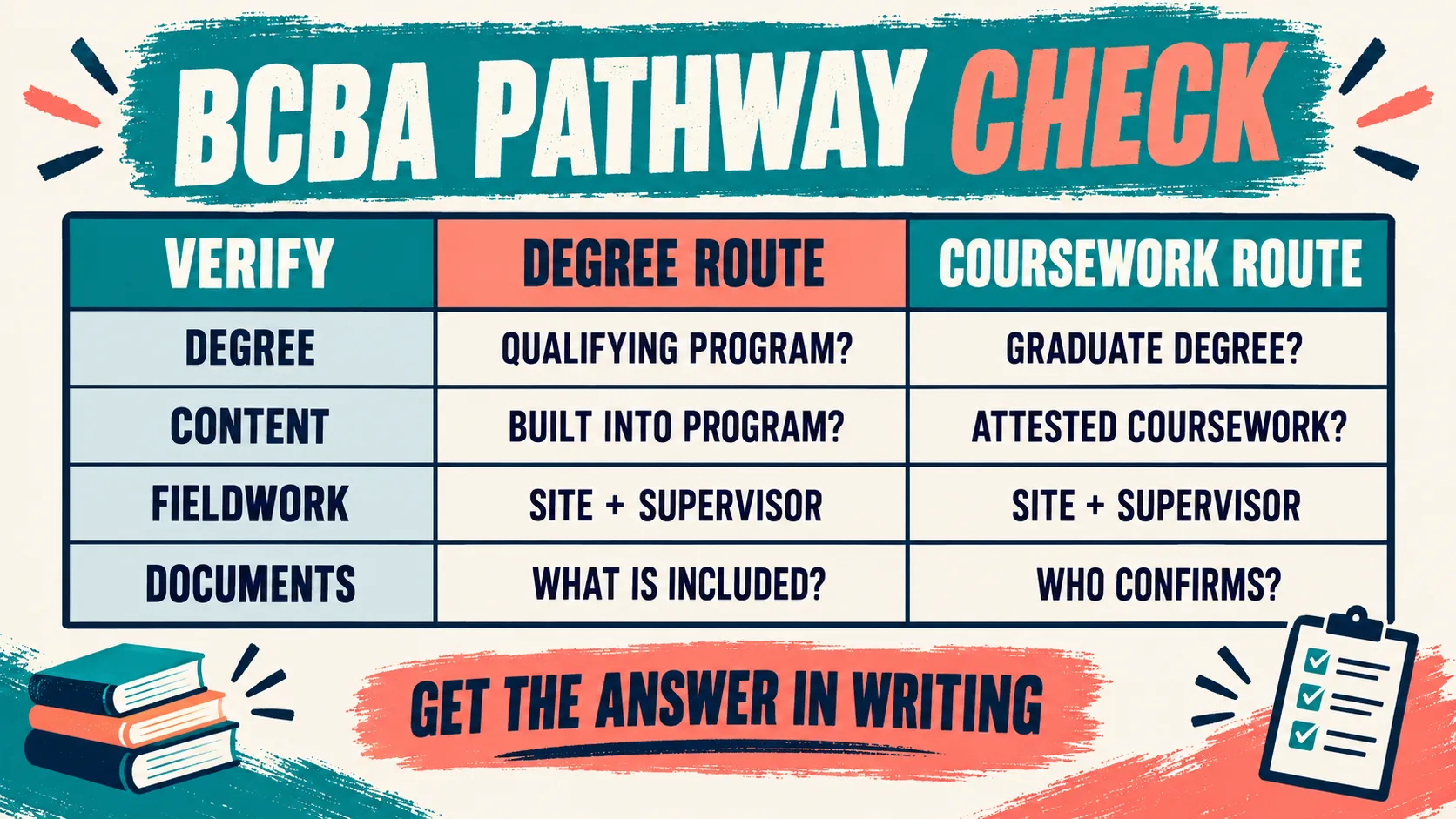
Use the matrix as a pre-enrollment checklist. A trustworthy program should be able to identify the evidence behind its answers: a catalog, handbook, course map, fieldwork agreement, supervisor policy, or written pathway explanation. If an admissions representative promises that a program “qualifies you” but cannot show how, pause before paying a nonrefundable deposit.
What Makes an ABA Master’s a Good Fit?
A good fit aligns with your intended role, learning style, schedule, location, finances, and tolerance for practical uncertainty. If you want clinical practice, prioritize fieldwork quality and supervision. If you want research, inspect faculty mentorship and thesis options. If you are changing careers while working full time, examine course pacing, practicum scheduling, and support for locating an approved site.
Also look for the program’s professional culture. Does it discuss client dignity, assent, cultural responsiveness, scope of competence, data-based decision making, and collaboration? The vocabulary on a brochure is not proof of quality, but silence about ethics and client welfare is worth asking about.
Master’s in Applied Behavior Analysis FAQ
Do I need a master’s specifically in ABA to become a BCBA?
The answer depends on the eligibility pathway and the rules in effect when you apply. The current BACB materials describe pathways that involve a qualifying graduate degree, behavior-analytic content, fieldwork, and examination requirements. Do not infer eligibility from the degree title alone; verify your specific record against the current handbook.
Can I complete an ABA master’s completely online?
Some academic coursework may be online, but practical fieldwork, supervision, observations, and local practice requirements may still require in-person arrangements. Ask the program to distinguish online classes from fieldwork and to explain how students in your state complete the practical requirements.
Is accreditation enough to prove a program is right for BCBA certification?
No single label answers every question. Check the program’s current status, the degree it awards, the pathway it supports, the content and fieldwork documentation, and the rules that apply to your application date. Use official BACB materials and get a written answer from the program before enrolling.
Key Takeaway
A master’s in applied behavior analysis is a major investment, so evaluate the route rather than the slogan. Verify the degree, current BCBA pathway, coursework, fieldwork, supervision, 2027 transition guidance, total cost, and support before you commit. When you are ready to connect graduate study with analyst-level exam practice, the site’s free BCBA mock exam can provide structured practice without replacing the official handbook or program advising. For targeted review, use our masters in applied behavior analysis practice questions to apply the concept in exam-style scenarios.
Quick Review Checklist
Use this final checklist to turn masters in applied behavior analysis into exam-ready reasoning. The goal is not to memorize a label in isolation; it is to identify the relevant evidence and explain why the best answer fits the scenario. Key ideas to review:
- State the central definition or decision point for masters in applied behavior analysis in your own words.
- Identify the detail that makes masters in applied behavior analysis different from its closest related ABA term.
- Separate the observable facts in a scenario from assumptions that are not supported by the facts.
- Write one example and one nonexample so you can recognize the concept in a new setting.
Exam application checks:
- Ask what the question is actually requesting before comparing the answer choices.
- Mark the antecedent, response, consequence, or other evidence that supports the selected answer.
- Look for a distractor that describes a related process but does not answer the specific question.
Final self-check:
- Explain how you would verify the interpretation with clear observations or data.
- Change one detail in the scenario and decide whether your answer should change.
- Give a one-sentence rationale that a supervisor or study partner could evaluate.
Take the Free BCBA Mock Exam
If you want a low-pressure way to check your recall, use the free practice resource below. Take the Free BCBA Mock Exam



