
A practical 12-month planning system for active BCBAs who want professional growth to become visible, useful, and reviewable. A BCBA professional development plan should do more than collect course certificates. It should help you decide what to learn, why the learning matters to your current role, how you will practice it, and what evidence will show that the work changed your performance. That is especially important when the official maintenance rules, ethics guidance, and 2027 transition materials are changing at different speeds.
Table of Contents
- What should BCBA professional development accomplish?
- Start with the official maintenance constraints
- The 12-month BCBA development loop
- Plan for evidence, not just hours
- Build ethics and supervision into the plan
- How to protect the plan during the 2027 transition
- Common BCBA professional-development mistakes
- Use a mock exam to find study gaps—not to claim CE
- BCBA professional development plan FAQ
- The bottom line
- Official sources to recheck
- Quick Review Checklist
- Take the Free BCBA Mock Exam
This guide gives active BCBAs a one-year planning loop. It is an editorial planning aid, not a BACB form, approval, CE-provider directory, or legal advice. Use the current BACB handbook and requirements pages to verify what counts in your cycle.
Scope note: BACB terminology matters. BCBAs generally plan and document continuing education (CE/CEUs), while RBT professional development uses a separate PDU framework. Do not assume that an RBT professional-development event earns BCBA CEUs, or that a BCBA study activity automatically counts as continuing education.
What should BCBA professional development accomplish?
Professional development is the process of becoming more capable in the work you already do and the work you expect to do next. For a BCBA, that can include improving assessment reasoning, supervision, caregiver collaboration, data interpretation, cultural responsiveness, documentation, or the implementation of a specific behavior-change procedure. A good plan connects the topic to a real decision instead of treating every course as interchangeable.
| Who is planning? | Relevant planning question | Do not confuse it with |
|---|---|---|
| Active BCBA | Which CE, ethics, supervision, and skill activities improve current practice and can be documented? | RBT PDUs or a generic career-development checklist. |
| BCBA supervisor | Which learning changes the quality of feedback, observation, and decisions made with supervisees? | A supervision course certificate by itself. |
| BCBA candidate | Which concepts and decision skills need deliberate practice before the exam? | Maintenance CE requirements for an already certified BCBA. |
The first row is the main audience for this page. If you are still pursuing certification, use the current BCBA certification roadmap instead of treating a maintenance plan as an eligibility plan.
Start with the official maintenance constraints
Before choosing topics, write down the requirements that control your current cycle. The BACB’s 2027 BCBA Requirements document says that maintaining certification includes ongoing continuing education, ethics and self-reporting responsibilities, and a recertification application every two years. It also states that the continuing-education requirement is 32 CEUs per two-year cycle, including 4 ethics CEUs and 4 supervision CEUs for supervisors under the 2027 maintenance requirements. Verify the version and your own cycle dates before using those figures as a checklist.
These numbers are constraints, not a complete professional-development strategy. A CE event may satisfy documentation requirements while doing little to improve your next clinical or supervisory decision, so track compliance and improvement as separate layers.
The 12-month BCBA development loop
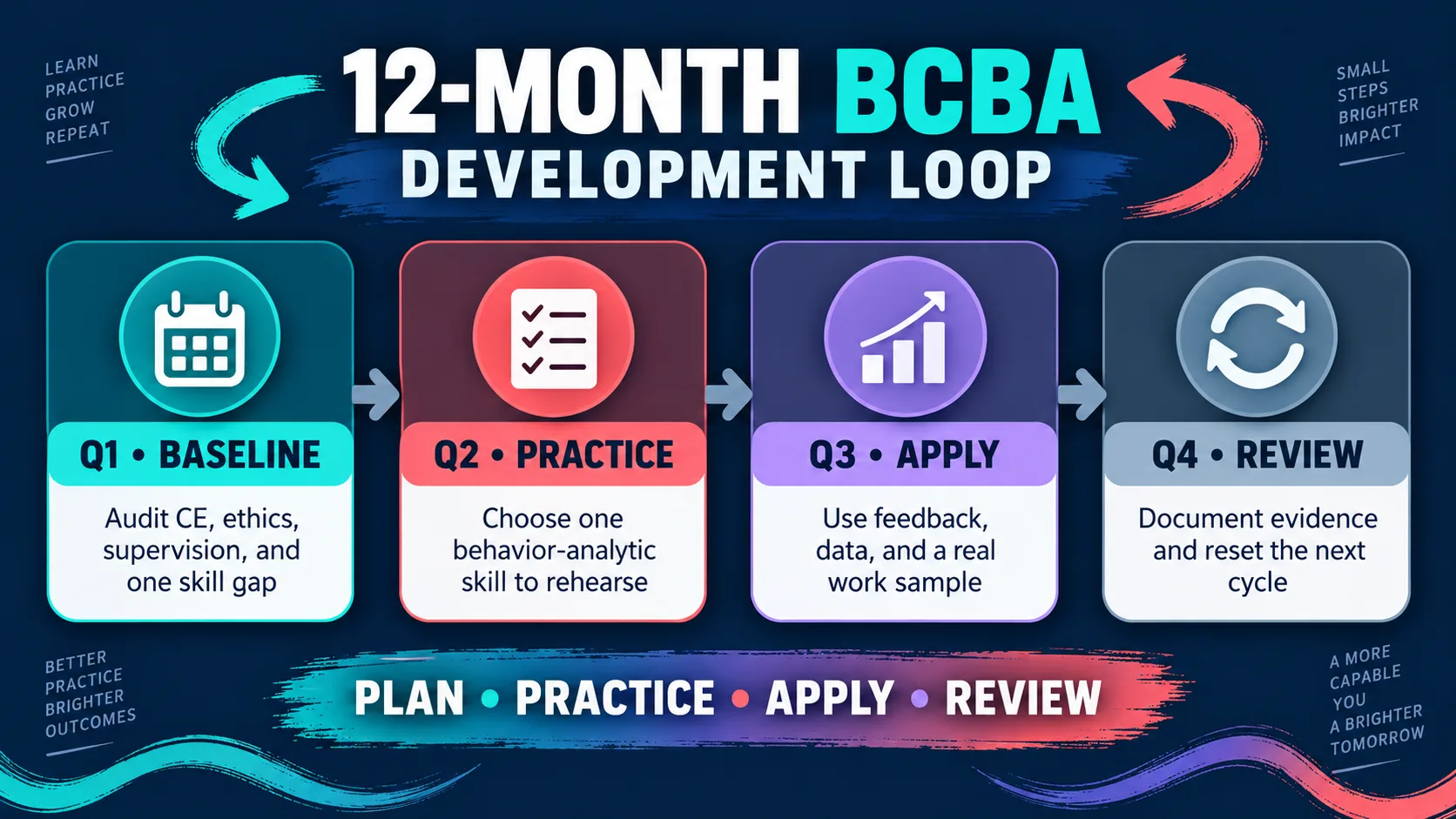
The simplest reliable structure is four quarters. Each quarter has a different job: establish a baseline, practice one selected skill, apply it to a real work sample, and review the evidence before resetting the next cycle. You do not need to wait until January; start with the month you are in and label the dates clearly.
Quarter 1: establish a baseline: Begin with a short inventory of your role, active cases, supervision responsibilities, recent feedback, and current recertification record. Look for friction rather than choosing a fashionable topic. Examples include inconsistent operational definitions, weak data interpretation, supervision meetings that end without a next action, caregiver coaching that does not generalize, or documentation that is technically complete but difficult for the team to use.
Choose no more than one primary skill gap and one supporting knowledge area. A narrow target makes the rest of the year measurable. For example, “improve supervision” is too broad; “give behavior-specific feedback and document a next rehearsal step in every supervision meeting” is a better development target.
Quarter 2: practice deliberately: Convert the skill gap into a rehearsal routine. Read or watch one authoritative resource, write a short decision rule, model the skill, rehearse it, and ask for feedback. If the topic is ethical decision-making, practice identifying the affected parties, the relevant code or policy, the least harmful next step, and the documentation boundary. If the topic is graph interpretation, practice explaining the level, trend, variability, and decision rule from several graphs without jumping to a treatment change. Record the date, source, practice task, feedback, and next adjustment. The purpose is not to create a diary; it is to make the learning observable enough that you can decide whether it helped.
Quarter 3: apply the skill to a real work sample: Use the selected skill in a real setting that is appropriate, authorized, and consistent with privacy and supervision requirements. A work sample could be a de-identified data display, a supervision agenda, a caregiver-training rehearsal, a treatment-integrity checklist, or an ethics consultation note. Do not include protected information in a personal learning file unless your organization’s policies explicitly allow it.
Ask a colleague or supervisor to review the sample against a short rubric. The question is not “Did I attend the event?” It is “Can another qualified person see the behavior or decision that improved?” If the answer is no, refine the target or the evidence method.
Quarter 4: review and reset: At the end of the twelve months, reconcile your CE documentation, ethics and supervision categories, practice evidence, feedback, and unresolved gaps. Keep compliance review separate from performance reflection. You may have completed the required credits and still need another cycle of practice in a high-impact skill. Conversely, a powerful work improvement may not be a CE event; do not label it as credit unless the provider and current BACB rules support that classification.
Plan for evidence, not just hours
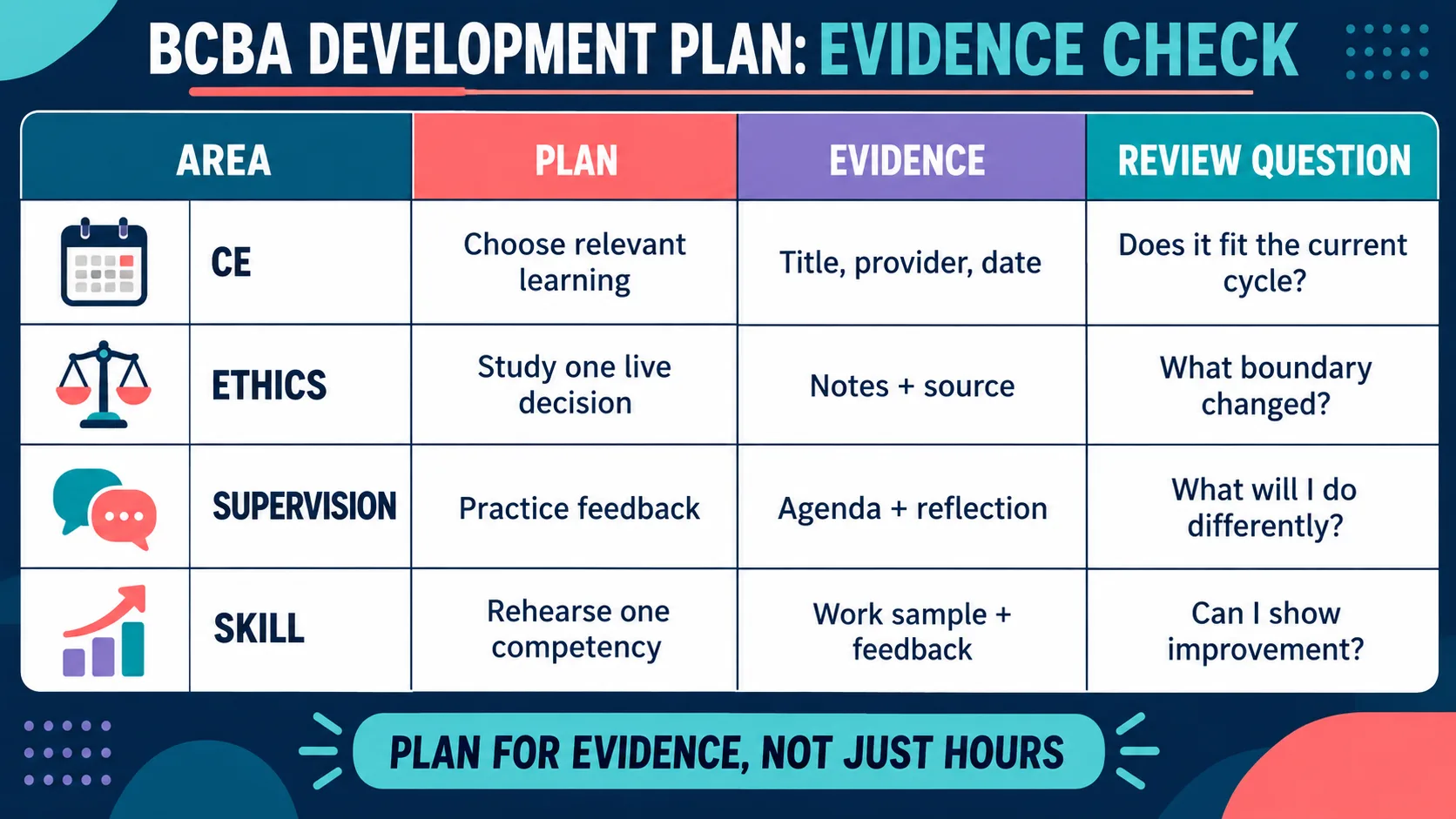
A professional-development plan becomes useful when every activity has an evidence question. Use a simple four-part record: the activity, the reason it was selected, the artifact or observation that shows application, and the review question that determines the next step.
| Area | Plan | Evidence to keep | Review question |
|---|---|---|---|
| CE | Select learning tied to the role and current cycle. | Title, provider, date, category, and completion record. | Does it fit the current rules and the problem I chose? |
| Ethics | Study one live decision or realistic vignette. | De-identified notes, source, options considered, and rationale. | What boundary or risk did the analysis clarify? |
| Supervision | Rehearse one feedback or observation routine. | Agenda, feedback notes, and the next rehearsal step. | What will I do differently in the next meeting? |
| Skill | Practice one competency until the criterion is visible. | Work sample, rubric, feedback, and revision. | Can I show improvement without exposing client information? |
Store official certificates and provider records according to the BACB and your organization’s retention expectations. Keep personal improvement notes separate from official submissions, respect privacy, and use de-identified work samples.
Build ethics and supervision into the plan
Ethics should not be a once-a-cycle box that you check at the end. Put one ethics review point into each quarter. Use the current BACB Ethics Code, relevant organizational policy, and appropriate consultation. Practice asking: Who is affected? What information is missing? Which role or boundary is in tension? What is the least risky next step? What should be documented, and who needs to be consulted?
If you supervise, treat supervision as a development system rather than a separate administrative obligation. Choose a feedback target, define what competent performance looks like, observe or review a sample, and document the next opportunity to rehearse. The BACB’s supervision resources and the current BCBA Handbook control the formal requirements; this page only gives you a planning structure for turning those requirements into repeated practice.
How to protect the plan during the 2027 transition
The BACB lists January 1, 2027, as the effective date for revisions to BCBA eligibility and maintenance requirements. The official transition materials should control any question about which requirements apply to a particular application or recertification situation. Do not copy a number from an old blog post into a new spreadsheet without recording the source date.
| Checkpoint | What to verify | Safe planning action |
|---|---|---|
| Cycle start | Your recertification date, current handbook, and applicable CE categories. | Record the document title and access date beside your tracker. |
| Before booking learning | Provider status, event category, completion evidence, and whether the activity is for BCBA CE or RBT PD. | Save the provider description before payment or attendance. |
| Transition review | The current BACB 2027 requirements and transition guidance. | Recheck the plan; do not assume old categories or dates still apply. |
Common BCBA professional-development mistakes
Mistake 1: treating hours as outcomes. Add an application or feedback step. Mistake 2: mixing credential stages. Candidate exam preparation, active-BCBA CE, and RBT PDUs are different lanes. Mistake 3: using a vague goal. Replace “learn more about ethics” with a behavior you can demonstrate. Mistake 4: forgetting the source date. The 2027 transition makes version control essential. Mistake 5: storing client-identifying material. Use de-identified work samples.
Use a mock exam to find study gaps—not to claim CE
Professional development and exam preparation can support each other, but they are not the same product. If your plan identifies a weak area in measurement, ethics, supervision, or behavior-change procedures, use scenario practice to diagnose the reasoning gap. The Free BCBA Mock Exam can help you identify which concepts need more study. It is not a CE event, does not verify recertification eligibility, is not a BACB result, and does not guarantee a passing score.
BCBA professional development plan FAQ
How often should a BCBA update a professional-development plan?: Review it at least quarterly and reconcile the official record at meaningful cycle checkpoints. A quarterly review is frequent enough to catch a changed role, missing evidence, or an outdated source without turning the plan into daily paperwork.
Is BCBA professional development the same as RBT professional development?: No. BCBAs generally track continuing education, while RBT professional development uses a separate PDU framework. Read the current BACB guidance and the provider’s documentation before assigning an activity to your cycle.
Do all learning activities count as BCBA CEUs?: No. A learning activity may be useful without qualifying for CE credit. Verify the provider, event category, documentation, and the rules that apply to your cycle. Do not convert a personal study session or a mock exam into CE simply because it improved your knowledge.
What should a one-year plan include?: Include the cycle dates, official source versions, required categories, one or two skill targets, quarterly practice and application steps, evidence fields, ethics and supervision review points, and a final reset decision. Keep compliance tracking and performance reflection visible but separate.
How should the 2027 changes affect my plan?: Use the BACB’s current 2027 requirements and transition guidance as the authority for your situation. Add a dated recheck to the plan, and update the tracker when the official handbook or requirements page changes. Do not rely on an undated third-party summary.
The bottom line
The strongest BCBA professional development plan connects official maintenance rules to observable improvement. Start with a baseline, select one meaningful skill gap, practice it, apply it safely, keep evidence, and review the result every quarter. Track CE and ethics requirements accurately, keep RBT PDU language separate, and recheck the official BACB materials as the 2027 transition approaches. That turns professional development from a folder of certificates into a repeatable system for better decisions.
Official sources to recheck
- BACB: 2027 BCBA Requirements
- BACB: 2027 BCBA Requirements PDF
- BACB: Recent and Upcoming Changes to Requirements
- BACB: Authorized Continuing Education Providers
- BACB: RBT Professional Development, In-Service, and ACE Events
- BACB: BCBA Handbook
- BCBA Mock Exam: Current continuing-education requirements guide
Quick Review Checklist
Use this final checklist to turn bcba professional development into exam-ready reasoning. The goal is not to memorize a label in isolation; it is to identify the relevant evidence and explain why the best answer fits the scenario. Key ideas to review:
- State the central definition or decision point for bcba professional development in your own words.
- Identify the detail that makes bcba professional development different from its closest related ABA term.
- Separate the observable facts in a scenario from assumptions that are not supported by the facts.
- Write one example and one nonexample so you can recognize the concept in a new setting.
Exam application checks:
- Ask what the question is actually requesting before comparing the answer choices.
- Mark the antecedent, response, consequence, or other evidence that supports the selected answer.
- Look for a distractor that describes a related process but does not answer the specific question.
Final self-check:
- Explain how you would verify the interpretation with clear observations or data.
- Change one detail in the scenario and decide whether your answer should change.
- Give a one-sentence rationale that a supervisor or study partner could evaluate.
Take the Free BCBA Mock Exam
A useful next step is to apply this idea in a fresh set of BCBA-style practice questions and review the feedback. Take the Free BCBA Mock Exam



