

A task-list study map for organizing ABA terms, separating near-neighbor concepts, and moving from a definition to a BCBA-style decision. If you search for ABA vocabulary, you can find plenty of glossaries. The harder study problem is knowing what to do after you read a definition. Can you distinguish the term from its closest distractor? Can you spot the cue in a vignette? Can you explain why one answer fits and another does not?
Table of Contents
- How ABA vocabulary becomes a study tool
- Map ABA vocabulary to the nine BCBA domains
- Build a confusion-pair card
- Use a four-line retrieval card
- Move from definition to decision
- Schedule review by error type
- Keep ethics vocabulary source-controlled
- A seven-day ABA vocabulary review plan
- Use mock questions to test transfer
- ABA vocabulary FAQ
- The bottom line
- Sources to recheck
- Quick Review Checklist
- Take the Free BCBA Mock Exam
This page uses the current BCBA Test Content Outline (6th ed.) as the organizing frame, but it is not another dictionary. The site’s ABA terms guide and ABA definitions guide remain lookup resources. Use this article to turn vocabulary into retrieval practice and scenario reasoning.
How ABA vocabulary becomes a study tool
For each term, learn four things: a short definition, the feature that makes it different, the near-neighbor that could be confused with it, and the vignette cue that would make you choose it. That fourth part matters because the BCBA exam tests knowledge and task application, not just the ability to recite a sentence.
| Vocabulary layer | Your study prompt | Evidence of learning |
|---|---|---|
| Definition | What does the term mean in behavior-analytic language? | You can state the meaning without copying the source sentence. |
| Defining feature | What feature must be present for this label to fit? | You can point to the decisive fact in a short example. |
| Boundary | Which similar term is tempting, and what separates it? | You can explain why the tempting distractor fails. |
| Application cue | What wording or data pattern would make the term relevant? | You can use the term to choose the next defensible action. |
Keep the official outline and ethics code as the authority. A flashcard, blog post, or mock question can simplify a concept for practice, but it should not replace the current BACB materials when wording, scope, or exam details matter.
Map ABA vocabulary to the nine BCBA domains
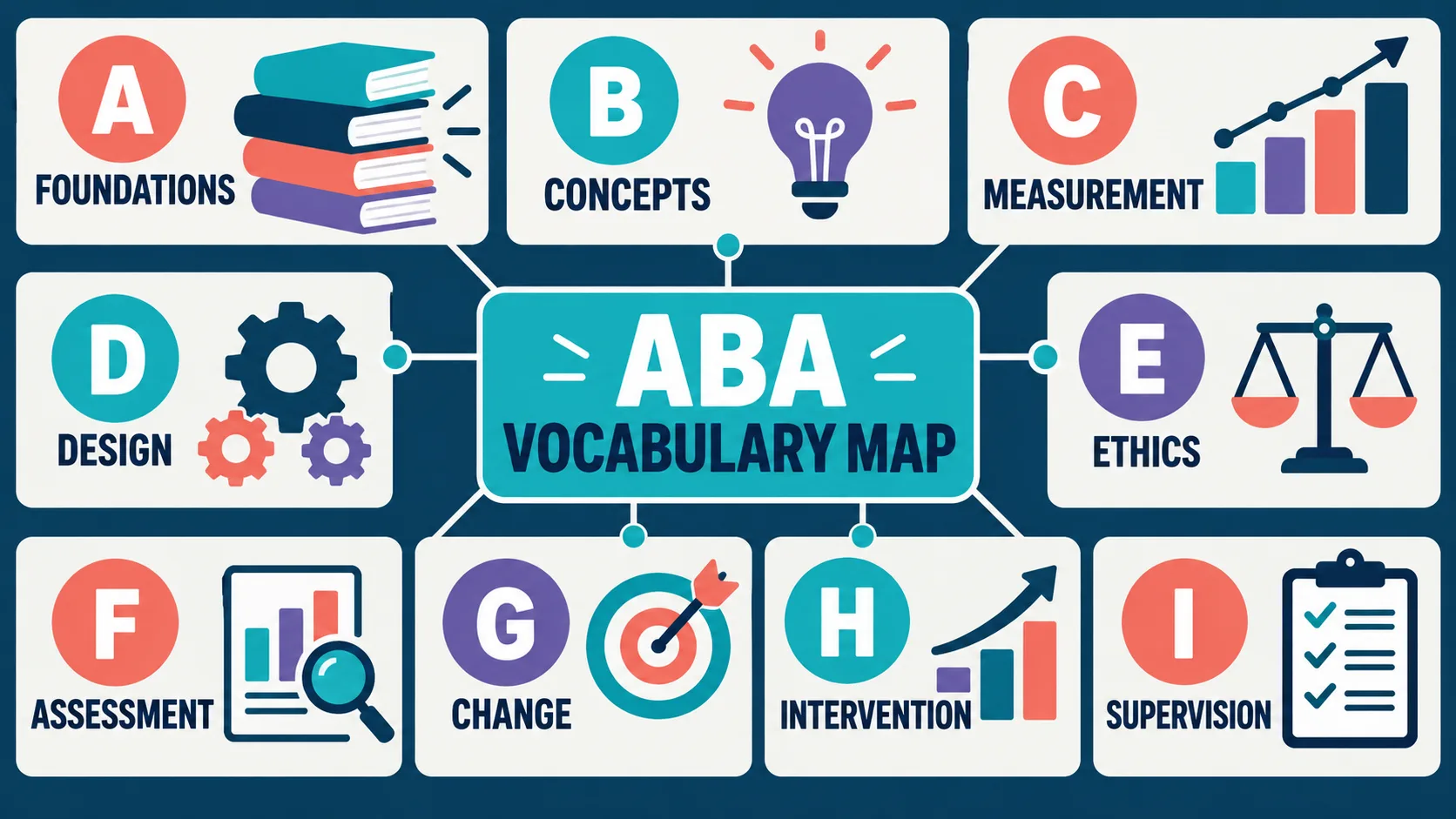
The 6th-edition BCBA Test Content Outline organizes 104 tasks into nine domains. Use the domains as folders for your vocabulary cards. The map below is a navigation tool, not a complete list of every term in a domain.
| Domain | Vocabulary cluster | Application question |
|---|---|---|
| A. Behaviorism and philosophical foundations | Behaviorism, selectionism, dimensions, assumptions | What philosophical assumption controls the interpretation? |
| B. Concepts and principles | Reinforcement, punishment, stimulus control, motivating operations | What contingency or stimulus relation is described? |
| C. Measurement and interpretation | Frequency, duration, interval, validity, reliability, display | What measure and quality check fit the behavior? |
| D. Experimental design | Baseline, reversal, multiple baseline, threats to validity | What design logic supports the conclusion? |
| E. Ethical and professional issues | Consent, confidentiality, competence, conflicts, scope | What protects the client and follows the applicable code? |
| F. Behavior assessment | Preference, descriptive, functional, skill, and risk assessment | What question is the assessment designed to answer? |
| G. Behavior-change procedures | Prompting, shaping, chaining, extinction, differential reinforcement | What procedure changes the relevant contingency? |
| H. Selecting and implementing interventions | Goals, social validity, fidelity, generalization, maintenance | How will the plan be selected, implemented, and evaluated? |
| I. Personnel supervision and management | Training, feedback, performance management, documentation | How will the supervisor teach and verify performance? |
When a card seems to belong to several domains, keep the card in the domain that matches the task being tested. For example, “treatment integrity” can appear in intervention implementation, measurement, or supervision. The vignette’s question—not the word alone—tells you which lens is active.
Build a confusion-pair card
Many vocabulary errors are not caused by ignorance. They happen because two terms share a surface feature. Put them on one card and force yourself to state the boundary before looking at the answer.
| Pair to separate | Decisive boundary | Vignette check |
|---|---|---|
| Positive vs. negative reinforcement | Positive means a stimulus is added; negative means a stimulus is removed. Both increase behavior when the contingency functions as reinforcement. | Did the behavior increase, and was a stimulus added or removed? |
| Respondent vs. operant conditioning | Respondent relations involve elicited responding; operant behavior is selected by its consequences. | Is the response elicited by an antecedent pairing or changed by a consequence? |
| Motivating operation vs. stimulus control | An MO changes value or momentary behavior; stimulus control changes responding based on a discriminative relation. | Is the clue about reinforcer value or which stimulus signals reinforcement? |
| Generalization vs. maintenance | Generalization concerns variation across people, settings, stimuli, or responses; maintenance concerns persistence over time. | Did the context change, or did time pass after teaching? |
| Accuracy vs. reliability | Accuracy concerns correspondence to what occurred; reliability concerns consistency across observers or measurements. | Is the question about truth of the record or agreement among records? |
Do not memorize the boundary as a slogan only. Write a one-sentence example in which the pair changes the answer. Then write a counterexample where the tempting term is wrong. That is where a vocabulary card becomes exam preparation.
Use a four-line retrieval card
A compact card is easier to review than a page of notes. Use this format:
- Term: write the word without a definition on the front.
- Definition: state the shortest accurate meaning you can recall.
- Discriminator: name the feature that rules out the closest pair.
- Decision cue: describe the data or wording in a vignette that would make the term relevant.
Score the card by the quality of the explanation, not just by whether you recognized the word. If you can define “extinction” but cannot identify whether the vignette describes an operation, a process, or an unplanned lapse in a contingency, the card is not finished.
Move from definition to decision
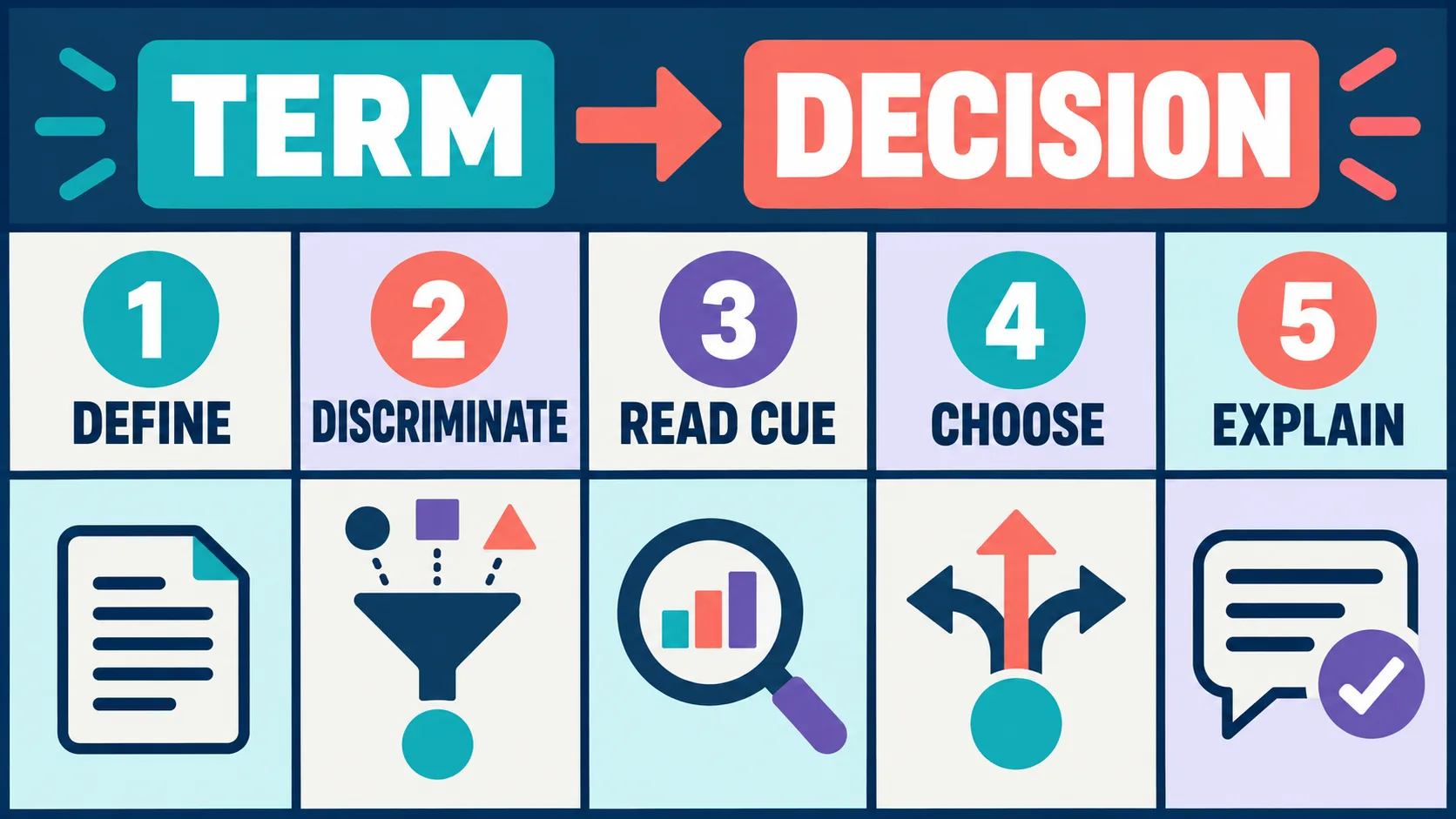
Use a five-step routine when a practice question contains a familiar term:
| Step | Question to ask | Write down |
|---|---|---|
| 1. Define | What does the term mean here? | One accurate sentence. |
| 2. Discriminate | What similar answer is tempting? | The decisive boundary. |
| 3. Read the cue | Which fact in the vignette activates the term? | The exact data or wording. |
| 4. Choose | What answer best fits the facts and task? | The answer plus one reason. |
| 5. Explain | Why does the closest distractor fail? | A correction for the next review. |
For example, if a question says a response increases after a stimulus is removed, do not stop at the word “negative.” First identify the outcome (increase), then the operation (removed), then decide whether the question is asking about reinforcement, an MO, or a different relation. Vocabulary supplies the labels; the vignette supplies the decision.
Schedule review by error type
Use your misses to choose the next review, rather than rereading the entire glossary. A simple error log can separate four problems:
- Recall error: you could not state the definition.
- Boundary error: you knew both terms but confused the decisive feature.
- Cue error: you missed the fact in the vignette that activated the concept.
- Decision error: you saw the cue but selected an answer that did not follow from it.
Review the error type within 24 to 48 hours, then retest the same pair in a new example. If the same boundary error returns, create a counterexample and explain it aloud. Repeatedly highlighting a definition is less informative than seeing whether you can use it when the wording changes.
Keep ethics vocabulary source-controlled
Terms such as competence, confidentiality, informed consent, multiple relationships, and scope can sound familiar while carrying important context. For ethics questions, use the current BACB ethics-code resources as the source of truth. A study card may point you to the issue, but it should not flatten a professional judgment into a slogan.
When an answer depends on a current rule, date, jurisdiction, or role, write that qualifier on the card. “Always” and “never” are warning signs to verify the source. The purpose of an ABA vocabulary map is better discrimination, not false certainty.
A seven-day ABA vocabulary review plan
- Day 1: choose one BCBA domain and collect 10 to 15 terms from the official outline and a trusted reference.
- Day 2: write the four-line retrieval card for each term without copying full paragraphs.
- Day 3: group the cards into at least three confusion pairs.
- Day 4: answer short vignettes and underline the cue that drove each choice.
- Day 5: review only recall and boundary errors; create one counterexample per repeated error.
- Day 6: mix terms from two domains so the prompt cannot be solved by topic recognition alone.
- Day 7: complete a short practice set, record distractor explanations, and choose the next domain.
Use mock questions to test transfer
Once you can define a term, the next useful test is a scenario. Use targeted practice to ask: What fact matters? What is the closest distractor? Which task-list domain is active? What would I document or do next? The goal is not to make a vocabulary list longer; it is to make your reasoning more precise.
When you want to practice that transfer, use the Free BCBA Mock Exam for scenario-based questions and review the rationale behind each option. It is a study resource—not a certification decision, eligibility review, or guarantee of exam success.
ABA vocabulary FAQ
Should I memorize every ABA term alphabetically?: No. Use an existing glossary for lookup, then organize high-value terms by the task-list domain and the decision they support. Alphabetical order is useful for finding a word, but it does not show how the word functions in a vignette.
How many terms should I study at once?: Choose a manageable group that includes a few related terms and at least one confusion pair. The right number is the group you can retrieve, discriminate, and apply without turning review into passive rereading.
Are ABA vocabulary words enough to pass the BCBA exam?: No. Vocabulary supports the knowledge and application tasks, but the exam also requires measurement, assessment, intervention, ethics, supervision, and decision-making. Use the current TCO to check coverage and practice questions to test transfer.
The bottom line
Use ABA vocabulary as a map to decisions: define the term, name its defining feature, separate it from the closest neighbor, and find the cue in a vignette. Keep the official BCBA outline and ethics materials as your source of truth, use glossaries for lookup, and use practice questions to prove that the term is available when the wording changes.
Sources to recheck
Current reference points: the BACB BCBA Test Content Outline (6th ed.), the BACB task-list hub, the examination-information page, and the BACB ethics-code resources. Recheck the current official materials before relying on a study card for a date-sensitive or ethics-sensitive question. For targeted review, use our aba vocabulary practice questions to apply the concept in exam-style scenarios.
Quick Review Checklist
Use this final checklist to turn aba vocabulary into exam-ready reasoning. The goal is not to memorize a label in isolation; it is to identify the relevant evidence and explain why the best answer fits the scenario. Key ideas to review:
- State the central definition or decision point for aba vocabulary in your own words.
- Identify the detail that makes aba vocabulary different from its closest related ABA term.
- Separate the observable facts in a scenario from assumptions that are not supported by the facts.
- Write one example and one nonexample so you can recognize the concept in a new setting.
Exam application checks:
- Ask what the question is actually requesting before comparing the answer choices.
- Mark the antecedent, response, consequence, or other evidence that supports the selected answer.
- Look for a distractor that describes a related process but does not answer the specific question.
Final self-check:
- Explain how you would verify the interpretation with clear observations or data.
- Change one detail in the scenario and decide whether your answer should change.
- Give a one-sentence rationale that a supervisor or study partner could evaluate.
Take the Free BCBA Mock Exam
A useful next step is to apply this idea in a fresh set of BCBA-style practice questions and review the feedback. Take the Free BCBA Mock Exam



