
A source-first guide to the national BCBA credential, Connecticut behavior-analyst licensure, application evidence, and 2027 planning. If you searched for BCBA certification CT, start with one important distinction: Connecticut does not issue the national BCBA certification. The Behavior Analyst Certification Board (BACB) issues the BCBA credential, while Connecticut regulates behavior-analytic practice through its own licensing system. Many candidates need both pieces, but they are not the same application.
Table of Contents
- BCBA Certification CT: The Short Answer
- The Two Credentials You Must Separate
- The BACB Certification Path
- The Connecticut License Check
- Connecticut Application Map
- How to Plan Around 2027
- When to Start BCBA Exam Practice
- Frequently Asked Questions
- Quick Review Checklist
- Take the Free BCBA Mock Exam
That distinction changes what you study, which documents you collect, and who can answer a question. The BACB controls certification eligibility and the BCBA examination. The Connecticut Department of Public Health controls the state license application. A program, employer, or online course may help you prepare, but it does not replace either official authority.
Short answer: To plan a Connecticut BCBA career, first verify an applicable BACB pathway, complete the required education and supervised fieldwork, submit the BACB application, and pass the BCBA examination. Then check the Connecticut behavior analyst license requirements before practicing under Connecticut rules. Treat the two checklists as related but separate.
BCBA Certification CT: The Short Answer
“BCBA certification CT” usually describes a Connecticut-based candidate trying to understand two connected questions: how to become a BCBA and what Connecticut requires to practice as a behavior analyst. The national route is governed by BACB rules. The local practice route is governed by Connecticut law and the Department of Public Health.
The safest order is to verify the BACB pathway first, because the Connecticut licensing page says an applicant must be a BCBA certified by the BACB to be eligible for a Connecticut behavior analyst license. That does not mean every employment or school setting will ask for exactly the same documents. It means you should not assume a state application can substitute for the national credential.
The Two Credentials You Must Separate
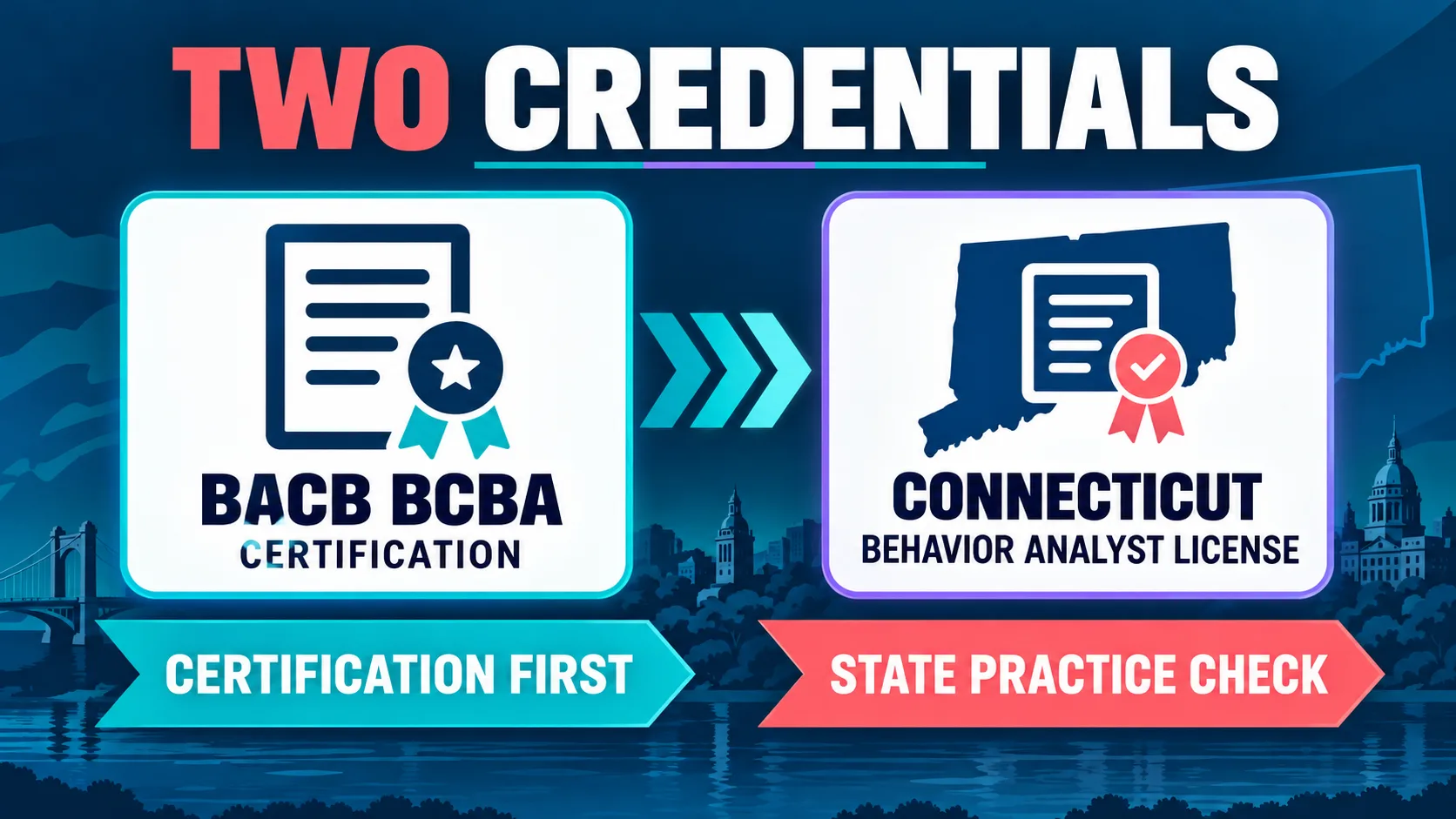
The table below is a planning aid, not a replacement for the governing documents. It helps you send a question to the right authority before you invest time or money.
| Question | BACB BCBA certification | Connecticut behavior analyst license |
|---|---|---|
| Who controls it? | The Behavior Analyst Certification Board. | Connecticut Department of Public Health and state law. |
| What does it establish? | Eligibility for the national BCBA credential after meeting the current pathway and examination requirements. | State authorization and boundaries for practicing or using the regulated behavior-analyst title in Connecticut. |
| What evidence matters? | Degree, behavior-analytic coursework, supervised fieldwork, application, and examination evidence under the applicable BACB pathway. | BCBA verification plus the state application and any required supporting or out-of-state license documents. |
| Where should you verify changes? | The current BCBA Handbook and BACB transition notices. | The Connecticut Department of Public Health licensing page and current Connecticut statutes. |
The practical implication is simple: a BCBA certificate number is not automatically a Connecticut license number, and a Connecticut application receipt is not proof that you have passed the BCBA examination. Keep the records in separate folders even when the same identity or education documents support both applications.
The BACB Certification Path
The current BACB handbook is the source for pathway details. At a high level, a candidate must choose an applicable eligibility pathway, satisfy the education and behavior-analytic coursework requirements, complete the required supervised fieldwork, submit a complete certification application, and pass the BCBA examination. The exact evidence depends on the pathway and the rules that apply when the application is reviewed. Do not choose a program because its page says “BCBA certification” without asking how it maps coursework and fieldwork to the current BACB requirements. Before enrollment, request written answers to four questions:
- Which BACB eligibility pathway does this program support?
- Which courses appear on the transcript and how are they documented?
- How are supervised fieldwork opportunities arranged and recorded?
- What support exists when the BACB application asks for evidence?
The site’s BCBA certification roadmap explains the national sequence in more detail. This Connecticut page adds the state-license decision after that sequence; it should not become a second general “how to become a BCBA” page.
The Connecticut License Check
The Connecticut Department of Public Health licensing page states that an applicant for a behavior analyst license must be BCBA certified by the BACB. It also says the department will verify the BCBA certification online. If you have held behavioral-analyst licenses in another state, the page says the relevant verification must be submitted directly from the source rather than assumed from an online lookup.
The page currently directs applicants to apply online and lists a $350 application fee. Because fees and submission instructions can change, treat that amount as a current-page check rather than a timeless promise. Save the page title, URL, and access date in your application notes, then recheck it before submission.
Connecticut law also matters for renewal, title use, and exceptions. The Connecticut General Assembly’s current chapter on behavior analysts should be read alongside the Department of Public Health instructions. If your work involves a school, Medicaid, employer credentialing, or another payer, ask that organization whether it has additional enrollment or documentation requirements. Those requirements are not the same thing as BCBA certification.
Connecticut Application Map
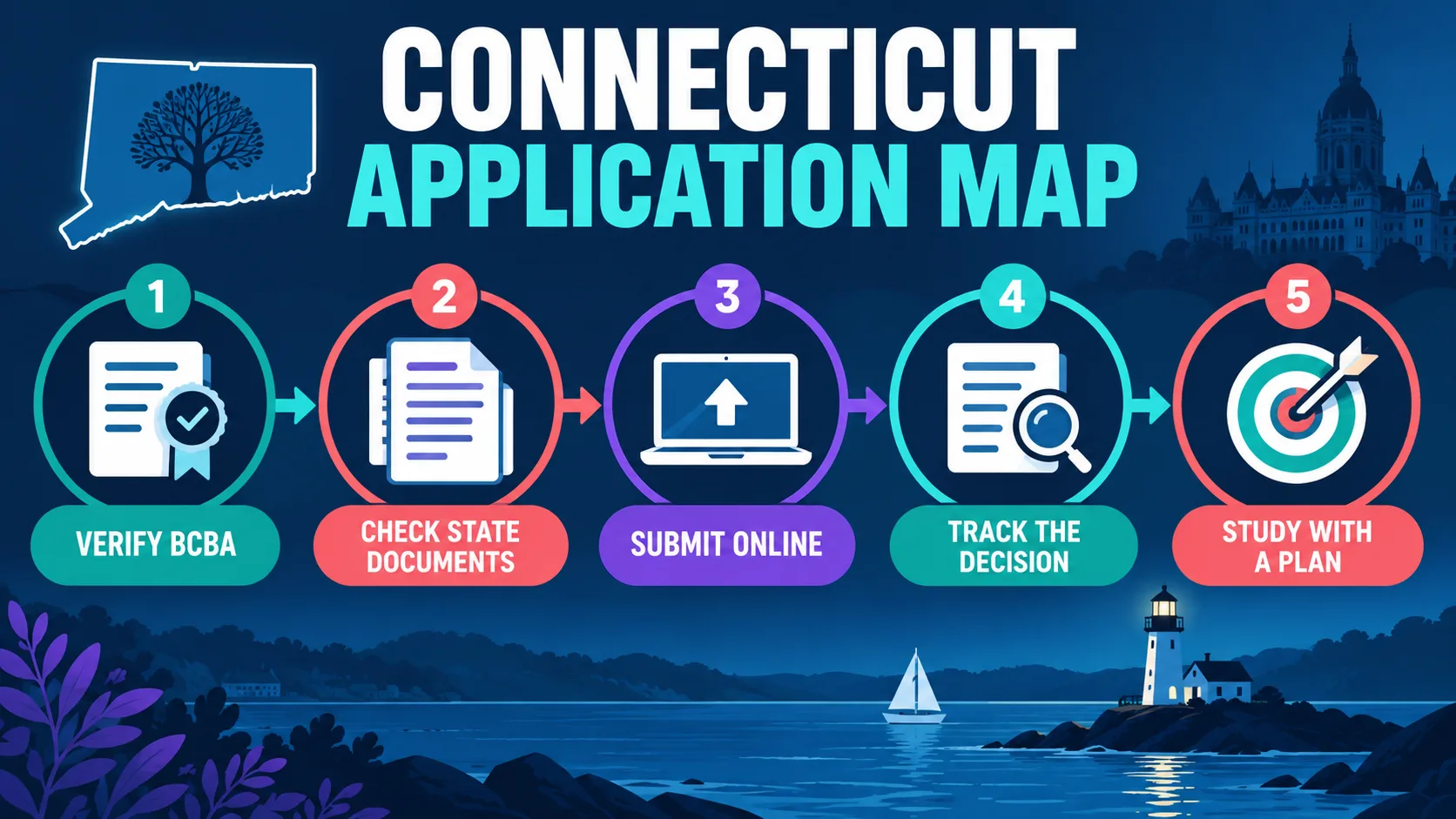
Use this sequence to keep the national and state tasks from becoming one confusing checklist.
- Define the role and location. Decide whether you are asking about BACB certification, Connecticut licensure, school practice, employer onboarding, or payer enrollment. One person may need several of these, but each has a different owner.
- Verify your BACB route. Open the current handbook and identify the pathway, degree evidence, coursework evidence, fieldwork evidence, and examination steps that apply to you.
- Build a fieldwork record. Keep your own copies of dates, hours, supervision, activities, signatures, and questions. Do not wait until the end of fieldwork to discover that a record is incomplete.
- Submit the BACB application. Follow the BACB instructions for the complete application and wait for the official determination or authorization steps that apply to your case.
- Check Connecticut documents. Use the Department of Public Health page to confirm BCBA verification, out-of-state license verification if applicable, online filing, fee, and any supporting evidence requested.
- Track the decision. Save receipts, confirmation messages, source URLs, and questions sent to the licensing office. A dated record is more useful than a screenshot with no context.
| Before moving forward | Evidence to collect | Who answers the question? |
|---|---|---|
| Does my education fit a current BACB pathway? | Degree and coursework documents matched to the handbook. | BACB and the program’s qualified advisor. |
| Will my fieldwork be usable? | Supervision plan, activity records, hours, dates, and attestations. | BACB rules plus the qualified supervisor. |
| What does Connecticut need after certification? | BCBA verification, application instructions, fee, and any out-of-state license verification. | Connecticut Department of Public Health. |
How to Plan Around 2027
The BACB says significant BCBA eligibility and maintenance requirement changes take effect on January 1, 2027. The official transition materials explain which complete applications can be reviewed under current requirements and what candidates should verify. The relevant boundary is not simply the date you start a class; it is the application and evidence status described by BACB.
Use the BACB upcoming changes page and the current handbook together. If you are close to applying, ask whether payment and all required documents will be received by the applicable deadline. If you are still choosing a degree or fieldwork route, do not rush an incomplete application merely to beat a date. A missing document can create a different problem than a later transition rule. Connecticut may also update state instructions independently. A national BACB transition does not automatically answer a Connecticut licensing question. Recheck both authorities before you file, change employers, or describe yourself as licensed in Connecticut.
When to Start BCBA Exam Practice
Exam practice is useful after you understand your eligibility route and have enough coursework to interpret scenarios. It cannot replace a qualifying degree, fieldwork, application evidence, or a state license. The goal is to practice selecting and explaining the best action, not to memorize a score from one familiar question set.
When you are ready, the Free BCBA Mock Exam can help you identify decision-making gaps. Review why the correct option fits the data, ethics, measurement, or intervention principle, and why the distractors fail. Treat the result as study feedback, not a guarantee of certification, licensure, employment, or exam success.
Frequently Asked Questions
Is BCBA certification the same as a Connecticut behavior analyst license?: No. BACB issues the national BCBA certification. Connecticut handles state behavior-analyst licensure through the Department of Public Health. A Connecticut candidate should verify both requirements rather than use the terms as interchangeable.
Do I need a Connecticut license if I already passed the BCBA exam?: Ask the Connecticut licensing authority and your employer or practice setting. Passing the BCBA examination completes one part of the national certification process; it does not by itself answer every state-practice, payer, school, or employer question.
How much is the Connecticut behavior analyst license application?: The Connecticut Department of Public Health licensing page currently lists a $350 application fee. Recheck the official page before applying because fees, forms, and submission instructions can change.
Can an online ABA program give me BCBA certification?: An online program may support an applicable BACB pathway, but the program itself does not issue the national BCBA credential. Verify degree, coursework, fieldwork, application, and examination requirements against the current BACB handbook.
What should I do first if I live in Connecticut?: Start by identifying your BACB pathway and then open the Connecticut Department of Public Health licensing page. Build separate evidence checklists, confirm the current rules with the responsible authorities, and keep dated records of what you submit.
Sources to recheck: the BACB BCBA page, the BCBA Handbook, the BACB transition page, the Connecticut Department of Public Health licensing requirements, and Connecticut Chapter 382a. Requirements and fees can change, so verify the current official documents before applying.
Quick Review Checklist
Use this final checklist to turn bcba certification ct into exam-ready reasoning. The goal is not to memorize a label in isolation; it is to identify the relevant evidence and explain why the best answer fits the scenario. Key ideas to review:
- State the central definition or decision point for bcba certification ct in your own words.
- Identify the detail that makes bcba certification ct different from its closest related ABA term.
- Separate the observable facts in a scenario from assumptions that are not supported by the facts.
- Write one example and one nonexample so you can recognize the concept in a new setting.
Exam application checks:
- Ask what the question is actually requesting before comparing the answer choices.
- Mark the antecedent, response, consequence, or other evidence that supports the selected answer.
- Look for a distractor that describes a related process but does not answer the specific question.
Final self-check:
- Explain how you would verify the interpretation with clear observations or data.
- Change one detail in the scenario and decide whether your answer should change.
- Give a one-sentence rationale that a supervisor or study partner could evaluate.
Take the Free BCBA Mock Exam
When you are ready to apply the idea, use the free practice resource below for additional feedback. Take the Free BCBA Mock Exam



