
A realistic guide to the time, fieldwork, application, and exam demands behind becoming a Board Certified Behavior Analyst. If you are asking, is it hard to become a BCBA, the honest answer is: it is demanding, but the difficulty is specific and manageable. The path combines graduate-level coursework, supervised fieldwork, an application process, and an application-based certification exam. Those parts can overlap, but they cannot be replaced by motivation alone.
Table of Contents
- Is It Hard to Become a BCBA? The Short Answer
- The Four BCBA Path Bottlenecks
- Can You Handle the Path? A Practical Self-Check
- What You Can Control
- How 2027 Changes Affect Planning
- Where Exam Preparation Fits
- Frequently Asked Questions
- Quick Review Checklist
- Take the Free BCBA Mock Exam
That does not mean the path is reserved for people with exceptional memory or a particular personality. It means you need a plan for long-term consistency, careful documentation, feedback, and decision-making. The better question is not “Am I naturally smart enough?” It is “Which part of the path is likely to be hardest for me, and what will I do before it becomes a problem?”
Quick answer: Becoming a BCBA is hard because several systems must work together. Coursework builds the conceptual foundation, fieldwork requires logistics and supervision, the application requires accurate records, and the exam asks you to apply concepts to scenarios. Early planning makes the path more predictable, but no article can guarantee a universal timeline or exam result.
Is It Hard to Become a BCBA? The Short Answer
The BCBA path feels difficult for four related reasons. First, the coursework is not just a list of vocabulary words. You must connect principles, measurement, assessment, intervention, ethics, and professional judgment. Second, fieldwork is a work-and-documentation system. Hours must be accumulated under the applicable rules, with supervision and activities that meet the current standard.
Third, candidates have to manage an application with records that are accurate, complete, and consistent. A strong student can still create delays by treating documentation as an afterthought. Fourth, the exam is not simply a recall test. It presents applied situations in which several answers may sound reasonable, but one best fits the function, data, ethics, or task-list requirement.
The BACB BCBA Handbook should be the source of truth for the current eligibility requirements. It describes the degree, behavior-analytic coursework, supervised fieldwork, and examination components. Separate state licensure or employer rules may add another layer after certification.
The Four BCBA Path Bottlenecks
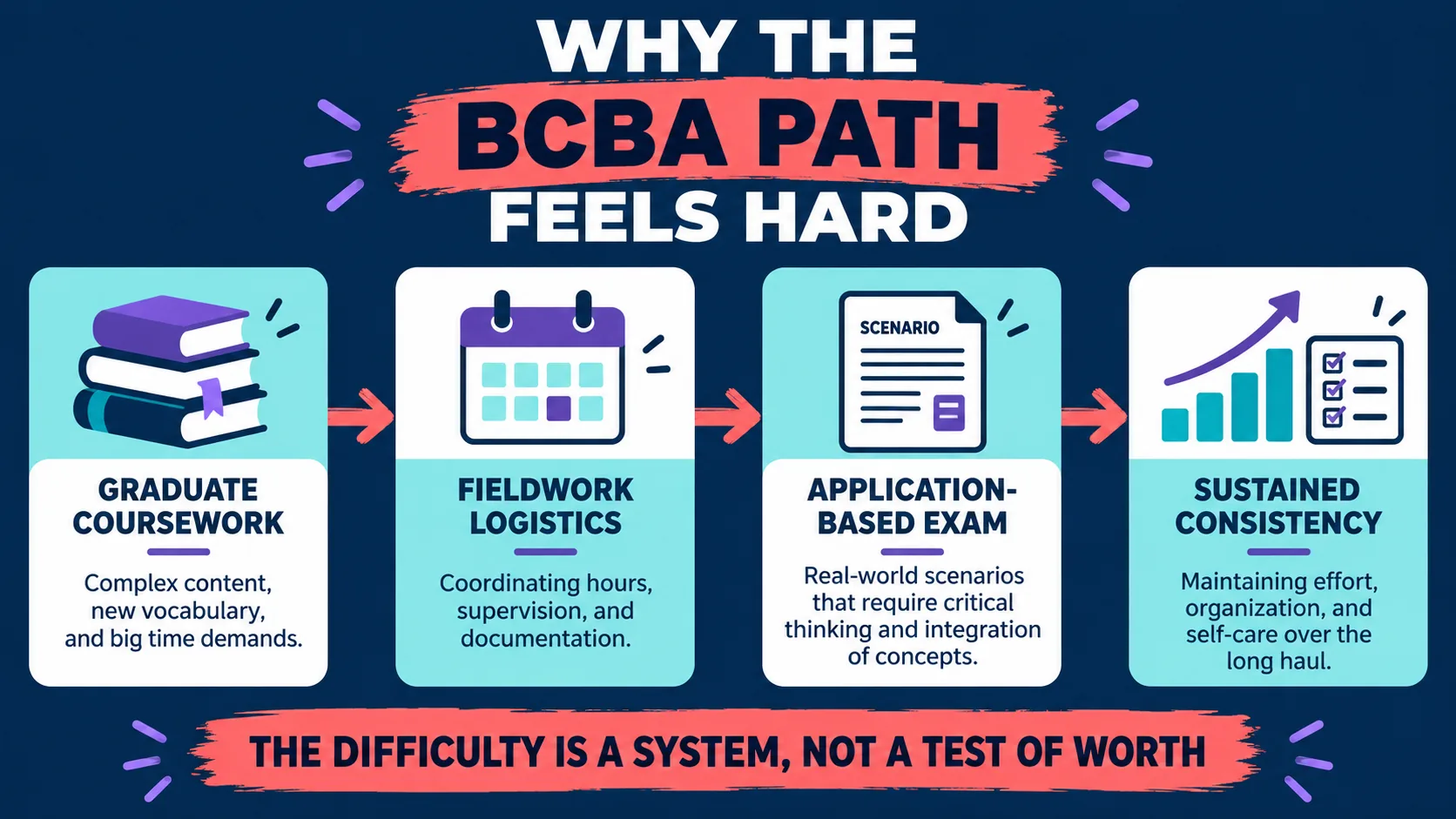
Thinking about difficulty as one giant feeling can make the path seem impossible. Break it into bottlenecks instead. Each bottleneck has a different warning sign and a different response.
| Bottleneck | Why it feels hard | Early warning sign |
|---|---|---|
| Coursework | Many concepts must be connected rather than memorized separately. | You can define a term but cannot select it in a scenario. |
| Fieldwork | Hours, supervision, unrestricted activities, work demands, and records must fit together. | Your job provides direct-service hours but no clear plan for qualifying activities. |
| Application | Small documentation errors can create large delays or questions. | You are waiting until the end to reconcile forms, dates, and supervisor records. |
| Examination | Questions require applied judgment under time pressure. | Practice scores look acceptable, but explanations for wrong answers are vague. |
These bottlenecks also interact. Weak conceptual understanding can make fieldwork feedback harder to use. Unstable work hours can reduce study time. Poor documentation can create stress just when exam preparation should become more focused. A useful plan checks the system monthly rather than waiting for a crisis.
Can You Handle the Path? A Practical Self-Check
This is not a personality test, and it should not be used to decide that someone is “not BCBA material.” It is a planning tool. Rate each area as stable, uncertain, or at risk, then identify the smallest action that would create better evidence.
| Question | Stable evidence | If uncertain |
|---|---|---|
| Can I protect recurring study time? | A weekly block survives normal work and family disruptions. | Test a two-week schedule before committing to a program. |
| Do I know who will supervise fieldwork? | The supervisor, activities, records, and meeting rhythm are discussed clearly. | Ask how unrestricted work and monthly documentation will actually happen. |
| Can I learn from wrong answers? | You can name the cue, rule, or data feature that changed the answer. | Keep an error log that records reasoning, not only a percentage. |
| Will I verify rules from primary sources? | You check the current BACB handbook and state authority when dates matter. | Bookmark the official pages and set a monthly recheck reminder. |
If several answers are uncertain, that does not mean “quit.” It means your next step should be information gathering rather than purchasing a program or scheduling an exam immediately. Talk with the program, potential supervisor, employer, or qualified advisor and ask for concrete answers.
What You Can Control
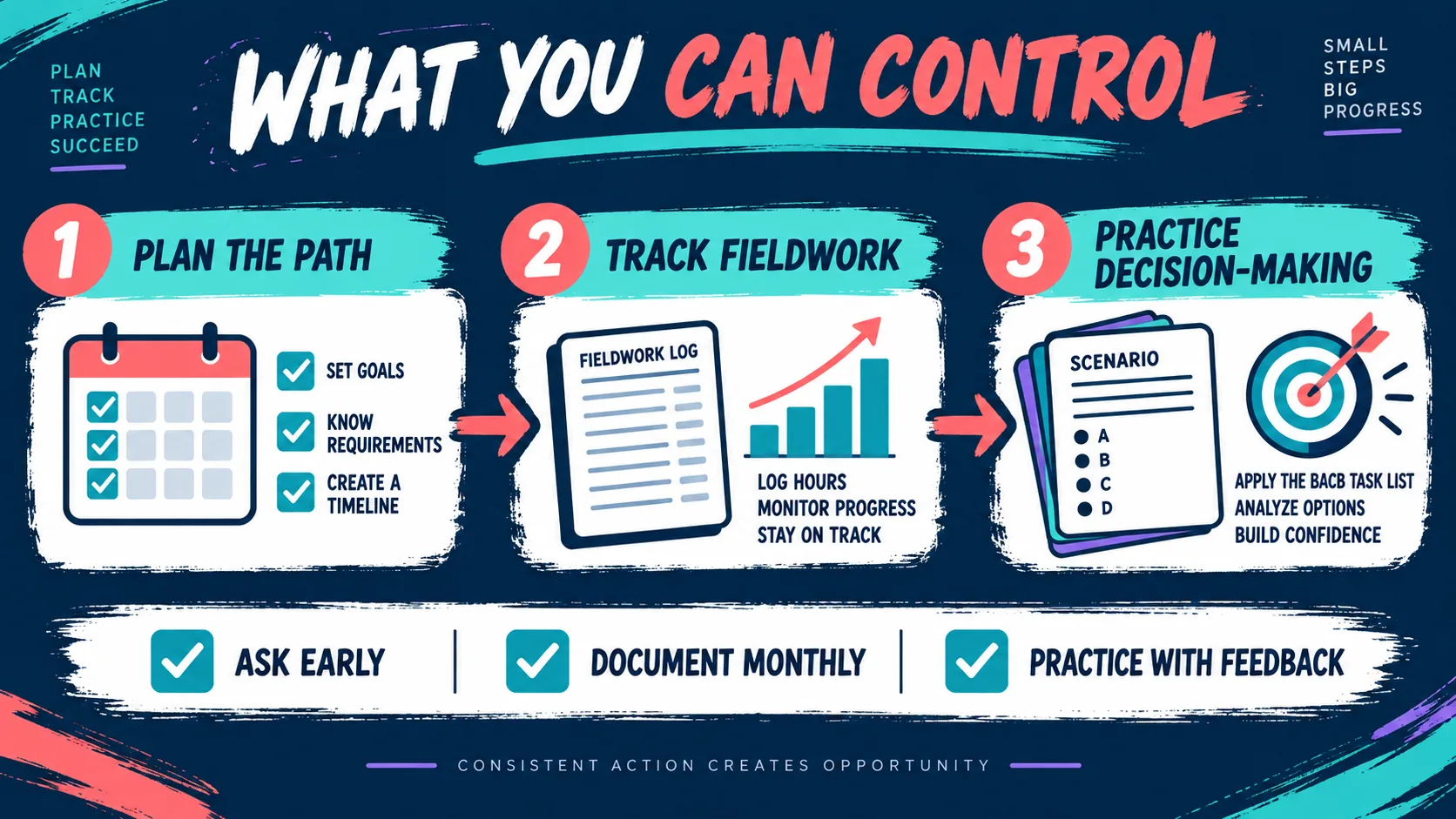
The path becomes more manageable when vague anxiety is converted into observable actions. Start with a simple three-part system: plan the path, track the evidence, and practice the decisions you will eventually need to make.
- Plan before enrolling. Confirm the degree and coursework route, how the program handles fieldwork, what support exists for documentation, and how the program distinguishes certification from state licensure.
- Track fieldwork monthly. Keep your own copies of hour records, supervision documentation, activities, dates, and questions. Do not rely on memory at the end of a long placement.
- Use feedback as data. When a supervisor or practice question exposes a gap, write down the decision rule that was missing. Revisit the same type of scenario later to see whether the reasoning changed.
- Protect recovery and boundaries. A plan that uses every available hour may look ambitious but fail after a month. Sustainable study is a professional skill, not a sign of low commitment.
| Risk | Preventive action | Evidence to review |
|---|---|---|
| Starting fieldwork without a realistic activity plan | Discuss restricted and unrestricted activities, supervision, and documentation before logging hours. | Monthly record review with the supervisor. |
| Studying only by rereading | Mix retrieval, scenario decisions, explanations, and targeted review. | An error log that shows the pattern is shrinking. |
| Using an old rule or handbook | Recheck the BACB transition page and current handbook when planning dates. | Source URL, access date, and the rule that applies to your pathway. |
| Treating one mock score as a forecast | Use repeated, timed practice plus domain-level analysis. | Stable reasoning across new scenarios, not one familiar test form. |
How 2027 Changes Affect Planning
The BACB lists significant BCBA eligibility and maintenance requirement changes taking effect on January 1, 2027. The official transition notice says that candidates who want to be reviewed under the current 2022 requirements must submit a complete application, including payment and required documents, by December 31, 2026. That date is a planning boundary, not a reason to rush incomplete records.
For anyone beginning or continuing the path, use the BACB upcoming changes page and the current handbook together. Do not rely on a social post, an old school page, or a generic “fastest path” article to determine which rules apply. Your application date, pathway, coursework evidence, and fieldwork documentation can change the answer.
The existing BCBA prerequisites guide is the better page for requirement details, and the BCBA timeline guide is the better page for time estimates. This article has a narrower job: help you diagnose the workload and build a sustainable plan without confusing estimates with official requirements.
Where Exam Preparation Fits
Exam preparation cannot solve a missing degree, an incomplete fieldwork record, or a pathway that was never verified. It becomes useful after you understand the eligibility route and have enough conceptual foundation to interpret feedback.
The BACB’s examination information reports historical first-time and retake outcomes, but population results are not a personal prediction. Treat them as a reason to prepare deliberately, not as a verdict on your ability. The existing exam difficulty guide covers the exam-only question in more depth.
Once you are ready for application-based practice, the Free BCBA Mock Exam can help you practice choosing the best answer in realistic scenarios. Use it diagnostically: review why an option is correct, why the alternatives fail, and which task-list concept needs another round. It is a study resource, not a guarantee of certification, licensure, employment, or exam success.
Frequently Asked Questions
Is it hard to become a BCBA if I am not a psychology major?: Not necessarily. The relevant question is whether you can meet the current degree and behavior-analytic coursework requirements through an applicable pathway. A bachelor’s major title alone does not answer the certification question. Verify the current route with the BACB and the program you are considering.
What is usually the hardest part of the BCBA path?: It varies. Some candidates struggle with graduate coursework and applied reasoning; others struggle with finding sustainable supervision, obtaining qualifying activities, or maintaining accurate records while working. Identify the bottleneck with evidence instead of assuming the exam is the only difficult stage.
Can I work while completing the BCBA requirements?: Many candidates work while completing coursework or fieldwork, but the practical answer depends on workload, employer support, supervision access, and the current fieldwork rules. Before starting, ask how your role will support qualifying activities and documentation rather than assuming every paid hour counts.
Does passing practice tests mean I am ready?: One score is not enough. Look for stable performance across new scenarios, timed conditions, and task-list domains, and make sure you can explain the reasoning behind each answer. Readiness is stronger when your process remains accurate even when the wording or context changes.
Should I wait because of the 2027 BCBA changes?: Do not make that decision from a general article. Compare your pathway, application timing, coursework evidence, and fieldwork records against the official BACB transition guidance. The January 1, 2027 changes make source checking more important; they do not create one universal answer for every candidate.
Sources to recheck: the BACB BCBA Handbook, the BACB upcoming changes page, and BACB examination information. Requirements and policies can change, so candidates should confirm the current official documents before applying or scheduling an examination.
Quick Review Checklist
Use this final checklist to turn is it hard to become a bcba into exam-ready reasoning. The goal is not to memorize a label in isolation; it is to identify the relevant evidence and explain why the best answer fits the scenario. Key ideas to review:
- State the central definition or decision point for is it hard to become a bcba in your own words.
- Identify the detail that makes is it hard to become a bcba different from its closest related ABA term.
- Separate the observable facts in a scenario from assumptions that are not supported by the facts.
- Write one example and one nonexample so you can recognize the concept in a new setting.
Exam application checks:
- Ask what the question is actually requesting before comparing the answer choices.
- Mark the antecedent, response, consequence, or other evidence that supports the selected answer.
- Look for a distractor that describes a related process but does not answer the specific question.
Final self-check:
- Explain how you would verify the interpretation with clear observations or data.
- Change one detail in the scenario and decide whether your answer should change.
- Give a one-sentence rationale that a supervisor or study partner could evaluate.
Take the Free BCBA Mock Exam
When you are ready to apply the idea, use the free practice resource below for additional feedback. Take the Free BCBA Mock Exam



