
Understanding Time Delay Procedures in ABA
Time delay is a prompting procedure that systematically delays the presentation of a prompt after an antecedent stimulus is presented. The primary purpose is to encourage independent responding by gradually transferring stimulus control from the prompt to the natural cue.
Table of Contents
- Understanding Time Delay Procedures in ABA
- Progressive vs. Constant Time Delay: Key Differences
- Worked Examples: Applying Time Delay in Practice
- BCBA Exam Relevance and Common Traps
- Quick Checklist for Implementing Time Delay
- Summary and Key Takeaways
This technique is particularly effective for teaching new skills while minimizing errors and reducing prompt dependency.
Core Definition and Purpose
Time delay procedures involve inserting a predetermined interval between the presentation of the discriminative stimulus (SD) and the delivery of a prompt. During this delay, the learner has an opportunity to respond independently. If no response occurs within the delay interval, the prompt is provided to ensure a correct response.
The procedure is designed to systematically fade prompts while maintaining high levels of correct responding.
Key Terminology for BCBA Candidates
- Prompt hierarchy: The sequence of prompts from most to least intrusive used during teaching
- Prompt fading: The gradual removal of prompts to promote independent responding
- Response latency: The time between the presentation of an antecedent and the initiation of a response
- Stimulus control: When a behavior occurs more frequently in the presence of a specific stimulus
- Errorless learning: Teaching procedures designed to minimize errors during skill acquisition
Progressive vs. Constant Time Delay: Key Differences
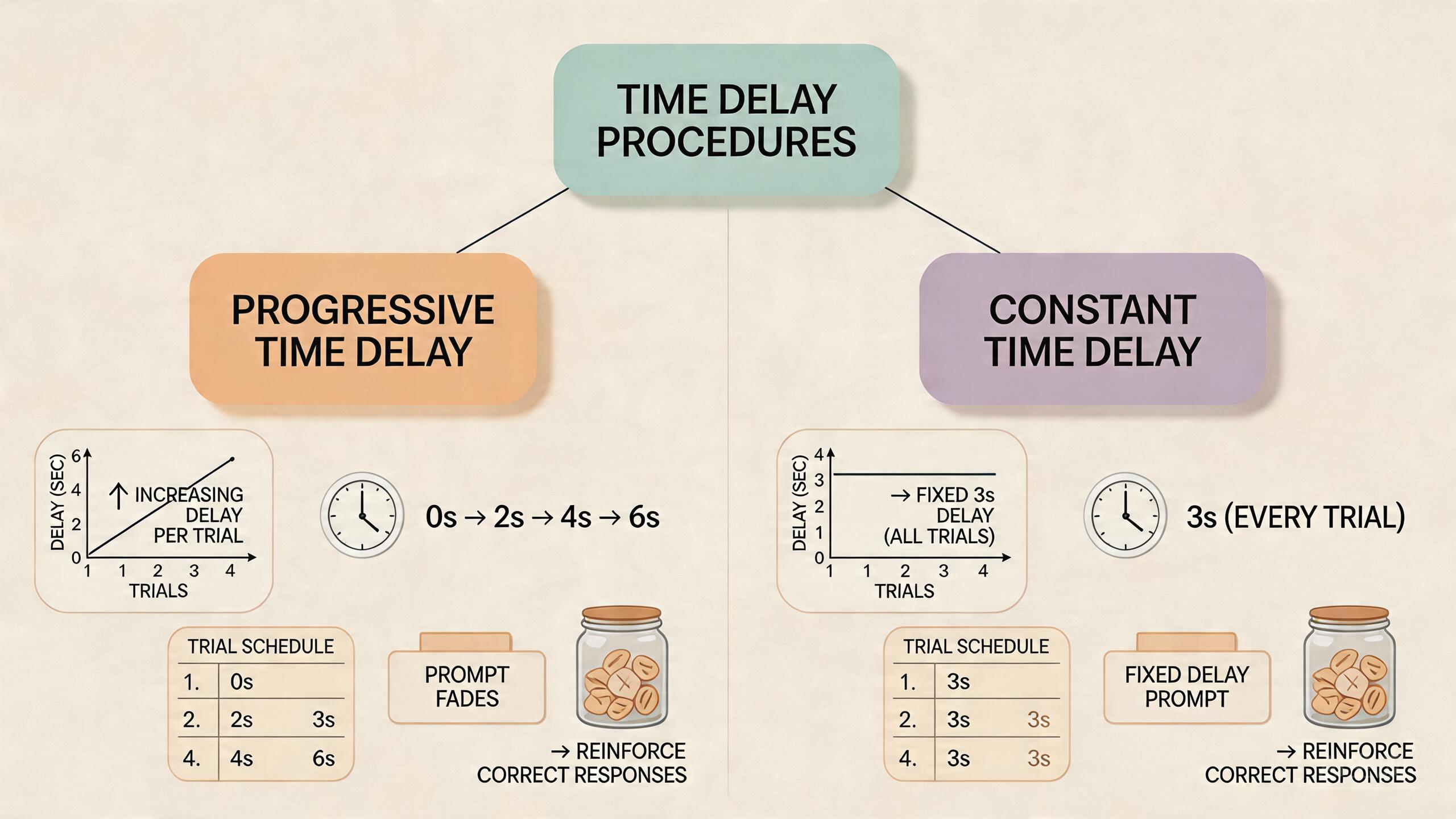
Time delay procedures can be implemented using either progressive or constant intervals. Understanding these two approaches is essential for effective intervention planning and BCBA exam success.
Progressive Time Delay Explained
In progressive time delay, the delay interval increases systematically across trials or sessions. Typically, instruction begins with a 0-second delay (prompt delivered immediately), then progresses to longer intervals such as 2 seconds, 4 seconds, 6 seconds, etc.
This gradual increase allows learners to adjust to the expectation of responding independently while maintaining high accuracy rates.
Constant Time Delay Explained
Constant time delay uses a fixed delay interval that remains the same across all trials. After initial 0-second delay trials to establish the response, all subsequent trials use the same predetermined delay (e.g., always 5 seconds).
This approach provides consistent expectations and can be easier to implement consistently across different staff members.
When to Use Each Method
- Use progressive time delay for learners who benefit from gradual increases in response expectations
- Choose constant time delay when consistency across implementers is a priority
- Consider progressive delay for complex skills requiring multiple teaching steps
- Select constant delay for maintaining skills already in the learner’s repertoire
- Use progressive delay when working with prompt dependency issues
- Apply constant delay for skills that need to be performed within specific time constraints
Worked Examples: Applying Time Delay in Practice
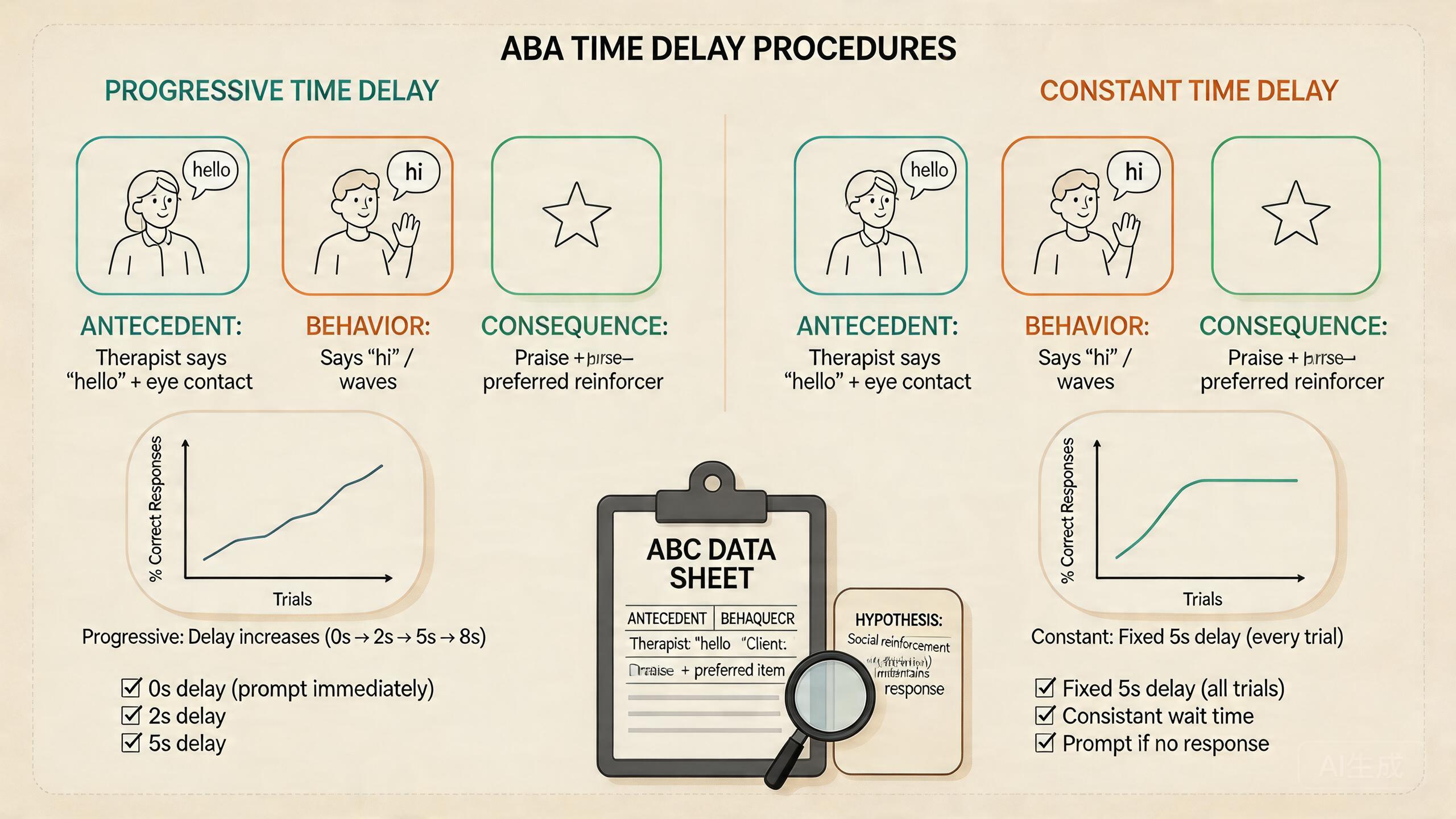
These practical examples demonstrate how time delay procedures are implemented in real ABA settings, complete with ABC data and hypothesized functions.
Example 1: Teaching Greeting Skills with Progressive Time Delay
Antecedent: Therapist says “hello” while making eye contact. Behavior: Client responds verbally with “hi” or waves. Consequence: Social praise and attention from therapist.
Procedure: Begin with 0-second delay (therapist immediately models “hi”), then progress to 2-second delay, then 4-second delay across sessions. Hypothesized function: Social attention. This approach helps build social communication skills while minimizing errors.
Example 2: Reducing Elopement with Constant Time Delay
Antecedent: Transition cue given (“Time to go to the table”). Behavior: Client remains in designated area. Consequence: Access to preferred item or activity.
Procedure: After initial teaching, implement constant 3-second delay before providing physical prompt to stay in area. Hypothesized function: Tangible/access. This intervention addresses escape-maintained behavior by teaching appropriate transition skills.
Example 3: Academic Task Completion
Antecedent: Worksheet presented with verbal instruction. Behavior: Client writes name on designated line. Consequence: Token earned toward preferred activity.
Procedure: Use progressive time delay starting with immediate gestural prompt, increasing to 5-second delay. Hypothesized function: Escape/avoidance of academic demands. This approach builds academic engagement while systematically fading support.
BCBA Exam Relevance and Common Traps
Time delay procedures frequently appear on the BCBA exam, particularly in scenario-based questions that test your ability to select appropriate interventions based on learner characteristics and goals.
How Time Delay Appears on the Exam
- Scenario questions asking you to select between progressive and constant time delay
- Questions about appropriate delay intervals based on learner characteristics
- Items testing your understanding of when to use 0-second delay trials
- Questions about data collection methods for time delay procedures
- Items related to prompt fading strategies within time delay frameworks
Frequent Mistakes and How to Avoid Them
Common errors include confusing delay types, selecting inappropriate intervals, and misunderstanding when to implement initial 0-second delay trials.
- Trap: Using progressive delay when constant would be more appropriate for the skill
- Solution: Consider the skill’s complexity and the learner’s history with similar tasks
- Trap: Starting with too long of a delay interval, resulting in increased errors
- Solution: Always begin with brief delays and increase systematically based on data
- Trap: Failing to collect data on both prompted and independent responses
- Solution: Track both response types to monitor progress toward independence
- Trap: Confusing time delay with other prompting strategies like most-to-least prompting
- Solution: Remember that time delay specifically involves delaying prompt delivery
Quick Checklist for Implementing Time Delay
- Determine whether progressive or constant time delay is more appropriate for the target skill
- Establish initial delay intervals based on the learner’s current skill level
- Implement 0-second delay trials initially to establish the correct response
- Systematically increase delay intervals (progressive) or maintain consistent intervals (constant)
- Collect data on both prompted and independent responses during each trial
- Adjust procedures based on ongoing data analysis and learner progress
- Ensure treatment integrity by training all implementers on the specific procedures
- Plan for generalization and maintenance of skills taught using time delay
Summary and Key Takeaways
Time delay procedures are essential tools in the ABA practitioner’s toolkit for teaching new skills while minimizing errors. The choice between progressive and constant time delay depends on learner characteristics, target skills, and implementation considerations.
Progressive time delay systematically increases delay intervals, while constant time delay maintains fixed intervals. Both approaches effectively transfer stimulus control from prompts to natural cues when implemented correctly with appropriate data collection.
For BCBA exam preparation, focus on understanding when to select each type of time delay, how to determine appropriate delay intervals, and how to collect and interpret data from time delay procedures. Remember that these procedures are part of a broader approach to skill acquisition that includes other evidence-based strategies like shaping and chaining.
For additional information on evidence-based practices in ABA, consult the BACB Ethics Code and peer-reviewed resources on prompting procedures.
Complete BCBA Exam Prep
Turn this topic into exam-day practice
Practice concepts in context with five full-length 6th Edition mock exams, two bonus practice exams, a 6th Edition study guide, and key-term flashcards—all in one $120 USD package.
Get the $120 All-in-One Prep Pack
Review everything included on the product page before ordering. No pass guarantee is implied.



