
Quick answer: BACB supervision standards are not a single checklist that applies identically to every relationship. They are a connected set of requirements covering the supervisor’s qualifications, required training, the supervision contract, planned observation and feedback, documentation, ethics, and the credential-specific rules for the person receiving supervision. A useful compliance review asks whether those parts agree before supervision starts, during each supervisory period, and when the relationship ends.
Table of Contents
- What Do BACB Supervision Standards Cover?
- What Should a Standards Review Check?
- 1. Confirm the Role and Supervisor Eligibility
- 2. Complete Required Supervisor Training Before Starting
- 3. Put the Scope in a Signed Supervision Contract
- 4. Plan Observation, Feedback, and Competence
- 5. Build an Evidence and Documentation System
- 6. Protect Ethics, Clients, and Continuity
- 7. Control Requirement Changes During the 2027 Transition
- A Practical BACB Supervision Standards Self-Audit
- Common Supervision Standards Mistakes
- Frequently Asked Questions
- Take the Free BCBA Mock Exam
That distinction matters because “supervision” can mean BCBA or BCaBA fieldwork, ongoing BCaBA oversight, RBT supervision, competency assessment, or training. The Behavior Analyst Certification Board groups these roles on its current supervision, assessment, training, and oversight page. Use that page and the relevant handbook as the rule sources; use the checklist below to find gaps.
What Do BACB Supervision Standards Cover?
The phrase bacb supervision standards usually describes the expectations that make supervision effective, documentable, and appropriate for the credential involved. It is not a substitute for reading the current BCBA, BCaBA, or RBT handbook. The controlling details can change with the role, the purpose of supervision, the fieldwork structure, the requirement edition, and applicable state or organizational rules.
The BACB’s current supervision hub separates supervising future behavior analysts from supervising ongoing services. It also identifies related responsibilities such as assessing or training RBTs. That role separation is the first quality control: a fieldwork trainee, an RBT receiving ongoing supervision, and a BCaBA receiving ongoing supervision are not interchangeable cases.
A strong standards review therefore has two layers. The first asks, “What does the official source require for this role?” The second asks, “Can the supervisor and supervisee show that the requirement was planned, performed, reviewed, and recorded?” A signed form is only one piece of that evidence.
What Should a Standards Review Check?
Use this map before treating a supervision arrangement as ready; verify the exact rule in the listed BACB source.
| Standards area | Evidence to look for | Red flag | Primary source to verify |
|---|---|---|---|
| Role and eligibility | Current certification status, role, and applicable pathway are identified. | A job title is treated as proof of qualification. | Relevant handbook and BACB registry or role page |
| Training before supervision | Required supervision training completion is verified and retained. | A general CE course is assumed to satisfy the requirement. | Current Supervisor Training Curriculum Outline (2.0) |
| Contract and scope | Signed agreement states roles, expectations, records, evaluation, and ending conditions. | The parties start counting hours before signing. | Official contract specifications and handbook |
| Performance and evidence | Meeting plans, observation, feedback, goals, work samples, logs, and forms tell one story. | The final form is the first time anyone checks the totals. | Fieldwork resources, forms, and supervision curriculum |
1. Confirm the Role and Supervisor Eligibility
Start by writing down who is being supervised and why. The answer should be specific: BCBA fieldwork, BCaBA fieldwork, ongoing BCaBA supervision, RBT supervision, RBT competency assessment, or RBT training. Then identify who is responsible for the supervision and which official resource controls the relationship.
The BACB’s role overview identifies different responsible individuals and different resources for supervising RBTs, supervising BCaBAs, supervising fieldwork, and assessing or training RBTs. Do not infer eligibility from a supervisor’s employer, job title, clinical specialty, or years of experience alone. Confirm the certification status and any additional condition that the relevant handbook or resource names.
Before the first meeting, record the credential, supervisor, trainee status, dates, and purpose. If more than one supervisor is involved, identify how responsibilities will be coordinated. This prevents applying a BCBA fieldwork rule to an RBT maintenance question or an RBT rule to a BCaBA trainee.
2. Complete Required Supervisor Training Before Starting
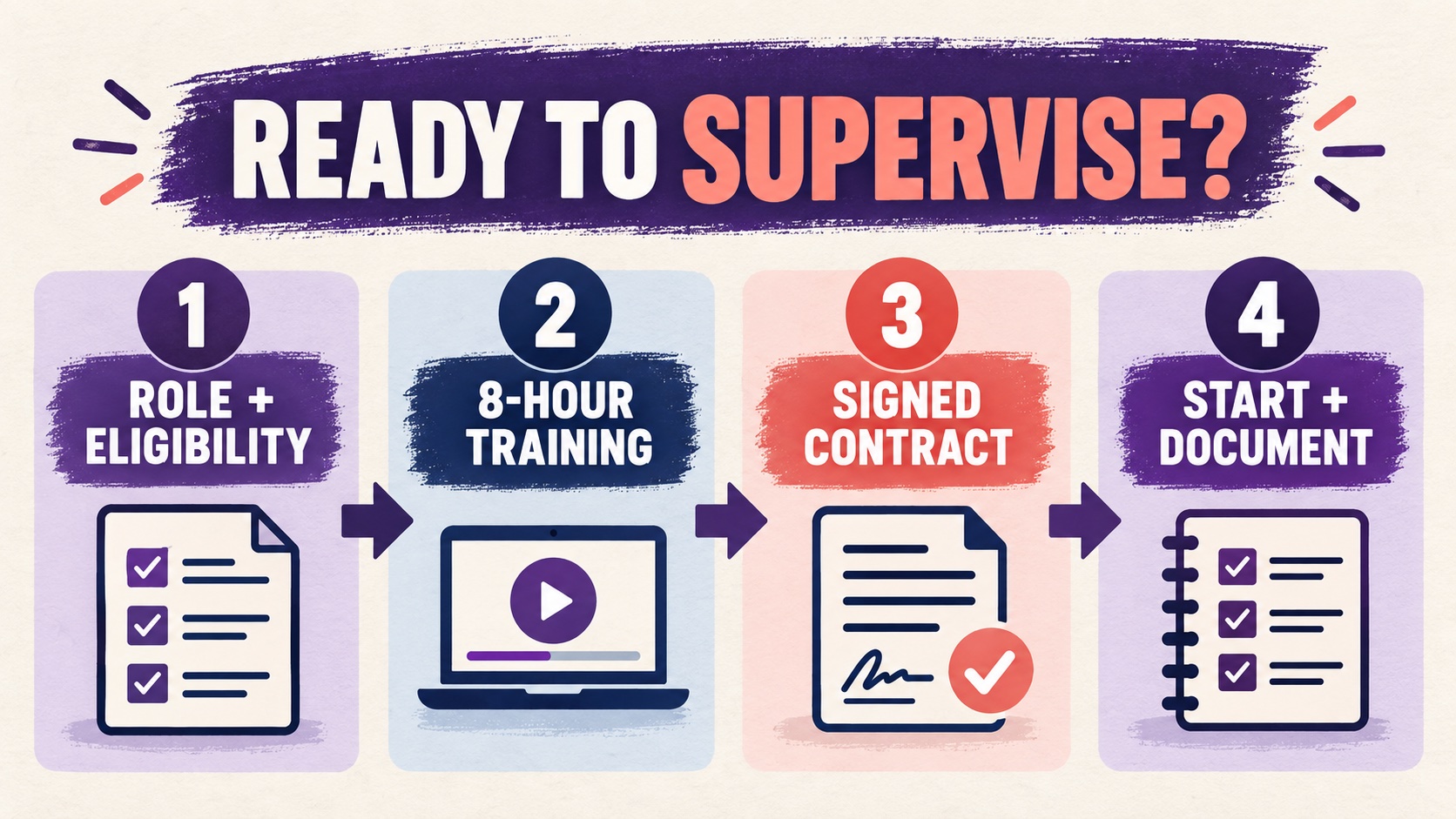
For the supervision relationships listed by the BACB, required supervisor training is a gate, not an optional professional-development suggestion. The current BACB supervision hub says that supervisors overseeing BCBA or BCaBA fieldwork and certain current BCaBA or RBT certificants who require ongoing supervision must complete an 8-hour training based on the Supervisor Training Curriculum Outline (2.0) before providing the applicable supervision.
The current curriculum outline also sets documentation expectations: an ACE provider, at least eight cumulative hours, opportunities to demonstrate verbal or practical competence, and confirmation of completion before the relationship begins. The completion document is evidence of the prerequisite; a course title containing “supervision” is not enough.
Check the training record for the provider, completion date, duration, curriculum basis, and any upload or approval step. Keep it with the supervision file. For the narrower course-versus-documentation question, see the site’s BACB supervision course guide.
3. Put the Scope in a Signed Supervision Contract
A contract turns an intention to supervise into an operational agreement. Before work begins, the parties should agree on the purpose, roles, meeting structure, feedback, evaluation, records, confidentiality, and conditions for changing or ending the relationship.
The contract should also explain missed meetings, performance concerns, when a supervisor may decline to sign a form, and how a transition will be planned. Those clauses make the decision path visible if a disagreement occurs.
For multiple supervisors, make the coordination rule explicit. State who communicates the overall plan, how overlapping supervision is documented, how each supervisor reviews the trainee’s work, and which person signs which form. The site’s BACB supervision contract guide for multiple supervisors covers that narrower clause-level task. The contract is not just a formality: it is the reference point for judging whether later hours, feedback, and signatures fit the agreed scope.
4. Plan Observation, Feedback, and Competence
Effective supervision standards are about what the trainee or supervisee can do, not simply how many meetings occurred. The Supervisor Training Curriculum Outline (2.0) describes planning supervision content, setting performance expectations, observing behavior, using behavioral skills training, delivering performance feedback, reviewing written work, and evaluating the effects of services and supervision.
Translate that principle into a recurring plan. Each supervisory period should have objectives, a way to evaluate performance, actionable feedback, and a record of what changed. The task might be a case conceptualization, data interpretation, program-writing exercise, role-play, observation, or report review. Connect it to the person’s role and credential pathway.
- Set a measurable objective before the meeting rather than only recording that a meeting happened.
- Use direct observation or a work sample when the skill cannot be evaluated from conversation alone.
- Give specific feedback, model the expected response when appropriate, and check for performance or understanding.
- Document the next practice opportunity and the criterion for improvement.
- Review whether the supervision itself is improving client, professional, and ethical performance.
5. Build an Evidence and Documentation System
Do not wait for a final form or audit request to reconstruct the relationship. Build the record system at the beginning: contract, notes, logs, observations, goals, feedback, evaluations, applicable forms, and training proof. For BCBA or BCaBA fieldwork, the official documentation resources are especially important. The BACB’s fieldwork hub points readers to the fieldwork checklist, the sample contract, forms, and a video about documenting fieldwork hours. The BACB’s current documentation guidance also emphasizes that both the trainee and supervisor should retain relevant records and that hours should be reviewed during the process, not only at the end.
- Choose one secure system and name the owner for keeping it current.
- Use dates that align across meeting notes, logs, forms, and the contract.
- Separate evidence of supervision from evidence of the underlying service when access or privacy rules require it.
- Review totals and signatures at each supervisory period.
- Keep a dated copy of the official form and handbook edition used for the decision.
If an organization uses multiple supervisors, reconcile the records before a monthly form is signed. The site’s monthly fieldwork verification form guide owns that specific form-entry task; this standards page explains why the form must match the contract and the underlying evidence.
6. Protect Ethics, Clients, and Continuity
Supervision standards are inseparable from client welfare and professional ethics. The BACB Ethics Code for Behavior Analysts provides the ethical foundation for BCBA and BCaBA applicants and certificants. A supervision system should make it possible to identify conflicts, protect confidentiality, provide competent oversight, respond to insufficient progress, and avoid accepting more supervisees than can be served effectively.
Build an escalation path into the relationship. If a supervisor is unavailable, progress is poor, a safety issue appears, a supervisee is outside competence, or a form cannot be signed honestly, document the next step: consultation, additional observation, corrective training, referral, a pause, or a planned transition. “We signed the form” does not resolve an ethical or service concern.
7. Control Requirement Changes During the 2027 Transition
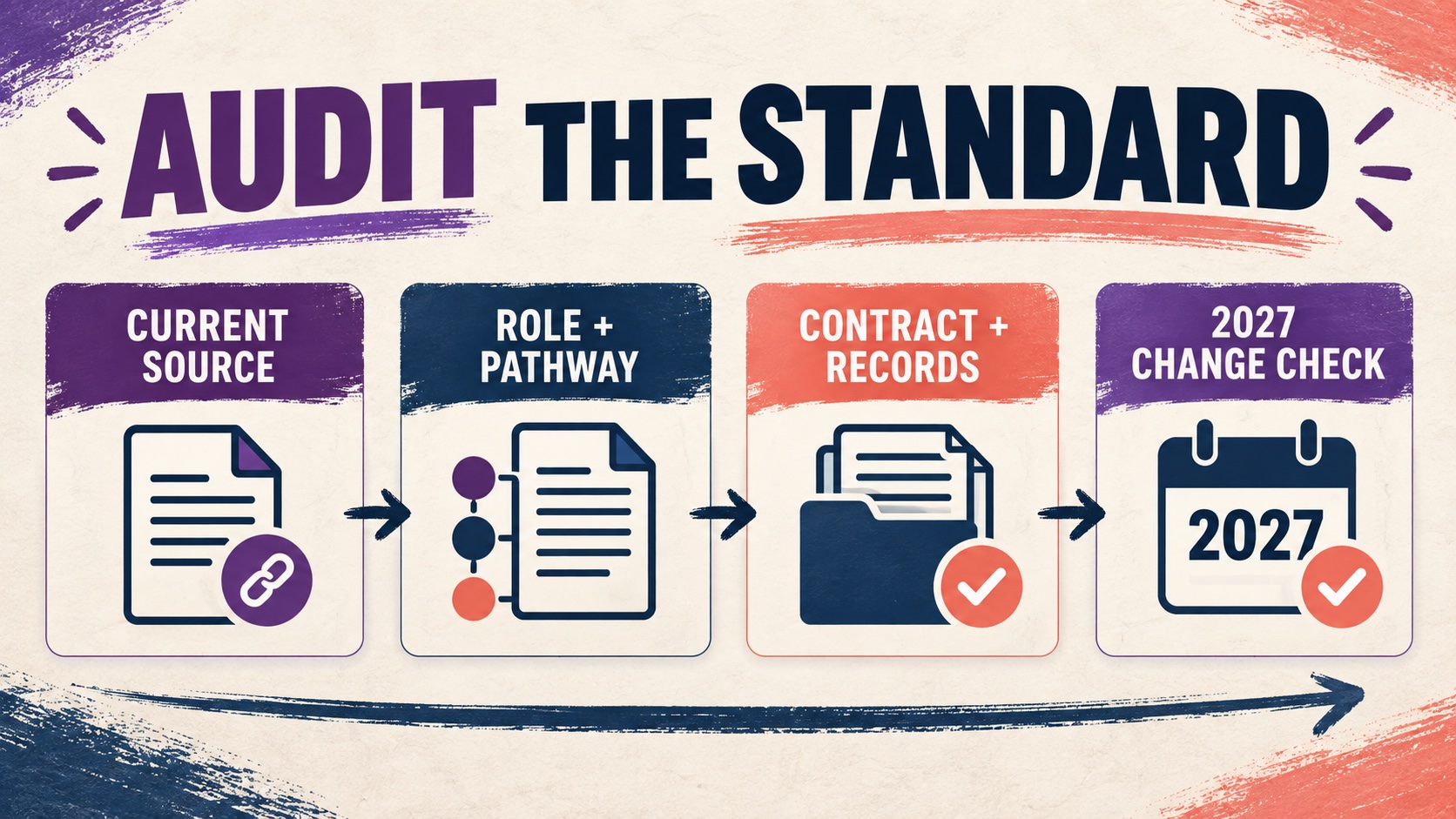
The 2027 transition adds a change-control problem to supervision planning. The BACB says significant BCBA and BCaBA certification changes take effect January 1, 2027, and provides separate requirement pages, transition guidance, handbooks, and forms. Those documents should be checked together when the applicant’s pathway, application timing, fieldwork dates, or form edition could change.
Do not label an old process “2027 compliant” merely because it contains a new date. Record the requirement edition, supervision start date, form version, and whether transition guidance changes the decision. Keep the current standard distinct from an exam-preparation article, third-party summary, or old screenshot.
- Version: save the official URL and the access date.
- Pathway: identify the credential route and application timing.
- Evidence: map the rule to the contract, logs, observation, and form.
- Review trigger: recheck when the credential, supervisor, setting, or requirement edition changes.
A Practical BACB Supervision Standards Self-Audit
Use this review before starting supervision and at regular checkpoints. Mark each item yes, no, or not applicable, then keep the result with the supervision record.
- The role and purpose of supervision are written in plain language.
- The supervisor’s credential and applicable eligibility conditions are verified.
- The required supervisor training is complete before applicable supervision begins.
- The contract is signed and names the scope, responsibilities, records, evaluation, and ending conditions.
- The meeting plan includes observation, feedback, practice, and competence evaluation where appropriate.
- Each supervisory period has dated evidence that matches the contract and form.
- Multiple-supervisor responsibilities and signatures are reconciled.
- The record system protects privacy and can support an audit without last-minute reconstruction.
- An escalation and continuity plan exists for missed supervision, concerns, or an ending relationship.
- The requirement edition and 2027 transition impact have been checked against current BACB sources.
A “no” answer is not automatically a violation, but it is a reason to pause and resolve the gap before signing the next attestation or allowing the problem to compound. If the answer is unclear, name the exact official source that must be reviewed instead of guessing from a search result.
Common Supervision Standards Mistakes
- Using a job title as proof: verify the credential, training, and handbook rules.
- Counting meetings: include objectives, observation, feedback, and evidence of progress.
- Signing first: reconcile dates, totals, signatures, and contract scope before attesting.
- Mixing rules or old PDFs: start with the official role page and current version date.
Frequently Asked Questions
Is there one official BACB supervision standards document?: No single document replaces the role-specific handbook, supervision hub, training curriculum, ethics code, and official forms. The current Supervisor Training Curriculum Outline (2.0) is an important source for training content, but it does not answer every fieldwork or ongoing-supervision question.
Who needs the 8-hour supervision training?: The BACB supervision hub identifies supervisors of BCBA or BCaBA fieldwork and certain current BCaBA or RBT certificants who require ongoing supervision. Confirm the current role, training status, and eligibility details in the official BACB resources before beginning supervision.
Does a signed contract prove that supervision meets BACB standards?: No. A contract is the agreed scope and responsibility framework. You still need appropriate supervision activities, observation or performance evidence, records, forms, ethical practice, and the qualification or training checks that apply to the relationship.
How should I handle multiple supervisors?: Define coordination, responsibilities, records, communication, and signatures before the relationship starts. Reconcile the documentation during each supervisory period. Do not assume that several individual logs automatically create one complete organization-level record.
Do the 2027 changes make every old supervision record invalid?: Do not make that assumption. Check the credential pathway, dates, current transition guidance, handbook, and form version that apply to the specific case. Keep the source and reasoning that support the decision.
Use practice separately from compliance research: After checking the current BACB source and your supervision records, use the free BCBA mock exam for independent terminology and application practice. It is study practice, not an official BACB supervision standard, handbook, or certification guarantee. Official Sources Used
- BACB Supervision, Assessment, Training, and Oversight
- BACB Supervisor Training Curriculum Outline (2.0), Version 05/2026
- BACB Supervising and Training Resources for BCBAs
- BACB BCBA Fieldwork Resource Hub
- BACB Documenting Fieldwork: Helpful Answers to Your FAQs
- BACB Ethics Codes
- 2027 BCBA Requirements
- 2027 BCBA and BCaBA Requirements: What You Need to Know
Take the Free BCBA Mock Exam
If you want a low-pressure way to check your recall, use the free practice resource below. Take the Free BCBA Mock Exam



