
ABA PROCEDURES · ETHICS AND ASSESSMENT The pros and cons of guided compliance ABA cannot be reduced to “physical prompting works” or “never use a prompt.” Guided compliance is a procedure with a history, a research base, possible side effects, and ethical limits. The right question is whether the learner’s goals, assent, function, safety, and data support the least intrusive effective approach.
Table of Contents
- What Is Guided Compliance ABA?
- What Are the Potential Benefits of Guided Compliance?
- What Are the Possible Risks and Drawbacks?
- How Do Assent and Ethics Change the Question?
- What Safeguards Should Come First?
- How Should a BCBA Compare Two Scenarios?
- What Are the BCBA Exam Takeaways?
- Frequently Asked Questions
- Sources for Further Study
- Take the Free BCBA Mock Exam
What Is Guided Compliance ABA?
Guided compliance generally refers to a sequence in which an adult presents an instruction, gives a prompt if the learner does not respond, and may use more intrusive guidance if the learner still does not complete the task. One version described in the literature uses a vocal instruction, a model or gestural prompt, and then physical guidance. The exact steps, timing, definition of compliance, and consequences vary across studies and clinical protocols.
That variation matters. “Guided compliance” is not a complete treatment plan, and “compliance” is not a meaningful goal unless the team can explain what skill the learner is acquiring and why it matters. A prompt may help a person complete a motor response they have chosen to learn. The same physical action may feel coercive when it overrides communication, removes a reasonable break, or targets harmless refusal simply because an adult wants immediate obedience.
Before weighing the procedure, identify the target response, the learner’s communication options, the function of refusal or problem behavior, the reinforcer, the prompt-fading plan, and the safety context. Without those details, the phrase can hide more than it explains.
What Are the Potential Benefits of Guided Compliance?
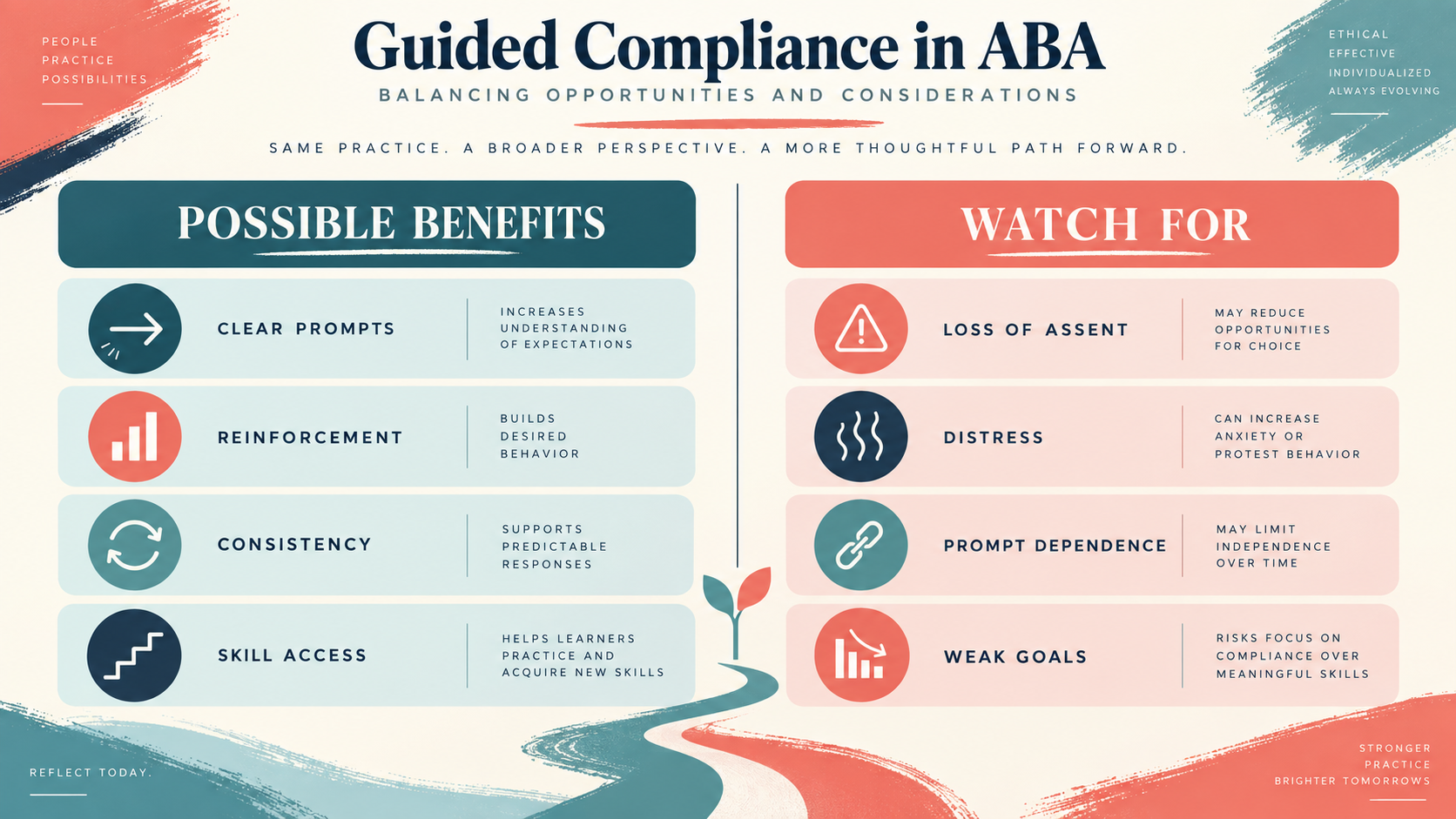
Research on three-step prompting and guided compliance has reported possible benefits in specific arrangements. A graduated prompt sequence can make an instruction clearer, reduce repeated verbal prompts, and help a learner contact reinforcement for completing a task. When the goal is a functional skill and prompts are faded systematically, physical guidance may provide information about the response topography that a learner cannot yet produce independently. Potential benefits may include:
- Prompt clarity: a learner receives a predictable level of support instead of a long chain of increasingly emotional verbal demands.
- Fast contact with reinforcement: completing a meaningful task, even with a prompt, may allow the learner to access a planned consequence and practice the response.
- Reduced prompt repetition: a defined sequence can help caregivers stop repeating the same instruction indefinitely.
- Caregiver consistency: training and rehearsal may improve treatment integrity when a clearly defined procedure is actually appropriate.
- Access to a motor response: careful graduated guidance can assist a person who wants to learn a movement but lacks the current motor control to complete it.
These are possible advantages, not guarantees. A small study with a particular population, task, prompt sequence, and consequence cannot prove that the same procedure will be effective or acceptable for every learner. The benefit should be measured as an independent, functional outcome—not simply as “the person stopped resisting.”
What Are the Possible Risks and Drawbacks?
The most important drawback is that guided compliance can produce an appearance of cooperation without teaching a useful choice, communication response, or independent skill. A learner may complete the task to end physical guidance rather than because the task has become easier, meaningful, or reinforcing. If prompts are not faded, the procedure can also create prompt dependence.
| Potential concern | What to monitor | Safer question |
|---|---|---|
| Coercion or loss of assent | Stopping signals, escape attempts, distress, and whether choices are honored. | How can the learner request a break, decline, or choose an equivalent response? |
| Problem behavior or emotional behavior | Changes in intensity, latency, aggression, self-injury, or distress during and after prompting. | Is the procedure making the task or interaction less safe? |
| Prompt dependence | Independent responding, prompt level, generalization, and maintenance. | What is the explicit fading and transfer plan? |
| Targeting harmless refusal | Whether the goal is social convenience rather than safety, access, communication, or autonomy. | Is this behavior actually harmful, or is it a valid communication of preference? |
Published studies also show why individual data matter. In one analysis, problem behavior was generally higher during guided-compliance conditions than during differential reinforcement for some participants. That does not make a universal statement about every prompting procedure; it does show why the team should monitor side effects rather than assume that task completion equals benefit.
How Do Assent and Ethics Change the Question?
The BACB Ethics Code defines assent as verbal or nonverbal behavior that can indicate willingness to participate when a person cannot provide informed consent. The exact requirements depend on the setting and applicable rules, but the ethical idea is practical: the learner’s signals should be observable, meaningful, and part of the service decision.
Assent is not the same as asking once, obtaining a nod, and then ignoring later distress. A respectful plan teaches or honors a functional stop or break response, offers choices where possible, explains the activity in understandable language, and treats repeated refusal as information. If immediate safety requires a protective response, that is a different question from using physical guidance to obtain routine compliance.
Ethical analysis also asks whether the goal is socially significant, whether the likely benefit outweighs the risk, whether the practitioner is competent with the procedure, and whether less intrusive options have been tried or reasonably considered. The client’s communication, culture, sensory experience, trauma history, medical needs, and preferences can change the answer.
What Safeguards Should Come First?
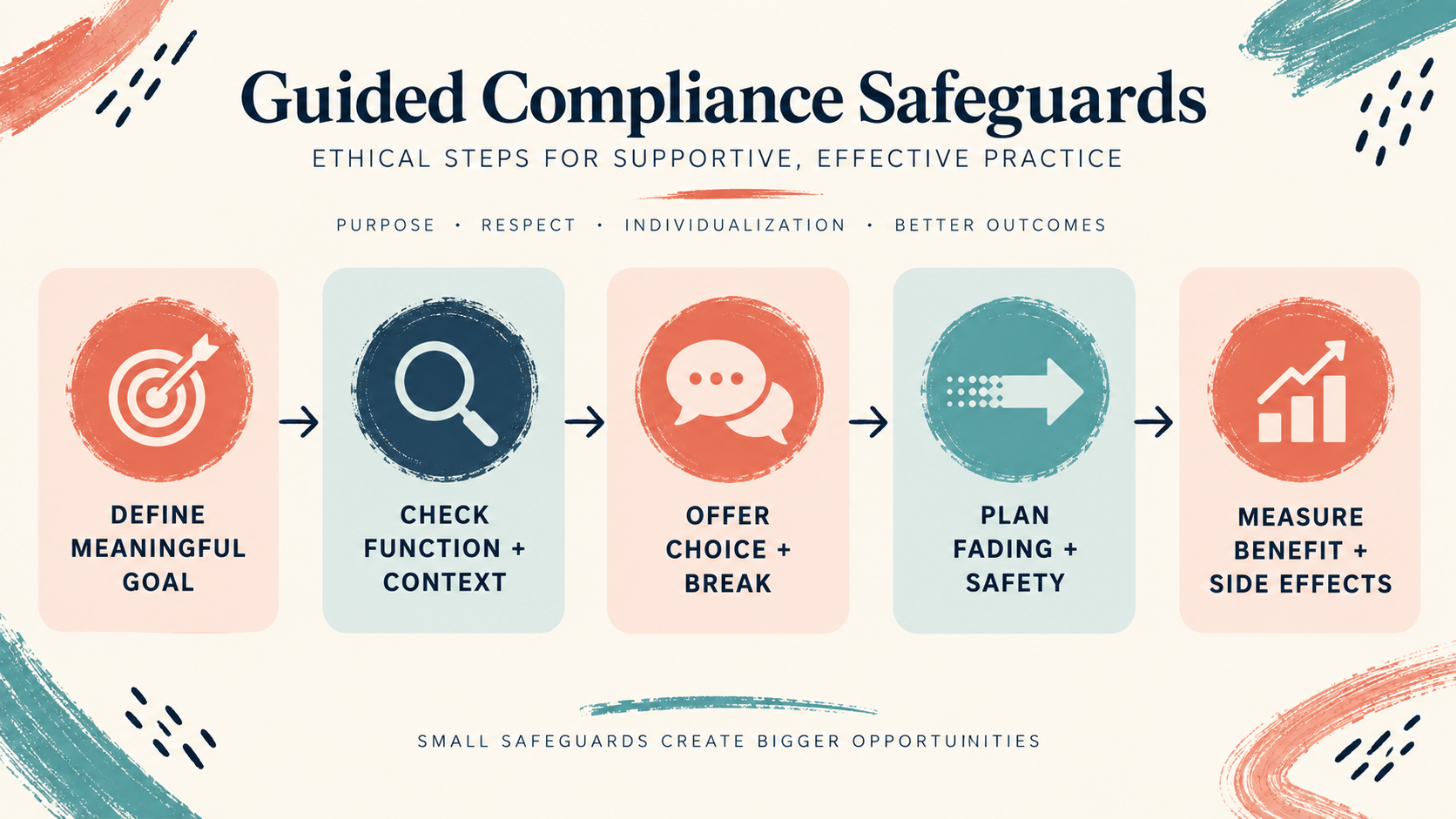
A BCBA learner can remember the following safeguard sequence:
- Define the goal. Name the skill or safety outcome, not just “compliance.” Explain why the learner and stakeholders should benefit.
- Assess the context. Consider task difficulty, communication, sensory variables, motivation, escape, attention, access, pain, and environmental demands.
- Offer communication and choice. Teach a break, help, all-done, protest, or alternative-choice response that will be honored within the safety plan.
- Use the least intrusive effective support. Start with clear instructions, choice, environmental arrangement, reinforcement, and appropriate prompting before escalating intrusiveness.
- Define stopping rules. Identify what signals pause, reassessment, caregiver consultation, medical referral, or an emergency procedure.
- Plan fading and generalization. Measure independent responding and reduce prompts systematically; do not let a prompted response become the only success measure.
- Review data and assent. Track the target outcome and side effects, then ask whether the learner is showing willingness and meaningful improvement.
This list is a decision screen, not a physical-prompt protocol. A client-specific procedure requires appropriate assessment, supervision, training, documentation, and safeguards. A learner should not improvise hand-over-hand guidance because an article or exam question mentioned guided compliance.
How Should a BCBA Compare Two Scenarios?
Imagine two cases. In the first, an adult is teaching a learner to place a chosen item into a container. The learner has a reliable “help” response, the item is meaningful, the prompt is brief and consent-compatible, reinforcement is available, and data show prompt fading and independent gains. In the second, staff repeatedly physically guide a learner through a non-preferred task, block a break request, record only “complied,” and continue despite distress.
Both cases could be described with words such as “physical guidance,” but they are not ethically or clinically equivalent. The first has a defined functional skill, communication, a fading plan, and outcome data. The second has a risk of coercion, weak measurement, and a failure to honor communication. The procedure name does not decide the case; the target, context, safeguards, and data do.
What Are the BCBA Exam Takeaways?
For a question about the pros and cons of guided compliance ABA, do not select an answer solely because it increases compliance quickly. Look for the option that identifies a meaningful target, functional assessment, assent or communication, least-intrusive support, reinforcement, prompt fading, safety, and measurement of both benefit and side effects.
- Three-step prompting may involve a vocal instruction, a model or gesture, and physical guidance, but procedures vary.
- A prompted response is not the same as independent skill acquisition.
- Compliance can improve while distress, escape behavior, or prompt dependence also increases.
- Assent and client dignity remain relevant even when a procedure is described as behaviorally effective.
- Research findings from small or specific studies should not be generalized into a universal recommendation.
For additional independent practice with ABA scenarios, the site’s free BCBA mock exam can be used as a study check. It is not BACB content and does not promise a passing result.
Frequently Asked Questions
Is guided compliance always unethical?: No single label answers every case. Ethical acceptability depends on the goal, function, assent, risk, competence, safeguards, and data. A procedure that helps teach a meaningful chosen skill is different from forcing harmless compliance while ignoring protest or distress.
Is guided compliance the same as least-to-most prompting?: They can overlap in the way prompts are arranged, but terminology varies. Least-to-most prompting usually describes increasing prompt intrusiveness, while guided compliance often refers specifically to completing an instruction after noncompliance. Read the actual steps and consequences rather than relying on the label.
What should a learner do if physical guidance causes distress?: Pause and raise the concern with the qualified supervisor or clinical team. Document the observable behavior and communication, ask what the safety and assent plan is, and do not improvise or continue a procedure beyond your training or authorization.
Sources for Further Study
- BACB Ethics Codes — current ethics resources and assent definition.
- Ethics Code for Behavior Analysts — current professional standards.
- Effects of Three-Step Prompting on Compliance with Caregiver Requests — prompting and caregiver training study.
- An Analysis of Modifications to the Three-Step Guided Compliance Procedure — participant-level guided-compliance findings and limits.
- Assent in Applied Behaviour Analysis and Positive Behaviour Support — practical assent considerations.
Take the Free BCBA Mock Exam
If you want a low-pressure way to check your recall, use the free practice resource below. Take the Free BCBA Mock Exam



