

When people search for BACB CEU events, they are often trying to answer a practical question: can this live session, webinar, recording, journal club, or podcast activity be counted toward continuing education? The safest answer is not “it has a BACB logo.” It is: verify the provider, the event type, the audience, the duration, the participation method, and the records you will receive.
Table of Contents
- In This Guide
- BACB CEU Events: What Counts?
- Event Versus Video, Course, or Certificate
- Which Formats Can a BACB CEU Event Use?
- How Presence and Participation Are Demonstrated
- Duration, Units, and Category Checks
- What to Save After the Event
- Common BACB CEU Event Mistakes
- Frequently Asked Questions
- Take the Free BCBA Mock Exam
The current BACB ACE Provider resources and the ACE Provider Handbook describe how Learning CE and RBT professional-development events are structured. Use those materials as the source of truth. A conference listing or course catalog can help you discover an event, but its marketing page is not a replacement for official verification.
In This Guide
BACB CEU Events: What Counts?
A BACB CEU event is a structured continuing-education activity offered by an authorized provider for an appropriate certificant audience. It should have defined content, learning objectives, an instructor or event structure, a stated duration, a way to confirm that participants were present and engaged, and documentation of completion. The exact requirements depend on the kind of event and the credential involved, so treat “event” as a format and compliance concept rather than a guarantee that every webinar counts.
For BCBA and BCaBA certificants, the relevant language is generally Learning CE. RBT professional development is a separate audience and recordkeeping context. The BACB’s current ACE Provider Verification Registry lets you check whether an organization or individual is authorized to offer the relevant type of event. It does not mean the BACB endorses every title in a provider’s catalog. That distinction gives you a useful first rule: verify the provider and the specific event. Do not count an event only because a page uses the phrases “BACB CEU,” “approved CEU,” or “certificate included.”
Event Versus Video, Course, or Certificate
A course can contain one or more events, and an event can be delivered as a live session, an online module, a conference presentation, or another structured format. The labels are less important than the requirements the activity actually meets. A video that anyone can play with no learning objectives, no participation check, and no reliable completion record may be useful education, but the page alone does not establish that it is a countable BACB event.
| What you see | What it may mean | What to verify |
|---|---|---|
| Live webinar | A synchronous event where the presenter and attendees participate at the same time | Provider status, start-to-finish participation, event objectives, duration, and completion record |
| Recorded module | An asynchronous event completed at the learner’s own pace | Active responding or knowledge checks, not only platform time, plus a usable certificate |
| Conference package | Several presentations or workshops grouped under one registration | Which sessions are included, their categories, attendance rules, and how each item is documented |
| Journal club | A structured group activity that reviews and critically evaluates research | Organized discussion, participation evidence, article limits, and provider documentation |
| Certificate-only offer | A marketing promise that may or may not describe a compliant event | Provider authorization, event structure, objectives, participation, category, and completion evidence |
Which Formats Can a BACB CEU Event Use?
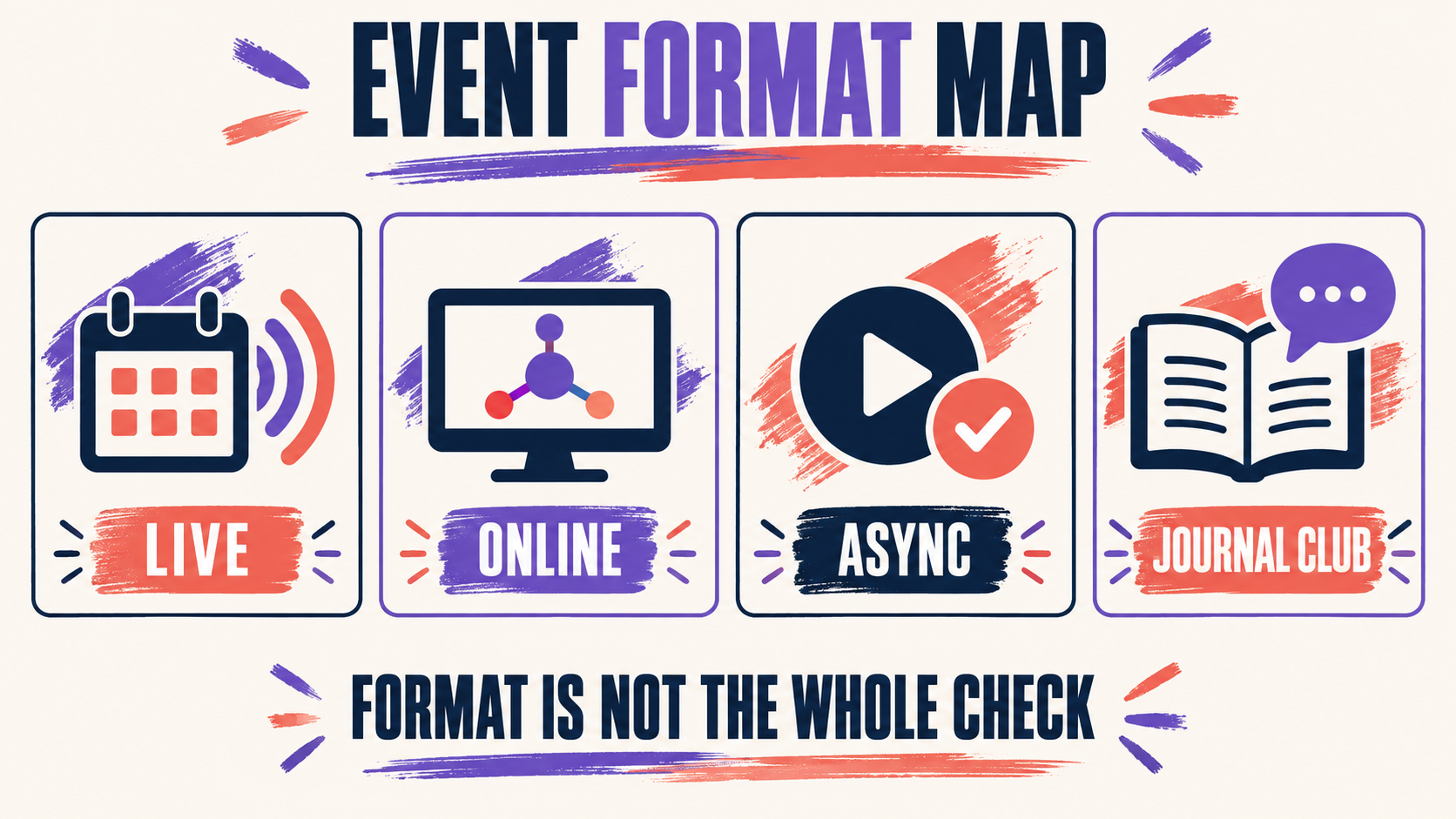
The ACE Provider Handbook allows both live and online delivery when the event meets the applicable requirements. A synchronous event occurs in real time, such as a live conference presentation, workshop, panel, or webinar. An asynchronous event is completed independently, such as an online module, recording, reading activity, or quiz-based lesson. Delivery mode alone does not determine whether the event counts.
For a live or synchronous event, ask how presence and participation are monitored. Signing in once, receiving a calendar invitation, or appearing in a video-conference log may not be the whole participation method. The provider should explain what attendees must do and how completion is recorded.
For an asynchronous event, look for active responding or another activity that shows engagement with the material. The 2026 handbook gives knowledge questions and other active-response activities as examples. Time logged into a learning platform as the sole measure is not a strong substitute for demonstrating participation. Read the provider’s instructions before you begin so you know which screens, quizzes, or activities must be completed.
Conference packages deserve extra care. A registration may give you access to many presentations, but access is not the same as completion. Save the program, select the sessions that apply to your credential, follow each attendance or assessment rule, and check whether the provider issues one combined certificate or separate documentation.
How Presence and Participation Are Demonstrated
A compliant event needs a way to show that the participant was present and engaged for the required activity. The method will vary with the format, but it should be more meaningful than a promise that you clicked “play.” Before enrolling, look for a clear explanation of the participation rule.
- Live attendance: the provider may use sign-in and sign-out, active responses during the event, or another method suited to the format.
- Online synchronous delivery: the provider should explain how participation is checked while the event is happening, rather than relying only on a platform attendance report.
- Asynchronous delivery: knowledge questions, quizzes, activities, or other active responses may demonstrate engagement with the content.
- Journal club: the group should discuss and critically evaluate the article; reading an article by yourself is not automatically the same activity.
- Podcast event: listening should be paired with an organized discussion or activity that demonstrates engagement, depending on the provider’s structure.
Do not confuse “I completed the login steps” with “the provider has documented the event correctly.” Your responsibility is to follow the event instructions and keep the resulting evidence. The provider remains responsible for using current forms and event procedures.
Duration, Units, and Category Checks
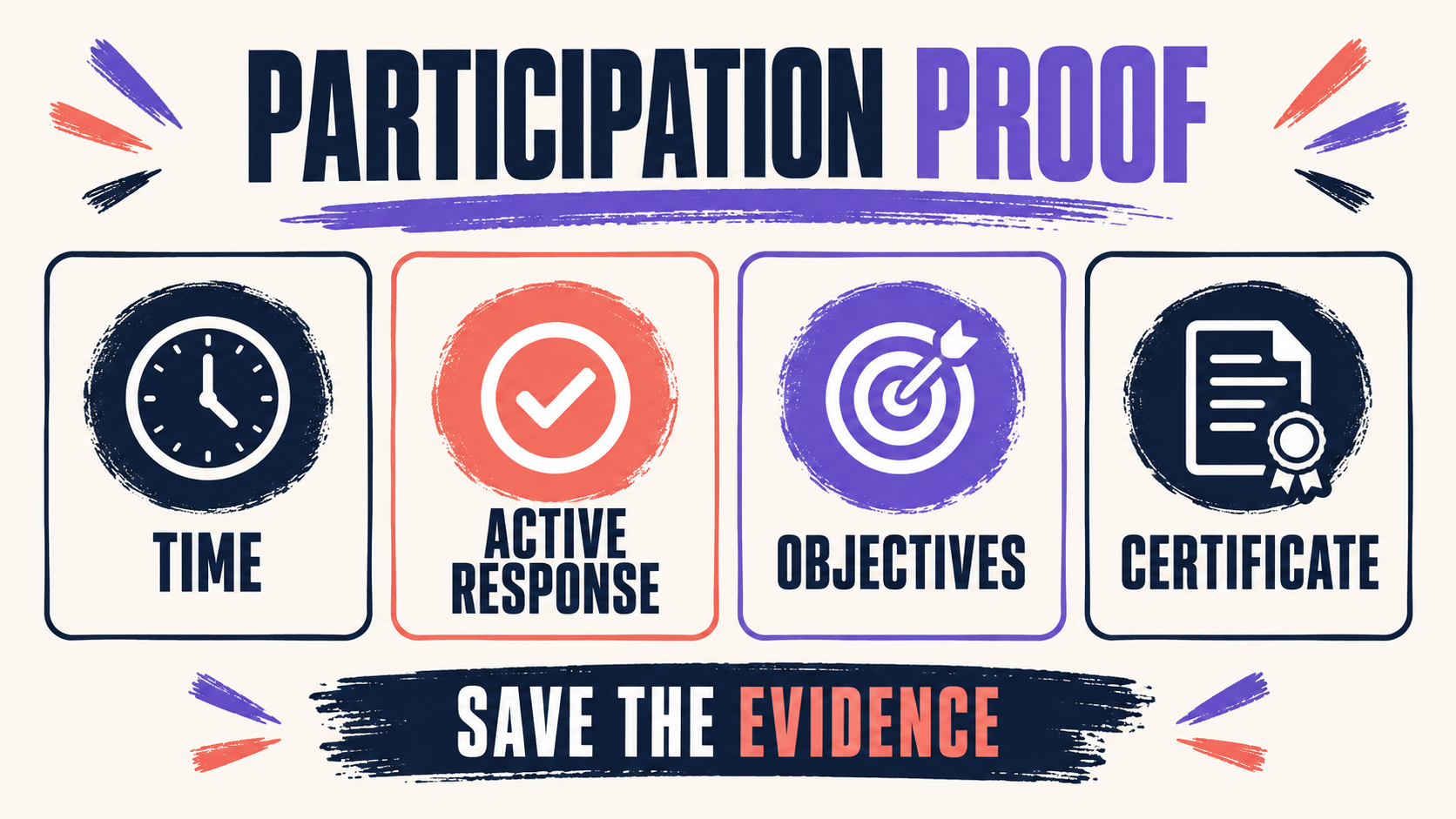
The ACE Provider Handbook states that an ACE event must include at least 25 minutes of instruction for 0.5 CEU or PDU, with additional credit awarded in 0.5-unit or 1-unit increments based on instruction time. Its examples include 50 minutes for 1 unit and 75 minutes for 1.5 units. Rounding up is not permitted when issuing credit. Always use the current handbook and the provider’s event record if the rules or form change. Duration is only one part of the decision. Also verify:
- your credential is included in the event audience;
- the course or event is offered under the correct Learning CE or professional-development context;
- the topic and objectives are relevant to your professional learning need;
- any ethics, supervision, or other category label is stated clearly; and
- the completion date falls inside the certification cycle you are tracking.
If you are shopping for a general BACB CEU course rather than evaluating the event format, see our separate BACB CEU courses guide. It covers provider, category, certificate, and cycle-fit comparisons. This page stays focused on whether the event itself has the structure and participation evidence you need.
What to Save After the Event
Create a record while the event is fresh. Save the registration or receipt, event page, learning objectives, program or agenda, attendance instructions, completed assessment or activity confirmation, certificate, and any provider email confirming completion. A certificate should connect your identity with the provider, event title, completion date, credit amount or duration, and relevant category or audience information when supplied.
For a conference or multi-session package, save the session list instead of relying on the package name. For an on-demand event, save the completion page and knowledge-check result if the provider makes them available. If the provider says a form or certificate will arrive later, note the expected delivery date and follow up before your renewal deadline. Use a tracker with these fields:
- provider name and registry check date;
- event title and format;
- credential audience and category;
- instruction time and credit awarded;
- completion date and certification cycle;
- participation or assessment evidence; and
- certificate file location and follow-up notes.
Common BACB CEU Event Mistakes
- Counting access instead of completion: registration, a replay link, or a conference badge does not necessarily prove that you completed the event.
- Assuming platform time is enough: a timer or login record may not be the provider’s only acceptable participation measure.
- Using the wrong audience: RBT professional development and BCBA/BCaBA Learning CE are not interchangeable labels.
- Rounding up the duration: use the event’s actual instruction time and current handbook rules.
- Saving only the certificate: keep the event description and participation evidence too, especially when the certificate is minimal.
- Using an old event listing: provider authorization, forms, and event requirements can change; recheck the current BACB sources.
Frequently Asked Questions
Are live BACB CEU events better than online events?: Not automatically. Both live and online formats can be permitted when the event meets the applicable requirements. Compare the provider, objectives, participation method, duration, category, and documentation instead of choosing by format alone.
Does watching a recorded webinar count as a BACB CEU event?: It may, if it is offered as a structured asynchronous event with appropriate participation or knowledge checks and completion documentation. Watching a recording found on the open web is not enough to establish that it is a countable event.
Can a conference registration count as CEUs by itself?: Registration gives you access; it does not necessarily prove that you attended or completed each session. Follow the provider’s session-level attendance and participation instructions, then save the program and certificate or other record.
Can a journal club or podcast earn BACB CEUs?: Some structured journal-club and podcast activities can be organized as learning events. The important distinction is active, organized engagement: independent reading or listening alone is not the same as a documented event with discussion, evaluation, or another participation measure.
What if the event page says “BACB approved” but I cannot find the provider?: Pause before counting it. Search the exact provider name in the BACB ACE Provider Verification Registry, ask the provider for clarification, and compare its answer with the current handbook and ACE Provider resources.
Continuing education and exam preparation are separate activities. If you are studying for the BCBA examination, our free BCBA mock exam can help you practice scenario-based questions; it is not a CEU event and does not replace your participation records. Try the Free BCBA Mock Exam For targeted review, use our bacb ceu events practice questions to apply the concept in exam-style scenarios.
Take the Free BCBA Mock Exam
If you want a low-pressure way to check your recall, use the free practice resource below. Take the Free BCBA Mock Exam



