
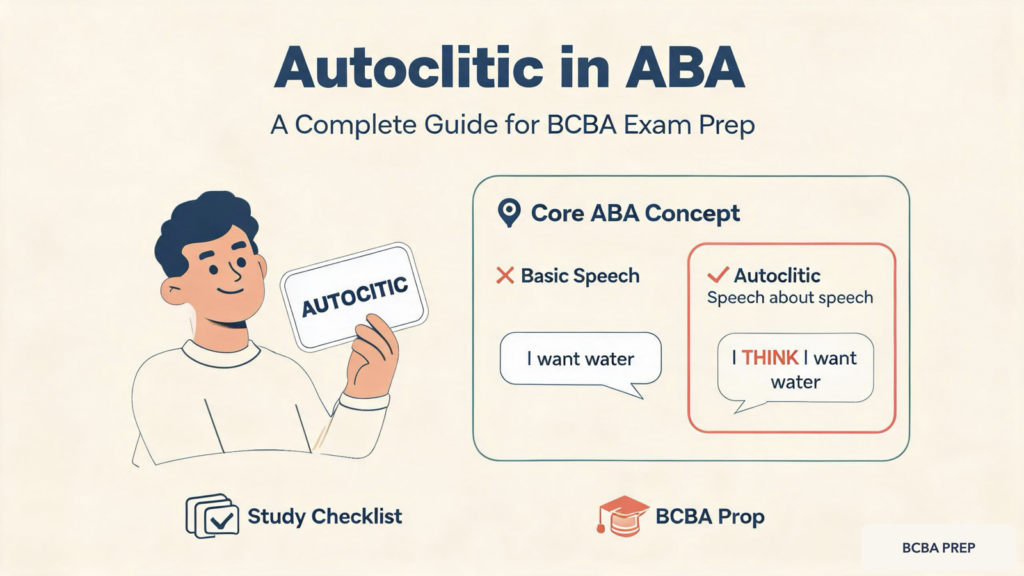
What Is an Autoclitic? Definition and Core Concept
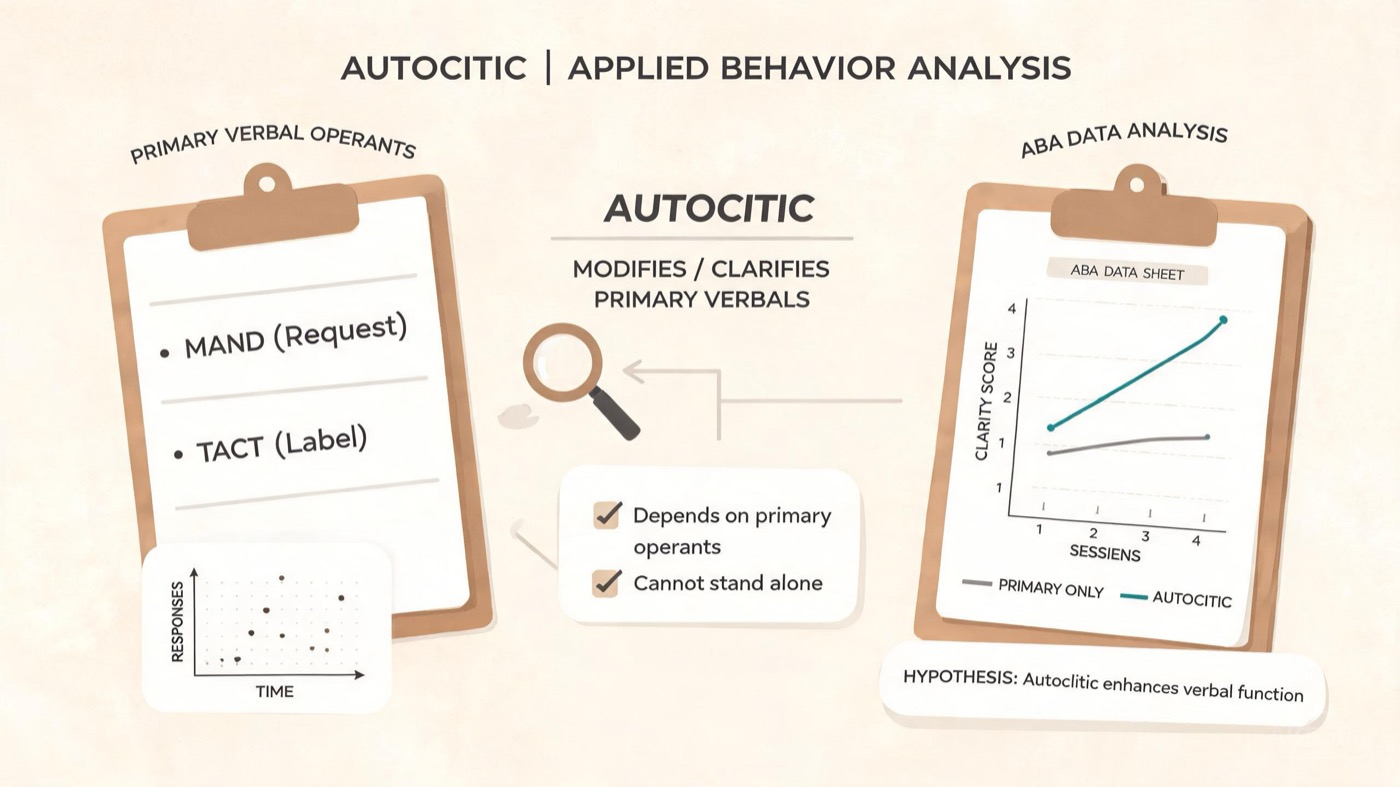
In applied behavior analysis, an autoclitic is a verbal operant that modifies or clarifies the function of other verbal behavior. Unlike a mand or tact, the autoclitic does not stand alone; it depends on primary verbal operants such as tacts, mands, or intraverbals. For example, in the statement “I think it’s a dog,” the phrase “I think” is an autoclitic that qualifies the speaker’s certainty.
Table of Contents
- What Is an Autoclitic? Definition and Core Concept
- Autoclitic Examples with ABC Analysis
- Why Autoclitics Matter for the BCBA Exam
- Summary: Master Autoclitics for Exam Day
- References
Think of the autoclitic as a secondary layer of language that adds nuance—like expressing doubt, negation, or intensity. On the BCBA exam, you may be asked to identify whether a phrase serves as an autoclitic versus a simple tact or intraverbal.
The Relationship Between Autoclitic and Primary Verbal Operants
Autoclitics always accompany a primary verbal operant. The primary operant carries the main content, while the autoclitic modifies it. Here are key points:
- Mand + Autoclitic: “I really want water” — ‘really’ strengthens the mand.
- Tact + Autoclitic: “That is probably a cat” — ‘probably’ weakens the tact.
- Intraverbal + Autoclitic: “I believe the answer is 4” — ‘I believe’ indicates uncertainty.
- Autoclitics can also combine with echoics or textuals (e.g., “I think I heard ‘yes'”).
On the exam, remember: the autoclitic’s function is to qualify the primary verbal operant, not to replace it. Misidentifying a tact as an autoclitic is a common error.
Autoclitic Examples with ABC Analysis
Let’s examine two concrete examples using an ABC (antecedent-behavior-consequence) framework to understand how autoclitics function in real interactions.
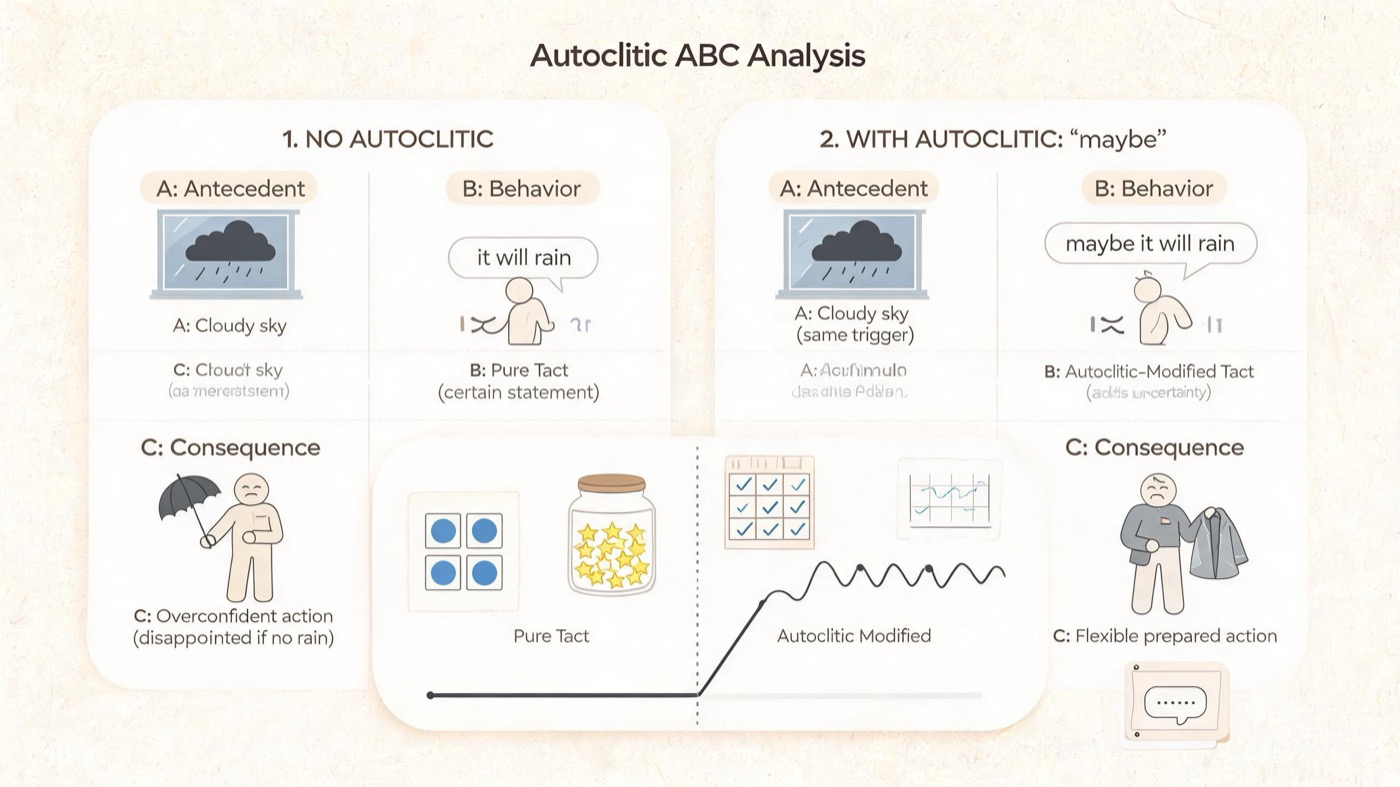
Example 1: Qualifying a Statement (“Maybe it will rain”)
- Antecedent: A friend asks, “Do you think it will rain today?”
- Behavior: The speaker says, “Maybe it will rain.”
- Consequence: The listener nods and says, “We’ll see.”
- Function of autoclitic ‘maybe’: Reduces the risk of being wrong; the speaker is not fully committed.
The autoclitic ‘maybe’ modifies the tact “it will rain” by adding uncertainty. Without ‘maybe’, the statement would be a pure tact. This distinction is important for exam questions asking you to identify the function of the autoclitic.
Example 2: Self-Editing (“No, that’s not right”)
- Antecedent: The speaker initially says an incorrect answer.
- Behavior: The speaker immediately says, “No, that’s not right.”
- Consequence: The listener corrects the statement or waits for the correct one.
- Function of autoclitic ‘no’: Negates the prior tact and signals a correction.
Here, ‘no’ is an autoclitic that negates the preceding statement. This is a common example of autoclitic self-editing. The autoclitic does not introduce a new tact; it modifies the previous one.
Example 3: Adding Emphasis (“That is absolutely amazing!”)
- Antecedent: The speaker sees a spectacular performance.
- Behavior: The speaker says, “That is absolutely amazing!”
- Consequence: The performer smiles and thanks the speaker.
- Function of autoclitic ‘absolutely’: Intensifies the tact ‘amazing’ to convey strong approval.
This example shows an autoclitic that strengthens the primary operant. ‘Absolutely’ does not change the basic tact but amplifies its intensity. On the exam, you may be asked to distinguish such intensifiers from tacts.
Why Autoclitics Matter for the BCBA Exam
The BCBA exam often includes questions on verbal operants, and autoclitics are frequently tested. You may need to identify autoclitics in transcripts, determine their function, or differentiate them from other operants.
Common test formats include:
- Multiple-choice scenarios where you select the verbal operant(s) present.
- Definition matching (e.g., “Which operant modifies another operant?”).
- Identify the function of an autoclitic in a given example.
Common Traps and How to Avoid Them
Many candidates confuse autoclitics with other verbal operants. Here are the most common traps:
- Trap 1: Confusing autoclitic with listener behavior. Remember: autoclitic is speaker behavior that modifies the speaker’s own verbal behavior, not listener’s response.
- Trap 2: Misidentifying grammar as autoclitic. For example, verb tense changes (“run” vs. “ran”) are not autoclitics; they are grammatical inflections. Autoclitics are separate words or phrases (e.g., “maybe”, “really”).
- Trap 3: Overgeneralizing entire statements as autoclitic. Only the modifying part is autoclitic; the rest is the primary operant. In “I wonder if it’s time,” only “I wonder if” is autoclitic.
Avoid these traps by focusing on the specific function of each component. Practice with mock questions that require you to isolate the autoclitic.
Quick Prep Checklist
Use this checklist to solidify your understanding before exam day:
- Define autoclitic in your own words (secondary verbal operant that modifies a primary operant).
- Identify the autoclitic in at least three sentences (e.g., “He definitely left,” “I suppose it’s fine,” “No, that’s wrong”).
- Distinguish autoclitic from mand, tact, intraverbal, echoic, and textual.
- Explain the function of each autoclitic (e.g., negation, intensification, qualification).
- Analyze an ABC example and label the primary operant and autoclitic separately.
For more practice, check out our Verbal Operants BCBA Exam Guide which includes sample questions and detailed explanations. You can also read the BACB’s Task List for further clarification on verbal behavior.
Summary: Master Autoclitics for Exam Day
Autoclitics are a subtle but essential part of verbal behavior. They allow speakers to qualify, quantify, negate, or intensify their own statements. For the BCBA exam, remember:
- Autoclitics depend on a primary verbal operant.
- They modify the meaning or function of the primary operant.
- Common autoclitics include words like ‘maybe’, ‘really’, ‘not’, ‘absolutely’, ‘I think’.
- Watch out for traps: don’t confuse autoclitics with grammar or listener behavior.
By mastering autoclitics alongside other verbal operants, you’ll be well-prepared for exam questions on verbal behavior. Keep practicing with real-world examples and review the BACB’s resources to deepen your understanding.
References
Next step for BCBA exam prep
Turn this topic into exam-day practice
Use this topic as a focused review, then test it in exam-style conditions with a free mock before deciding whether five full-length mocks are the right next step.
Start the Free BCBA Mock ExamContinue with Five Full-Length Mocks — $99
Review the included materials and access details before ordering. No pass guarantee is implied.



