

Attending goals ABA should describe an observable response in a meaningful context, not simply say “pay attention.” A useful goal tells the team what to look for, when to look for it, how to measure it, and what level of performance counts as progress.
Table of Contents
- In This Guide
- What Does Attending Mean in ABA?
- The Measurable Attending-Goal Formula
- Strong Versus Weak Attending-Goal Examples
- How to Measure Attending
- Keep the Goal Meaningful and Generalizable
- How to Review Progress
- How Attending Goals Connect to the BCBA Exam
- Attending Goals ABA FAQ
- Take the Free BCBA Mock Exam
Attending is also more than forced eye contact. Depending on the learner and activity, the relevant response may be orienting toward a speaker or item, responding to an instruction, looking at task materials, remaining engaged with a functional activity, or checking a visual cue. The behavior analyst should select a socially meaningful response with the learner and stakeholders, define it clearly, and use data to decide whether the goal is helping.
In This Guide
What Does Attending Mean in ABA?
In ABA, attending is not a single universal topography. It is a label for behavior that shows functional engagement with a person, instruction, material, activity, or relevant environmental cue. The observable definition depends on the learner’s goal. For one learner, attending may mean orienting to a communication partner long enough to receive an instruction. For another, it may mean manipulating task materials and responding to a visual schedule without leaving the activity.
Start with the outcome, not the appearance. If the purpose is to participate in group instruction, the target might be orienting to the teacher or task, following the group cue, and responding within a reasonable interval. If the purpose is independent work, looking at the page for one second is not necessarily the outcome; completing the next task step may be more meaningful. A goal should capture the behavior that makes learning, communication, safety, or independence more likely.
The current BACB BCBA Test Content Outline places measurement, behavior-change procedures, and intervention selection within exam scope. That makes attending-goal wording a useful practice topic: the goal must be observable enough to measure and meaningful enough to guide intervention.
The Measurable Attending-Goal Formula
A practical formula is: When [condition] occurs, the learner will [observable attending response] for [amount or quality] in [number or percentage] of opportunities across [sessions or settings]. Add a measurement definition and mastery criterion that the team can apply consistently.
For example: “When the teacher presents a group instruction and the visual cue is available, the learner will orient toward the teacher or task within 3 seconds and remain engaged until the instruction ends in at least 80% of opportunities across three consecutive sessions.” This is not a universal template. It is a model showing the parts that make a goal testable.
- Condition: state the instruction, activity, cue, or environmental event that begins the opportunity.
- Observable response: describe what an observer can see or hear without guessing about an internal state.
- Criterion: state the required duration, latency, frequency, percentage, or task completion level.
- Measurement: name the system and define what counts as an opportunity, correct response, and error.
- Mastery: specify the number of sessions, people, materials, or settings needed before calling the goal met.
Avoid putting several unrelated skills into one attending goal. “Will sit, look, listen, follow directions, answer questions, and complete all work” is difficult to interpret because a learner may improve in one component while another remains unchanged. Split the response class when the instructional decisions, measurement systems, or supports differ.
Strong Versus Weak Attending-Goal Examples
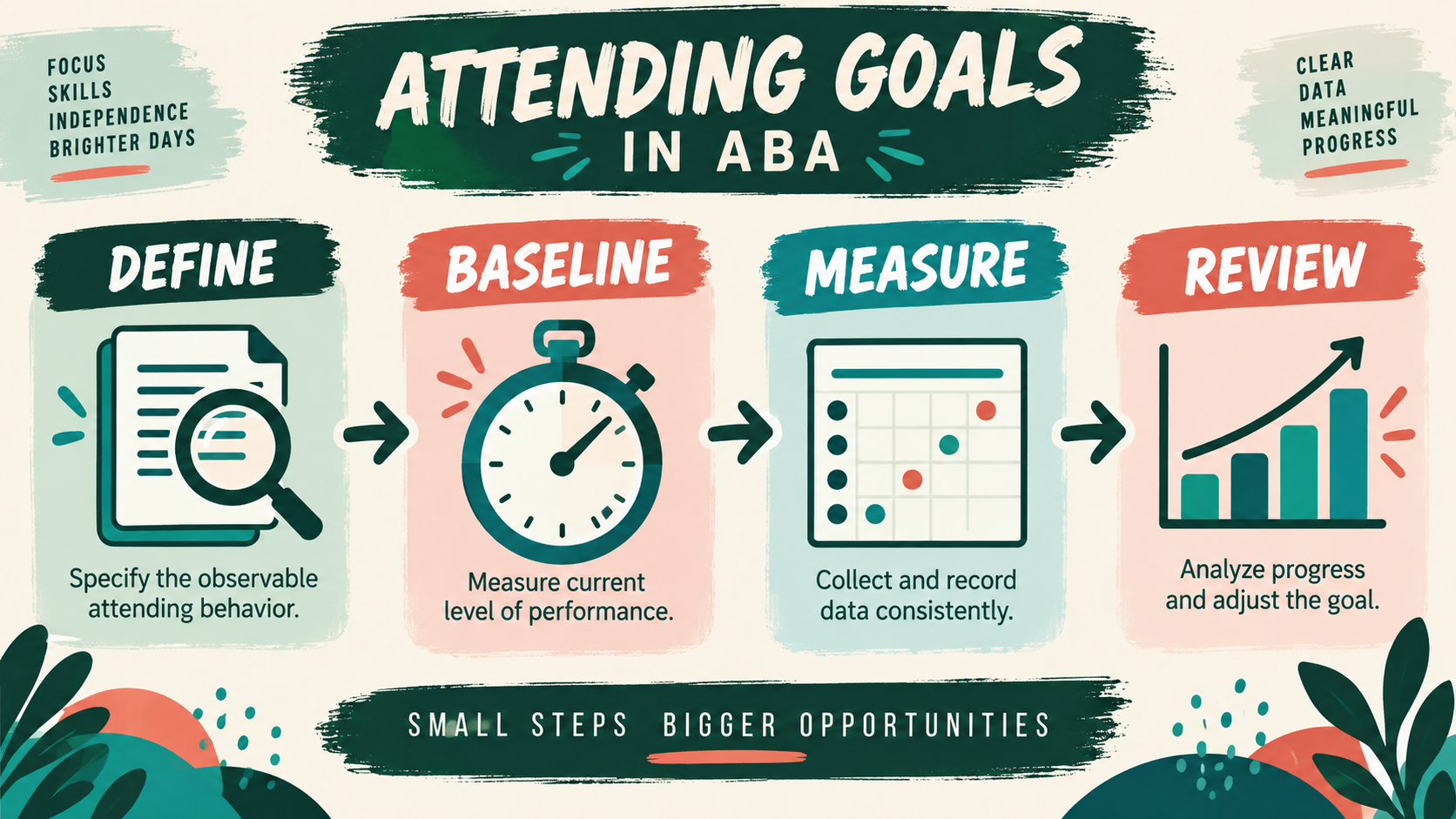
The same general intention can produce a measurable goal or a vague sentence. Use the table as a writing check, not as a ready-made clinical prescription.
| Weak wording | Stronger direction | What changed? |
|---|---|---|
| Pay attention in class. | Orient to the teacher or task within 3 seconds of a group instruction in 4 of 5 opportunities. | The response, condition, latency, and opportunity count are visible. |
| Stay focused longer. | Remain engaged with the assigned task for 6 minutes, with the defined break procedure available. | The duration and context can be measured. |
| Make eye contact when spoken to. | Orient toward the communication partner or relevant item and respond to the instruction within the defined interval. | The target emphasizes functional attending rather than a single appearance. |
| Improve attention by the end of treatment. | Use the defined attending response across two people and two activities at the stated mastery level. | The generalization requirement is explicit and reviewable. |
A stronger goal is not necessarily a longer goal. The useful test is whether two trained observers would agree about when an opportunity occurred, whether the response happened, and what data should be graphed.
How to Measure Attending
Choose the measurement system after defining the response. Different attending goals call for different measures:
- Latency: useful when the question is how quickly the learner orients or begins the task after an instruction.
- Duration: useful when sustained engagement is the target and the beginning and end of attending can be identified.
- Frequency or rate: useful when the target is a countable response, such as orienting to a cue or checking a schedule.
- Opportunity-based percentage: useful when each instruction or teaching trial creates a clear opportunity to respond.
- Partial- or whole-interval recording: useful in some settings when continuous measurement is impractical, but the team must understand what the interval estimate does and does not show.
Do not use percentage simply because it looks precise. If opportunities vary dramatically by session, a percentage can hide important context. If the goal is sustained engagement, a duration measure may answer the clinical question better. If the target is starting work, latency may be more informative than total minutes seated.
Define the start and stop rules. For example, “engaged” might require hands interacting with task materials, responding to the instructor, or orienting to a relevant visual cue; it should not be left to the observer’s impression. Also decide how prompts, breaks, competing events, and unavailable materials are recorded.
Keep the Goal Meaningful and Generalizable
Attending goals should support a meaningful activity rather than make a person look compliant for its own sake. Ask what the learner gets access to when attending improves: communication, a preferred activity, classroom participation, daily living, safety information, or independent choice. Include the learner’s preferences, sensory needs, communication mode, culture, and context when selecting the response.
Plan generalization deliberately. A learner may orient to a familiar therapist at a table but not to a teacher in a group, a parent at home, or a community sign. Move across people, materials, settings, and activities only when the learner is ready and the change remains socially valid. Generalization is not proof that the original goal was mastered; it is a separate performance question that should be measured.
- Use more than one communication partner when the goal requires social responding.
- Vary materials without changing the essential response definition.
- Include natural routines instead of measuring only at a training table.
- Teach a functional break or help response when sustained engagement is effortful.
- Review whether the target increases access and independence, not just adult convenience.
How to Review Progress
Graph the chosen measure and review trend, level, variability, and contextual changes. If the graph is flat, do not immediately label the learner unmotivated or simply raise the demand. Check whether the definition is clear, the opportunity is available, the prompt and reinforcement procedures are implemented as designed, the task is accessible, and the goal remains important.
A goal may need revision when the learner meets the criterion easily, the response does not generalize, the measure is unreliable, or the target creates an unwanted tradeoff. A good review asks whether the learner is communicating more effectively, participating in a valued activity, and gaining independence—not merely whether the learner is looking in the expected direction.
How Attending Goals Connect to the BCBA Exam
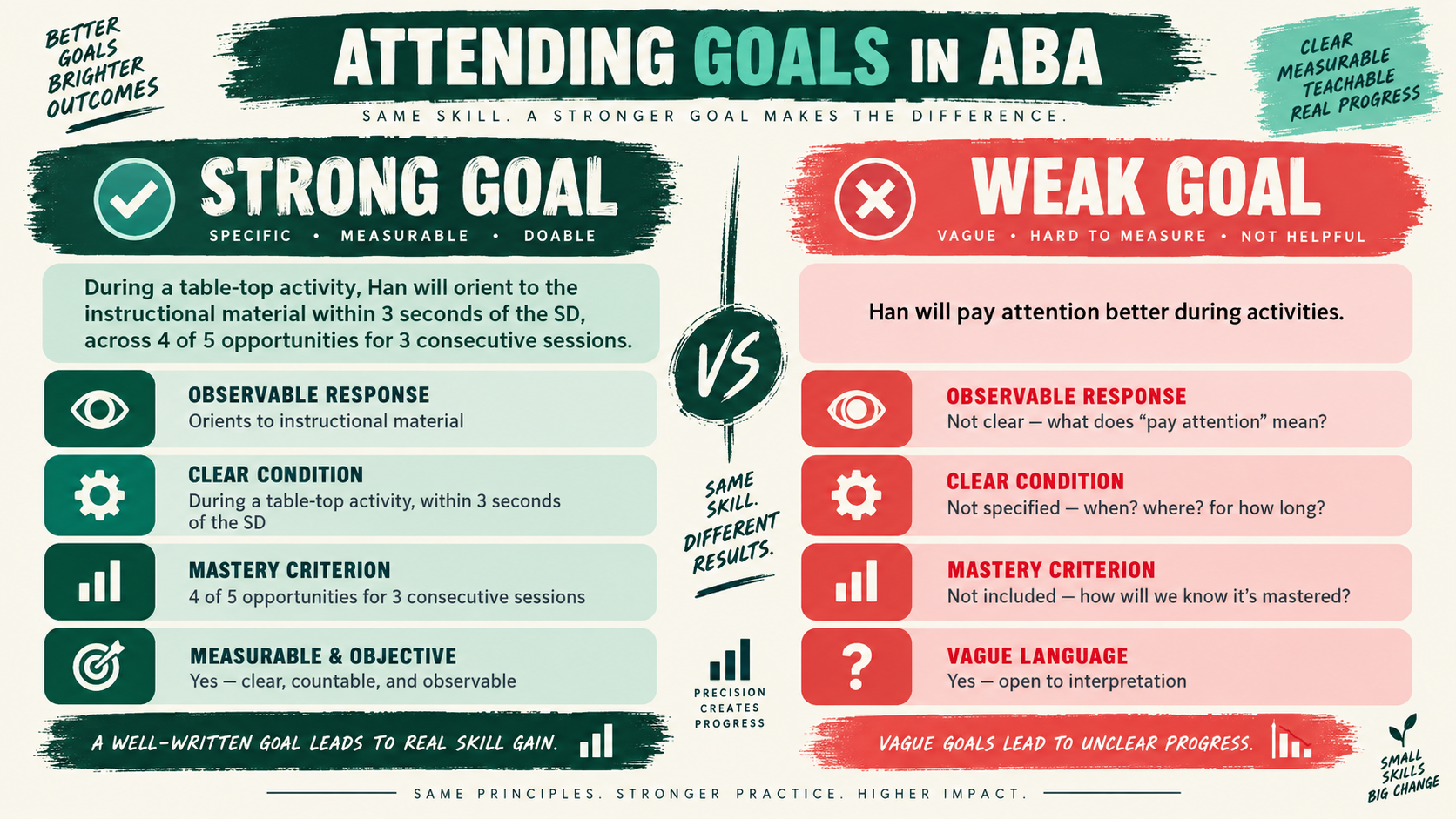
On a BCBA exam item, look for the measurement and intervention logic. A vague target such as “pay attention” is weaker than a definition that identifies the condition, observable response, criterion, and measurement system. The correct answer may ask you to operationally define attending, select a duration or latency measure, establish baseline, or revise the goal to include a functional context.
The current BCBA Test Content Outline is the source for exam scope. Use the scenario details to distinguish a data problem from a goal-writing problem: if observers disagree about what counts as attending, improve the definition; if the definition is clear but performance changes by setting, examine generalization and contextual variables; if the measure does not match the response, select a better measurement system.
For more practice with measurement, intervention selection, and scenario wording, try the free BCBA mock exam. The goal is not to memorize one attending sentence; it is to recognize the decision rule that makes a target observable, meaningful, and measurable.
Attending Goals ABA FAQ
Is eye contact required in every attending goal?: No. Eye contact is only one possible response and may not be the most functional or respectful target for a particular learner. Define the attending response that supports the actual activity, communication, safety, or independence outcome. What should an attending goal include?: Include a clear condition, observable response, criterion, measurement system, and mastery rule. Add the people, materials, settings, or activities needed for meaningful generalization.
Should I measure attending with duration or percentage?: It depends on the response and opportunity structure. Duration fits sustained engagement; latency fits starting or orienting; opportunity-based percentage fits discrete, countable opportunities. Choose the measure that answers the question the team needs to make a decision.
Can I use these examples as a treatment plan?: No. These are educational writing examples. A qualified behavior analyst should individualize targets with the learner and stakeholders, review baseline and context, and modify the plan based on data and social validity.
What is the exam-ready takeaway?: A strong attending goal says what the learner will do, when the opportunity occurs, how performance is measured, and what criterion counts as progress. “Pay attention” is a starting idea, not a measurable target. For targeted review, use our attending goals aba practice questions to apply the concept in exam-style scenarios.
Take the Free BCBA Mock Exam
If you want a low-pressure way to check your recall, use the free practice resource below. Take the Free BCBA Mock Exam



