
Searchers who type after the BCBA has conducted initial training are usually asking a narrow role question: once a BCBA has trained parents or staff on a behavior intervention plan, may the RBT provide an occasional refresher when implementation looks incorrect? The safest exam answer is not “the RBT can do anything the BCBA once demonstrated” and not an unsupported universal statement that an RBT can never support training.
Table of Contents
- In This Guide
- The Direct Answer: Follow the Plan and Escalate Training Questions
- The RBT Role After Initial BCBA Training
- Implementation Feedback Versus Refresher Training
- What to Do When Implementation Is Incorrect
- When the BCBA or Supervisor Must Direct Next Steps
- What the RBT Should Document
- How to Answer the BCBA Exam Question
- After Initial BCBA Training FAQ
- Take the Free BCBA Mock Exam
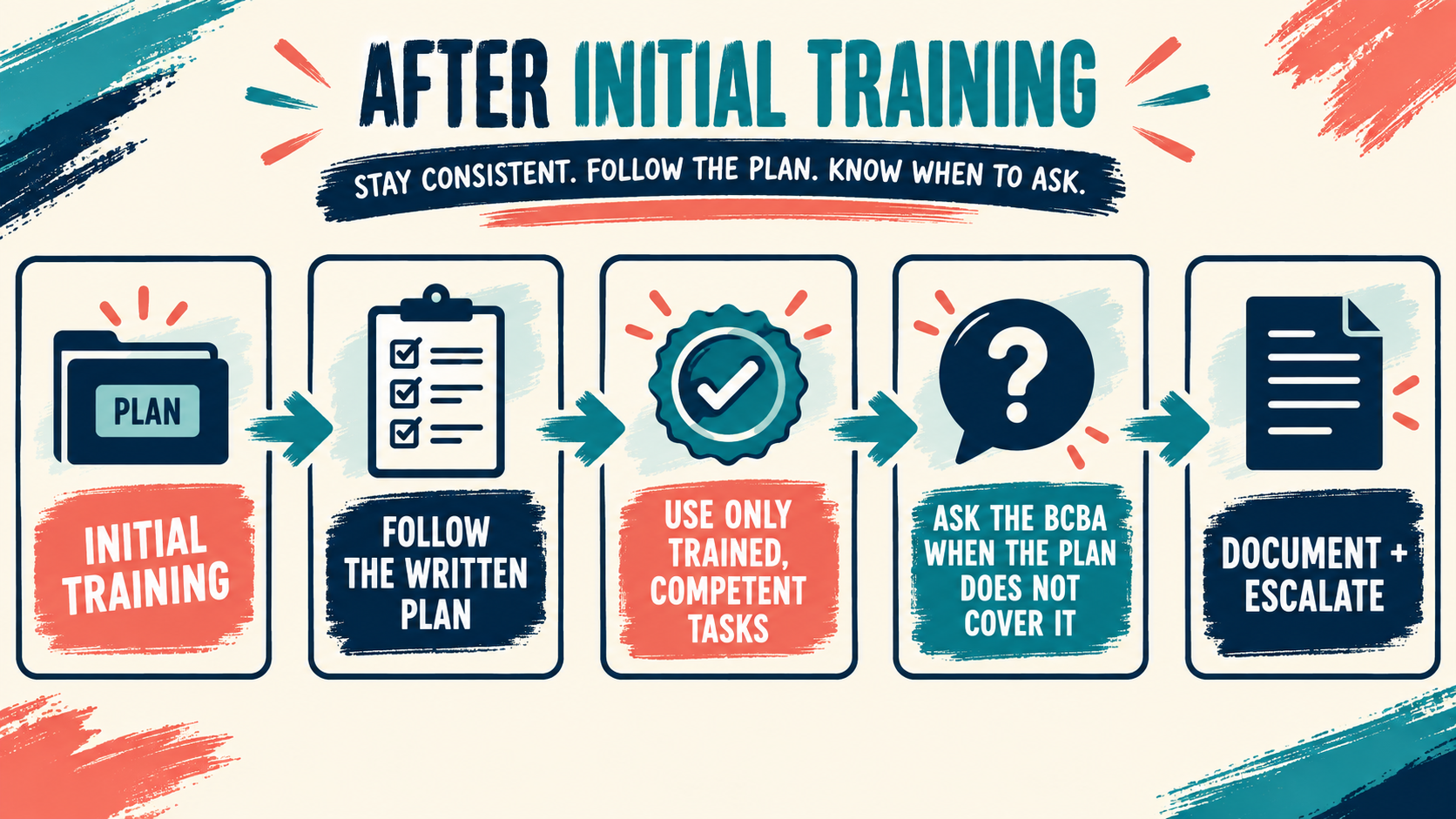
After initial BCBA training, an RBT should work within the current written plan, assigned role, competence, supervision arrangement, and employer procedures. The RBT can implement as trained, collect and document data, describe what was observed, and promptly bring a training or plan problem to the responsible supervisor. A refresher session should be directed or authorized through that supervisory process rather than invented by the RBT from an observation alone.
In This Guide
The Direct Answer: Follow the Plan and Escalate Training Questions
The question is often written as: “After the BCBA has conducted initial training with parents on the child’s behavior intervention plan, is it okay for the RBT to provide an occasional refresher if the RBT observes incorrect implementation?” A strong answer is: not automatically. The observation gives the RBT a reason to document and communicate the concern; it does not, by itself, authorize the RBT to redesign the plan or independently take over caregiver training.
Use the current BACB supervision and training resources, the RBT Handbook, and the supervisor’s written direction to identify what is allowed in the specific setting. The RBT’s next step may include a brief reminder or modeling only when that action is already within the plan, training, competence, and supervision arrangement. When the situation requires a new explanation, a change in procedure, competency assessment, or formal caregiver training, the RBT should refer it to the BCBA or responsible supervisor.
The RBT Role After Initial BCBA Training
An RBT is a paraprofessional who provides behavior-analytic services under ongoing supervision. In practical terms, the RBT’s role after initial training is to implement the current plan accurately, observe and measure behavior as assigned, communicate relevant information, and seek clarification when the plan does not match the situation. The RBT is not the person who independently decides that a behavior plan needs a new contingency.
That boundary protects the client and the team. A caregiver’s incorrect implementation could reflect a confusing instruction, a missing step, a change in the environment, an unanticipated safety problem, weak treatment integrity, or a plan that needs clinical review. The same observation can have different causes. An RBT should not assume that repeating the original training will solve the problem.
The current BACB materials should control the details of supervision and credential requirements. The broad exam principle is role clarity: the BCBA or other qualified supervisor determines the clinical plan and training process, while the RBT performs assigned implementation and communicates what happens in the field. In an ordinary session, that role boundary can be summarized this way:
- use the current plan and materials;
- apply only procedures for which the RBT is trained and competent;
- record the client response and relevant implementation details;
- ask the supervisor when the plan, setting, or safety facts do not fit.
Implementation Feedback Versus Refresher Training
These actions may sound similar, but they carry different responsibilities. Implementation feedback is a limited, plan-consistent response such as pointing to the written step, modeling the exact response already described, or reminding a caregiver to use the programmed prompt. Refresher training is broader: it may involve assessing performance, teaching the procedure again, answering new clinical questions, evaluating competency, or changing how the plan is explained.
| Action | Usually points toward | Exam caution |
|---|---|---|
| Implement the written procedure | RBT responsibility when trained, competent, and assigned. | Do not quietly change prompts, reinforcement, or consequences. |
| Report incorrect implementation | RBT communication and objective documentation. | Describe observable events, not a judgment about the caregiver’s character. |
| Model an existing step | May be appropriate when explicitly within the plan, training, and supervision. | Modeling is not permission to create a new procedure. |
| Create a new caregiver training sequence | BCBA or responsible supervisor review and direction. | Do not infer authority from the fact that the RBT noticed the error. |
The practical distinction is authorization. A supervisor may specifically assign an RBT to support caregiver or staff practice within a defined protocol, with training and competency checks. That is different from an RBT deciding independently that an occasional refresher is needed and delivering it without communication, documentation, or oversight.
What to Do When Implementation Is Incorrect
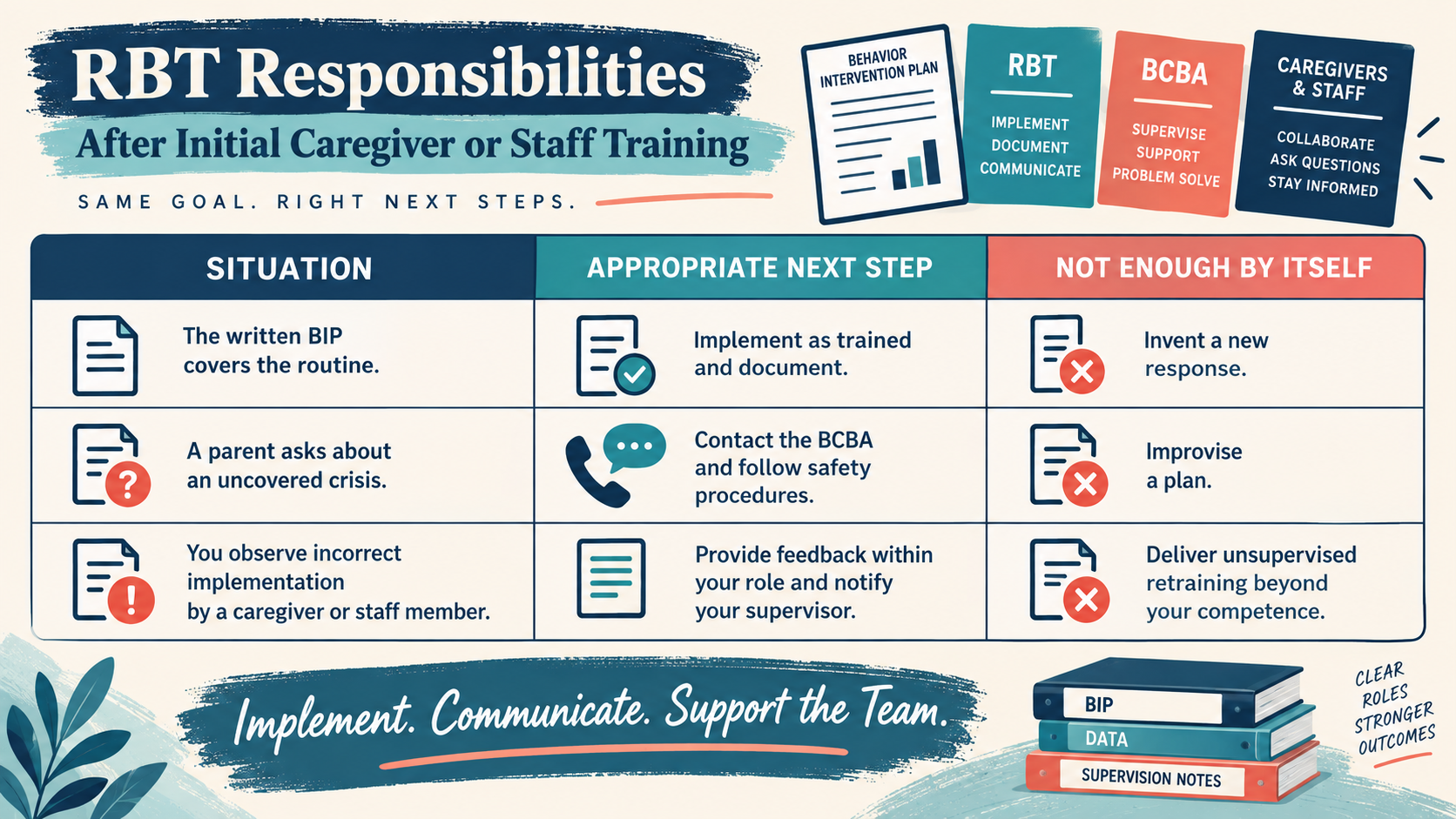
When an RBT observes an error, use a calm sequence that protects fidelity and keeps the clinical decision with the appropriate supervisor:
- Check immediate safety. Follow the current safety plan, emergency procedure, and organizational policy. If there is imminent risk, use the established response and notify the appropriate person.
- Compare the situation with the written plan. Identify the exact step, prompt, antecedent, consequence, or measurement instruction that appears different. Do not rely on memory if the plan is available.
- Give only plan-consistent support that is already authorized. A brief reminder or model may be appropriate when it does not add a new clinical decision and is within the RBT’s training and assignment.
- Document observable facts. Record what happened, when it happened, which step was involved, the client response, and any immediate action taken according to the plan.
- Contact the supervisor. Report the concern and ask whether the caregiver needs a formal refresher, additional practice, a competency check, or a plan review.
- Wait for direction when the plan is unclear. Do not fill a gap by inventing a consequence, changing the reinforcement schedule, or teaching a new response strategy.
This is not about blaming a parent or staff member. A well-written report helps the BCBA determine whether the problem is a training gap, a treatment-integrity issue, a feasibility problem, a communication mismatch, or a clinical change that requires reassessment.
When the BCBA or Supervisor Must Direct Next Steps
Escalate rather than improvise when any of the following is true:
- the caregiver asks a question that the written plan does not answer;
- the proposed “reminder” would change a prompt, consequence, reinforcement schedule, or mastery criterion;
- the client’s risk profile has changed or a new safety issue appears;
- the caregiver needs a competency assessment or repeated training sequence;
- the RBT is not trained or competent to perform the requested activity;
- the current plan conflicts with the setting’s policy or available resources;
- the RBT observes a pattern of implementation errors rather than one isolated mistake.
The BCBA may decide to observe the caregiver, revise the teaching materials, conduct a performance assessment, coordinate with another professional, or update the behavior plan. Those are clinical and supervisory decisions. The RBT’s accurate observation and timely report are valuable inputs, but they do not replace the decision process.
What the RBT Should Document
Documentation should be objective, specific, and connected to the plan. A useful note can answer:
- What exact instruction or plan step was being implemented?
- What did the caregiver or staff member do or say that differed from the instruction?
- What did the client do next?
- What did the RBT do, if anything, under the existing plan?
- Who was notified and what direction was received?
- What follow-up is pending?
Write “the caregiver delivered the programmed break after the prompt was repeated three times” rather than “the caregiver did not understand the plan.” The first statement is observable and gives the supervisor something to analyze. The second is an interpretation that may be unfair or clinically unhelpful.
How to Answer the BCBA Exam Question
For a question using the wording after the BCBA has conducted initial training, look for the scope-and-supervision issue. The distractor often suggests that an RBT may independently provide an occasional refresher whenever an error is observed. That answer is too broad because it skips authorization, competence, documentation, and supervisor direction.
A stronger answer usually says that the RBT should implement the plan as trained, document and report the implementation concern, and have the BCBA or responsible supervisor determine whether additional caregiver training or plan revision is needed. If the question explicitly states that the RBT has been trained, authorized, and assigned to conduct a defined refresher protocol under supervision, then the facts are different. Read the entire stem rather than memorizing a one-line rule.
Use the official BACB RBT supervision guidance and BCBA supervising resources when a study card and a current source appear to conflict. Then practice the scenario with the free BCBA mock exam, focusing on who has authority to make the next clinical decision.
After Initial BCBA Training FAQ
Can an RBT ever model a procedure for a caregiver?: Possibly, when modeling is part of the current plan or a clearly assigned and supervised training protocol, and the RBT is trained and competent. The RBT should not treat a single observation of an error as independent authority to create a new training program.
What should an RBT do if the caregiver is implementing the plan incorrectly?: Follow the current safety and behavior plan, provide only plan-consistent support that is already authorized, document observable facts, and contact the responsible supervisor for direction about refresher training or plan review.
Does reporting the problem mean the RBT is blaming the caregiver?: No. Objective reporting separates what was observed from an interpretation of why it happened. The purpose is to improve treatment integrity, identify training needs, and protect the client.
What if the written plan is unclear?: Ask the supervisor for clarification and follow the organization’s escalation process. Do not invent a missing step or alter a contingency because the team needs an immediate answer.
What is the exam-ready takeaway?: After initial BCBA training, an RBT implements, observes, documents, and reports within scope. A refresher or new caregiver-training sequence requires the appropriate supervisor’s direction unless a defined, authorized protocol already assigns that task.
Take the Free BCBA Mock Exam
If you want a low-pressure way to check your recall, use the free practice resource below. Take the Free BCBA Mock Exam



