

Table of Contents
- What Does ABA Turnover Mean?
- How Do You Measure ABA Turnover?
- Why Is ABA Turnover Difficult to Interpret?
- Which Maintaining Variables Should You Assess?
- How Can a BCBA Use OBM to Reduce ABA Turnover?
- What Does Research Say About ABA Turnover?
- How Should You Build an ABA Turnover Dashboard?
- Common Mistakes When Writing About ABA Turnover
- ABA Turnover FAQ
- Key Takeaway
- Take the Free BCBA Mock Exam
Turnover matters because ABA services depend on stable relationships, reliable implementation, and repeated practice. When a technician, supervisor, or analyst leaves, an organization may lose skill, require replacement training, change a client’s schedule, or interrupt treatment continuity. At the same time, not every departure is harmful, and a high percentage can be misleading when a clinic is rapidly expanding. The right question is: which people are leaving, why, under what conditions, and what changes after an intervention?
In this guide:
- What ABA turnover means and how to calculate it
- Why role, cohort, and time window change the interpretation
- How to assess maintaining variables before choosing an intervention
- How to build an OBM-informed turnover dashboard
- Common mistakes and BCBA exam connections
What Does ABA Turnover Mean?
In an ABA organization, turnover usually refers to a permanent separation from the employer. That can include a voluntary resignation, an involuntary termination, or another defined separation category. It is different from absenteeism, a temporary leave, a transfer within the organization, or a promotion into a different role. The organization should write its definitions before it calculates a rate; otherwise, two departments can report different numbers while using the same label.
“ABA turnover” can also refer to different populations. A clinic might track RBT turnover, BCBA turnover, technician turnover, supervisor turnover, or all employee turnover. Combining every role into one percentage may hide the problem. For example, a small number of supervisor departures can have a very different effect from a larger number of short-term entry-level separations. A useful report keeps the overall number but also stratifies it by role, tenure, location, employment status, and separation type.
Turnover should also be distinguished from retention. Retention is the proportion of a defined group that remains during a period. The two metrics are related, but they answer different questions. A retention report can make a team look stable while a critical role is losing experienced staff. A turnover report can look high during a planned expansion when the organization is hiring and replacing short-term positions. Always inspect the underlying counts and cohort.
How Do You Measure ABA Turnover?
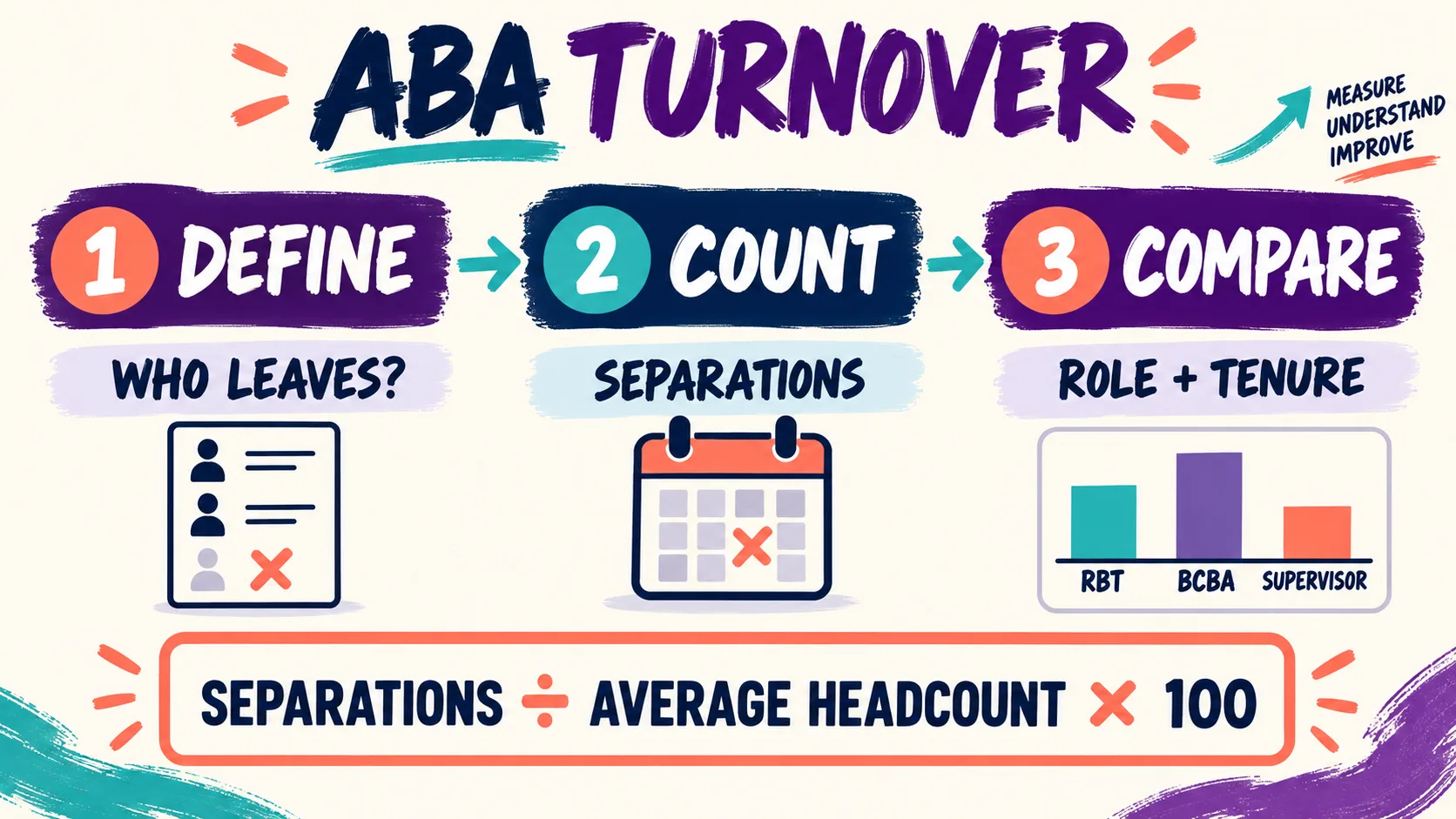
A practical monthly calculation is: Turnover rate = separations during the period ÷ average eligible headcount during the period × 100. The average headcount should reflect more than the number of employees on the first day. If a clinic grows from 20 to 25 eligible staff during a month, use repeated headcount observations or a documented averaging method. The exact method matters less than using it consistently and labeling it clearly. The open-access review On Turnover in Human Services explains why a simple count of departures can become misleading when staffing levels change.
| Field | Definition to document | Why it changes the result |
|---|---|---|
| Eligible employee | Employees, contractors, interns, or selected roles included in the report | A different population creates a different denominator |
| Separation | Voluntary, involuntary, transfer, leave, or another pre-defined status | Not every exit represents the same organizational problem |
| Time window | Month, quarter, year, or tenure cohort | Short windows are noisy; long windows can hide recent change |
| Role and location | RBT, BCBA, supervisor, administrative staff, site, or service line | Averages can conceal a role-specific or site-specific pattern |
For example, if four eligible staff separate during a quarter and the average eligible headcount is 40, the quarterly turnover rate is 10%. That number is descriptive, not diagnostic. It does not tell you whether the separations were avoidable, whether they were concentrated in the first 90 days, or whether client access changed. Keep raw counts beside the percentage so the reader can see the scale of the event.
Why Is ABA Turnover Difficult to Interpret?
First, the same percentage can represent very different service conditions. Four separations in a 40-person team and 40 separations in a 400-person system both equal 10%, but the recruitment workload and continuity risk may differ. Second, an annual number can conceal a seasonal pattern. Student schedules, school calendars, authorization changes, and hiring cycles can affect different quarters.
Third, turnover is often reported without a tenure cohort. A clinic may have low overall turnover but lose many employees during onboarding. Another clinic may have high turnover among new technicians while experienced staff remain stable. Compare 0–90 day, 3–12 month, and 12-month-plus cohorts when the data allow it. Fourth, employee exit reasons are often collected as a single free-text comment. That produces stories, but not a repeatable measurement system.
Finally, turnover is not automatically a client outcome. It can be a risk signal that prompts a clinical and operational review, but the organization should not claim that one percentage caused a treatment outcome without supporting data. Monitor client cancellations, missed sessions, supervision continuity, caregiver satisfaction, and procedural-fidelity measures separately.
Which Maintaining Variables Should You Assess?
Before choosing a retention intervention, treat turnover as a problem to assess rather than a character flaw in employees. Ask what happens before the separation, what consequences may be maintaining the pattern, and whether different employee groups experience different contingencies. This is consistent with an OBM approach: define the performance problem, measure it, assess relevant variables, and test a function-matched change.
- Training and response effort: Is onboarding long, inconsistent, unpaid, or disconnected from the skills required on the first case?
- Supervision and feedback: Do employees receive timely, specific feedback and a predictable path to ask for help?
- Scheduling: Are travel time, cancellations, split shifts, weekend requirements, and last-minute changes visible in the data?
- Pay and benefits: Are wages, mileage, paid preparation, and advancement expectations clear for the role?
- Job design: Can employees use their skills, make meaningful progress, and see a realistic next step?
- Caregiver and team conditions: Do conflict, low caregiver satisfaction, or unstable caseloads precede departures?
- Ethical climate: Are employees pressured to implement procedures outside their competence or to prioritize billing over client welfare?
Use multiple data sources: separation records, anonymous surveys, stay interviews, exit interviews, training completion, supervision contacts, schedule changes, cancellations, and client-continuity indicators. Do not treat an anonymous survey as proof that every employee shares one opinion. Instead, look for converging patterns and protect confidentiality.
How Can a BCBA Use OBM to Reduce ABA Turnover?
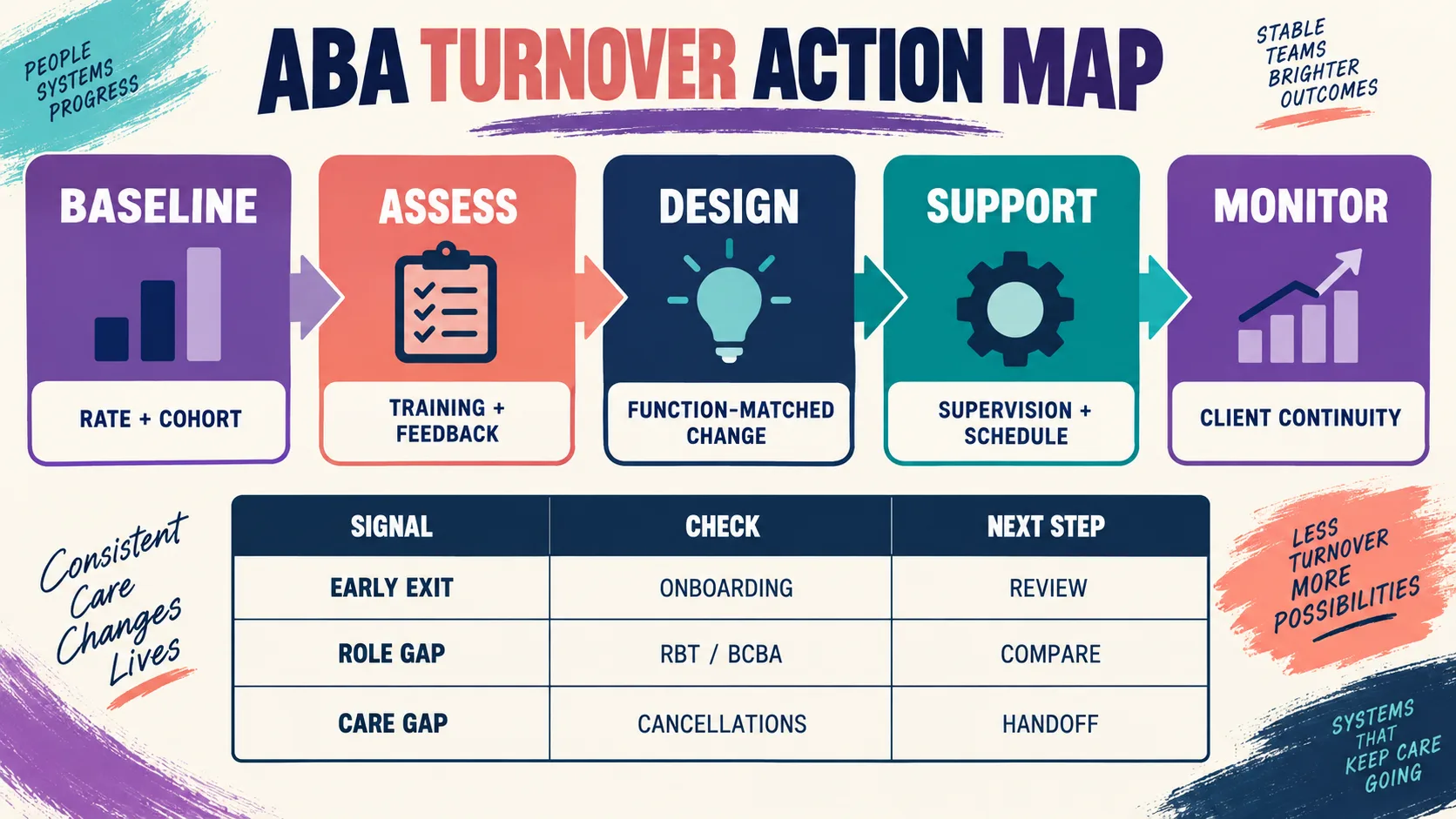
A BCBA may contribute clinical knowledge, but a turnover project still needs defined organizational authority and collaboration. The BCBA should not quietly turn a staff survey into an employment decision or give legal advice outside their role. Coordinate with the appropriate owner, human-resources professional, clinical director, or compliance lead. The separate guide on assessing maintaining variables in OBM explains why intervention should follow assessment.
- Define the target: Choose one measurable outcome, such as voluntary RBT separations within the first 90 days, and state the time window.
- Establish a baseline: Graph the rate by month, role, site, and tenure. Keep raw counts and note policy or staffing changes.
- Identify a likely barrier: Use interviews, observations, and performance data to test whether the problem is training, supervision, schedule fit, reinforcement, response effort, or another variable.
- Design a small intervention: Examples include a structured onboarding checklist, scheduled feedback, mentor contact, predictable scheduling, paid competency practice, or a transparent advancement pathway.
- Monitor both benefit and side effects: Track turnover, employee participation, client continuity, training completion, satisfaction, and procedural fidelity. A lower separation rate is not enough if workload or ethical risk increases.
What Does Research Say About ABA Turnover?
The behavior-analytic literature supports careful measurement but does not justify one universal “normal” turnover rate. The open-access review by Wine and colleagues describes turnover as a developing area of behavior-analytic research and discusses definitions, measurement, cost, and intervention. It also emphasizes that organizations should examine who leaves and why rather than report one undifferentiated number.
A more recent study, An Analysis of Variables Contributing to Board Certified Behavior Analyst Turnover, surveyed BCBAs and reported burnout as the top endorsed contributor among respondents who had left a previous BCBA job. Pay and benefits, supervision and mentorship, professional relationships, ethical violations, and training or professional development were also reported. This is valuable evidence, but it is not a national benchmark for every ABA organization. Survey findings describe the sample; they do not prove that one factor causes every departure.
Research on behavior-analytic organizations has also examined relationships among staff turnover, caregiver satisfaction, and job-class variables. The study in the Journal of Organizational Behavior Management is useful for understanding why organizations should analyze technicians and supervisors separately. Use the evidence to generate testable questions, not to copy a percentage from another provider.
How Should You Build an ABA Turnover Dashboard?
A simple dashboard can be more useful than a polished report with no decision rule. Review the following fields on a regular schedule:
| Metric | Review question | Possible next action |
|---|---|---|
| Monthly turnover rate | Is the level changing after a policy or staffing change? | Continue, revise, or replicate the intervention |
| Early-tenure separation | Are new hires leaving before competency and supervision stabilize? | Review realistic job previews, onboarding, and mentor access |
| Role-specific rate | Is the pattern concentrated among RBTs, BCBAs, or supervisors? | Run a role-specific functional assessment |
| Continuity indicator | Do departures coincide with cancellations, missed supervision, or caregiver concerns? | Add a client-handoff or coverage safeguard |
Common Mistakes When Writing About ABA Turnover
- Using an unsupported universal benchmark: Different roles, definitions, and periods cannot be compared as if they were identical.
- Confusing correlation with cause: A survey association is a reason to investigate, not proof that changing one variable will solve turnover.
- Reporting percentages without counts: Always show the number of separations, average headcount, cohort, and time window.
- Only measuring exits: Pair turnover with onboarding, supervision, workload, client continuity, and employee-performance data.
- Choosing a reward before assessing function: A bonus may not solve a schedule, competence, workload, safety, or ethical problem.
- Ignoring privacy: Aggregate small groups carefully and remove identifying details from dashboards and case examples.
ABA Turnover FAQ
Is ABA turnover the same as RBT turnover?: No. ABA turnover is a broad label. RBT turnover is one role-specific measure. A report should state whether it includes RBTs, BCBAs, supervisors, contractors, or other employees.
What is a good ABA turnover rate?: There is no single rate that can be called good without knowing the role, time window, separation definition, local labor market, and service context. Use a consistent baseline and evaluate whether the pattern improves without harming client care or staff well-being.
How can a BCBA help reduce turnover?: A BCBA can help define observable performance, improve training and feedback systems, review supervision and client-continuity data, and collaborate on a function-matched OBM intervention. Employment decisions and legal questions should be routed to the appropriate organizational professionals.
Should turnover be tracked monthly or annually?: Monthly tracking can detect changes sooner, while quarterly or annual views can reveal larger patterns. Use a monthly operational measure and review it alongside longer windows so short-term noise does not drive a rushed conclusion.
Key Takeaway
ABA turnover is a measurement problem before it is an intervention problem. Define the population, count separations consistently, calculate the denominator transparently, and analyze role, tenure, schedule, training, supervision, pay, workload, and ethical context. Then test a small change against data and monitor client continuity as well as employee outcomes. If you are studying OBM and want practice applying measurement and intervention logic to BCBA-style scenarios, you can try the free BCBA mock exam next.
For targeted review, use our aba turnover practice questions to apply the concept in exam-style scenarios.
Take the Free BCBA Mock Exam
If you want a low-pressure way to check your recall, use the free practice resource below. Take the Free BCBA Mock Exam



