
BCBA exam and ABA career guide If you are searching for the difference between ABA and BCBA, the shortest answer is this: ABA is a field and evidence-based approach to understanding and changing behavior; BCBA is a professional certification held by a person who has met the Behavior Analyst Certification Board’s requirements. ABA describes the “what” and “how” of behavior analysis. BCBA describes the “who” and the credential that signals advanced behavior-analytic training.
Table of Contents
- Difference Between ABA and BCBA: The Short Answer
- What ABA Means
- What a BCBA Is and Does
- ABA and BCBA Side by Side
- Related Roles That Cause Confusion
- Choose the Right Next Step
That distinction matters because people often use ABA, ABA therapy, behavior analyst, BCBA, RBT, and behavior technician as if they were interchangeable. They are not. A family choosing services is asking a different question from a student planning a BCBA career, and both questions are different from a client checking whether a provider’s credential is current. This guide separates the terms, shows where they overlap, and gives each reader a practical next step.
For current certification and examination rules, use the BACB Handbook, the BCBA Test Content Outline, and the official BACB examination information. The comparison below is an educational explanation, not BACB advice, an official BACB product, or a guarantee of a certification or exam result.
Difference Between ABA and BCBA: The Short Answer
ABA stands for applied behavior analysis. It is a discipline that applies principles of behavior and learning to socially meaningful goals. In practice, an ABA service may involve assessment, skill teaching, data collection, communication support, caregiver training, or behavior-change procedures. The exact service depends on the person, setting, goals, consent, risk, and professional plan.
BCBA stands for Board Certified Behavior Analyst. It is a certification for an individual, not the name of a therapy. A BCBA may use behavior-analytic knowledge to assess behavior, design or supervise programs, interpret data, train staff, and make ethical, individualized decisions. The word “BCBA” therefore tells you something about the professional’s certification status; the word “ABA” tells you about the field or approach being used. One useful sentence to remember is:
ABA is what the discipline or service is based on; a BCBA is a credentialed professional who may practice or supervise behavior analysis.
That sentence does not mean every ABA service is delivered by a BCBA in every moment. A BCBA may supervise other staff, and different professionals may have different responsibilities. It also does not mean that using the label “ABA” proves that a person holds a BCBA certification. Credential verification is a separate step. The practical difference between ABA and BCBA is a category distinction before it is a career or service decision.
What ABA Means
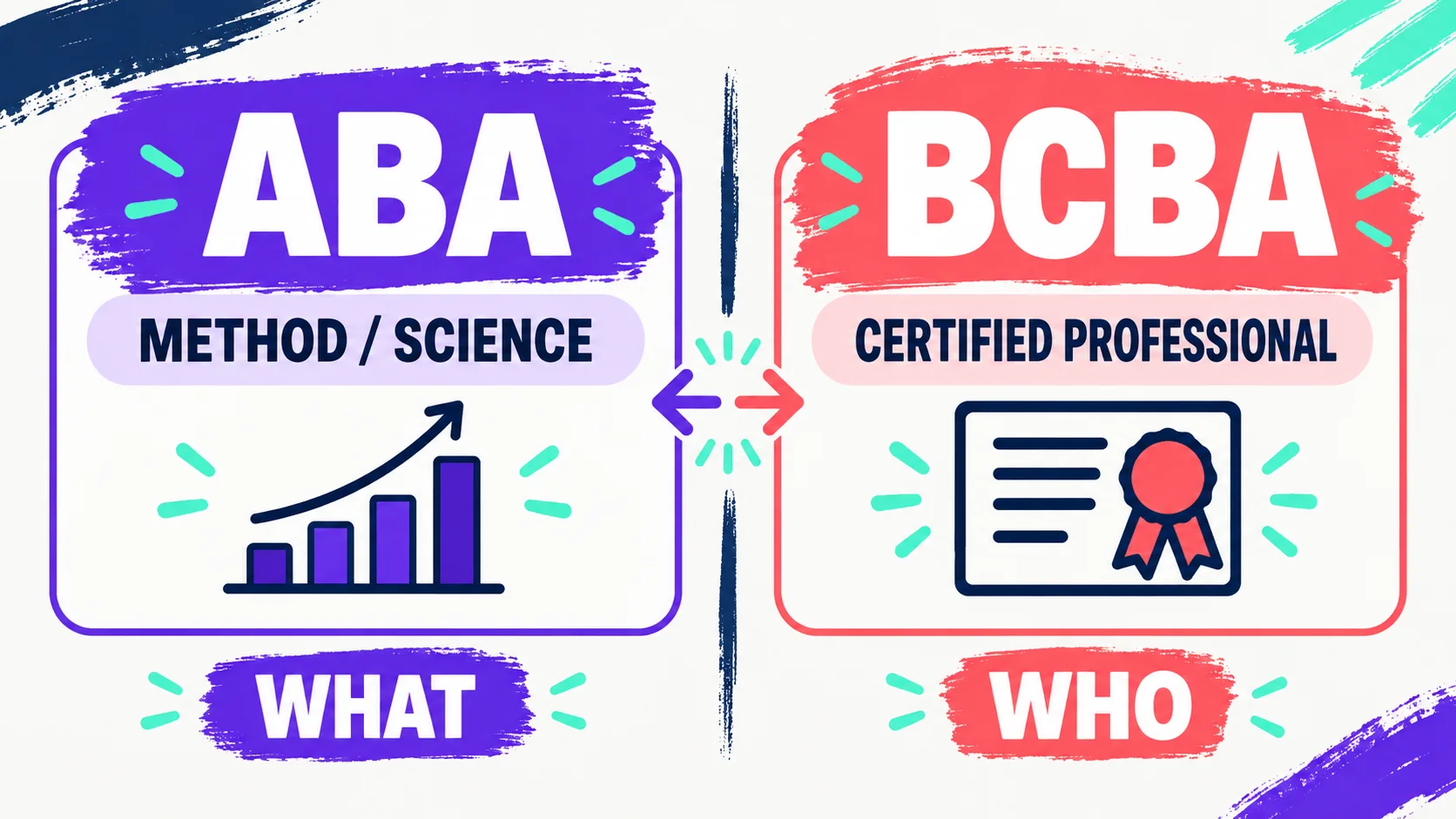
ABA is broader than a job title and broader than one diagnosis. It is applied because the goals matter in everyday life, behavior because behavior is measured and analyzed, and analysis because decisions should be connected to observable data and the conditions affecting behavior. A program might address communication, self-management, academic responding, daily living skills, safety, or another socially meaningful outcome.
When people say “ABA therapy,” they usually mean behavior-analytic services delivered in a clinical, educational, home, community, or other setting. The phrase describes a service context, but it does not identify every member of the service team. For example, one program may include a BCBA, a BCaBA, an RBT, caregivers, teachers, or other professionals. Their roles, supervision, and legal authority are not automatically identical. A helpful way to recognize ABA reasoning is to look for the relationship among the environment, the behavior, and the outcome. A practitioner may ask:
- What exactly happened before the behavior?
- How can the behavior be defined so two observers could measure it?
- What consequence followed, and did the behavior change over time?
- Is the goal meaningful to the person and appropriate for the context?
- What data would justify continuing, changing, or stopping the plan?
Those questions describe a way of thinking. They do not by themselves prove that a person is a BCBA. If you are comparing services, ask what the goal is, who is responsible for assessment and supervision, how progress is measured, how assent and consent are handled, and how the team responds when data do not support the plan.
What a BCBA Is and Does
A BCBA is a person who holds the Board Certified Behavior Analyst credential. The credential is connected to an eligibility and examination process administered by the BACB, and current requirements can change. The safest practice is to verify the current handbook and official certification pages instead of relying on an old course page, a social-media summary, or a general career article.
In day-to-day work, a BCBA’s responsibilities may include defining target behaviors, reviewing records, conducting or supervising assessment, designing interventions, analyzing graphs, coaching staff, communicating with caregivers, and monitoring whether a plan is effective and ethically appropriate. The exact scope also depends on the setting, employer, payer, state law, and other applicable rules.
- Assess: define the question, gather relevant information, and identify what should be measured.
- Design: connect goals, procedures, data, and decision rules to the individual situation.
- Supervise: train and support the people implementing the plan within the applicable role boundaries.
- Evaluate: review data and change course when the evidence does not support the current plan.
It is important not to turn that list into a universal job description. A BCBA may work in schools, clinics, homes, hospitals, research, consulting, organizational settings, or other environments. A BCBA certification is not the same thing as a state license, and the presence of a BCBA credential does not erase local practice requirements. For a specific state or service question, check the relevant authority and the professional’s current status.
For exam candidates, the most important distinction is that studying ABA concepts is not the same as holding the BCBA credential. The BCBA examination tests behavior-analytic knowledge and application across the current content outline. A candidate must build the required education, supervised experience, application, and examination plan according to the current official rules. Commercial study materials can support preparation, but they do not replace the official source documents.
ABA and BCBA Side by Side
The table below is a practical comparison. It is designed to prevent category errors, such as treating a therapy approach as a professional title or treating a credential as proof that every service decision is automatically appropriate.
| Question | ABA | BCBA |
|---|---|---|
| What is it? | A discipline and applied approach to behavior and learning. | A professional certification held by an individual. |
| What does the label describe? | The method, science, service model, or intervention framework. | The person’s certification status and professional role. |
| Is it a person? | No. People deliver or study ABA; ABA itself is not a credential. | Yes. A BCBA is an individual who holds the certification. |
| What should a reader verify? | Goals, data, consent and assent, supervision, fit, and service quality. | Current certification status, role, supervision, and applicable state rules. |
| What is the study question? | How does the behavior-analytic concept or procedure work? | How do I apply the concept and meet the current certification process? |
For a family, the right question may be “Who is supervising this service and how will progress be measured?” For a student, the right question may be “Which current BACB pathway and study plan apply to me?” Those questions can share vocabulary, but they should not be answered with the same page or the same CTA.
Preparing for the BCBA exam? After you can explain the difference between the field and the credential, try a few targeted practice questions to see whether you can apply the distinction in a scenario. Take the Free BCBA Mock Exam to practice the difference between ABA and BCBA without treating the practice content as official BACB material.
Related Roles That Cause Confusion
Several labels appear beside ABA and BCBA, so a useful comparison should name the boundaries instead of leaving the reader to guess.
- RBT: a registered behavior technician credential with a different eligibility, supervision, and role structure from BCBA certification. An RBT is not automatically a BCBA.
- BCaBA: a separate assistant-level behavior analyst certification. BCaBA and BCBA are not interchangeable, and their requirements and supervision structures differ.
- ABA therapist or behavior technician: broad workplace labels that may be used differently by employers. The label alone does not establish a BACB certification.
- Licensed behavior analyst: a state practice title or license that may interact with, but is not identical to, national BACB certification. Requirements depend on the jurisdiction.
- Behavior analyst: a professional description that can be used in different ways. Ask which certification, license, degree, or supervised role the person actually holds.
These distinctions are not just vocabulary trivia. On an exam, a question may place several roles in one scenario and ask who should perform assessment, supervise staff, interpret data, or make a particular decision. In real life, the same distinction helps a family ask the service provider a precise question instead of assuming that every team member has the same training.
Use primary sources for current titles and requirements. If an article, job post, or program page says that a particular role is “equivalent” to a BCBA, treat that as a claim to verify, not as a rule. The official BACB directory and current handbook can help you check certification information; state authorities may be needed for licensure questions.
Choose the Right Next Step
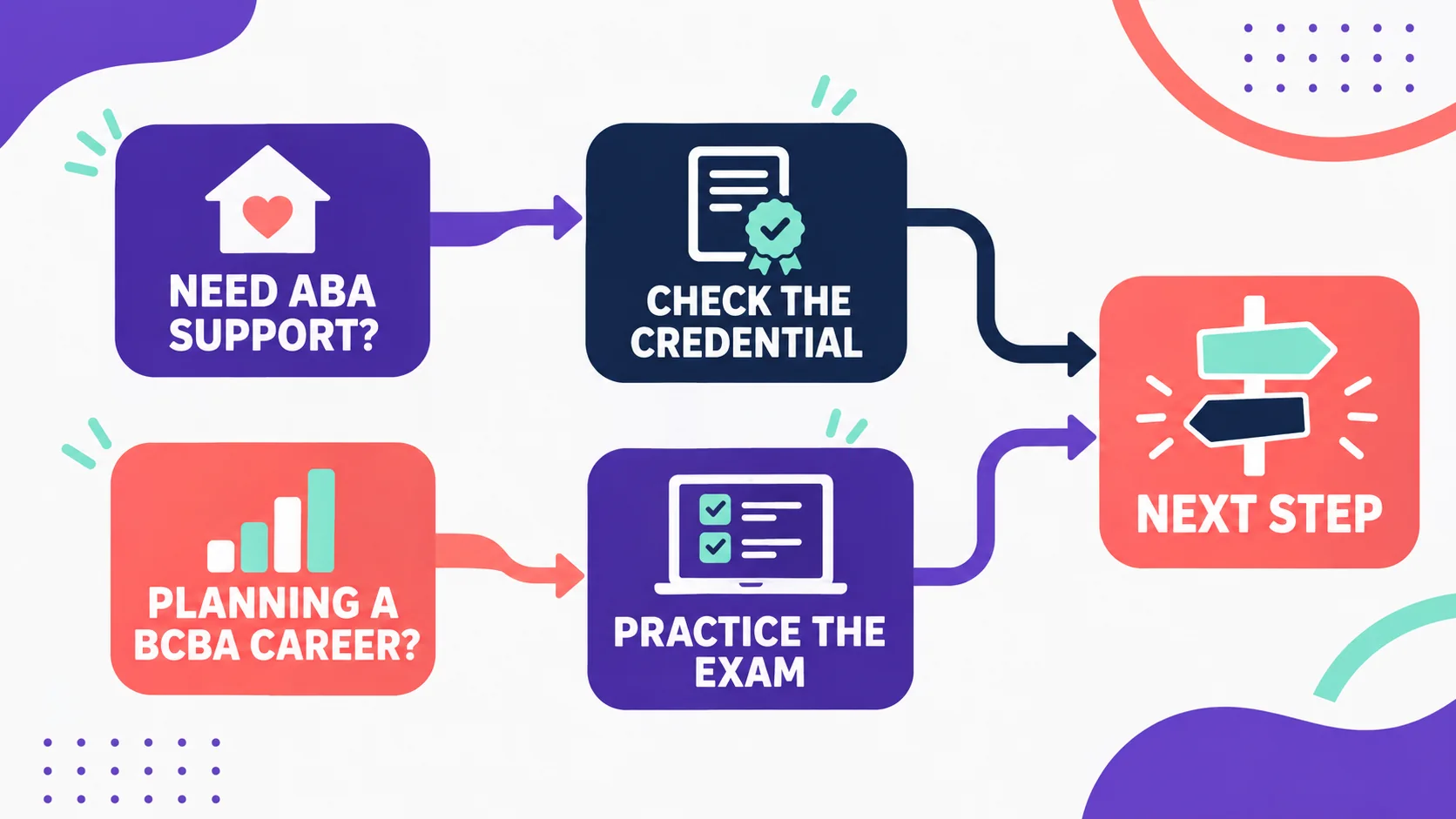
Your next step depends on why you searched. Do not choose a BCBA exam course simply because you need help finding ABA services, and do not evaluate a family’s service team using only a career-path checklist. If you need ABA support: Use this point as a focused exam-review label rather than a separate major section.
- Write down the meaningful skill or behavior goal in plain language.
- Ask who will assess, supervise, collect data, and communicate progress.
- Ask how consent, assent, dignity, cultural responsiveness, and safety are handled.
- Check the relevant professional credentials and state requirements rather than relying on a job title.
- Ask what data would lead the team to continue, change, or stop an intervention.
If you are planning a BCBA career: Use this point as a focused exam-review label rather than a separate major section.
- Start with the current BACB pathway and handbook instead of an old blog post.
- Confirm how your education, coursework, supervised experience, application, and exam plan fit the current rules.
- Use the current BCBA Test Content Outline as the scope map for studying.
- Separate definition review from discrimination and scenario application practice.
- Track errors by concept, reading, data interpretation, ethics, or pacing so your next study session has a job.
If the words ABA and BCBA still feel interchangeable, return to the category test: Is the sentence naming a method, a service, a person, a certification, or a state license? That single question often reveals the confusion. ABA can describe the approach. BCBA can describe the credentialed person. A specific service decision or career decision still requires more context.
For a candidate who is ready to practice, use an unofficial question set to test the distinction in varied scenarios, then review why the best answer fits and why the strongest distractor does not. Try the free BCBA mock exam as a practice step, and verify all current certification and examination requirements through BACB’s official resources.
Bottom line: ABA is the applied field or approach; BCBA is a professional certification. Once you keep “what” and “who” separate, you can ask better service questions, compare roles accurately, and build a more focused BCBA study plan.



