
Table of Contents
- What Is an ABA Social Skills Curriculum?
- How Do You Choose Social Skills Priorities?
- How Do You Write Measurable Social Skills Goals?
- How Should You Sequence Social-Skills Instruction?
- How Do You Measure Progress in an ABA Social Skills Curriculum?
- How Do You Plan Generalization?
- How Do You Compare ABA Social Skills Curriculum Tools?
- What Ethical Boundaries Matter?
- ABA Social Skills Curriculum FAQ
- Key Takeaway
- Quick Review Checklist
- Take the Free BCBA Mock Exam
Social behavior can include communication, joining an activity, responding to a peer, requesting help, sharing control of materials, navigating a group, or repairing a misunderstanding. The right target depends on the learner, the setting, the people involved, and what the learner values. This guide is educational and does not replace an individualized assessment or professional judgment.
In this guide:
- What an ABA social skills curriculum should contain
- How to prioritize goals and write measurable targets
- How to sequence instruction and choose useful data
- How to plan generalization and evaluate curriculum tools
- Ethical boundaries and common BCBA exam traps
What Is an ABA Social Skills Curriculum?
An ABA social skills curriculum is a structured teaching framework for social and communication repertoires. It may include assessment items, goal examples, lesson sequences, practice activities, data sheets, caregiver coaching, and generalization plans. The word curriculum describes the organization of instruction; it does not mean that one commercial package is automatically appropriate for every learner.
Many curriculum systems divide social behavior into areas such as joint attention, play, social language, emotional or self-regulation skills, group participation, conversation, and problem solving. Those labels can help organize observations, but the BCBA still needs to define the behavior in observable terms. “Improve social skills” is too broad. “Approaches a peer within 10 seconds, says ‘Can I play?’ and waits for a response during a structured game” gives a team something to teach and measure.
Keep assessment and curriculum separate. An assessment describes the learner’s current repertoire and context. A curriculum organizes what to teach next. The site’s functional social skills assessment guide covers a named assessment workflow; this page focuses on what happens after the team has enough information to prioritize instruction.
How Do You Choose Social Skills Priorities?
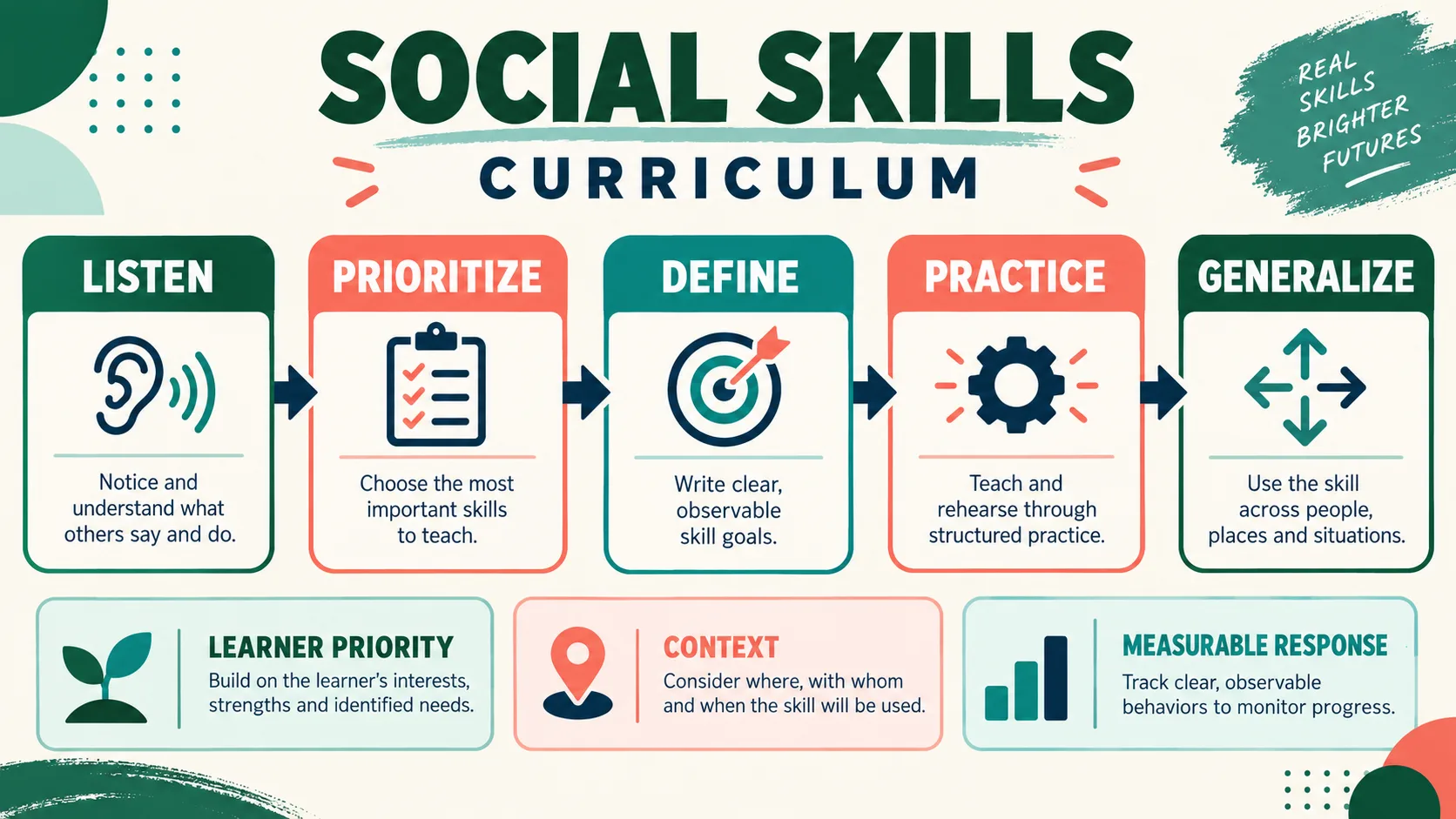
Start with social significance, not with the easiest checklist item. Ask what would improve access, communication, autonomy, participation, safety, relationships, or the learner’s ability to express preferences. Include the learner’s communication mode and interests. A spoken greeting is not automatically a better outcome than a sign, device response, gesture, written message, or comfortable way to join an activity.
Collect information across people and settings before choosing a long target list. Observe a natural routine when possible, interview the learner and caregivers in an accessible way, review existing records, and identify what happens before and after the behavior. A learner may initiate successfully with a familiar adult but not with peers, or may respond in a clinic but not in a noisy cafeteria. Those differences are curriculum information.
- Ask whose priority it is: Include the learner, caregivers, teachers, and relevant team members, while giving the learner meaningful ways to assent, decline, or request a change.
- Define the context: Note the people, materials, activity, distance, noise, wait time, and communication supports involved.
- Find the component skills: A “play with peers” goal may require orientation, approaching, requesting, turn-taking, waiting, responding, and ending the activity.
- Check response effort: If the target is difficult, slow, physically uncomfortable, or disconnected from reinforcement, the curriculum may need a better starting step.
- Limit the initial load: Choose a small number of high-value targets so instruction, practice, and data review remain feasible.
The goal is not to make a learner appear typical in every situation. It is to build flexible, effective ways to communicate and participate while respecting autonomy, sensory needs, culture, and personal boundaries.
How Do You Write Measurable Social Skills Goals?
A useful goal states the response, the relevant conditions, the expected level of performance, and how the team will know whether the change matters. Avoid goals that only describe an adult’s impression, such as “is more social” or “has better eye contact.” Those phrases can hide whether the learner is communicating, tolerating an unwanted interaction, or simply complying.
| Goal element | Question to answer | Example |
|---|---|---|
| Response | What observable action or communication counts? | Hands a card, signs, or uses a device to request a turn |
| Context | With whom, where, and during which routine? | During a cooperative game with one peer |
| Criterion | How often, how accurately, or for how long? | Four of five opportunities across three sessions |
| Meaningful outcome | What does success make easier or more accessible? | Can join a preferred activity with less adult mediation |
Write a baseline before claiming progress. For instance, a baseline might show that the learner requests a turn in 1 of 10 opportunities with an adult and 0 of 5 opportunities with peers. The team can then teach a component response, measure it under the same conditions, and revise the plan if the learner is not contacting useful reinforcement.
How Should You Sequence Social-Skills Instruction?
Sequence instruction from the learner’s current repertoire toward the functional outcome. A curriculum may begin with a clear request or response, then add a partner, a wait, a change in materials, a second possible response, or a less predictable context. The sequence should be based on data and learner experience, not on an assumption that a particular developmental order fits everyone.
- Make the first response efficient: Use an accessible communication form and a clear opportunity to respond.
- Arrange meaningful consequences: Make sure the response produces a relevant outcome, such as access, information, assistance, a break, or continued participation.
- Teach component responses: Break a complex interaction into teachable steps without losing the real purpose of the interaction.
- Vary examples deliberately: Change people, materials, wording, distance, and activity features when the learner is ready.
- Fade unnecessary prompts: Track prompt levels so independence, not prompt-following, is the measured goal.
- Include natural partners: Coach caregivers, teachers, peers, and staff on how to offer opportunities and respond consistently.
Behavior-analytic research on teaching the general case emphasizes programming examples and contexts that represent the situations in which a skill will actually be used. That principle helps prevent a curriculum from becoming a clinic-only performance routine. Practice can be structured, but the team should continually check whether the response is useful outside the lesson.
How Do You Measure Progress in an ABA Social Skills Curriculum?
Choose the measurement dimension that matches the target. Frequency or rate may fit initiations; latency may fit how long it takes to respond; duration may fit sustained participation; percentage of opportunities may fit turn-taking; and a brief rubric may capture a sequence of component responses. Use direct observation when feasible, and document who collected the data and under what conditions.
| Target pattern | Possible measure | Interpretation check |
|---|---|---|
| Initiates a shared activity | Count or rate per opportunity | Did the partner respond and did the learner gain access? |
| Responds to a peer’s communication | Percentage of opportunities and latency | Was the cue available and understandable? |
| Participates in a group routine | Duration plus prompt level | Was participation voluntary and meaningfully supported? |
| Repairs a misunderstanding | Opportunity-based scoring | Did the repair restore communication rather than require compliance? |
Graph performance by context instead of collapsing every setting into one percentage. A learner may improve with a familiar adult while remaining unsupported with peers. If data are collected by different people, check observer agreement or use a clear scoring definition. If the target is socially meaningful but the measurement is easy to collect, do not let convenience decide the goal.
How Do You Plan Generalization?
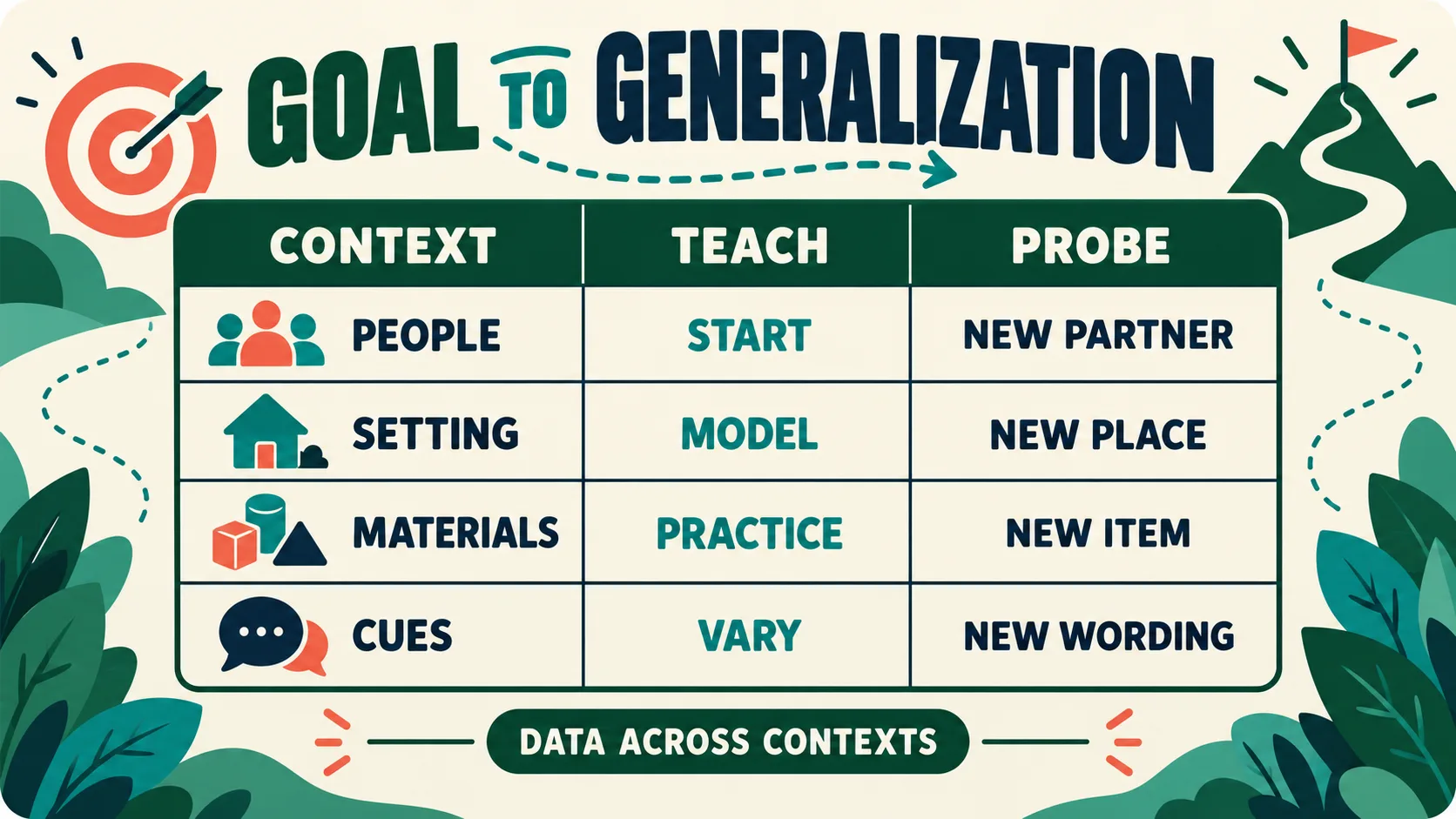
Generalization means the response occurs with relevant variation beyond the original teaching arrangement. In social skills instruction, that may mean using a request with different peers, in a different room, with a new game, after a change in the routine, or with a communication partner who uses different wording. Do not wait until the end of treatment to discover that a skill only works with one instructor and one set of cards.
Plan a generalization probe before changing the curriculum. List the dimensions that matter: people, settings, materials, cues, response forms, time of day, group size, and natural consequences. Teach enough examples to cover the range that the learner is likely to encounter, then sample an untrained example. A correct response in the original lesson is acquisition data; a correct response in a new but relevant context is generalization data.
The site’s stimulus generalization guide explains the concept for BCBA study. For curriculum planning, add response generalization and maintenance checks as well. Ask whether the learner can use more than one effective response and whether the skill remains useful after prompts and dense teaching arrangements are reduced.
How Do You Compare ABA Social Skills Curriculum Tools?
A named program can save planning time, but it is still a tool to evaluate. Compare what the program actually measures, how it handles communication differences, whether it offers teaching guidance or only a checklist, and whether its goals fit the learner’s priorities. A high score on a commercial assessment is not the same as a meaningful outcome.
| Selection question | What a strong answer includes |
|---|---|
| Is it individualized? | The team can skip mastered items, add relevant goals, and honor communication preferences. |
| Does it show how to teach? | It explains antecedents, prompts, practice, consequences, fading, and error support. |
| Does it support generalization? | It identifies variation across people, settings, materials, and natural routines. |
| Can the team evaluate outcomes? | It produces observable data and decision rules rather than only completion certificates. |
What Ethical Boundaries Matter?
Social skills goals can become harmful when they are selected only to make a learner look less different, suppress harmless self-regulation, or reward compliance with unwanted contact. Review the current BACB ethics codes for professional obligations, and apply the relevant code to consent, assent, competence, confidentiality, cultural responsiveness, and client welfare.
Use function-based and person-centered reasoning. A learner should be able to communicate “no,” request a break, avoid an unsafe interaction, and choose a different way to participate. Teaching a conversation opener does not justify forcing eye contact. Teaching turn-taking does not require giving up a preferred item without a communication option. Document how the learner’s preferences and assent affect the plan.
Also check scope. A BCBA can design behavior-analytic instruction and collaborate with speech-language, occupational, educational, and medical professionals, but should not represent a curriculum as a diagnosis, guarantee, or substitute for another professional service. When a tool makes claims beyond the available evidence, record the uncertainty and choose the least risky, most useful next step.
ABA Social Skills Curriculum FAQ
What should an ABA social skills curriculum include?: It should include an assessment process, individualized priorities, observable goals, teaching procedures, data definitions, prompt-fading plans, partner coaching, generalization probes, and decision rules. A list of activities without measurement or context is not enough.
Is a commercial social skills curriculum required?: No. A commercial curriculum can organize materials, but the BCBA still must evaluate fit, evidence, accessibility, learner priorities, and outcomes. A team can build a curriculum from assessment information, published procedures, natural routines, and collaboration.
How many social skills goals should be taught at once?: There is no universal number. Start with a manageable set of meaningful targets and consider teaching prerequisites when they block progress. The team should review data, workload, learner assent, and opportunities for practice before adding more goals.
How do you know whether social skills are generalizing?: Probe untrained but relevant combinations of people, settings, materials, cues, and routines. Record the response and prompt level in each context. Generalization is demonstrated by data across relevant conditions, not assumed because a learner succeeds with the original instructor.
Key Takeaway
An ABA social skills curriculum should connect meaningful priorities to observable goals, respectful instruction, useful data, and planned generalization. Choose tools for what they help the team do, not for their branding or the number of checklist items. If you are studying how assessment, teaching, ethics, and data-based decisions fit together, you can continue with the site’s free BCBA mock exam.
For targeted review, use our aba social skills curriculum practice questions to apply the concept in exam-style scenarios.
Quick Review Checklist
Use this final checklist to turn aba social skills curriculum into exam-ready reasoning. The goal is not to memorize a label in isolation; it is to identify the relevant evidence and explain why the best answer fits the scenario. Key ideas to review:
- State the central definition or decision point for aba social skills curriculum in your own words.
- Identify the detail that makes aba social skills curriculum different from its closest related ABA term.
- Separate the observable facts in a scenario from assumptions that are not supported by the facts.
- Write one example and one nonexample so you can recognize the concept in a new setting.
Exam application checks:
- Ask what the question is actually requesting before comparing the answer choices.
- Mark the antecedent, response, consequence, or other evidence that supports the selected answer.
- Look for a distractor that describes a related process but does not answer the specific question.
Final self-check:
- Explain how you would verify the interpretation with clear observations or data.
- Change one detail in the scenario and decide whether your answer should change.
- Give a one-sentence rationale that a supervisor or study partner could evaluate.
Take the Free BCBA Mock Exam
If you want a low-pressure way to check your recall, use the free practice resource below. Take the Free BCBA Mock Exam



