
Quick answer: An ABA therapist license is not one national license with one application. In the United States, people may use “ABA therapist” for an RBT, behavior technician, BCaBA, BCBA, or another direct-care professional. BACB certification and a state license are separate systems. A person may hold an RBT, BCaBA, or BCBA credential and still need a state registration or license, while a technician’s requirements may come from state law, an employer, a school, an agency, or a payer.
Table of Contents
- Is There a National ABA Therapist License?
- What Is the Difference Between Certification and Licensure?
- Which ABA Roles May Need a License?
- How Do Certification and Licensure Fit Together?
- How Can You Check Your State’s ABA License Rule?
- Does an RBT Need an ABA Therapist License?
- What Should an Employer Explain Before You Start?
- Can Insurance or Medicaid Add Another Requirement?
- What Happens If You Move to Another State?
- Does the 2027 BACB Change Create a New ABA Therapist License?
- How Do You Verify an ABA Credential or License?
- What Should You Verify Before Working?
- ABA Therapist License Checklist
- ABA Therapist License FAQ
- Is an ABA therapist license the same as an RBT certification?
- Can a BCBA work without a state license?
- Does finishing an ABA course give me a license?
- Key Takeaway
- Take the Free BCBA Mock Exam
Before you enroll in a program or start work, identify the exact service and jurisdiction. Ask which credential is required for the duties, whether the state regulates the title or practice, who must be licensed, and whether the insurance or Medicaid program has extra provider rules. This guide explains how to separate the terms and verify the answer without treating a national certification, a course certificate, and legal permission to practice as the same thing.
Is There a National ABA Therapist License?
No. “ABA therapist” is generally a public-facing or employer-defined job label, not a single national license issued by the BACB. The BACB offers certifications at different levels, including RBT, BCaBA, and BCBA. States may separately regulate behavior analysis through a professional license, title protection, registration, exemptions, or a board that oversees the profession.
That is why two job posts with the same title can ask for different qualifications. One agency may hire an RBT to implement an assigned plan under supervision. Another may use “ABA therapist” for a technician who completes agency training. A third may use the phrase for a BCaBA or BCBA. Read the duties and supervision section before assuming the title tells you the legal scope.
What Is the Difference Between Certification and Licensure?
| Question | BACB certification | State licensure or registration | Why it matters |
|---|---|---|---|
| Who issues it? | A national credentialing board | A state board, department, or authorized agency | The issuer and appeal process are different |
| What does it show? | The person met the certification board’s eligibility, exam, ethics, and maintenance rules | The person may practice or use a regulated title under that jurisdiction’s law | Certification does not automatically grant state permission |
| Does it cover every role? | No; RBT, BCaBA, and BCBA have different pathways | No; the state may regulate analysts, assistants, technicians, or settings differently | Match the rule to the actual duties |
| Where should it be checked? | The BACB Certificant Registry | The state licensing or registration database | A course badge or employer profile is not enough |
The BACB’s consumer resources explain that certification is required by many funders and licensing boards, but that wording does not mean certification replaces a state license everywhere. Treat it as a signal to check both systems. The state’s current statute, board rules, and application instructions control the legal question in that state.
Which ABA Roles May Need a License?
Licensure usually focuses on the regulated practice of behavior analysis and the professional titles defined by the jurisdiction. A BCBA who independently assesses, develops treatment plans, supervises staff, or bills a payer may face different rules from an RBT who implements assigned procedures under supervision. A BCaBA may also have a separate state pathway or may be regulated through the supervising BCBA and agency structure. Do not infer the answer from the credential alone. Ask four role questions:
- Will the person assess behavior or independently make clinical decisions?
- Will the person write, modify, or authorize a treatment plan?
- Will the person supervise other staff or sign records submitted to a payer?
- Is the person delivering direct care under a defined plan and supervisor?
The more the role involves independent professional judgment, the more important the state license and scope-of-practice check becomes. Direct-care work still requires training, ethical conduct, client protections, and supervision; a role is not “unregulated” merely because it does not use the word analyst.
How Do Certification and Licensure Fit Together?
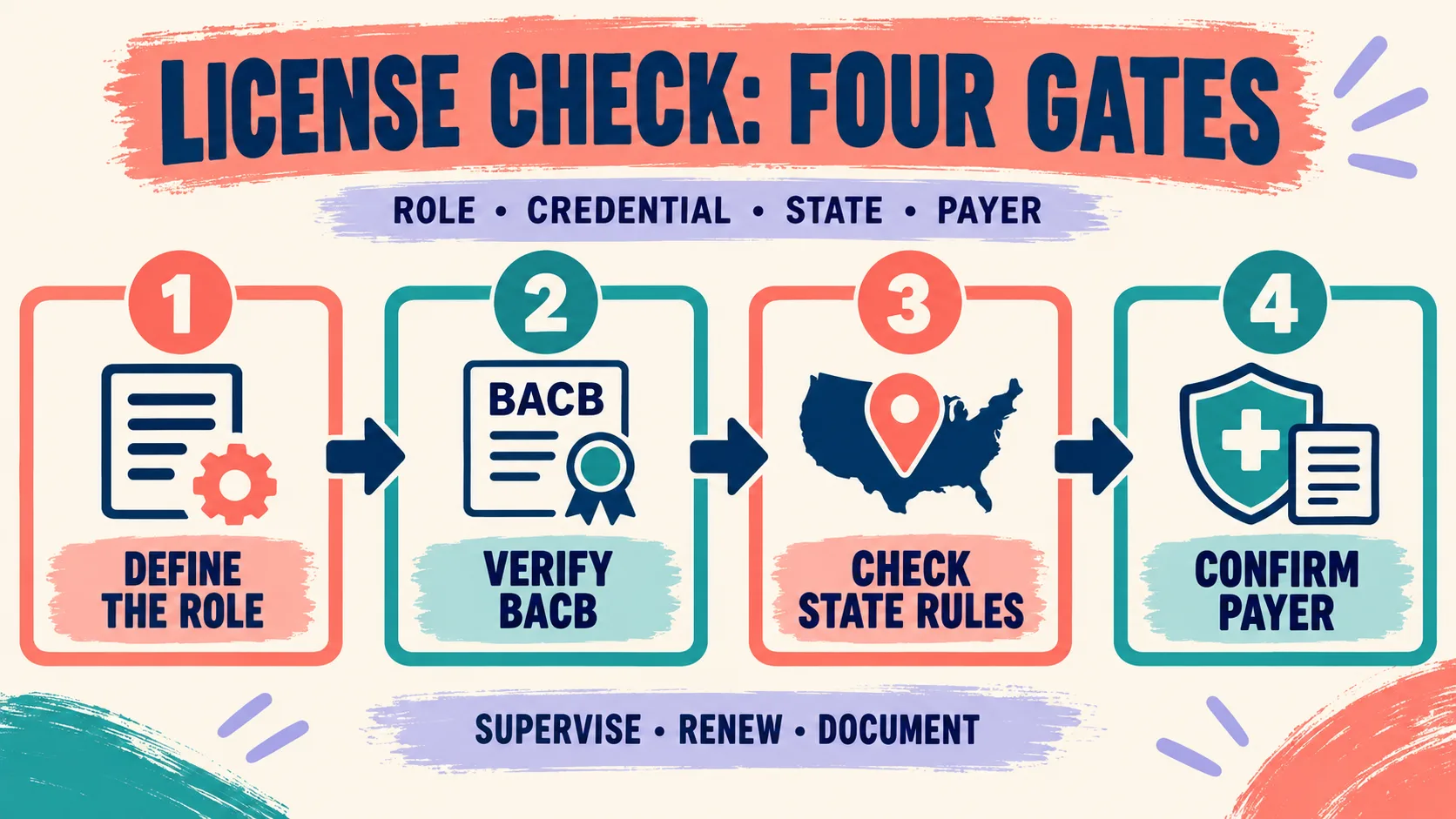
Think of the pathway as a set of gates. First identify the job duties and setting. Then confirm the relevant national certification, if any. Next check the state license or registration, followed by employer onboarding and payer credentialing. The last gate is ongoing supervision and renewal. Passing one gate does not automatically pass the others.
For example, a person may complete RBT training and pass the RBT examination, but the employer may still require a background check, state registration, additional training, or a specific supervisor. A BCBA may hold active BACB certification but still need a state license before providing regulated services in a particular state. The exact answer depends on the jurisdiction and the service arrangement.
How Can You Check Your State’s ABA License Rule?
Start with the BACB’s U.S. licensure of behavior analysts resource for a map and links, but do not stop there. The BACB notes that its list is a starting resource and that applicants should review the relevant state websites. Open the state board or department link and look for the current statute, rules, application page, exemption language, renewal requirements, and contact information.
Search for the exact combination of state, credential, and duty. “BCBA license” may produce a different rule from “assistant behavior analyst,” “behavior technician,” “RBT registration,” or “school-based ABA.” Also confirm whether the rule applies where the client is located, where the clinician is located, or both when telehealth is involved.
- Find the state agency with authority over the regulated title or practice.
- Read the current rule rather than relying on a training provider’s summary.
- Check whether BACB certification is required, accepted, or only one part of the application.
- Look for exemptions, temporary permits, supervision rules, and renewal deadlines.
- Save the official page and the date you verified it.
Does an RBT Need an ABA Therapist License?
There is no single answer for every state and employer. RBT is a BACB paraprofessional certification, and an RBT works under close, ongoing supervision. Some jurisdictions or payers may require an additional registration, background clearance, or agency credential. Others may address the work through the supervising professional and employer.
Ask the agency to identify the exact rule it follows and who is responsible for each step. A safe employer should be able to tell you whether you need RBT certification, state registration, a criminal-background check, child-abuse clearance, CPR or safety training, payer enrollment, and a named supervisor. If the answer is “the course makes you legal everywhere,” do not rely on that claim. Our related guide on ABA therapist certification explains the RBT, BCaBA, and BCBA pathways. This page adds the separate state-permission question so the two topics do not become one vague credential article.
What Should an Employer Explain Before You Start?
Ask for the supervision and compliance plan in writing. You should know who observes your work, how feedback is delivered, what happens if the supervisor leaves, how errors are corrected, and who submits or signs payer documentation. If you are a BCaBA or BCBA, ask which state license and payer credentials must be active before you see clients or bill services.
Also ask whether the job title matches the actual role. “ABA therapist” can hide a direct-care job, an assistant-analyst job, or an analyst job with very different responsibilities. The offer letter should state the expected credential, work setting, supervisor, scope, training period, renewal support, and any requirement to maintain a state license.
Can Insurance or Medicaid Add Another Requirement?
Yes. A payer may require a specific credential, provider type, taxonomy, supervision arrangement, authorization, or network enrollment even when state law allows the service. A clinic can also have a credentialing policy that is stricter than the legal minimum. Verify the plan or program’s provider rules before assuming that an active BACB credential is enough to bill.
For families, ask which person is the licensed or certified provider of record, who delivers direct treatment, who supervises, and whose credentials appear on the authorization. For professionals, ask whether the agency is submitting services under your name, a supervisor’s name, or the organization’s credential. Keep the answer with your employment and renewal records.
What Happens If You Move to Another State?
Do not assume that a state license transfers automatically. Some jurisdictions may offer reciprocity or endorsement; others may require a new application, background check, fee, jurisprudence test, or proof of current BACB certification. The scope of a license can also differ even when the person’s national credential stays active.
Before moving, contact the destination board and ask about the correct pathway. Confirm whether you can work while the application is pending, whether a temporary authorization exists, and whether the supervisor must be licensed in the destination state. If services are delivered through telehealth, verify the location rules for both the provider and client.
Does the 2027 BACB Change Create a New ABA Therapist License?
No. Significant BCBA and BCaBA certification eligibility and maintenance changes take effect January 1, 2027. Those changes affect the BACB pathways, including education, coursework, supervised fieldwork, continuing education, and ongoing supervision. They do not create one national ABA therapist license, and they do not replace a state board’s authority.
If your goal is BCBA or BCaBA certification, read the official 2027 requirements and transition guidance for the pathway and application date that apply to you. If your goal is an RBT or technician role, use the current RBT handbook and your employer/state rules instead of assuming the BCBA transition changes your route. Keep “certification date,” “license date,” and “employment start date” as separate planning fields.
Because the transition is date-sensitive, save the current handbook version and ask the program or supervisor to identify the rule they are applying. Do not make a nonrefundable enrollment decision from a social-media summary or an undated blog post.
How Do You Verify an ABA Credential or License?
For BACB credentials, use the BACB Certificant Registry, which is the board’s primary verification resource. For a state license, use the state board’s official lookup tool. Check the name, credential level, active or expired status, expiration date, and any publicly reportable discipline where the database provides it.
Do not treat a certificate image, course badge, business website, or search result as final proof. Ask for the credential number or official verification report when appropriate. If the name is common, confirm the state, credential type, and employer so you do not verify the wrong person.
What Should You Verify Before Working?
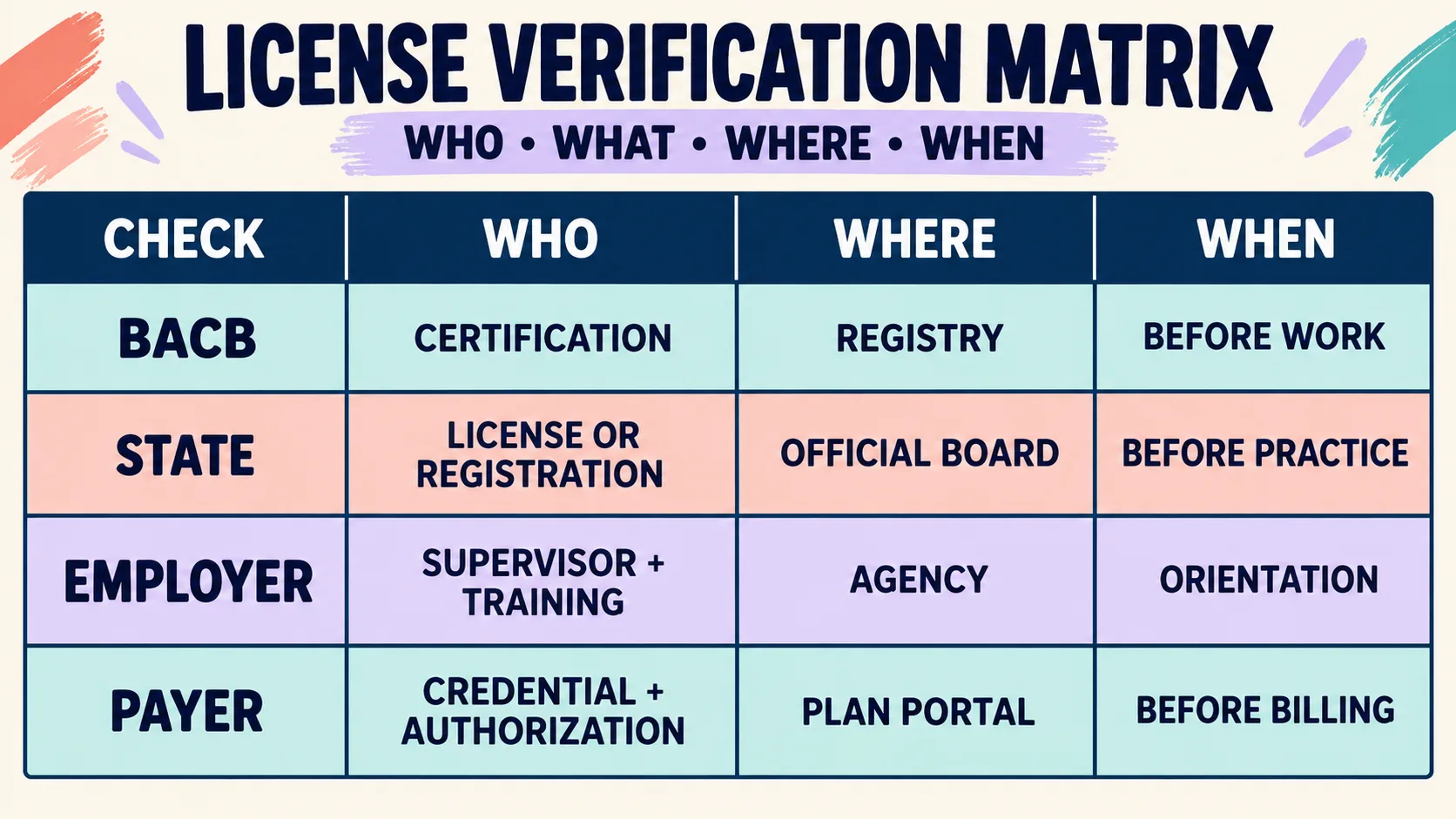
Use the matrix as a quick audit. Record the answer for the exact state, setting, client population, and payer rather than copying a generic national checklist.
ABA Therapist License Checklist
- Write down the actual duties, setting, client location, and supervisor.
- Identify whether the role requires RBT, BCaBA, BCBA, a state license, registration, or employer training.
- Verify the current BACB credential pathway and handbook.
- Check the state board for licensure, title protection, exemptions, supervision, and renewal rules.
- Confirm employer background checks, onboarding, and documentation requirements.
- Ask the payer or Medicaid plan about provider credentials and authorization.
- Save official verification results and the date you checked them.
- If applying near January 1, 2027, identify whether the BCBA/BCaBA transition affects your application.
ABA Therapist License FAQ
Is an ABA therapist license the same as an RBT certification?
No. RBT is a national BACB certification for a paraprofessional role. A state license or registration is a jurisdictional permission or requirement. An RBT may need another state or employer step, and the answer must be checked locally.
Can a BCBA work without a state license?
It depends on the state, the role, the setting, and any applicable exemption. Many states regulate behavior analysis, while some have different implementation rules. Check the state board and payer requirements before providing regulated services.
Does finishing an ABA course give me a license?
No. A course may satisfy part of a training requirement, but it does not automatically grant BACB certification, a state license, employer approval, or payer enrollment. Confirm what the course does and does not provide in writing.
Key Takeaway
ABA therapist license is a search phrase that hides several different questions. Separate the job duties, BACB certification, state licensure or registration, employer onboarding, payer rules, and supervision plan. Verify each one with the current official source—especially if you are planning around the January 1, 2027 BCBA/BCaBA transition. If you are preparing for the analyst-level concepts behind supervision, measurement, ethics, and treatment planning, continue with the site’s free BCBA mock exam. For targeted review, use our aba therapist license practice questions to apply the concept in exam-style scenarios.
Take the Free BCBA Mock Exam
If you want a low-pressure way to check your recall, use the free practice resource below. Take the Free BCBA Mock Exam



