
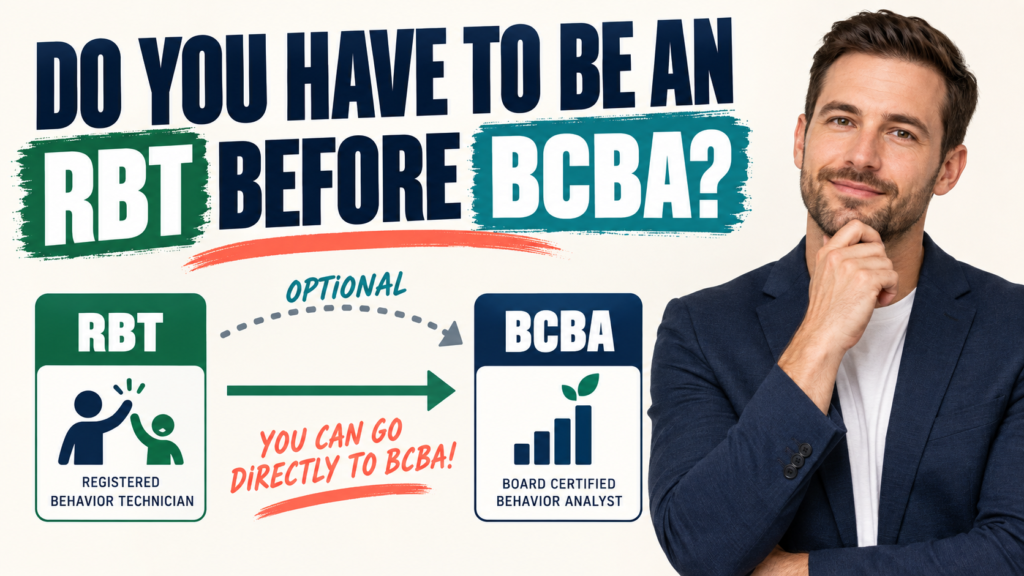
Short answer: no. If you are asking, “do you have to be an RBT before BCBA?”, the answer is no: you do not have to become a Registered Behavior Technician (RBT) before becoming a Board Certified Behavior Analyst (BCBA). RBT certification can be a useful way to gain supervised experience and learn how behavior-analytic services are delivered, but it is not listed as a required BCBA prerequisite. The BCBA route is built around the applicable degree, behavior-analytic education, supervised fieldwork, and BCBA examination requirements.
Table of Contents
- Do You Have to Be an RBT Before Becoming a BCBA?
- What Does the BCBA Route Actually Require?
- What Does RBT Certification Add?
- RBT Versus BCBA: What Is the Difference?
- Why Do RBT Hours Not Automatically Become BCBA Fieldwork?
- What Are Two Practical Routes to BCBA Preparation?
- Does the 2027 BCBA Transition Change the RBT Answer?
- A Simple Decision Checklist
- Frequently Asked Questions
- Quick Review Checklist
- Take the Free BCBA Mock Exam
That distinction matters because “RBT before BCBA” can describe two different questions. One is an eligibility question: Does the BACB require the RBT credential first? The other is a career-planning question: Would working as an RBT help me prepare for graduate school or fieldwork? The first answer is no. The second answer is often yes, but the experience does not automatically replace BCBA coursework or count as BCBA fieldwork.
Do You Have to Be an RBT Before Becoming a BCBA?
No. RBT certification is not a required rung that every BCBA applicant must complete first. The BACB describes the RBT as a paraprofessional credential practiced under close, ongoing supervision, while the BCBA is a graduate-level credential for independent behavior-analytic practice and supervision. They are related roles, but they are not two consecutive certificates in a mandatory ladder.
A candidate can enter a qualifying graduate program, complete the required behavior-analytic education and supervised fieldwork, and apply for the BCBA examination without first holding an RBT certificate. A candidate may also work as an RBT, behavior technician, teacher, research assistant, or in another relevant role before or during graduate training. The credential that matters is the one required by the pathway and application date, not the job title someone held before graduate school.
The most useful correction to the common myth is this: RBT experience can support your preparation, but RBT certification is not the same thing as BCBA eligibility. Do not let a job posting, a university admission preference, or an employer’s internal hiring sequence become confused with a BACB certification rule.
What Does the BCBA Route Actually Require?
For BCBA planning, begin with the current BCBA Handbook and the BACB requirements page that applies to your application date. In broad terms, a BCBA applicant must meet the applicable graduate-degree and behavior-analytic education conditions, complete supervised fieldwork in applied behavior analysis, and pass the BCBA certification examination. The exact pathway, documentation, and transition rules are time-sensitive, so the official handbook controls over a blog summary or an employer’s checklist.
| BCBA planning component | What to verify | Is RBT certification itself required? |
|---|---|---|
| Degree and education | The qualifying graduate degree, behavior-analytic coursework, and pathway rules in effect when you apply | No |
| Supervised fieldwork | A qualified supervisor, an approved structure, required activities, supervision contacts, observations, and verification records | No, but an RBT job can sometimes be the setting where eligible fieldwork is arranged |
| Application and examination | Current BACB application instructions, documentation, and the BCBA examination requirement | No |
This framework also explains why the answer should not be reduced to “just get RBT hours.” The RBT credential may help someone access a supervised service setting, but the BCBA applicant still needs to document the right kind of fieldwork under the right supervision arrangement. A supervisor or employer cannot make an otherwise ineligible activity count simply by calling the person an RBT.
What Does RBT Certification Add?
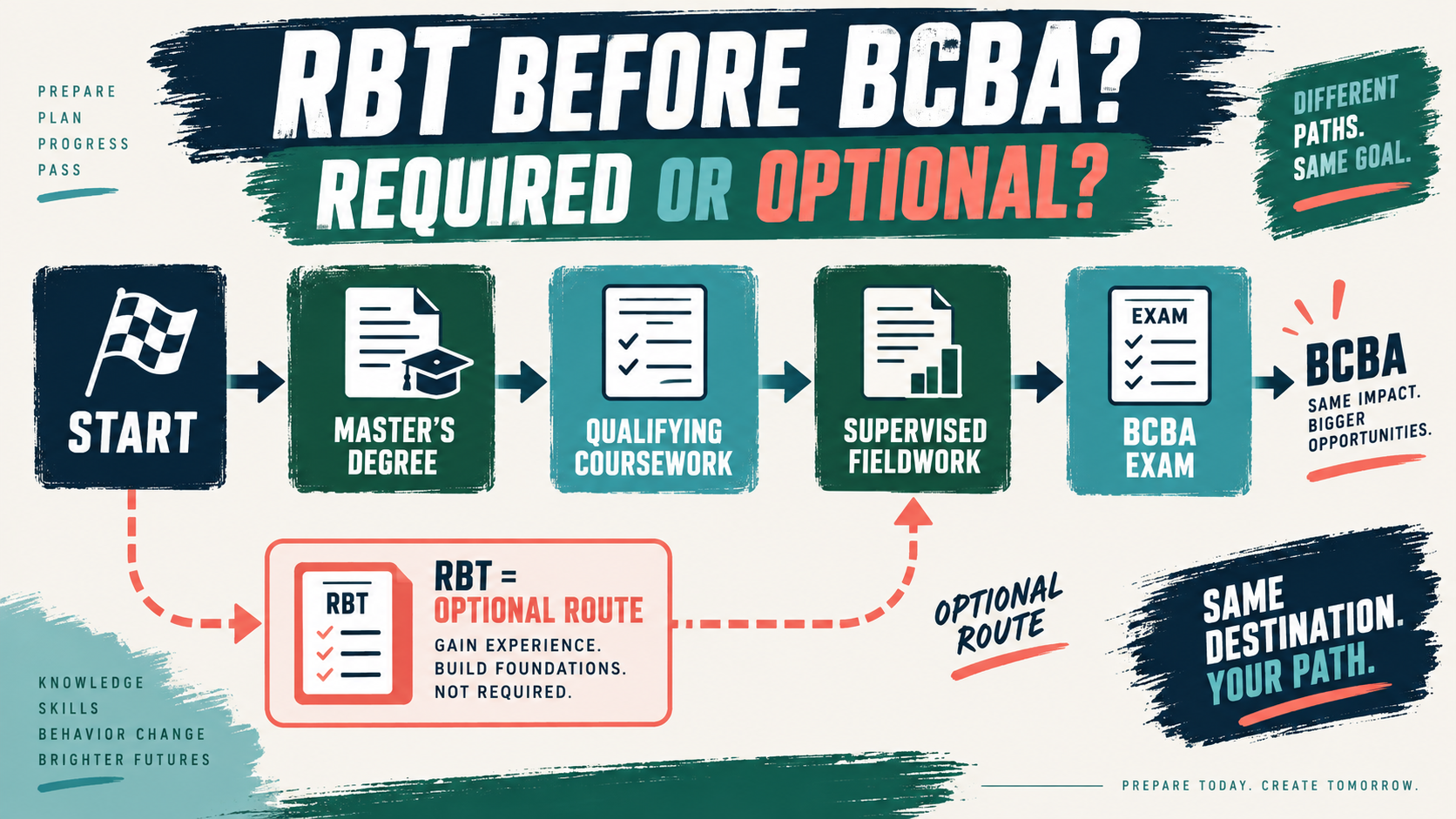
RBT certification can be valuable for practical and professional reasons. It can introduce a learner to session routines, data collection, prompting, reinforcement, implementation of behavior plans, collaboration with a supervising analyst, and the realities of direct service. It may also make it easier to find a job in an organization that offers access to BCBA supervision or graduate-level fieldwork.
Those benefits are different from eligibility. RBT training is designed for a paraprofessional role with close ongoing supervision. BCBA preparation requires broader analytic responsibilities: assessing behavior, interpreting data, designing and evaluating interventions, making treatment decisions within competence, communicating with stakeholders, and supervising others where authorized. Experience implementing a plan can build context, but it does not by itself demonstrate competence in designing or evaluating that plan.
Think of RBT work as one possible learning environment, not as a shortcut. It can help you decide whether you enjoy the field, understand client-facing work, and want to pursue graduate education. It can also expose gaps in your knowledge that you can address before the BCBA examination. But you should not enroll in an RBT course solely because you believe the BCBA application will reject you without that certificate.
RBT Versus BCBA: What Is the Difference?
The titles describe different credential levels and scopes of responsibility. The table below is a study aid, not a replacement for the current BACB handbooks or applicable jurisdictional rules.
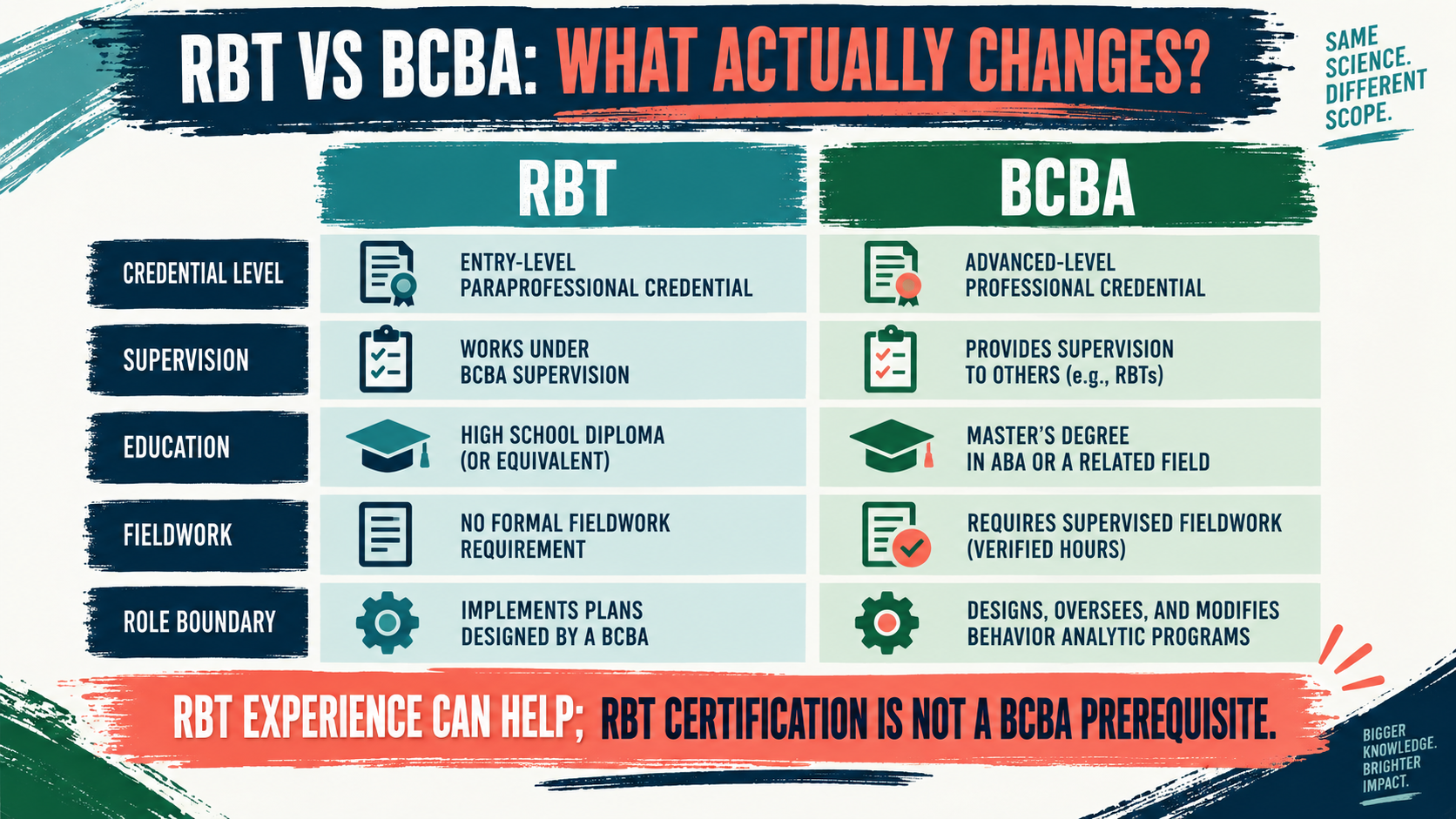
| Question | RBT | BCBA |
|---|---|---|
| Credential level | Paraprofessional behavior-analytic credential | Graduate-level behavior-analytic credential |
| Supervision relationship | Practices under close, ongoing supervision | May practice independently and provide supervision within the applicable rules |
| Typical work boundary | Implements assigned procedures and records relevant data | Analyzes data, designs or modifies programs, and oversees behavior-analytic services |
| Relationship to BCBA application | Optional experience and credential; not a mandatory prerequisite | The target credential with its own eligibility and examination requirements |
On an exam or in a career plan, watch for the verb. “Implements,” “records,” and “works under close supervision” point toward the RBT role. “Analyzes,” “designs,” “evaluates,” and “supervises” point toward BCBA-level responsibilities. The credential names are not interchangeable even when both professionals work on the same client team.
Why Do RBT Hours Not Automatically Become BCBA Fieldwork?
BCBA fieldwork is a documented training experience, not simply a total of hours spent near ABA services. The current BCBA Handbook explains that a trainee needs the applicable supervision structure, fieldwork agreement, qualified supervision, required contacts and observations, activity mix, and verification records. The work must fit the fieldwork requirements that apply to the person’s pathway and application date.
An RBT may perform meaningful clinical work and still have many of those activities fail to qualify as BCBA fieldwork. Direct implementation is often considered restricted work, while BCBA fieldwork includes a required proportion of unrestricted activities such as assessment, program design, data analysis, caregiver training, and other higher-level tasks. The exact classification depends on the current handbook and the documented activity, not on the employee’s preferred title.
- Ask whether a BCBA fieldwork agreement exists. A normal RBT employment agreement is not automatically a BCBA fieldwork contract.
- Confirm who is supervising which role. RBT supervision and BCBA trainee supervision have different purposes and records.
- Track unrestricted and restricted activities separately. Do not assume every paid service hour advances the BCBA requirement.
- Verify each month before signing. Corrections are much easier before a form is finalized and submitted.
What Are Two Practical Routes to BCBA Preparation?
There is no single best sequence for every candidate. Most people fall into one of two practical patterns. Route 1: RBT first, then graduate training: This route can make sense if you want early client-facing experience, need an entry-level job, or want to test whether behavior analysis is a good fit. Treat the RBT position as a professional learning step. When you later begin BCBA coursework, create a new fieldwork plan with a qualified supervisor and ask which activities can be documented under that plan. Do not backfill a BCBA record from memory.
Route 2: Graduate training first, with fieldwork arranged through the program or employer: This route can make sense if you are ready for graduate education and the program can connect you with compliant supervised fieldwork. You may work in an RBT or behavior technician role while you study, but the job title still does not decide whether the hours count. The supervisor, activity, documentation, and applicable BACB rule decide that.
Both routes can lead toward the same BCBA goal. The right choice depends on your education, finances, access to supervision, schedule, and confidence that the role will provide the learning opportunities you need. Avoid choosing an RBT program simply to satisfy a prerequisite that the BACB does not require.
Does the 2027 BCBA Transition Change the RBT Answer?
The 2027 transition changes BCBA eligibility and maintenance requirements for applications and certification decisions covered by the new rules. It does not turn RBT certification into a universal BCBA prerequisite. The BACB’s transition materials describe the degree or coursework route, supervised fieldwork, and examination as the relevant BCBA components; RBT certification is a separate credential.
Because an application date can change which pathway and documents apply, check the current 2027 BCBA Requirements page, the BCBA Handbook, and the official transition guidance. Use those sources to build a dated plan. Do not treat a social-media claim that says “the 2027 exam requires RBT first” as evidence of a BACB rule.
A Simple Decision Checklist
Before enrolling in an RBT course or counting a job toward your BCBA plan, ask:
- Am I asking about a BACB certification requirement, an employer requirement, or a university admission preference?
- Have I checked the current BCBA Handbook for the pathway and application date that apply to me?
- If I plan to count fieldwork, do I have a separate agreement and qualified BCBA supervision?
- Are the activities being labeled as restricted or unrestricted under the current rules?
- Will the supervisor review my records monthly rather than signing hours after the fact?
- Am I choosing RBT work because it supports my goals, or only because I think it is mandatory?
If the answer to the last question is “only because I think it is mandatory,” pause and verify the source before spending time or money. RBT experience may be a smart choice, but it should be a deliberate career and training decision.
Frequently Asked Questions
Can I become a BCBA without ever being an RBT?: Yes. The RBT credential is not a required prerequisite for BCBA certification. You still must satisfy the BCBA pathway, education, supervised fieldwork, application, and examination requirements that apply to your situation.
Will RBT experience help me become a BCBA?: It can help you gain direct-service experience, understand behavior plans, and find a supervised setting. It does not replace graduate-level education or guarantee that the hours qualify as BCBA fieldwork.
Can RBT hours count toward BCBA fieldwork?: Some work performed in an RBT job may occur in a setting where BCBA fieldwork is also arranged, but the hours do not count automatically. The activity, supervision arrangement, fieldwork agreement, documentation, and current BACB requirements must all line up.
Do I need to be an RBT before starting a BCBA master’s program?: Not as a universal BACB rule. A university may have its own admissions preferences, and an employer may use RBT certification for a particular job. Those local requirements should not be confused with the BACB’s BCBA certification eligibility rules.
Is RBT or BCBA the better first credential?: That depends on your goal. RBT can be a practical entry-level role for supervised direct service. BCBA is the graduate-level target for people who want to analyze, design, evaluate, and supervise behavior-analytic services. Choose based on the work you want to do and the education you are ready to complete.
Study the exam content separately: Once your education and fieldwork plan are clear, use the free BCBA mock exam to practice measurement, assessment, ethics, and intervention questions. It is study practice, not a BACB application decision or certification guarantee. Official sources used
- BACB BCBA Handbook
- BACB 2027 BCBA Requirements
- BACB Guidance for Meeting the BCBA Requirements During the 2027 Transition
- BACB credential overview
- BACB supervision, assessment, training, and oversight resources
For targeted review, use our do you have to be an practice questions to apply the concept in exam-style scenarios.
Quick Review Checklist
Use this final checklist to turn do you have to be an into exam-ready reasoning. The goal is not to memorize a label in isolation; it is to identify the relevant evidence and explain why the best answer fits the scenario. Key ideas to review:
- State the central definition or decision point for do you have to be an in your own words.
- Identify the detail that makes do you have to be an different from its closest related ABA term.
- Separate the observable facts in a scenario from assumptions that are not supported by the facts.
- Write one example and one nonexample so you can recognize the concept in a new setting.
Exam application checks:
- Ask what the question is actually requesting before comparing the answer choices.
- Mark the antecedent, response, consequence, or other evidence that supports the selected answer.
- Look for a distractor that describes a related process but does not answer the specific question.
Final self-check:
- Explain how you would verify the interpretation with clear observations or data.
- Change one detail in the scenario and decide whether your answer should change.
- Give a one-sentence rationale that a supervisor or study partner could evaluate.
Take the Free BCBA Mock Exam
If you want a low-pressure way to check your recall, use the free practice resource below. Take the Free BCBA Mock Exam



