
ASSESSMENT · SOCIAL SKILLS The Functional Social Skills Assessment, often shortened to FSSA, is best understood as a structured way to look at functional social performance across skills, partners, and settings. It can organize observations and goal planning, but it is not a diagnosis and it should not be used as a standalone treatment decision.
Table of Contents
- What Is the Functional Social Skills Assessment?
- What Does the FSSA Look At?
- Why Do Context and Communication Mode Matter?
- How Do FSSA Rating Levels Work?
- How Do You Use FSSA Results to Plan Goals?
- How Do You Check Generalization and Social Validity?
- What Are the FSSA’s Limits?
- What Are the BCBA Exam Takeaways?
- Frequently Asked Questions
- Sources for Further Study
- Take the Free BCBA Mock Exam
What Is the Functional Social Skills Assessment?
The Functional Social Skills Assessment (FSSA) is a structured skills assessment designed to help a team examine how a learner communicates and interacts in functional social situations. The resource commonly associated with the FSSA includes skill areas, context prompts, a way to rate current performance, and space for comments or assessment notes. Its value is not a single total score. Its value is the pattern: which skills are emerging, which are independent, which depend on a particular partner, and which need to be checked in other environments.
That pattern makes the FSSA different from a diagnostic evaluation. It does not determine whether someone has a disability, explain every reason a social response occurs, or prescribe a universal intervention. A BCBA or another qualified professional may use it as one source of assessment information alongside observation, interviews, records, preference and communication information, and measures of meaningful outcomes.
Use the authorized version and respect the instrument’s copyright and completion instructions. A copied checklist without its directions, context, or scoring anchors can turn a structured assessment into an unreliable informal survey. The person completing it should document who provided the information, when it was collected, and what conditions were actually observed.
What Does the FSSA Look At?
The FSSA focuses on practical social behavior rather than a vague idea of being “social.” Depending on the version and context, items may address communicating with a partner, initiating or responding, participating in interaction, using social information, and maintaining an interaction across people and activities. The exact item wording belongs to the instrument; the study task is to understand the assessment logic.
Translate each item into an observable response. “Has good social skills” is too broad to measure. “Responds to a peer’s greeting within five seconds using speech, sign, or the learner’s communication system” is more useful because the team can identify the antecedent, response, partner, latency, and level of independence. Observable definitions also make it easier to ask whether the target is meaningful to the learner rather than merely typical-looking.
- Communication access: Can the learner express a message, respond, repair a breakdown, or indicate a preference in an accessible mode?
- Interaction: Can the learner start, respond to, sustain, or end an interaction in a way that works for the context?
- Partner variation: Does the response occur with familiar adults, unfamiliar adults, peers, or communication partners who use different styles?
- Context variation: Does the skill appear during play, instruction, community activity, group participation, or a less structured situation?
- Independence: Does the response require prompts, repeated directions, reinforcement, or a specific arrangement?
Why Do Context and Communication Mode Matter?
A social response is not a fixed trait that appears identically everywhere. A learner may greet an adult who gives a long wait but not a peer who moves quickly. A person may communicate effectively with a speech-generating device at home but lose access to that system in a noisy community setting. These differences are assessment information, not proof that one score captures the whole person.
FSSA-style information may be gathered through natural observation, a planned task, prior knowledge, an informant, or more than one method. Record which method produced the rating. A skill reported by a caregiver is valuable, but it answers a different question from a skill observed with an unfamiliar peer. When ratings disagree, investigate the setting, partner, prompt history, motivation, sensory load, and communication access rather than averaging away the difference.
Also separate “does not perform” from “does not have access.” If a learner’s communication device is unavailable, a lack of spoken response should not be scored as a lack of communication skill. If a social situation is unsafe or coercive, the ethical response may be to change the situation rather than train the learner to tolerate it.
How Do FSSA Rating Levels Work?
The FSSA resource uses a progression that can be read as acquisition, fluency, maintenance, and generalization. The labels and directions in the authorized version control, but the learning logic is useful for BCBA study: a response may be absent or require substantial support, beginning to emerge, independent in a known context, or independent across people, materials, directions, and environments.
| Rating idea | What it suggests | What to verify next |
|---|---|---|
| Not yet observed or acquisition | The response is absent, inconsistent, or requires substantial prompts, time, or reinforcement. | Define the response, identify a functional context, and confirm communication access before selecting a goal. |
| Emerging or fluency | The learner performs the skill under some conditions but may need support, time, or reinforcement. | Measure independence, latency, prompt level, and the conditions in which the skill is reliable. |
| Independent or maintenance | The skill occurs without the listed prompts or extra support in a familiar context. | Probe over time and with natural consequences rather than assuming one successful observation is maintenance. |
| Generalization | The skill transfers across people, environments, materials, directions, or activities. | Identify which dimension changed and whether the learner still has choice, access, and a meaningful reason to respond. |
Do not treat the highest rating as a demand for constant performance. A functional assessment asks whether the skill is available when it matters, not whether the learner behaves identically in every social situation. The team should also allow alternative communication, breaks, refusal, and different ways of participating.
How Do You Use FSSA Results to Plan Goals?
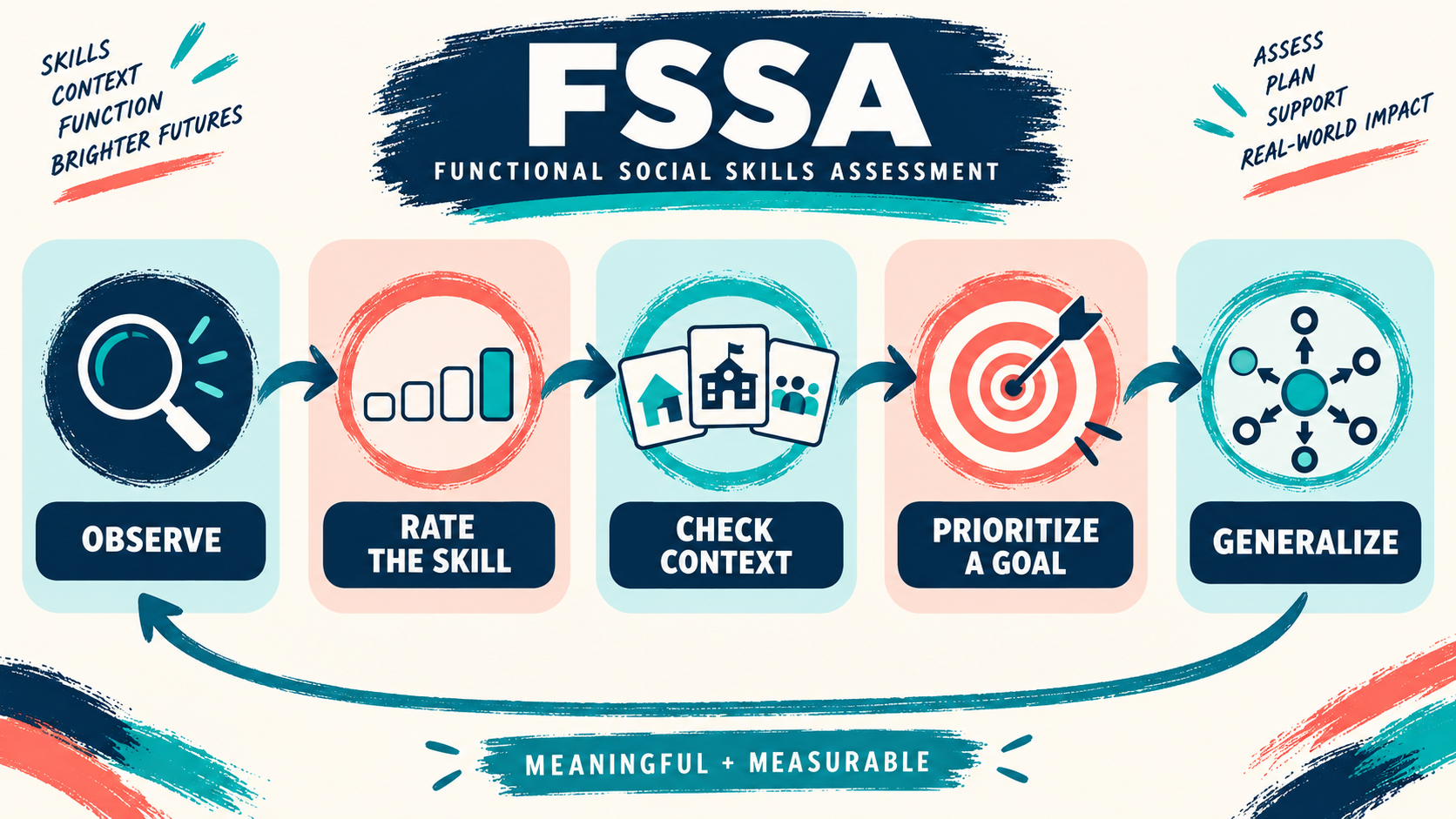
Start with the largest meaningful gap, not the lowest number in a spreadsheet. A low rating may reflect a missing opportunity, an inaccessible communication mode, an unfamiliar partner, or a skill that is not relevant to the learner’s current priorities. Review the context notes and ask the learner and their supporters what outcome would improve participation or quality of life.
- Choose one observable skill and write an operational definition.
- Identify the context, partner, materials, and communication mode.
- State the response criterion and how independence will be measured.
- Plan teaching, prompting, reinforcement, and assent procedures within qualified supervision.
- Probe a second person or setting early enough to reveal a generalization problem.
- Review whether the goal produces a meaningful outcome rather than only a higher checklist rating.
For example, a rating pattern might show that a learner can answer an adult’s question in a quiet room but does not independently initiate a request for help with a peer during a group activity. The next goal might concern accessible help-seeking in that group context, not “increase social skills.” The team could measure independent requests, communication repairs, prompt levels, and whether help actually becomes available.
How Do You Check Generalization and Social Validity?
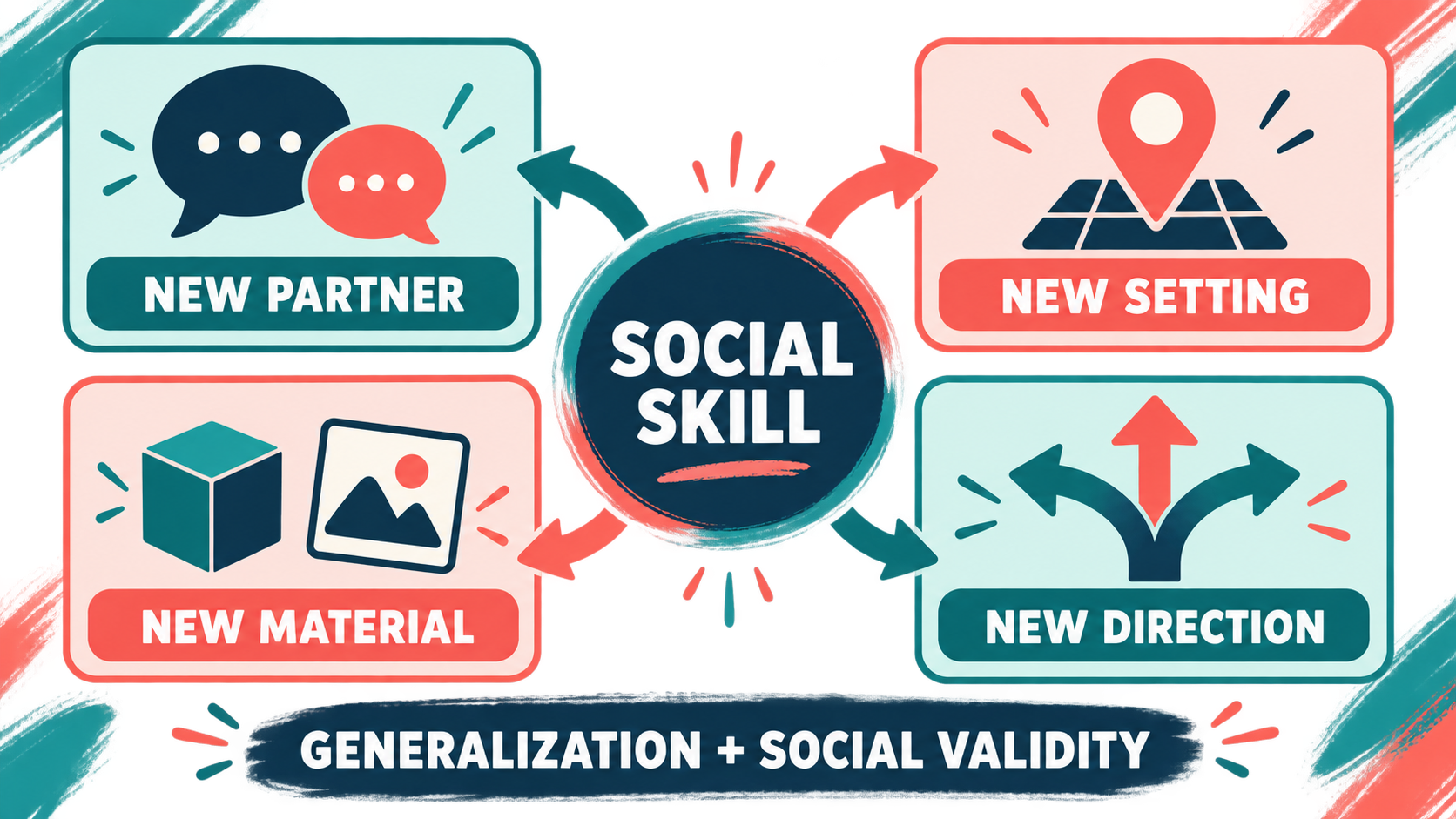
Generalization is not a box to check only after teaching ends. Plan variations in partners, environments, materials, instructions, and natural outcomes as the skill develops. If the learner performs only with the person who delivered the training, the program may have taught a narrow performance rather than a transferable skill.
Social validity asks whether the goal matters, whether the procedure is acceptable, and whether the outcome improves the learner’s life. Ask the learner when possible, use accessible ways to gather preference and assent, and include supporters without allowing adult convenience to define success. A person may choose not to greet every passerby and still have excellent functional communication.
Keep assessment records secure and de-identified in study examples. A checklist can support clinical reasoning, but it should not be copied into a public portfolio with a learner’s name, diagnosis, device information, or identifiable observations.
What Are the FSSA’s Limits?
No single assessment captures every social, communication, cultural, sensory, or environmental variable. Ratings can be influenced by informant opportunity, observer expectations, prompt history, language access, and the design of the task. A responsible interpretation reports those limits and combines the FSSA with direct observation and other relevant measures.
The FSSA is also not a replacement for functional behavior assessment when the question concerns problem behavior. A social-skill rating may describe what happens, but it does not by itself identify the maintaining variables for aggression, escape, self-injury, or other behavior. Match the assessment to the question.
What Are the BCBA Exam Takeaways?
For a BCBA question about the Functional Social Skills Assessment FSSA, remember that the tool organizes functional social-skill observations and learning levels. The strongest answer will consider context, communication access, independence, maintenance, generalization, and social validity instead of treating one total score as a diagnosis.
- Use the authorized instrument and preserve its directions and rating anchors.
- Record how, where, with whom, and when the skill was assessed.
- Translate broad social labels into observable and measurable responses.
- Separate acquisition, fluency, maintenance, and generalization.
- Use results to plan meaningful goals, not to force compliance or erase communication differences.
For additional practice with assessment, measurement, and generalization scenarios, the site’s free BCBA mock exam is an independent study resource. It is not official BACB content and does not guarantee certification.
Frequently Asked Questions
Is the FSSA a diagnostic test?: No. It is a functional social-skills assessment resource. It can organize observations and goal planning, but a diagnosis requires an appropriate diagnostic process and the FSSA should not be used alone.
Can a parent or teacher complete the FSSA?: An informant can provide valuable information when the authorized directions allow it, but the record should identify the informant and distinguish report from direct observation. Comparing sources can reveal context differences that a single rating would hide.
Does a generalization rating mean the learner should respond everywhere?: No. Generalization means a meaningful skill transfers across relevant conditions. It does not require identical social performance in every setting or remove the learner’s right to choose, decline, communicate differently, or take a break.
Sources for Further Study
- Functional Social Skills Assessment resource — checklist structure and rating concepts; use the authorized version and respect copyright.
- BACB BCBA Test Content Outline, 6th edition — current assessment, measurement, and generalization study context.
- Utility of an Observational Social Skill Assessment — peer-reviewed context for observational measurement.
- Contextual Assessment of Social Skills — peer-reviewed measurement and validity context.
Take the Free BCBA Mock Exam
If you want a low-pressure way to check your recall, use the free practice resource below. Take the Free BCBA Mock Exam



