

The strongest ABA flash cards do not make a definition look familiar. They make you retrieve it, explain it, distinguish it from a close concept, and use it in a scenario. If you are choosing ABA flash cards for BCBA preparation, start by asking what the cards are designed to do. A definition deck can help you build vocabulary. It cannot, by itself, prove that you can select the best procedure in a long scenario or manage a timed practice set. Your study system should turn recognition into active recall and then turn recall into application.
Table of Contents
- ABA Flash Cards: What They Can and Cannot Do
- Build a Card That Forces Retrieval
- Use Distinction Cards for Similar ABA Concepts
- Move Flash Cards Into Scenarios and Mocks
- Schedule Review Without Cramming the Whole Deck
- Keep the 2027 Transition in Context
- A Seven-Day ABA Flashcard Cycle
- FAQ About ABA Flash Cards
- Take the Free BCBA Mock Exam
ABA Flash Cards: What They Can and Cannot Do
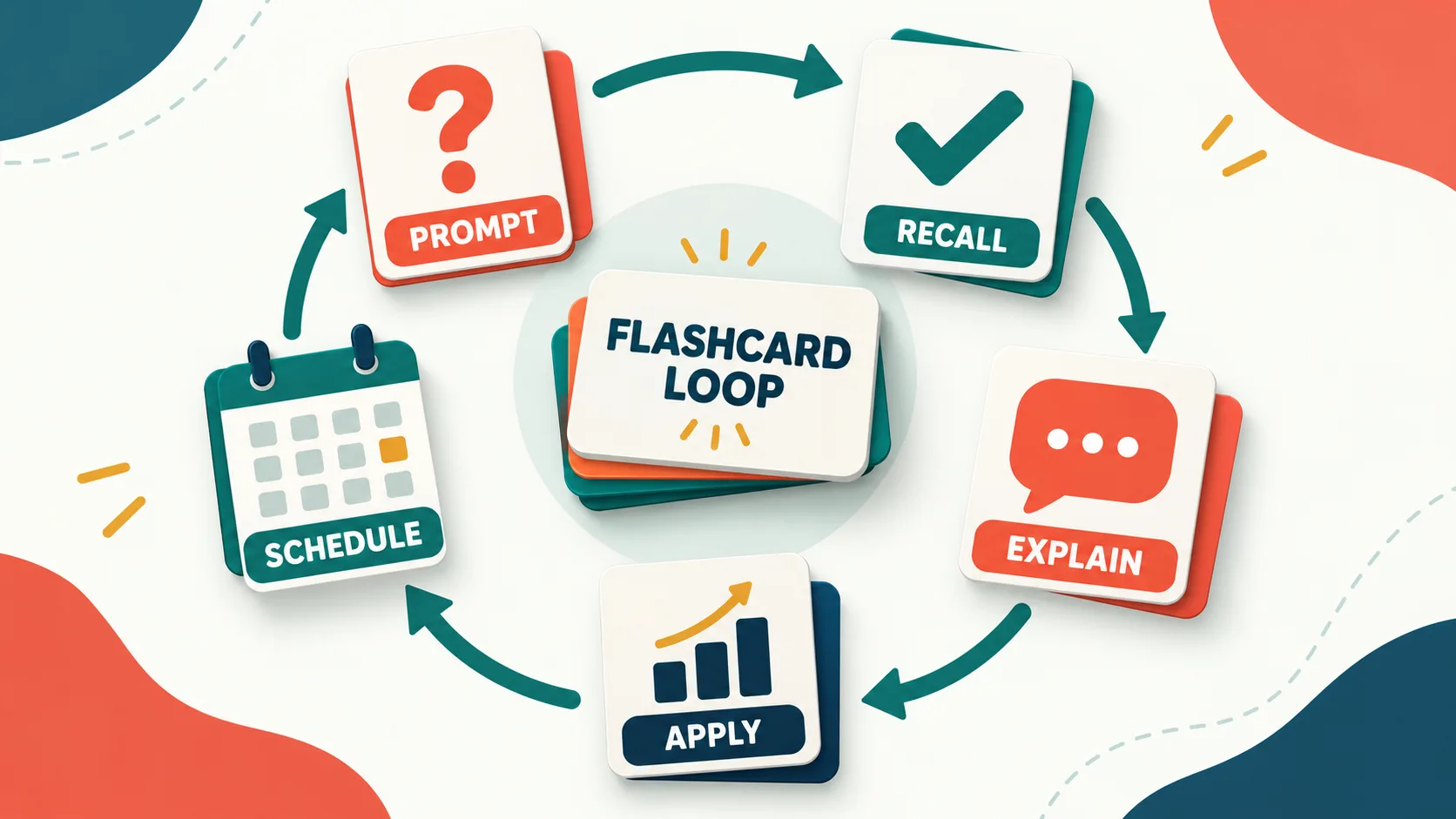
Flash cards are useful for fast retrieval of terms, features, examples, and decision rules. They are especially helpful when you have a crowded week and need a portable way to revisit weak concepts. The limitation is that the front of a card usually removes the context that makes a BCBA exam question difficult.
The current BCBA examination is based on the BCBA Test Content Outline, 6th edition. Use that outline as a coverage map, not as a reason to create one card for every phrase. A good deck should help you retrieve what a concept means, what it looks like in a case, what it is often confused with, and what data or ethical detail changes the decision.
Do not judge a deck only by its card count. A smaller deck with clear prompts and accurate distinctions can produce more useful practice than a large list of isolated definitions. The real test is whether your answer survives when the wording changes.
Build a Card That Forces Retrieval
Recognition feels easy because the answer is visible. Retrieval is harder: you see a prompt, produce an answer from memory, and then check the quality of that answer. That difficulty is the point. Before you reveal the back of a card, say or write the answer in your own words.
- Put one decision on the front, not a paragraph of textbook notes.
- Ask for a feature, contrast, example, or next step instead of copying a heading.
- Keep the back short enough to check, but add one applied example when the concept needs context.
- Tag the card by TCO domain and by the type of error it fixes.
- Mark “guessed” separately from “correct,” because a lucky answer is not mastery.
| Card type | Front prompt | What a strong back includes |
|---|---|---|
| Definition | What does the term mean? | Plain-language definition plus one identifying feature. |
| Discrimination | How is this different from its closest look-alike? | The feature that separates the two and a short example. |
| Application | What would you choose in this situation, and why? | The decision rule, relevant detail, and why another option is weaker. |
When a card keeps causing the same error, do not simply repeat it faster. Rewrite the prompt. It may be testing recognition instead of the distinction you actually need. You can also split a crowded card into two: one for the concept and one for the scenario decision.
Use Distinction Cards for Similar ABA Concepts
Many candidates know individual definitions but lose points when two options share familiar words. Build cards that place similar concepts side by side. The goal is not to memorize a longer paragraph; it is to identify the single feature that changes your answer.
| Distinction prompt | Ask yourself | Exam transfer |
|---|---|---|
| Measurement terms | What dimension is actually being counted or timed? | Select the measurement that matches the behavior and question. |
| Reinforcement procedures | What consequence, contingency, or schedule feature is present? | Separate the named procedure from a similar-sounding outcome. |
| Assessment and intervention | What evidence supports the next decision? | Avoid choosing an intervention before identifying the assessment detail. |
| Ethics and supervision | What obligation, boundary, or reporting step controls the choice? | Notice the professional responsibility hidden in the scenario. |
Use a “why not?” prompt on the back. If the card asks for the best answer, add one sentence explaining why the tempting alternative is not the best fit. This makes your deck more like exam practice and less like a glossary.
Move Flash Cards Into Scenarios and Mocks
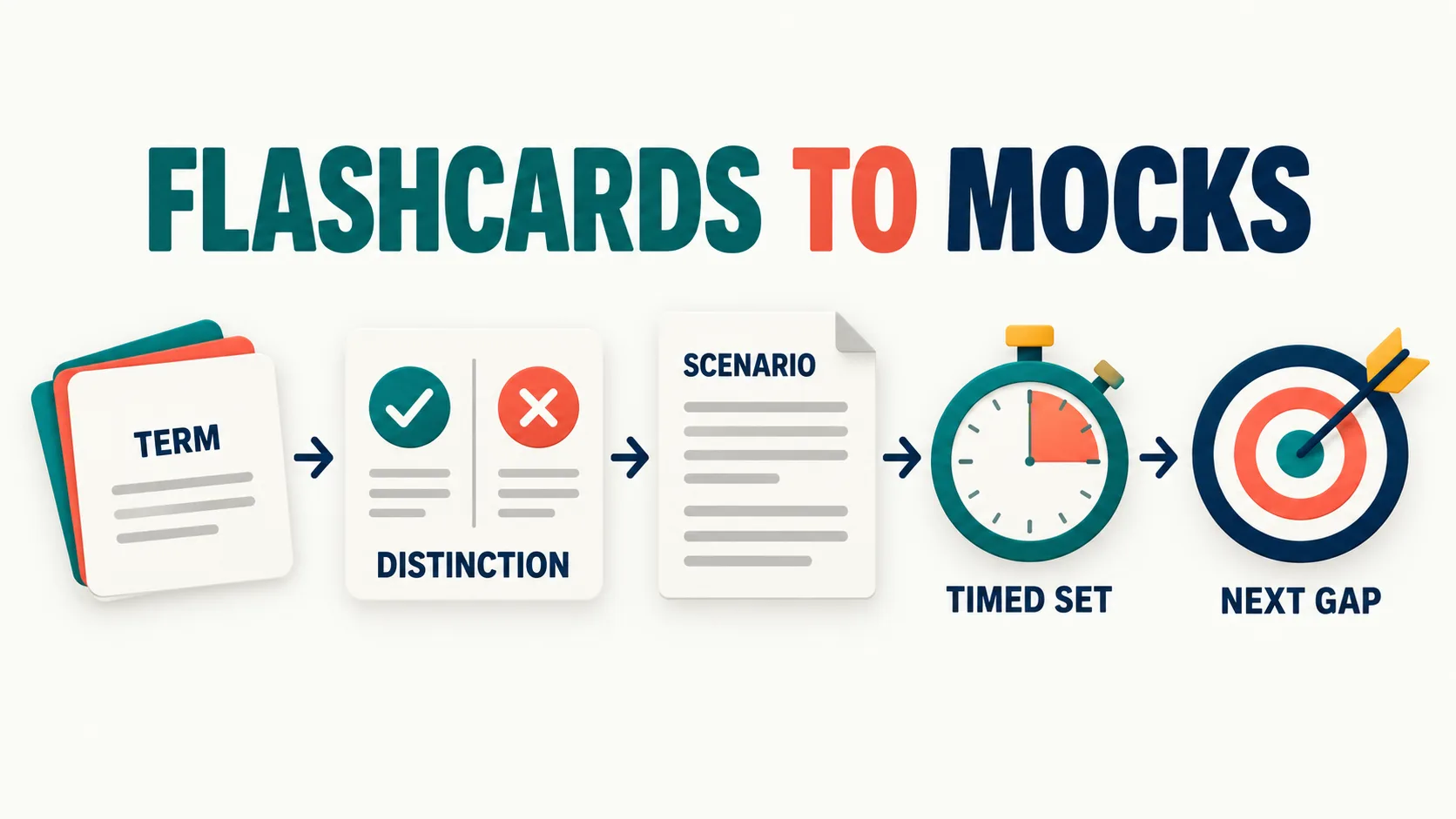
Flash cards should feed a larger loop. After you retrieve a term, use it in a short scenario. After the scenario, test the concept in a timed set. Then send the missed or guessed concept back into the deck with a better prompt.
- Term: retrieve the definition or feature without looking.
- Distinction: compare it with the closest competing concept.
- Scenario: identify the detail that controls the decision.
- Timed set: answer under a realistic pace and record uncertainty.
- Next gap: rewrite the card or create a new card from the error.
That loop matters because the BCBA exam does not present every concept as a clean flashcard. You may see several plausible choices, extra information, or a question that asks for the most appropriate next step. A card that prepares you only to recite a definition will not fully prepare you for that change in context.
- Use flash cards early in a study session to warm up retrieval.
- Use scenario questions in the middle to practice discrimination.
- Use a timed mock later to test pacing, fatigue, and mixed-domain transfer.
Schedule Review Without Cramming the Whole Deck
Spaced review is more useful when the schedule follows performance. Cards you miss, guess, or explain poorly should return sooner. Cards you retrieve accurately several times can wait longer, but they should not disappear permanently. The exact interval matters less than having a system that prevents the same weak cards from being buried under familiar ones.
| Result today | Deck action | Add next |
|---|---|---|
| Correct and fluent | Move to a later review group. | A scenario or distinction version later in the week. |
| Correct but hesitant | Keep in the near-term group. | A shorter prompt that tests the key feature. |
| Wrong or guessed | Return soon and record the error type. | A why-not card or targeted practice question. |
Do not measure success by how many cards you “finished.” Measure whether you can retrieve the idea after a delay and use it when the prompt changes. If the deck grows too large, suspend low-value cards and prioritize concepts that appear in your missed-question log or that connect several TCO tasks.
- Keep difficult cards visible until you can answer them without a cue.
- Mix older mastered cards into new review so recognition does not replace retrieval.
- Use a scenario or question set each week to test whether the card knowledge transfers.
Keep the 2027 Transition in Context
The BACB’s 2027 changes concern certification eligibility and maintenance requirements. They do not mean that every flashcard deck suddenly becomes unusable. The official 2027 summary and the current BCBA Handbook should be your sources for requirement timing, forms, and application decisions.
For exam study, verify the current examination information and 6th-edition TCO separately. A provider may update a deck because terminology, explanations, or references need revision; that is different from claiming that a certification-transition date automatically changed the examination. Look for a dated update note and a clear scope.
A Seven-Day ABA Flashcard Cycle
Use this cycle when you want flash cards to support, rather than replace, question practice:
- Day 1: map the deck to TCO domains and remove cards that are duplicates or too vague.
- Day 2: run active recall; mark wrong, guessed, and slow cards separately.
- Day 3: make distinction cards for the most common look-alike concepts.
- Day 4: answer short scenarios without looking at the card back.
- Day 5: take a targeted question set and create cards from errors.
- Day 6: take a timed mixed set and note pacing or fatigue problems.
- Day 7: review the weak deck, then plan the next week around the evidence.
Our BCBA 6th-edition flashcard resource can serve as the structured retrieval layer. When you are ready to test transfer, use the free BCBA mock exam and bring your weakest concepts back into the deck.
FAQ About ABA Flash Cards
Are flash cards enough to pass the BCBA exam?: Usually, flash cards work best as one layer of preparation. They help with retrieval and distinctions, while scenario questions and timed mocks test application, pacing, and mixed-domain reasoning.
Should I use digital or paper ABA flash cards?: Use the format you will review consistently and that lets you separate weak cards from fluent cards. Digital tools may make scheduling and progress tracking easier; paper can be useful for writing, sorting, and explaining concepts aloud.
How many flash cards should I study each day?: Choose a workload you can review again. A smaller set that you retrieve accurately and apply is more useful than racing through hundreds of cards and confusing recognition with mastery.
Do I need a new deck because of the 2027 requirements?: Not automatically. Verify what the provider updated and compare it with the current BACB examination information, TCO, and handbook. A certification-requirement update is not the same thing as an exam-content update.
Sources checked for this guide include the BACB task-list hub, BCBA Test Content Outline (6th ed.), BCBA Handbook, examination information, and official 2027 requirement resources. Independent flashcard tools are not BACB-endorsed unless the BACB explicitly states otherwise.
Take the Free BCBA Mock Exam
A useful next step is to apply this idea in a fresh set of BCBA-style practice questions and review the feedback. Take the Free BCBA Mock Exam



