
A useful mock exam does more than produce a percentage. It should show what you practiced, why an answer was right or wrong, and what your next study session should fix. If you are comparing ABA exam review mock exams, the biggest number is rarely the most important one. A platform can advertise hundreds of questions and still leave you unsure about what to study next. Before you pay, audit the product for five things: alignment with the current BCBA Test Content Outline (TCO), realistic item design, useful explanations, domain-level feedback, and an access policy that fits your study schedule.
Table of Contents
- ABA Exam Review Mock Exams: What You Should Audit First
- 1. Check TCO coverage, not just question count
- 2. Take a baseline before you compare scores
- 3. Read every explanation, including the answers you got right
- 4. Inspect analytics that change your next study action
- 5. Check timing, retakes, and access before you pay
- Keep the 2027 transition in context
- Free versus paid ABA exam review mock exams
- A seven-day audit plan before you commit
- FAQ about ABA exam review mock exams
- Take the Free BCBA Mock Exam
The goal is not to find a mock exam that predicts your exact BACB result. No practice product can make that promise. The goal is to find a review system that helps you practice the work the exam demands, shows you why an answer is correct, and turns each attempt into a better study decision.
ABA Exam Review Mock Exams: What You Should Audit First
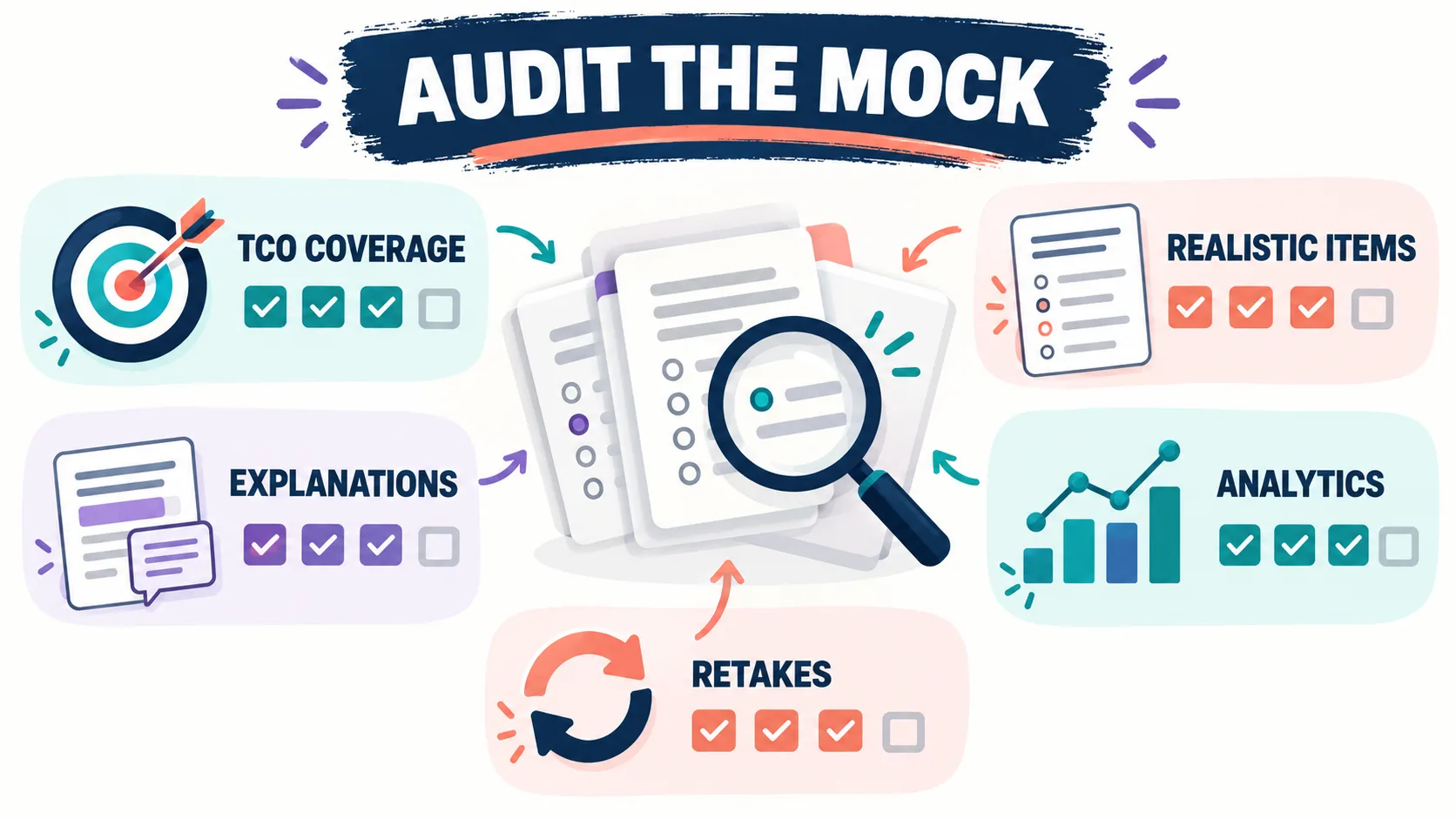
Start with evidence, not testimonials. A trustworthy review page should let you understand what the practice questions cover, how feedback is delivered, and what happens after you finish. If the sales page only says “hard questions,” “real exam feel,” or “pass faster,” you do not yet have enough information to compare it.
The current BCBA exam is based on the BCBA Test Content Outline, 6th edition. That makes the TCO your first audit document. A mock exam does not have to reproduce the real exam, but it should make its content coverage clear enough for you to identify what you practiced and what remains weak. Use the following sequence when you open a review product. If you cannot answer one of the questions, mark the product as “unverified” instead of assuming the missing information is favorable.
1. Check TCO coverage, not just question count
Question volume is only useful when you know what the questions represent. A large bank may contain many variations of the same easy definition, while a smaller bank may give you better coverage of application, measurement, assessment, intervention, and ethics scenarios. Look for a domain map or a clear explanation of how the product was built from the TCO.
| Audit item | What to check | Red flag |
|---|---|---|
| TCO version | The page names the current BCBA TCO and explains its scope. | Only “latest” or “updated” appears, with no version or date. |
| Domain coverage | You can see which domains or task areas are represented. | A single total hides the distribution of questions. |
| Application level | Questions require choosing a response in a scenario, not only recalling a term. | Most items are one-line definition prompts. |
Do not confuse alignment with endorsement. The BACB publishes the examination information and TCO; it does not turn an independent commercial mock exam into an official BACB product. A careful provider should state that distinction plainly.
2. Take a baseline before you compare scores
Take one practice set before spending hours reading reviews. Use a timed mode if you are close to your exam date, and use an untimed mode if you are still learning how to reason through scenarios. Record more than the percentage correct:
- How long did the set take?
- Which items did you guess on?
- Which wrong answers looked almost correct?
- Which domains felt slow, even when you got the answer right?
- Did you change answers because of a real reasoning correction or because you became anxious?
Your baseline gives the review product a job. If the first attempt shows a measurement weakness, you need explanations and targeted practice in that area. If the score is acceptable but the timing is poor, you need realistic pacing and a review loop. Without a baseline, a high score can create false confidence and a low score can feel like a vague verdict.
3. Read every explanation, including the answers you got right
An explanation is valuable when it teaches a decision rule. It should identify the detail in the scenario that matters, explain why the correct option fits, and show why the distractors fail. A sentence such as “Option B is correct because it is the best answer” does not give you a reusable skill.
Read the explanation for a correct answer when you guessed, when you took too long, or when two options felt interchangeable. This is where many mock exams become either a learning tool or a score counter. You should be able to turn a missed item into a short note such as “select the measurement that matches the behavior dimension,” “separate function from topography,” or “check the ethical requirement before choosing the convenient action.”
Also look for answer-key maintenance. A provider should have a way to report an ambiguous item, a broken explanation, or an outdated reference. You do not need a public claim that every question is perfect. You do need a visible correction path.
4. Inspect analytics that change your next study action
Analytics are useful only when they answer “what should I do next?” A dashboard that shows one overall percentage is less helpful than a simple domain breakdown with enough detail to identify a pattern. Look for performance by domain, question review, timing, and attempt history.
| Signal | Useful interpretation | Next action |
|---|---|---|
| Low score and slow time | The concept and the decision process both need work. | Review the concept, then practice shorter targeted sets. |
| High score and slow time | Recognition may be stronger than fluent application. | Add timed scenario practice and review hesitation points. |
| Repeated misses in one domain | The gap is more likely a study priority than bad luck. | Build a domain-specific review loop before another full mock. |
Be cautious with precise “readiness scores.” A mock exam score depends on the difficulty and design of that provider’s item bank. Use it to compare your own attempts under similar conditions, not as a guarantee that you will pass the actual examination.
- A domain report that identifies patterns instead of only ranking you against other users.
- A review history that lets you see whether the same error keeps returning.
- A clear distinction between learning-mode results and timed-exam results.
5. Check timing, retakes, and access before you pay
A review product can be academically strong and still be a poor fit if its access rules do not match your schedule. Confirm whether you can pause an attempt, review answers after submission, restart a set, and see previous results. If you are buying a short subscription, check whether the clock starts at checkout or at first use.
- Can you pause a study-mode attempt without losing the review state?
- Can you see which options you selected and revisit the explanation later?
- Are retakes new practice, or are you mainly seeing the same items again?
- Are renewal, refund, and account-access terms visible before checkout?
| Feature | Why it matters | Better sign |
|---|---|---|
| Timed and study modes | You need both exam pacing and learning feedback. | The mode is explicit and the feedback rules are clear. |
| Retakes | A second attempt is only useful if you can distinguish learning from memorization. | New sets, shuffled items, or a clear review history are available. |
| Access window | Your study plan may change around work, fieldwork, or an exam appointment. | The provider states the time limit, renewal terms, and refund rules. |
Keep the 2027 transition in context
The BACB’s 2027 transition matters to certification planning, but it should not be used as a vague sales trigger for every mock exam. The official 2027 summary says significant eligibility and maintenance changes take effect January 1, 2027, and the transition guidance explains how application timing affects the requirement set.
At the same time, the BACB’s transition guidance states that the BCBA examination has been based on the 6th-edition TCO since January 1, 2025, and that certification-requirement changes do not automatically mean the exam or TCO changes on the same date. Check the current examination information page and the handbook when planning. A product that says “2027-ready” should explain exactly what it updated: certification guidance, study explanations, exam content, or merely its marketing page.
Free versus paid ABA exam review mock exams
A free practice test can be the best first step because it gives you a baseline without forcing a purchase. A paid product may be worthwhile when it adds a deeper question bank, full explanations, domain analytics, multiple timed forms, or a study path that you will actually use. The correct sequence is test, inspect, then decide.
| Your situation | Start with | What to measure |
|---|---|---|
| You have not taken a full practice set | A free baseline mock | Timing, uncertainty, and domain pattern |
| You know your gaps but need repetition | A product with targeted sets and explanations | Whether review changes the next attempt |
| You are close to test day | Timed full-length practice plus error review | Pacing, fatigue, and repeatable decision rules |
A seven-day audit plan before you commit
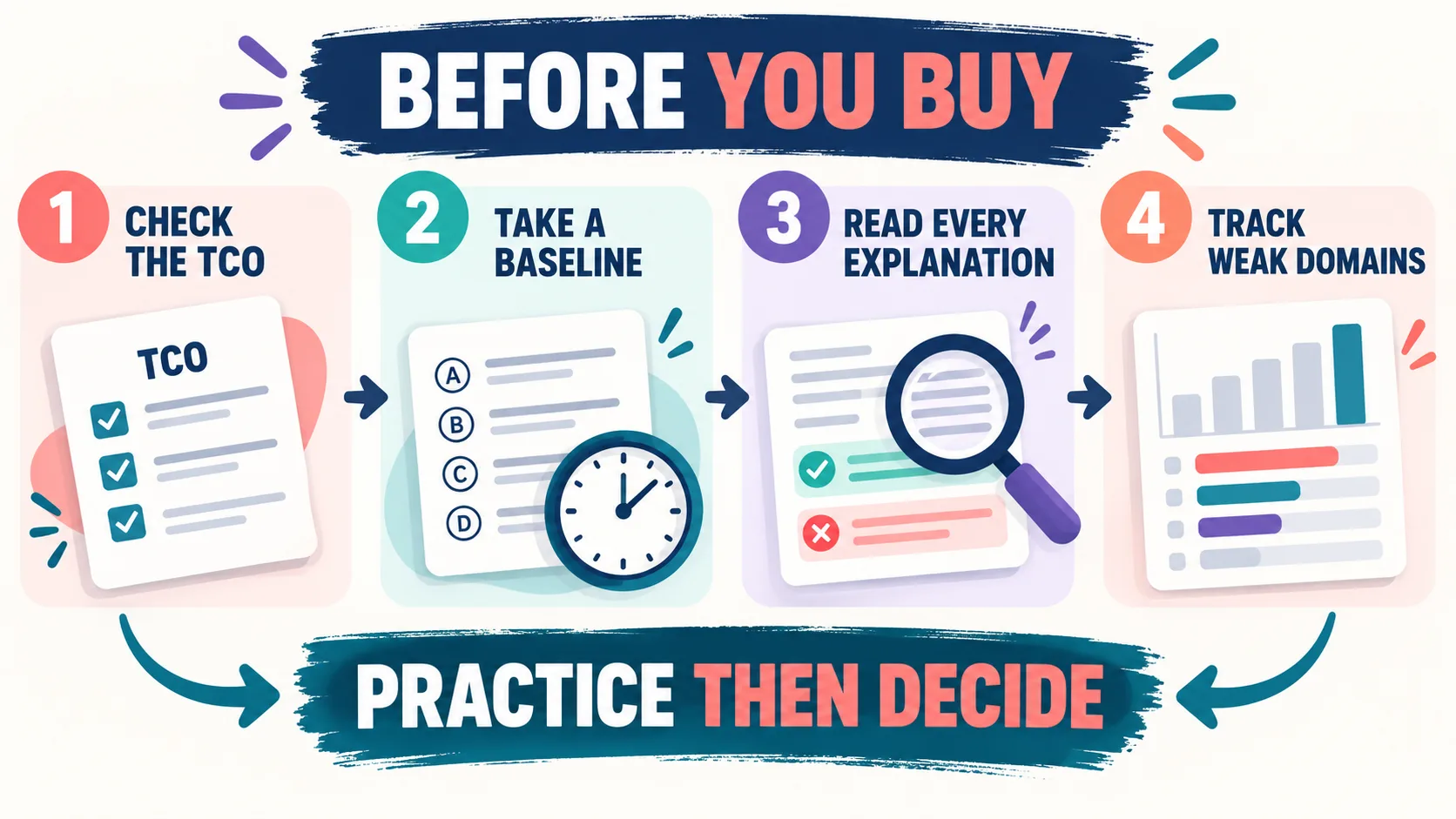
- Day 1: read the product page and record the TCO version, domains, question formats, and access terms.
- Day 2: take a baseline set under the mode that matches your current goal.
- Day 3: review every missed, guessed, or slow item and write one decision rule per pattern.
- Day 4: study the two weakest domains instead of immediately taking another full mock.
- Day 5: take a short targeted set and compare reasoning, not only percentage.
- Day 6: take a timed set and note fatigue, pacing, and answer changes.
- Day 7: decide whether the product gives enough feedback and access value to justify payment.
If you want a low-risk starting point, use our free BCBA mock exam as a baseline. Record your timing and domain observations before looking for a larger study package. If the baseline shows that you need a structured review loop, compare the BCBA exam study materials against the audit criteria above.
FAQ about ABA exam review mock exams
Can a mock exam guarantee that I will pass the BCBA exam?: No. A mock exam can show practice performance and help you build better reasoning, but it cannot guarantee a BACB result. Treat scores as signals for your own study decisions.
Should I choose the mock exam with the most questions?: Not automatically. First verify TCO coverage, scenario quality, explanations, analytics, and access. More questions are useful only when they add meaningful practice rather than repeated low-value items.
Does the 2027 BCBA requirement change mean I need a new mock exam?: Not by itself. The 2027 changes focus on certification requirements and transition timing. Check the BACB’s current examination information and TCO separately, then ask the provider what its “2027” update actually changes.
What is the fastest way to compare two review products?: Use the same baseline questions: Which TCO version is named? Are the domains visible? Are explanations available for every option? Can you see domain performance and timing? What are the retake and access rules? The product that gives clearer answers is easier to evaluate honestly.
Sources checked for this guide include the BACB examination information hub, BCBA Test Content Outline (6th ed.), BCBA Handbook, and official 2027 transition guidance. Independent mock-exam products are not BACB-endorsed unless the BACB explicitly says otherwise.
Take the Free BCBA Mock Exam
A useful next step is to apply this idea in a fresh set of BCBA-style practice questions and review the feedback. Take the Free BCBA Mock Exam



