

Whole-interval recording is conservative by design: an interval is scored only when the target behavior occurs for the entire interval. That rule can miss brief or interrupted behavior. If you are trying to understand why whole interval recording provides an underestimate of behavior, focus on the scoring rule rather than memorizing the phrase alone. The method can be useful when continuous behavior is expected and the goal is to increase sustained engagement. It is a poor fit when a brief response, a single episode, or the number of events matters.
Table of Contents
- Why Whole Interval Recording Provides an Underestimate of Behavior
- Compare Whole, Partial, and Momentary Recording
- Choose the Measure From the Target
- Protect the Treatment Decision From Measurement Bias
- How to Answer the BCBA Exam Question
- A Quick Measurement-Selection Checklist
- FAQ About Whole Interval Recording
- Take the Free BCBA Mock Exam
Why Whole Interval Recording Provides an Underestimate of Behavior
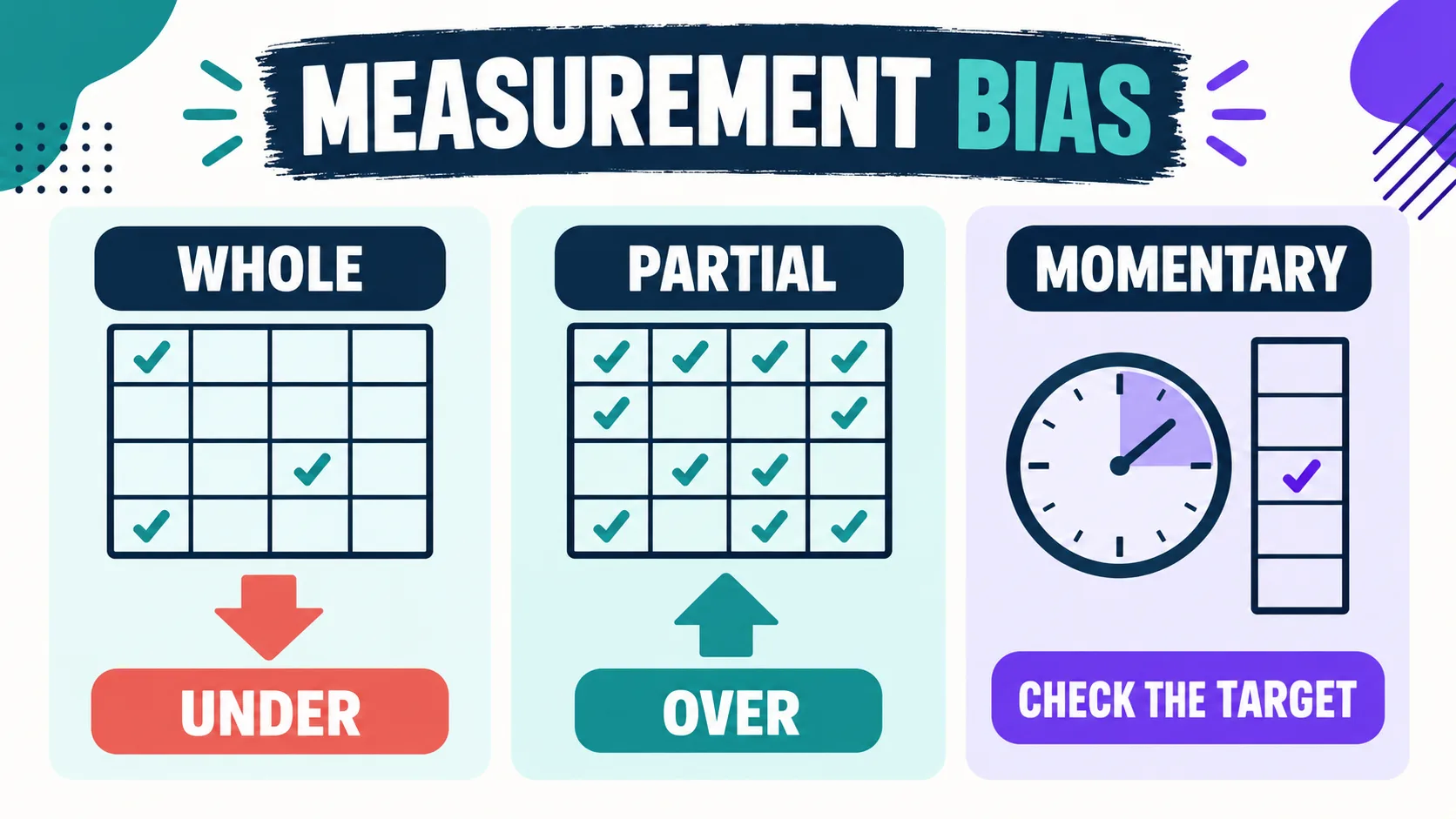
Imagine a 30-second interval in which a learner is expected to remain seated. The learner sits for 25 seconds, stands for 3 seconds, and sits again for the final 2 seconds. Under whole-interval recording, the interval is scored only if the behavior occurred during all 30 seconds. Because standing interrupted the behavior, the interval is scored as “no” even though the learner was seated for most of it.
The same logic applies to on-task behavior, vocal behavior, hand raising, or any target for which you require continuous performance throughout the interval. Whole interval is not asking, “Did the behavior happen at some point?” It is asking, “Did the behavior persist for the whole interval?” That stricter rule creates a conservative estimate of occurrence or duration.
The estimate is not automatically “bad data.” Measurement bias is a relationship between the procedure and the question. If the clinical goal is sustained behavior, a conservative measure may help you see whether the behavior is occurring continuously enough. If the goal is to count brief events, the same procedure can hide meaningful changes.
Compare Whole, Partial, and Momentary Recording
Discontinuous procedures divide an observation period into intervals and record a decision instead of measuring every response continuously. The three common procedures differ in when the observer scores the interval. The BACB’s current BCBA Test Content Outline is the right starting point for studying measurement-procedure distinctions; the target and the question still determine the best application.
| Procedure | When you score “yes” | Typical directional bias |
|---|---|---|
| Whole interval | The behavior occurs for the entire interval. | Usually underestimates occurrence or duration. |
| Partial interval | The behavior occurs at any time during the interval. | Usually overestimates occurrence or duration. |
| Momentary time sampling | The behavior is occurring at the specific moment checked. | Can under- or overestimate depending on the target and interval arrangement. |
These are general tendencies, not promises about every dataset. Interval length, behavior pattern, observation schedule, and the target definition affect the amount and direction of error. That is why the best exam answer usually connects the method to the behavior and the measurement goal.
Choose the Measure From the Target
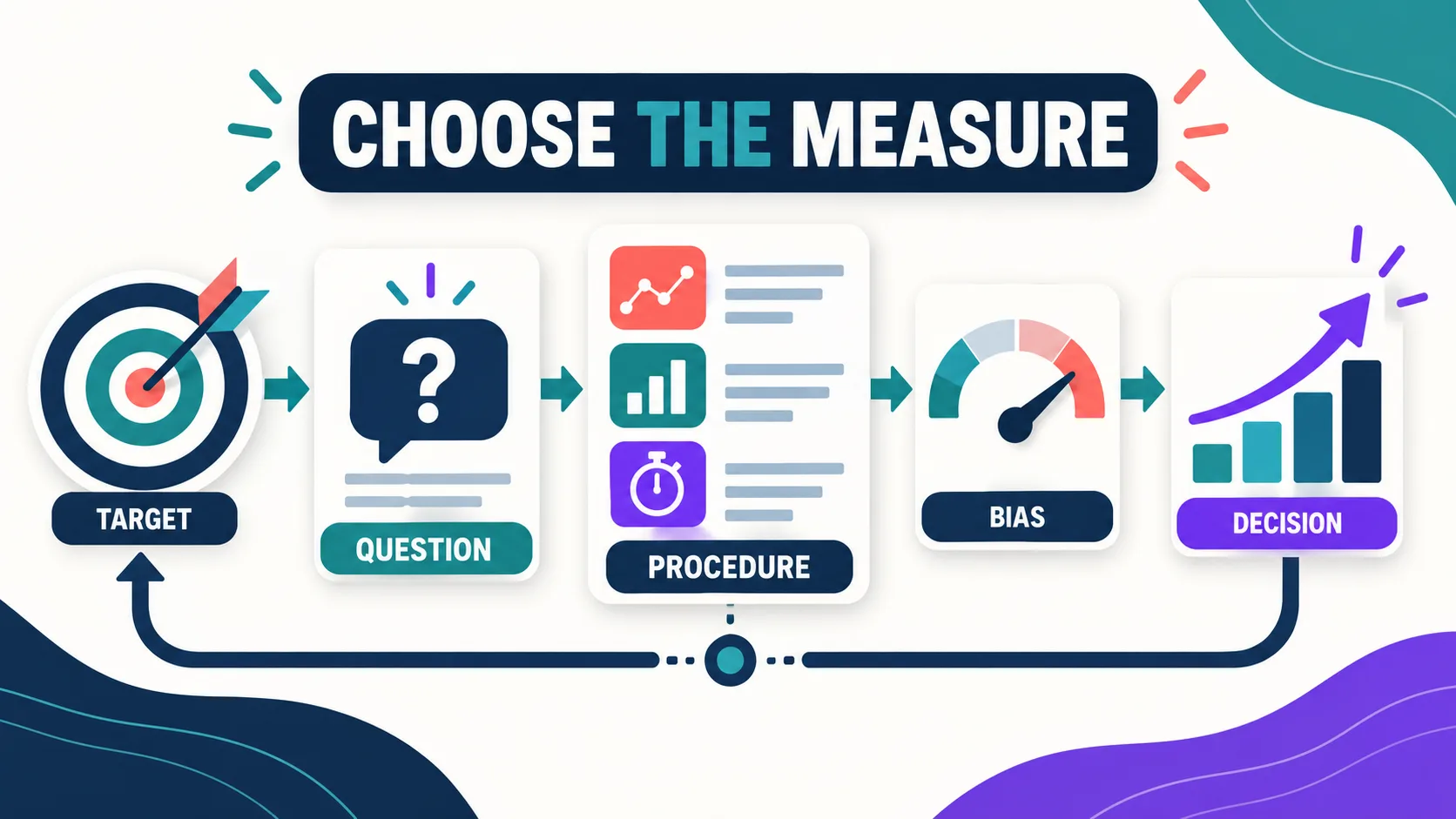
Before choosing a procedure, write the question you want the data to answer. “Is the learner improving?” is too broad. A better question might be “How many times does hand biting occur per hour?”, “What percentage of a 10-minute work period is the learner on task?”, or “Is the learner sustaining seated behavior for the expected interval?”
- Frequency or rate: consider countable, discrete responses when the number of events matters.
- Duration: consider continuous behaviors when the amount of time engaged is the central question.
- Whole interval: consider when sustained behavior for the entire interval is meaningful and a conservative estimate is acceptable.
- Partial interval: consider when detecting any occurrence is more important than estimating exact duration, while remembering the likely overestimate.
- Momentary time sampling: consider when checking at specific moments is practical and the resulting estimate fits the decision.
| Question | Possible fit | Caution |
|---|---|---|
| Did the behavior occur how many times? | Frequency or rate | An interval percentage may hide multiple responses inside one interval. |
| How long did the behavior last? | Duration, or a carefully selected time-sampling method | Whole and partial methods estimate rather than capture every second. |
| Was the learner engaged throughout each interval? | Whole interval | A brief break converts the whole interval to a nonoccurrence. |
Operationally define the target before collecting data. “On task” might mean eyes on materials, hands engaged, responding to the instruction, or another observable action. If the definition changes from one observer to another, the apparent underestimation may actually be a definition or observer-agreement problem.
Protect the Treatment Decision From Measurement Bias
The most important risk is not that a number is imperfect. It is that you interpret the number as if it were a direct measurement of the whole behavior. With whole-interval data, a low percentage may reflect brief interruptions even when the behavior occurred for most of the session. With partial-interval data, a high percentage may reflect one brief response in many intervals.
- Keep the measurement rule the same when comparing baseline and intervention unless you document the change.
- Do not compare a whole-interval percentage with a partial-interval percentage as if they were identical units.
- Interpret the trend with the target definition, interval length, and treatment goal visible.
- When the decision has high consequences, ask whether continuous frequency or duration data are feasible.
- Write the measurement rule beside the graph.
- Record interval length and observation schedule.
- Discuss whether the direction of bias could change the treatment decision.
Peer-reviewed ABA literature has warned that whole-interval measures can underestimate problem behavior and may make an intervention appear more effective than it is. That does not mean whole interval should never be used. It means the procedure should be selected knowingly, and its bias should be part of the interpretation.
How to Answer the BCBA Exam Question
When you see the statement “whole interval recording provides an underestimate of behavior,” look for the scoring rule in the answer choices. The correct reasoning is usually:
- Whole interval requires behavior for the complete interval.
- Any pause or absence makes that interval a nonoccurrence.
- Some behavior that really occurred is therefore not counted as a positive interval.
- The percentage of positive intervals can be lower than the behavior’s actual occurrence or duration.
Then check the target. If the question asks about a brief, countable response, frequency or rate may be a better measure. If it asks about sustained engagement, whole interval may be defensible. If it asks what happened at a particular moment, momentary time sampling is the relevant comparison.
A useful memory cue is “whole requires all.” That cue helps you recall the direction, but a scenario still requires you to identify the target and the decision. Practice the distinction with targeted BCBA mock questions rather than studying the sentence in isolation.
A Quick Measurement-Selection Checklist
| Step | Ask | Record |
|---|---|---|
| 1. Define | What observable response or engagement pattern is the target? | Operational definition and examples. |
| 2. Decide | Do I need count, time, sustained performance, or a momentary snapshot? | Measurement goal before the procedure name. |
| 3. Interpret | What bias does this method introduce? | The limitation beside the graph or percentage. |
For a broader comparison, see the site’s continuous versus discontinuous measurement guide. Use the current BACB TCO and reliable measurement references when studying, and remember that a practice explanation is not a substitute for clinical supervision or professional judgment.
FAQ About Whole Interval Recording
Why does whole interval recording underestimate behavior?: Because the behavior must occur for the entire interval to receive a positive score. A brief pause causes the interval to be scored as a nonoccurrence, even if the behavior occurred for most of that interval.
Does partial interval recording underestimate behavior?: Partial interval recording generally tends to overestimate occurrence or duration because the interval is scored positive if the behavior happens at any point. The exact error depends on the procedure and behavior pattern.
Is whole interval recording always inappropriate?: No. It can be useful when sustained behavior throughout the interval is the goal and a conservative estimate fits the decision. It is not a universal substitute for frequency or duration recording.
What is the difference between whole interval and momentary time sampling?: Whole interval asks whether the behavior occurred throughout the full interval. Momentary time sampling checks whether it is occurring at a specified moment, usually at the end or another predetermined point.
Sources checked for this guide include the BACB 6th-edition TCO, Vanderbilt University IRIS measurement resources, and peer-reviewed ABA research on discontinuous measurement accuracy. Use the current BACB materials and qualified supervision for decisions about actual practice.
Take the Free BCBA Mock Exam
When you are ready to apply the idea, use the free practice resource below for additional feedback. Take the Free BCBA Mock Exam



