
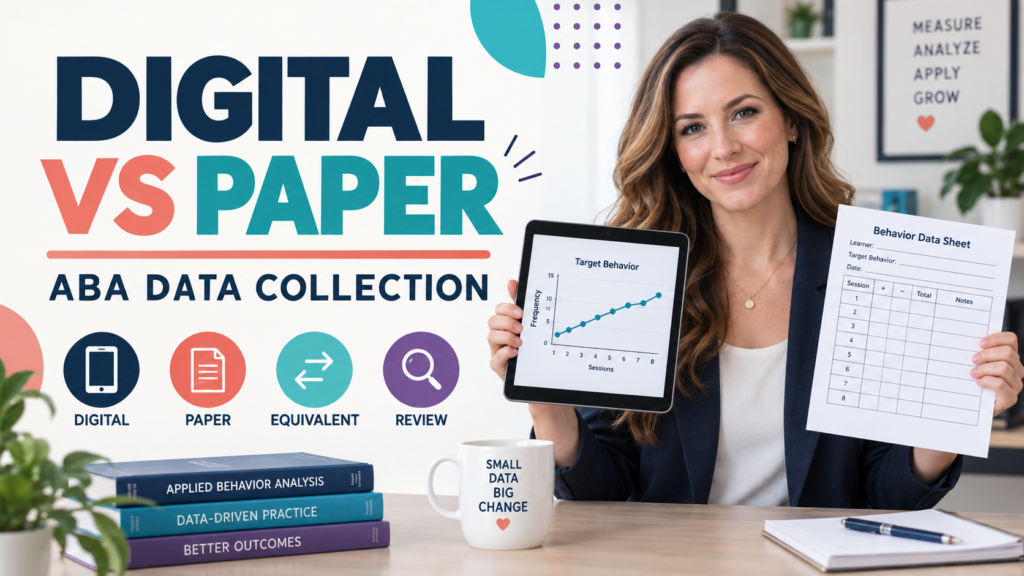
Digital vs paper ABA data collection is not a simple technology decision. The stronger question is whether the workflow produces accurate, timely, secure, and usable data under the conditions in which the team actually works.
Table of Contents
- What Is the Real Difference?
- Which Format Protects Data Quality?
- How Do You Keep Digital vs Paper ABA Data Collection Equivalent?
- What Are the Offline and Device Questions?
- How Do You Protect Privacy?
- How Do You Choose Between Digital and Paper?
- What Does the BCBA Exam Test?
- What Is the Bottom Line?
- Quick Review Checklist
- Take the Free BCBA Mock Exam
Digital vs paper ABA data collection compares electronic tools such as tablets, phones, and web platforms with printed data sheets and later data entry. Either format can support good measurement. Either can also create errors when the operational definition is unclear, the form is hard to use, or staff are not trained to record every opportunity.
The BCBA Test Content Outline makes data-based decision making more important than the appearance of the tool. A digital graph is not automatically more valid than a paper graph. The measure, timing rule, denominator, observer training, and decision process still determine what the data mean.
What Is the Real Difference?
Paper usually requires a pencil, a printed form, and a later step for calculation or entry. Digital collection may time responses, calculate percentages, display graphs, and attach notes during the session. Those features can reduce transcription work, but they also introduce device, battery, software, login, synchronization, and privacy dependencies.
The format changes the workflow, not the underlying behavior. Frequency is still a count, duration is still elapsed time, latency is still time to response, and percentage still requires a defined denominator. If a digital form uses a different opportunity rule from the paper form, the two data streams are not equivalent just because both have numbers.
Which Format Protects Data Quality?
Data quality depends on the match between the form and the session. A paper form may be faster when the target is simple and the observer needs to look up frequently. A digital form may reduce arithmetic and missing fields when the interface is designed well. The best choice is the one that lets the observer record the defined response without delaying care or changing the interaction unnecessarily.
| Question | Digital strengths | Paper strengths | Risk to manage |
|---|---|---|---|
| Calculation | Automatic totals and graphs | Transparent manual math | Formula or transcription errors |
| Continuity | Sync across approved devices | Works without battery or signal | Device failure or lost paper |
| Corrections | Audit trail may be available | Visible cross-out and note | Unclear edits or silent overwrites |
| Privacy | Access controls and encryption may help | Physical control is straightforward | Unauthorized access or exposure |
How Do You Keep Digital vs Paper ABA Data Collection Equivalent?
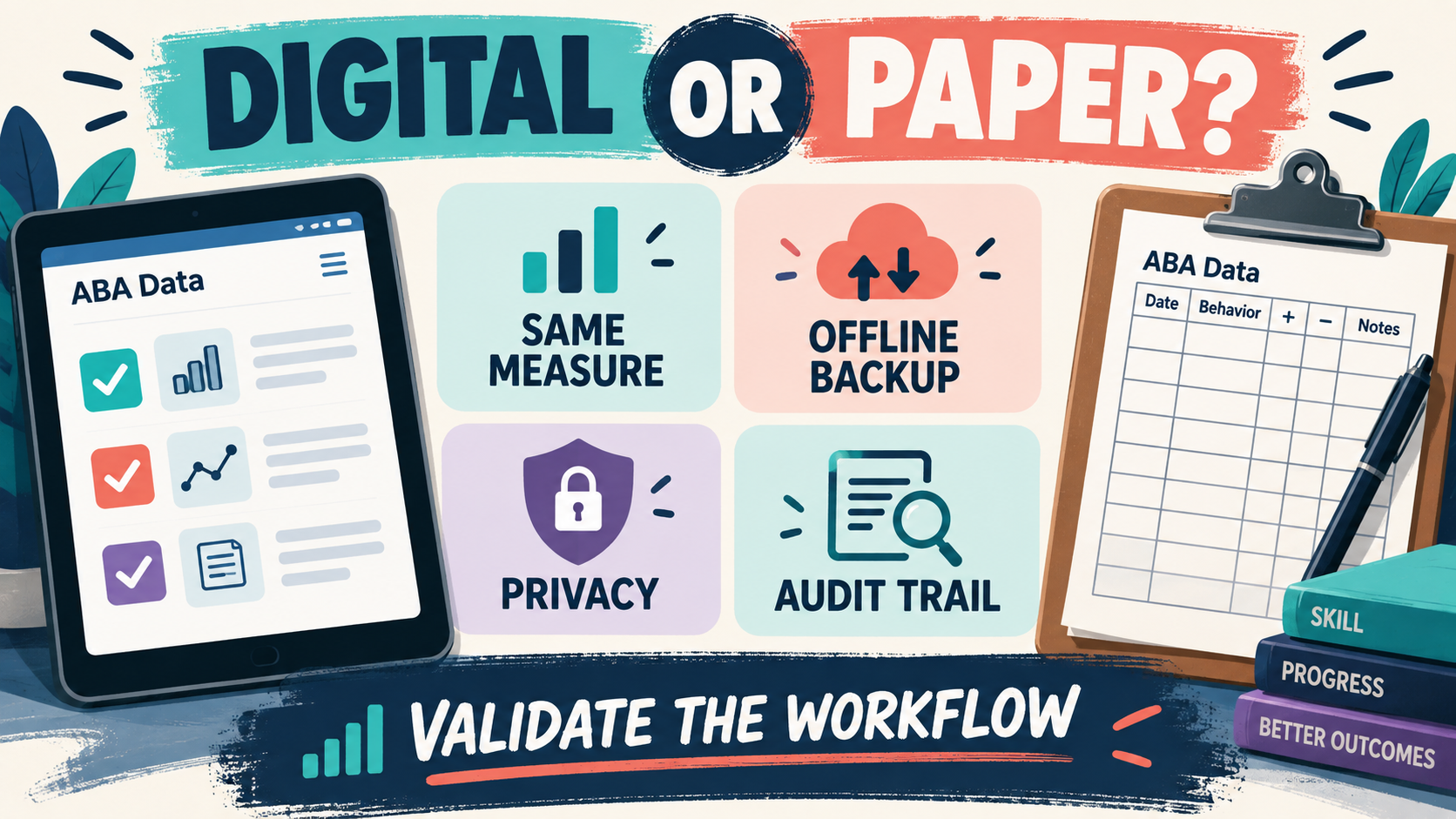
Write the measurement rule once and implement it in both forms. Include the target definition, start and stop criteria, opportunity rule, prompt code, consequence code, observation duration, and correction method. Test the two forms side by side with the same sample session before using them interchangeably. This protects comparability.
If paper uses one row per opportunity and digital uses one button per session, the forms may produce different missing-data patterns. If digital automatically rounds seconds but paper records exact times, latency values may not be comparable. Document the smallest unit, rounding rule, and how incomplete sessions are handled.
What Are the Offline and Device Questions?
Ask what happens when the battery dies, the app logs out, the network disappears, or the device must be used for another safety need. An offline-capable digital system may queue data, but the team must know how synchronization conflicts and edits are resolved. A paper backup can preserve continuity, but it requires a plan for secure storage and later entry. Do not make the observer responsible for troubleshooting during a crisis. Decide in advance which format is the backup, how the backup is labeled, and who enters or verifies the data later.
How Do You Protect Privacy?
Digital tools need approved accounts, access controls, secure devices, and a clear retention policy. Paper forms need controlled storage, transport, disposal, and a rule for what identifying information appears on the page. Convenience is not a reason to put unnecessary client information into a personal device or an unsecured notebook. Use the organization’s policies and applicable privacy requirements. The BACB Ethics Code provides the professional context, but it does not turn an unapproved app into a secure clinical system.
How Do You Choose Between Digital and Paper?
- Define the measure and decision before selecting a tool.
- Observe the real session and identify where recording slows the interaction.
- Test the form with the people who will actually use it.
- Check offline continuity, correction history, privacy, and backup procedures.
- Compare a sample of digital and paper records for agreement before switching.
- Review the data after implementation; a convenient form that produces missing or biased records needs revision.
What Does the BCBA Exam Test?
- Tool is not measure: the same target can be recorded on paper or digitally if the rules remain equivalent.
- Automatic calculation is not automatic validity: a wrong denominator can be calculated perfectly.
- Missing data needs a rule: do not convert a device failure into a zero.
- Corrections should be traceable: preserve what changed and why.
- Privacy is part of implementation: select approved storage and access procedures.
What Is the Bottom Line?
Digital vs paper ABA data collection is a workflow comparison, not a contest between devices and pencils. Choose the format that preserves the operational definition, accurate timing, reliable correction, secure handling, and usable decisions. For more practice with measurement and data-based decision making, try the free BCBA mock exam. It is study support, not a replacement for local policy or supervision.
For targeted review, use our digital vs paper ABA data collection practice questions to apply the concept in exam-style scenarios.
Quick Review Checklist
Use this final checklist to turn digital vs paper ABA data collection into exam-ready reasoning. The goal is not to memorize a label in isolation; it is to identify the relevant evidence and explain why the best answer fits the scenario. Key ideas to review:
- State the central definition or decision point for digital vs paper ABA data collection in your own words.
- Identify the detail that makes digital vs paper ABA data collection different from its closest related ABA term.
- Separate the observable facts in a scenario from assumptions that are not supported by the facts.
- Write one example and one nonexample so you can recognize the concept in a new setting.
Exam application checks:
- Ask what the question is actually requesting before comparing the answer choices.
- Mark the antecedent, response, consequence, or other evidence that supports the selected answer.
- Look for a distractor that describes a related process but does not answer the specific question.
Final self-check:
- Explain how you would verify the interpretation with clear observations or data.
- Change one detail in the scenario and decide whether your answer should change.
- Give a one-sentence rationale that a supervisor or study partner could evaluate.
Take the Free BCBA Mock Exam
When you are ready to apply the idea, use the free practice resource below for additional feedback. Take the Free BCBA Mock Exam



