

If you are asking which strategy is used for behaviors maintained by automatic reinforcement, the safest BCBA answer is not a single procedure that works for every case. Start by confirming the function, identify the sensory consequence that may be reinforcing the behavior, and then select a function-matched competing stimulus or alternative response. Environmental enrichment, noncontingent access to matched stimulation, response interruption and redirection (RIRD), response blocking, or sensory extinction may be considered in different cases. The assessment result, safety profile, preference, and treatment integrity determine the choice.
Table of Contents
- Which Strategy Is Used for Behaviors Maintained by Automatic Reinforcement?
- Why Function Comes Before Procedure
- A Function-Matched Strategy Selection Process
- How the Main Strategies Differ
- When RIRD, Blocking, or Sensory Extinction Appears
- Data, Preference, and Treatment Integrity
- Common BCBA Exam Traps
- Quick Review Checklist
- FAQ
For a multiple-choice question, a competing-stimulus or matched-stimulation answer is often the best general fit when the stem says that a repetitive or problem behavior is maintained by automatic reinforcement. It gives the learner another way to contact similar stimulation. That does not mean the procedure is automatically effective, ethical, or appropriate without assessment. A good answer connects the intervention to the identified function instead of choosing a strategy because it sounds familiar. Table of Contents
Which Strategy Is Used for Behaviors Maintained by Automatic Reinforcement?
The general strategy is to arrange an alternative source of reinforcement that competes with, matches, or substitutes for the sensory consequence produced by the target behavior. In practice, this may be called a competing-stimulus procedure, matched stimulation, environmental enrichment, or noncontingent reinforcement when access is delivered on a time-based schedule. The best choice depends on what the behavior produces for the individual, not merely on how the behavior looks.
For example, suppose a learner repeatedly taps a hard surface because the sound and vibration appear to be reinforcing. A plan might evaluate highly preferred objects that produce similar auditory or tactile feedback, provide access to those objects, teach an acceptable alternative response, and measure both engagement with the alternative and the original behavior. The point is not to guess that any toy will work. The point is to create meaningful competition with the relevant consequence.
Automatic reinforcement means that the consequence is produced by the behavior itself rather than being delivered by another person. The consequence can involve sensory stimulation, such as sound, visual movement, or tactile feedback, or a reduction in an unpleasant internal experience. A behavior that occurs when no obvious social consequence is arranged may be consistent with automatic reinforcement, but observation alone does not prove function. Functional assessment still matters.
The current BCBA Test Content Outline emphasizes identifying interventions from assessment results, selecting alternative behaviors, considering risks and contextual fit, evaluating progress, and making data-based decisions. Those tasks support a function-based answer: assess first, match the competing source, monitor the outcome, and modify the plan when the data do not support it.
Why Function Comes Before Procedure
Two behaviors can look identical but be maintained by different consequences. Hand flapping, humming, skin picking, placing objects near the eyes, or repetitive movement may be automatically reinforced in one case, but attention, escape, access to tangibles, or a combination of functions may be involved in another. If the assumed function is wrong, a visually appealing intervention can fail because it does not compete with the reinforcer maintaining the behavior.
- Automatic positive reinforcement: the behavior produces additional stimulation, such as an interesting sound, movement, visual effect, or tactile sensation.
- Automatic negative reinforcement: the behavior may reduce or interrupt an unpleasant internal state, although the relevant private event must be treated cautiously and assessed behaviorally.
- Social reinforcement: another person provides attention, escape, tangible access, or another consequence; a competing sensory item alone may miss the real contingency.
- Multiple control: more than one consequence may support the behavior, so one replacement source may not be enough.
A strong exam stem gives clues about the contingency. The behavior may persist in an alone condition, occur across settings, or continue when social interaction and demands are absent. Those clues can suggest automatic reinforcement, but the answer should still respect the limits of the evidence. “The behavior is stereotypic” is not a functional assessment. “The behavior occurs without a social consequence and produces a consistent sensory effect” is more useful reasoning.
A Function-Matched Strategy Selection Process
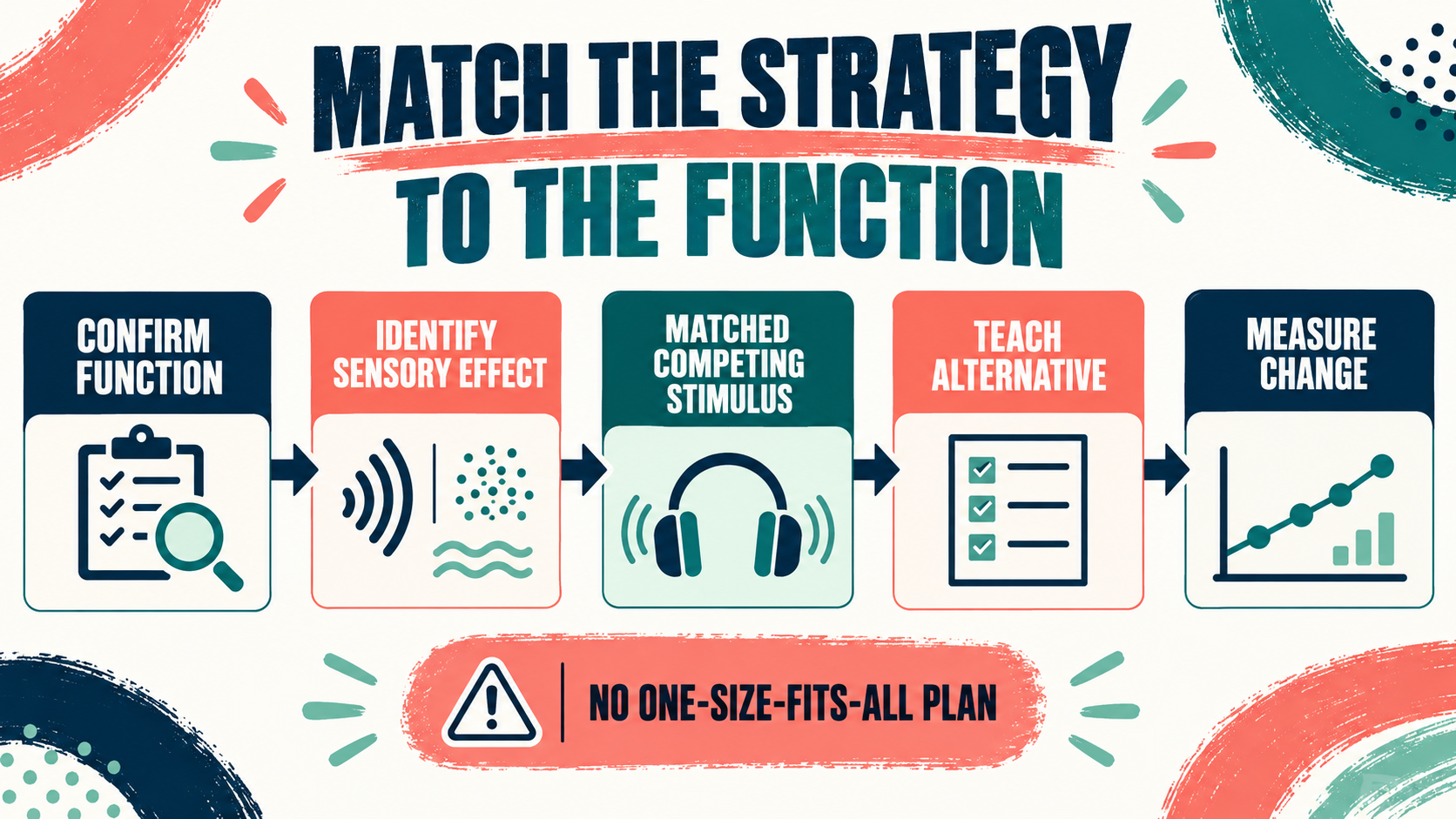
Use the following sequence when a case identifies automatic reinforcement. It is a study framework, not a universal clinical protocol. A qualified behavior analyst must consider the person, setting, risk, consent or assent processes, available resources, and current professional requirements before implementing an intervention.
- Confirm the behavioral definition. Describe exactly what the learner does, when it occurs, and how it is measured. Avoid labels such as “sensory behavior” when the observable response has not been defined.
- Review the assessment evidence. Ask what consequence follows the behavior and whether the pattern remains when social consequences are not arranged. Consider competing explanations rather than treating the first hypothesis as fact.
- Identify the relevant sensory effect. Determine whether the behavior appears to produce auditory, visual, tactile, oral, vestibular, or another observable effect. The replacement source should be selected for functional similarity, not convenience.
- Assess preference and competition. A competing stimulus is only useful if the learner will engage with it and if that engagement actually competes with the target behavior. Preference assessment and direct treatment data are more informative than adult assumptions.
- Teach an acceptable alternative. When possible, arrange an appropriate response that produces access to the matched stimulation or another socially meaningful outcome. Reinforcing an alternative can build a usable repertoire instead of only suppressing behavior.
- Monitor outcomes and side effects. Track the target behavior, engagement with the alternative, schedule effects, implementation fidelity, and any escalation or new response forms. Modify the plan when the data do not show a socially valid improvement.
The sequence helps distinguish a function-based plan from a procedure-first answer. If a question asks what to do next after identifying automatic reinforcement, look for the option that preserves the assessment-to-intervention connection. An answer such as “provide a preferred item” is incomplete unless the item is relevant to the sensory consequence and the learner’s behavior changes in the expected direction.
How the Main Strategies Differ
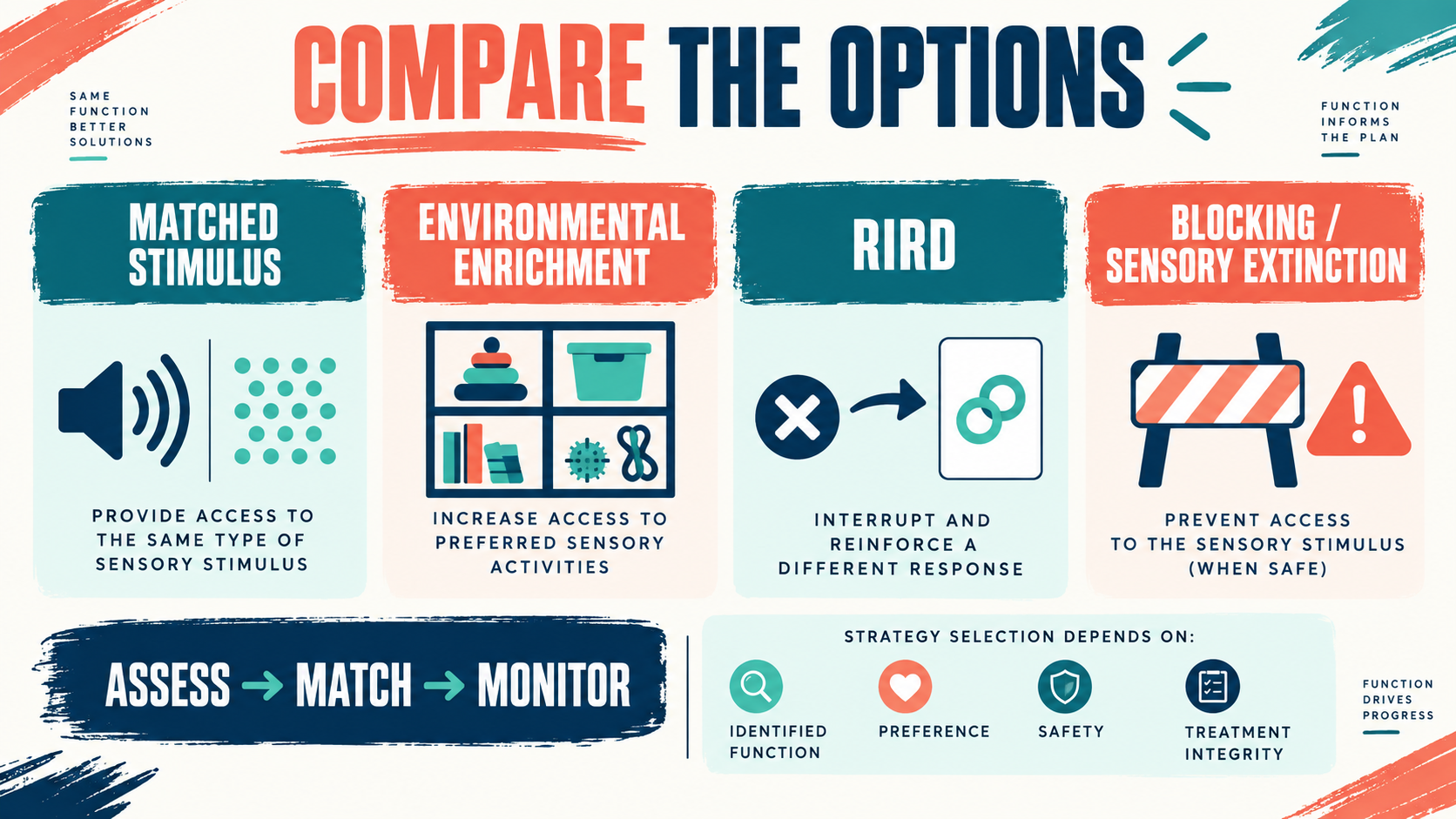
The table below compares common strategy families. The categories overlap, and a treatment package may include more than one component. On an exam, use the stem’s details to identify the procedure that matches the function and the question’s requested level of specificity.
| Strategy | Best conceptual fit | Key caution or exam clue |
|---|---|---|
| Matched competing stimulus | Provides stimulation similar to the consequence produced by the target behavior. | The match and the learner’s preference must be demonstrated; a random preferred item is not automatically a match. |
| Environmental enrichment or NCR | Adds access to preferred stimulation or activities independent of the target response. | It may compete with behavior but does not automatically teach a specific replacement skill; accidental reinforcement and persistence must be monitored. |
| RIRD | Interrupts repetitive behavior and redirects the learner to an appropriate competing response. | It requires competent implementation, clear response definitions, and monitoring for escalation, generalization, and treatment acceptability. |
| Response blocking or sensory extinction | Prevents the target response from contacting its automatic sensory consequence. | It can be difficult, restrictive, or unsafe if poorly designed; the least restrictive, function-based alternative should be considered first. |
Research on automatically reinforced behavior often evaluates combinations, such as noncontingent access plus blocking, rather than claiming that one component is universally superior. That distinction matters for a BCBA exam. If the question asks for a general strategy, choose a function-matched competing source. If it asks about preventing the sensory consequence, sensory extinction or blocking may be the more specific answer. If it asks about interrupting and teaching another response, RIRD may be the intended term.
When RIRD, Blocking, or Sensory Extinction Appears
Response interruption and redirection is different from simply saying “stop.” RIRD interrupts a response pattern and directs the learner toward a defined alternative response. The alternative should be teachable, measurable, and relevant to the case. A question describing persistent repetitive behavior across contexts may point toward RIRD, especially when the stem highlights interruption followed by a competing vocal, motor, or task response.
Response blocking prevents or interrupts contact with the sensory consequence. For example, a barrier or protective arrangement may reduce access to the stimulation produced by a dangerous response. Blocking does not automatically teach a replacement behavior, and it may create additional risks or response effort. The plan must account for safety, dignity, treatment integrity, and what the learner can do instead.
Sensory extinction changes the environment so the target behavior no longer produces the sensory effect that maintained it. If a behavior produces a distinctive sound, changing the materials so the sound no longer occurs is conceptually different from giving attention or removing a demand. Sensory extinction can be difficult to implement because the individual may contact the sensory consequence in many places. Extinction-related increases, variation, or emotional responding also need monitoring.
These procedures are not permission for an untrained person to improvise blocking, restraint, or restrictive intervention. For exam reasoning, identify the consequence, recognize the strategy family, and evaluate risk and fit. Actual implementation must remain within the behavior analyst’s competence and applicable rules.
Data, Preference, and Treatment Integrity
A good automatic-reinforcement intervention should produce more than a persuasive explanation. It should create measurable changes in the target behavior and the competing response. If a new sensory item is offered, record whether the learner engages with it, how long engagement lasts, whether the target behavior changes, and whether the effect holds across relevant conditions. These data help distinguish a true competing stimulus from an item that is merely present.
- Measure the target response with an operational definition and a method that fits its dimension.
- Record engagement with the competing item or alternative response, not only the absence of problem behavior.
- Check whether the replacement produces a similar consequence or another meaningful reinforcer.
- Monitor generalization across people, materials, activities, and settings when those contexts matter.
- Review procedural fidelity so an apparent treatment failure is not actually an implementation failure.
- Look for unwanted effects, such as escalation, response variation, resurgence, or reduced access to appropriate activities.
Preference is especially important because competing-stimulus procedures depend on the learner’s actual selection and engagement. An adult may believe that a toy, music, or activity is a good substitute, but the learner’s choices and treatment data are more relevant. A preferred item can also stop competing when it becomes less valuable, when the schedule changes, or when the target behavior produces a stronger sensory effect.
Common BCBA Exam Traps
- Choosing attention for an automatically reinforced behavior: attention is a social consequence and may not compete with the sensory reinforcer.
- Assuming every stereotypy is automatic: topography does not establish function; the behavior may be socially maintained or multiply controlled.
- Picking any preferred item: preference alone does not prove functional matching or treatment effectiveness.
- Confusing NCR with DRA: NCR delivers reinforcement independent of the target response, while DRA reinforces a specified alternative response.
- Treating blocking as teaching: blocking may prevent contact with a consequence, but it does not by itself establish a useful replacement.
- Using extinction as a universal first answer: automatic extinction may be hard to arrange and may produce unwanted effects; the context and risks matter.
- Ignoring measurement: a strategy is not validated because the behavior looked lower for one brief observation.
When the stem includes a clear sensory consequence and asks for the most appropriate general strategy, look first for a matched competing stimulus, environmental enrichment, or an alternative that provides access to similar stimulation. When the stem names the exact procedure, follow the wording: interrupt and redirect points to RIRD; prevent access to the sensory consequence points to blocking or sensory extinction; time-based access points to NCR.
Quick Review Checklist
- Did I confirm the function instead of inferring it from the behavior’s appearance?
- What sensory consequence may be produced by the target response?
- Does the proposed competing stimulus match that consequence?
- Has the learner shown preference and engagement with the alternative?
- Is the intervention teaching an acceptable response or only suppressing behavior?
- Which data will show both target reduction and useful alternative engagement?
- What safety, acceptability, generalization, and treatment-integrity concerns must be monitored?
FAQ
What is the most common strategy for automatic reinforcement?: A function-matched competing stimulus or matched source of stimulation is a common general answer. The exact plan depends on the assessment, the sensory consequence, preference, risk, and whether the alternative actually competes with the behavior.
Is NCR used for behavior maintained by automatic reinforcement?: It can be. NCR arranges access to a reinforcer on a time-based schedule rather than requiring the target response. For automatic reinforcement, the arranged stimulation should be relevant to the suspected sensory consequence, and the data should show whether it reduces the target behavior without creating new problems.
When would RIRD be the best answer?: RIRD may be the intended answer when the stem describes interrupting repetitive behavior and directing the learner to a competing or appropriate response. It is not simply a command to stop, and it requires clear definitions, trained implementation, and monitoring.
Is response blocking always appropriate?: No. Blocking may be considered when preventing access to a dangerous or reinforcing consequence is necessary, but it can be restrictive and may not teach an alternative. The least restrictive, function-based, safe option should be evaluated by a qualified professional.
Remember the exam logic: automatic function → identify the sensory consequence → match a competing source or alternative → monitor data and integrity. If you want to practice applying that chain to original BCBA-style scenarios, Take the Free BCBA Mock Exam for additional practice and feedback.



