
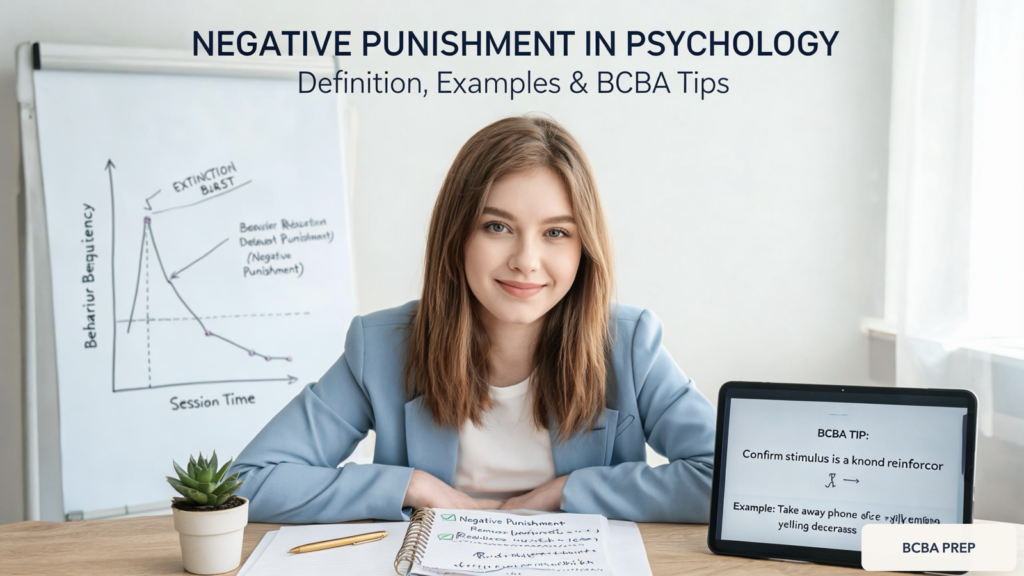
What Is Negative Punishment in Psychology?
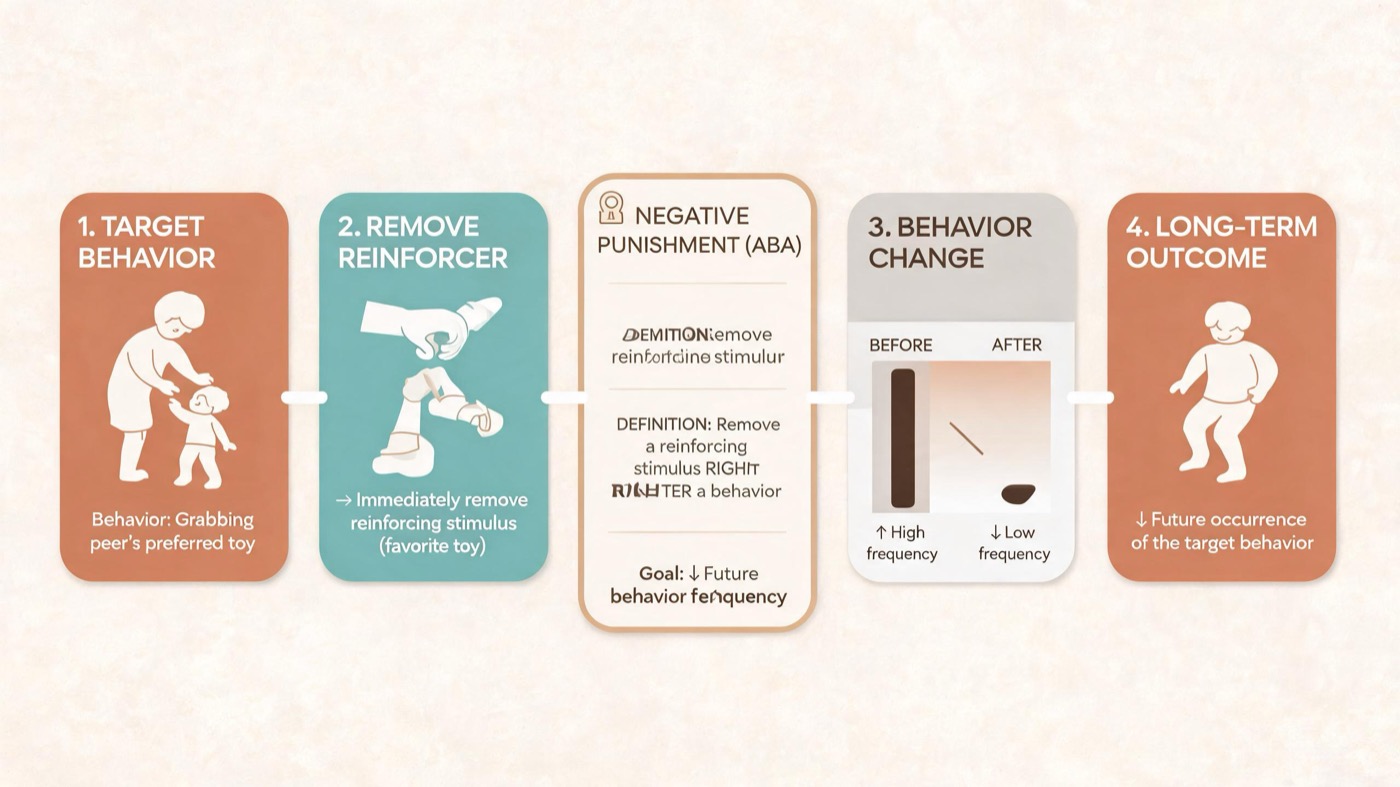
In applied behavior analysis (ABA), negative punishment psychology definition refers to the removal of a reinforcing stimulus immediately after a behavior, resulting in a decrease in the future frequency of that behavior. It is one of two punishment procedures, the other being positive punishment (adding an aversive stimulus).
Table of Contents
- What Is Negative Punishment in Psychology?
- Negative Punishment in ABA: Worked Examples with ABC Analysis
- Why Negative Punishment Matters for the BCBA Exam
- Quick Checklist for Negative Punishment
- Final Summary
Key Elements of Negative Punishment
Three elements define negative punishment: the behavior, the removal of a stimulus, and the subsequent reduction in behavior. The term ‘negative’ means something is taken away, not that it is ‘bad’ or harmful. The removed stimulus must be a reinforcer for the individual at that moment.
How It Differs from Extinction
A common point of confusion is the difference between negative punishment and extinction. In extinction, reinforcement that previously maintained a behavior is discontinued (e.g., ignoring a child’s tantrum that used to get attention). In negative punishment, a stimulus is removed contingent on the behavior, even if that behavior was not previously reinforced by that stimulus. For example, losing a token for talking out (negative punishment) is different from no longer receiving tokens for talking out (extinction).
Negative Punishment in ABA: Worked Examples with ABC Analysis
Seeing how negative punishment is applied in real ABA settings helps solidify your understanding. Below are three examples using the ABC (Antecedent-Behavior-Consequence) format.
Example 1: Loss of Token During Token Economy
- Setting: Classroom
- Antecedent: Teacher instructs students to work quietly
- Behavior: Student talks out of turn
- Consequence: Student loses one token from their token board
- Hypothesized function: Access to tangibles (tokens)
- Outcome: Talking out decreases over time
Example 2: Response Cost for Aggression
- Setting: Home
- Antecedent: Parent asks child to clean up toys
- Behavior: Child hits sibling
- Consequence: Loss of 15 minutes of TV time
- Hypothesized function: Escape from demand (cleaning) – note: the loss of TV is intended to punish hitting, but the function of hitting may be escape; negative punishment still applies to the hitting behavior
- Outcome: Hitting decreases
Example 3: Time-Out from Positive Reinforcement
- Setting: Clinic
- Antecedent: Therapist provides a preferred activity
- Behavior: Client screams for 5 seconds
- Consequence: Therapist removes the activity for 2 minutes (time-out)
- Hypothesized function: Attention (screaming gains attention from therapist; time-out removes access to attention and the activity)
- Outcome: Screaming decreases
In each example, the consequence involves removal of a valued item or opportunity, which leads to a reduction in the problem behavior.
Why Negative Punishment Matters for the BCBA Exam
The BCBA exam frequently tests your ability to identify punishment procedures, distinguish them from reinforcement and extinction, and evaluate their ethical use. Understanding negative punishment is critical because it appears in questions about behavior reduction, ethical considerations, and treatment integrity.
Common Exam Traps
Here are the most common mistakes candidates make with negative punishment:
- Confusing negative punishment with extinction: In extinction, the reinforcer that maintained the behavior is removed; in negative punishment, any reinforcer can be removed contingent on the behavior, even if it didn’t maintain the behavior. For example, if a child screams for attention and the parent removes TV time (which is not the maintaining reinforcer), that is negative punishment, not extinction.
- Misidentifying the function when behavior does not decrease: If negative punishment is used but the behavior does not decrease, the stimulus removed might not have been a reinforcer for that individual at that time. Always assess the effectiveness of the punisher.
- Overlooking ethical considerations: The BACB Ethics Code requires that punishment procedures be used only after reinforcement-based interventions have been tried or are contraindicated. Negative punishment should always be combined with reinforcement for alternative behaviors.
Practice Questions to Test Your Knowledge
Question 1: A teacher removes a student’s preferred toy for 2 minutes every time the student hits a peer. Hitting decreases. This is an example of:
A) Positive punishment
B) Negative punishment
C) Extinction
D) Negative reinforcement
Answer: B. The removal of a reinforcing item (toy) contingent on hitting, leading to a decrease in hitting, defines negative punishment.
Question 2: Which of the following best differentiates negative punishment from extinction?
A) Negative punishment involves removal of a stimulus; extinction involves withholding a reinforcer
B) Negative punishment always increases behavior; extinction decreases behavior
C) Both are identical procedures
D) Extinction requires adding a stimulus
Answer: A. Negative punishment removes a stimulus contingent on behavior; extinction discontinues the reinforcer that previously maintained the behavior.
Question 3: A BCBA implements a response cost procedure where a child loses 5 minutes of recess for every instance of swearing. Swearing decreases. The procedure is ethical if:
A) It is the only intervention used
B) Reinforcement procedures have been tried and were ineffective
C) The parent requests it
D) Swearing is dangerous
Answer: B. Ethical guidelines require that punishment be considered only after reinforcement-based strategies have been tried or are not appropriate.
Quick Checklist for Negative Punishment
Use this checklist to review key points before your exam:
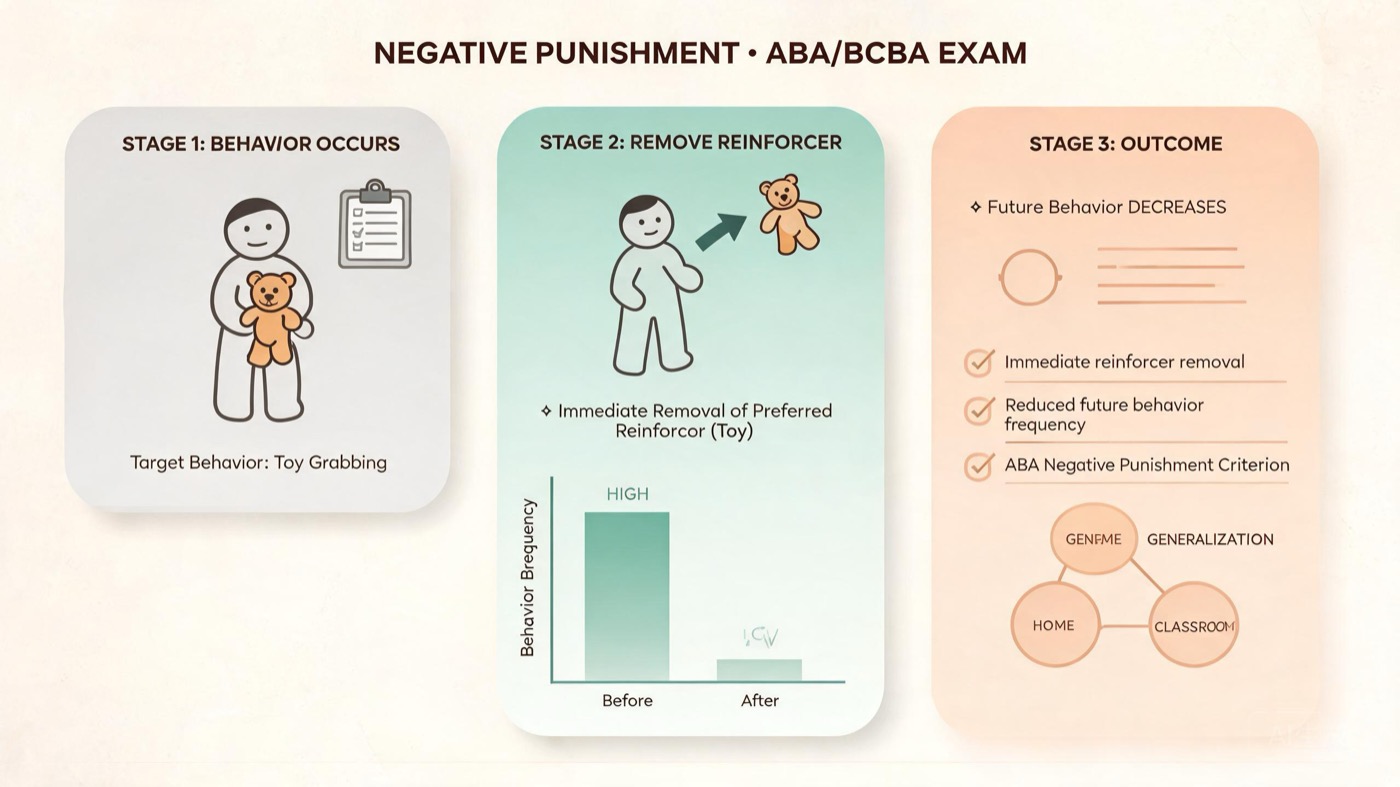
- Definition clear: Behavior decreases because a reinforcing stimulus is removed contingent on the behavior.
- Distinguished from extinction: In extinction, the maintaining reinforcer is withheld; in negative punishment, any reinforcer may be removed.
- Examples mastered: Response cost (loss of tokens, money, time) and time-out from positive reinforcement are common forms.
- Ethical use: Always pair with reinforcement for appropriate behavior; use only after reinforcement-based interventions have failed or are contraindicated.
- Exam application: When given an ABC scenario, identify whether the consequence involves removal of a stimulus and whether the behavior decreases. If yes, it’s negative punishment.
Final Summary
Negative punishment is a core principle in psychology and ABA. It involves removing a reinforcing stimulus after a behavior, leading to a decrease in that behavior. The negative punishment psychology definition is essential for BCBA exam success. Remember the key differences from extinction, practice with ABC analyses, and always consider ethical guidelines. For more in-depth study, check out our guide on positive vs negative punishment in ABA and review ethical considerations of punishment. For additional authoritative reading, see the BACB Ethics Code and PubMed for research on punishment.



