
What Is an Antecedent? A Clear Definition for BCBA Candidates
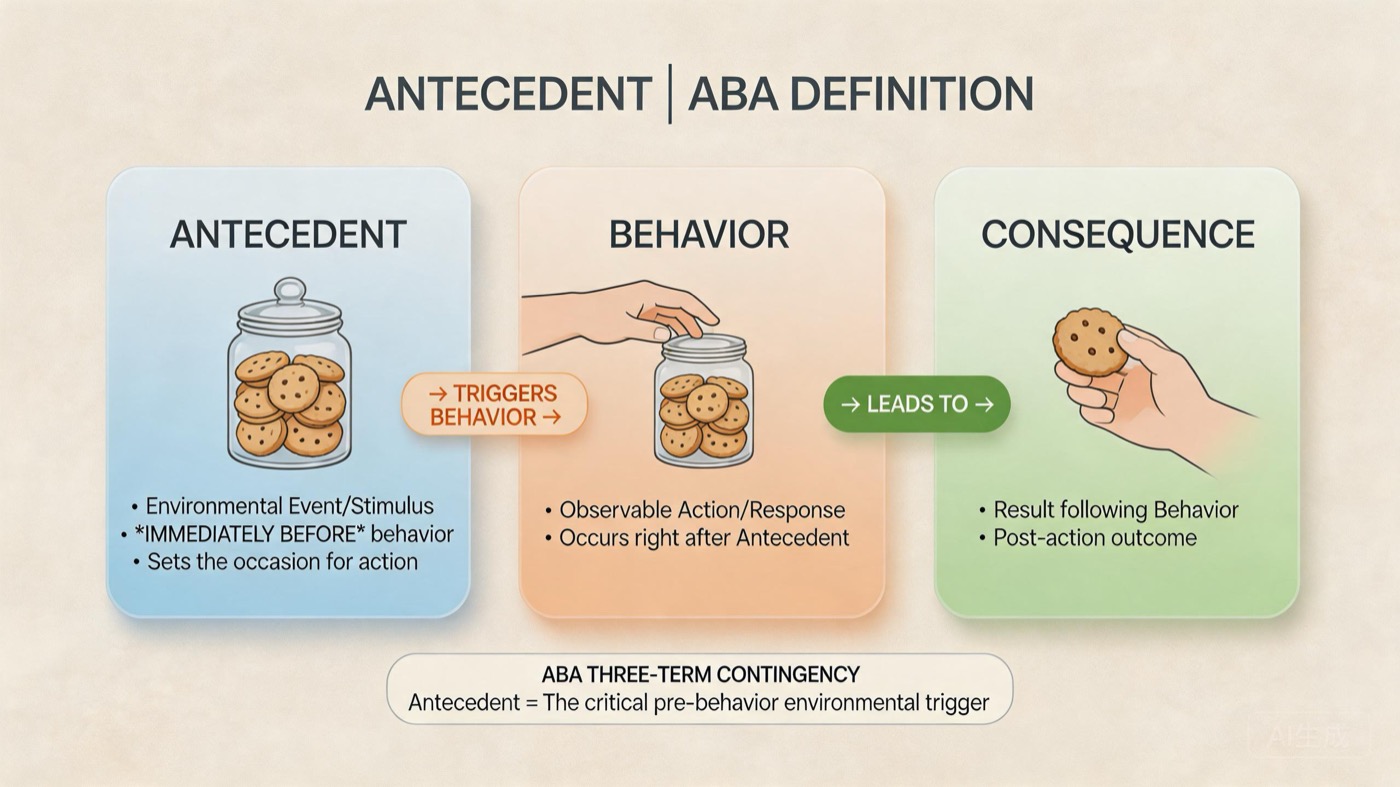
In Applied Behavior Analysis (ABA), the antecedent definition refers to any environmental event or stimulus that occurs immediately before a behavior. Antecedents set the occasion for behavior and are a critical part of the three-term contingency (ABC): Antecedent – Behavior – Consequence. On the BCBA exam, you will be asked to identify antecedents from vignettes and distinguish them from consequences and motivating operations.
Table of Contents
- What Is an Antecedent? A Clear Definition for BCBA Candidates
- Types of Antecedents You Must Know for the BCBA Exam
- Three Worked ABC Examples for Exam Practice
- Common Exam Traps – Watch Out for These Mistakes
- Quick Antecedent Identification Checklist for Test Day
- Summary – Master the Antecedent for the BCBA Exam
Why Antecedents Matter in the ABC Contingency
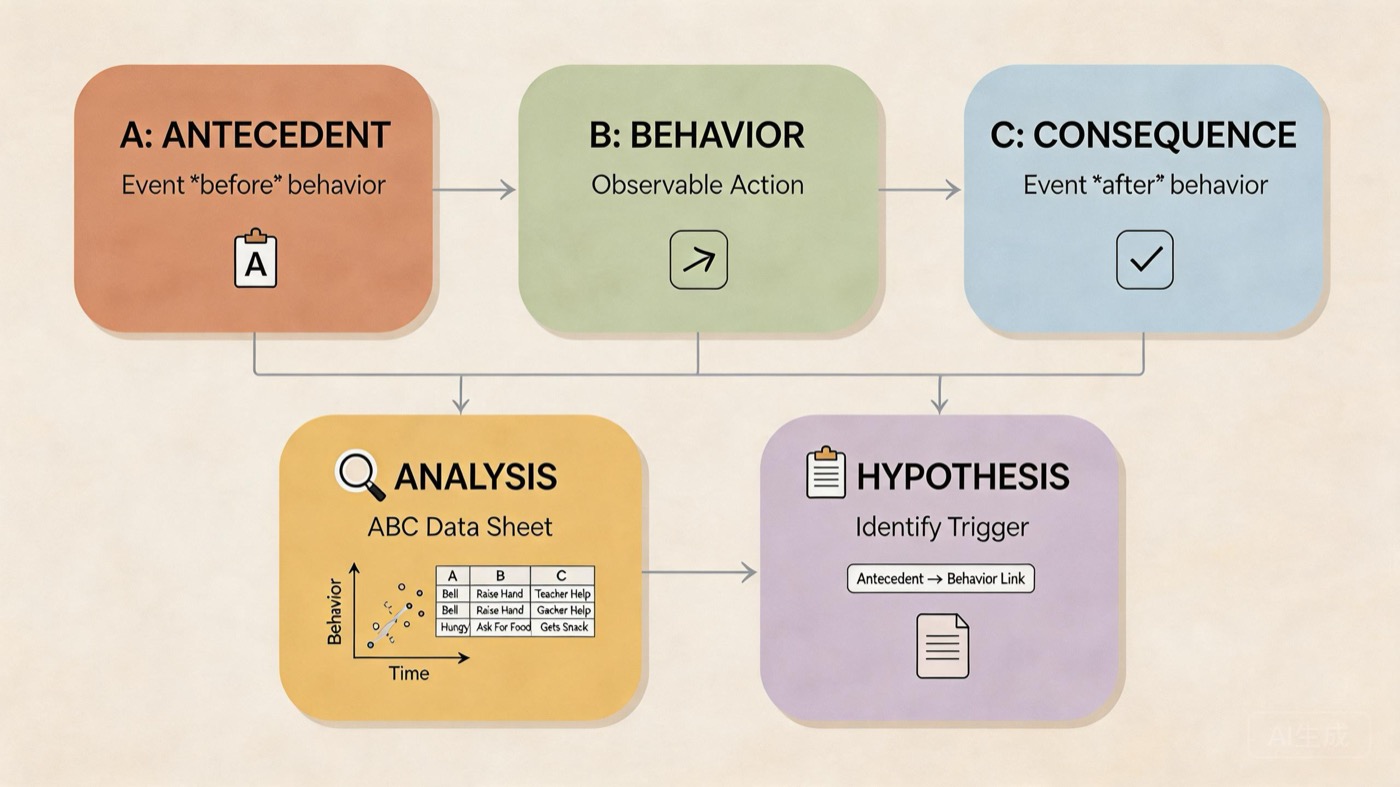
The ABC model is the foundation of behavioral assessment. The antecedent is what triggers the behavior; the consequence determines whether that behavior will be repeated. For example, a teacher says ‘What is 2+2?’ (antecedent), the student says ‘4’ (behavior), and the teacher gives praise (consequence). On the exam, you must isolate the antecedent from the context to correctly hypothesize the function.
Types of Antecedents You Must Know for the BCBA Exam
Antecedents are not all the same. The BCBA exam tests your ability to differentiate between discriminative stimuli (SD), S-delta, and motivating operations (MO). Each type influences behavior differently.
Discriminative Stimulus (SD)
An SD is an antecedent stimulus that signals the availability of reinforcement for a particular behavior. For example, when a therapist holds up a blue card and says ‘Touch blue’ (SD), the child touches the blue card and receives praise. The SD sets the occasion for the behavior because that behavior has been reinforced in the presence of that stimulus in the past.
Motivating Operations vs. Antecedent Stimuli
Motivating operations (MOs) are environmental events that alter the value of a reinforcer and change the momentary frequency of behavior. For instance, food deprivation (EO) makes food more valuable, increasing behaviors that have led to food in the past. However, deprivation itself is not an antecedent; the sight of the food (SD) is. Exam questions often test whether you can separate the MO from the antecedent stimulus. Remember: MOs affect motivation, while SDs signal availability.
Three Worked ABC Examples for Exam Practice
Below are three common exam vignettes. For each, identify the antecedent, behavior, and consequence, then hypothesize the function.
Example 1: Escaping a Demanding Task
- Antecedent: Teacher presents a math worksheet to a student.
- Behavior: Student throws the pencil across the room.
- Consequence: Teacher removes the worksheet and tells the student to take a break.
- Hypothesized function: Escape from the math demand.
In this example, the worksheet presentation is the antecedent that evokes escape-maintained behavior. The consequence (removal of the task) reinforces the throwing.
Example 2: Access to Tangible Items
- Antecedent: Child sees a favorite toy on a high shelf.
- Behavior: Child points and says ‘Want toy’.
- Consequence: Adult retrieves the toy and hands it to the child.
- Hypothesized function: Access to tangibles.
The sight of the toy serves as an SD signaling that pointing and vocalizing may produce the toy. Note that the MO (e.g., previous deprivation from the toy) is not part of the immediate antecedent.
Example 3: Attention-Seeking
- Antecedent: Mother is on the phone, not attending to the child.
- Behavior: Child screams loudly.
- Consequence: Mother ends the call and scolds the child (social attention).
- Hypothesized function: Attention.
Here, the mother’s phone conversation signals that attention is unavailable, which evokes screaming behavior that historically produced attention. The antecedent (mom on phone) is distinct from the establishing operation of attention deprivation.
Common Exam Traps – Watch Out for These Mistakes
Many BCBA test-takers miss points because they confuse antecedents with other components. Here are two frequent traps.
Trap 1: Mistaking the Consequence for the Antecedent
Vignette: A student talks out in class. The teacher reprimands him. The student talks out more frequently.
Common wrong answer: The reprimand is the antecedent. Correct answer: The antecedent is whatever happened immediately before the talking-out behavior (e.g., the teacher was writing on the board). The reprimand is the consequence that reinforces the behavior.
Trap 2: Confusing Establishing Operations with Antecedents
Vignette: A child who has not eaten for 4 hours sees a cookie jar. The child asks for a cookie. The parent gives one.
Some test-takers identify ‘4 hours of food deprivation’ as the antecedent. However, that is the establishing operation. The actual antecedent is the sight of the cookie jar (SD). On the exam, be alert for MOs presented in the background.
Quick Antecedent Identification Checklist for Test Day
When you encounter a vignette on the BCBA exam, run through this checklist to pinpoint the antecedent:
- Ask yourself: What event or stimulus occurred immediately before the behavior?
- Is that event a discriminative stimulus (signals reinforcement) or an S-delta (signals no reinforcement)?
- Is there a motivating operation (deprivation, satiation) present? Remember, the MO is not the antecedent.
- Could the antecedent be environmental (e.g., presence of a person, object, or instruction)?
- Once identified, link the antecedent to the hypothesized function (escape, access, attention, automatic).
Summary – Master the Antecedent for the BCBA Exam
Understanding the antecedent definition is essential for passing the BCBA exam. Remember: An antecedent is the stimulus that occurs right before the behavior. Differentiate between SD, S-delta, and MO. Practice identifying antecedents in vignettes and avoid the common trap of confusing the consequence or MO with the antecedent. Use the checklist above to stay on track. For more practice, check out our free BCBA mock exam questions and our guide on discriminative stimuli. Also, refer to the BACB’s official BCBA Task List for detailed content areas.



