
What Is Backwards Chaining?
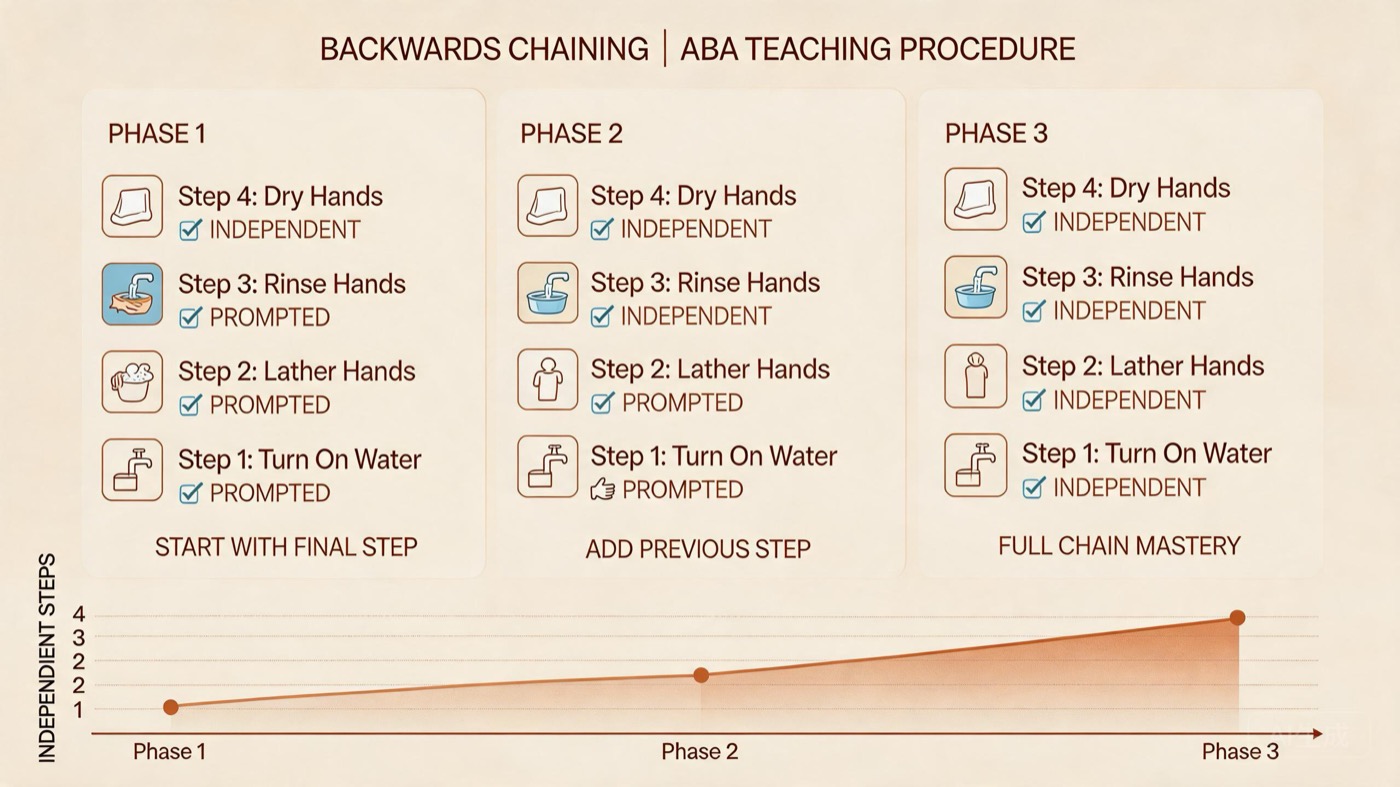
Backwards chaining is a behavioral teaching procedure where you teach a chain of behaviors starting from the last step first. The learner completes the final step independently while you prompt all earlier steps. Once the last step is mastered, you move to the second-to-last step, and so on, until the entire sequence is performed independently.
Table of Contents
- What Is Backwards Chaining?
- ABA Examples of Backwards Chaining: From Theory to Practice
- Why Backwards Chaining Matters for the BCBA Exam
- Quick Checklist: When to Use Backwards Chaining
- Summary
- References
This approach is especially effective when the natural reinforcer occurs at the end of the chain (e.g., completing a task). Because the learner finishes the entire sequence and immediately experiences the reinforcer, motivation remains high.
How Backwards Chaining Differs from Forward Chaining
In forward chaining, you teach the first step of the chain first, then the second, and so on. The key difference is the starting point of instruction:
- Backwards chaining: Begin with the final step; prompt all earlier steps. The learner experiences the terminal reinforcer after every trial.
- Forward chaining: Begin with the first step; prompt all later steps. The learner earns a reinforcer after completing the first step, then later after the second, etc.
- When to use: Backwards chaining is ideal when the natural reinforcer is strong at the end and you want to minimize errors. Forward chaining works well for skills where each step builds on the previous one.
ABA Examples of Backwards Chaining: From Theory to Practice
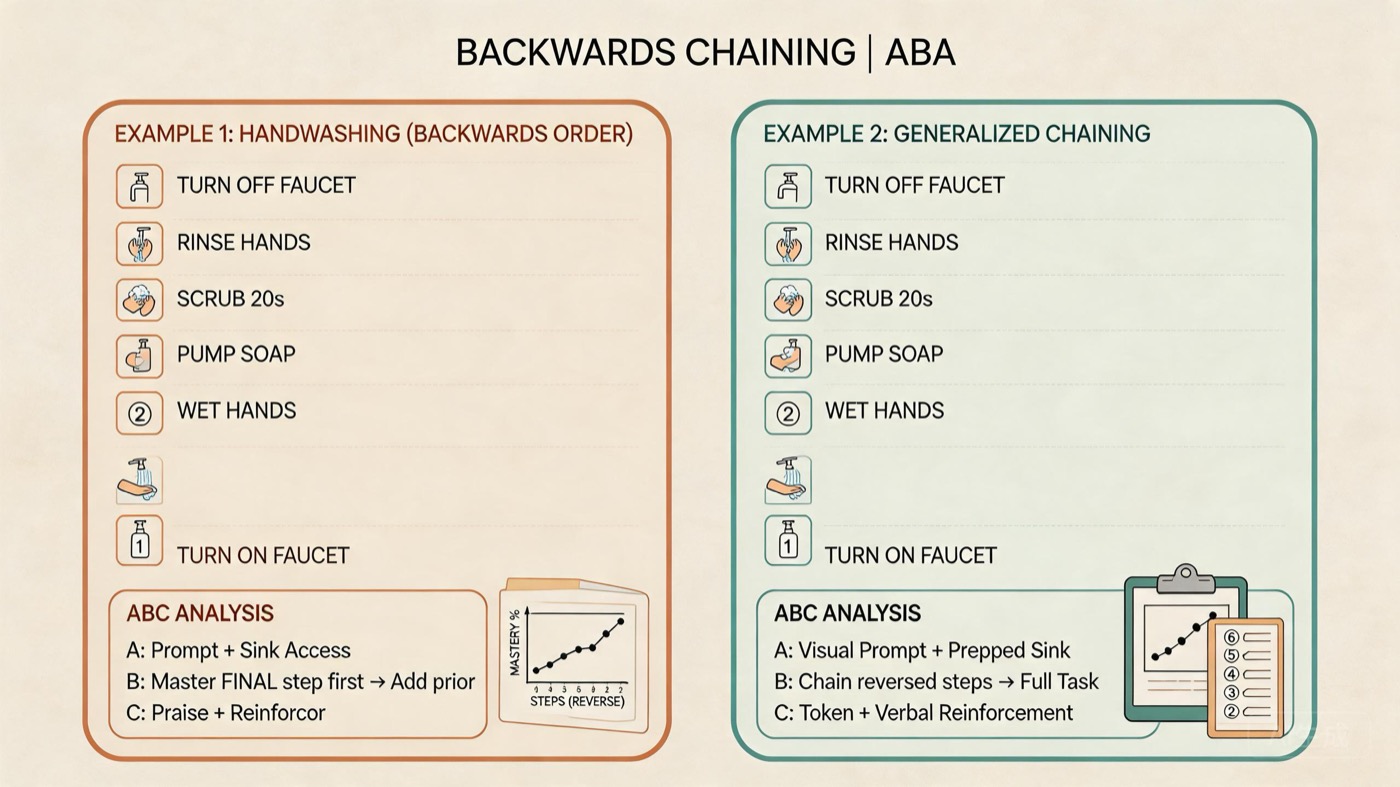
Let’s look at two practical examples using ABC analysis (Antecedent-Behavior-Consequence) to illustrate how backwards chaining works in real ABA scenarios.
Example 1: Teaching a Child to Wash Hands
Task analysis: (1) Turn on faucet, (2) wet hands, (3) pump soap, (4) scrub for 20 seconds, (5) rinse, (6) turn off faucet, (7) dry hands with towel. We will teach step 7 first.
| Antecedent | Behavior | Consequence | Hypothesized Function |
|---|---|---|---|
| Child’s hands are wet; towel is held out by therapist | Child wipes hands on towel (last step) | Therapist praises and child has dry hands | Access to preferred activity after handwashing |
| On later steps: therapist completes steps 1–6; child completes step 7 | Child independently dries hands | Natural reinforcer: hands are dry, task is complete | Termination of task (escape) + access to play |
Once the child independently dries hands, the therapist fades prompts for step 6 (turn off faucet), and so on backwards.
Example 2: Teaching a Teen to Prepare a Simple Meal
Task analysis for making a sandwich: (1) Get bread, (2) get peanut butter and jelly, (3) spread peanut butter, (4) spread jelly, (5) close sandwich, (6) put sandwich on plate, (7) eat. We teach step 7 first.
| Antecedent | Behavior | Consequence | Hypothesized Function |
|---|---|---|---|
| Sandwich assembled; therapist presents plate | Teen picks up sandwich and takes a bite (last step) | Immediate access to food reinforcer | Access to tangible (food) |
| After mastering step 7: therapist completes steps 1–5; teen does step 6 (put on plate) | Teen places sandwich on plate | Therapist provides praise; teen then eats | Access to tangible + praise |
Backwards chaining ensures the teen experiences the natural reinforcer (eating) after each session, maintaining motivation.
Why Backwards Chaining Matters for the BCBA Exam
The BCBA exam often tests your ability to distinguish chaining procedures and apply them to case scenarios. You will likely see questions that require you to identify the procedure described or select the correct next step in a chaining intervention.
Common Exam Traps to Avoid
Here are the most frequent mistakes test-takers make:
- Confusing backwards with forward chaining: Remember: backwards = last step first. If the question says ‘the learner is always prompted through all steps except the last,’ that is a dead giveaway for backwards chaining.
- Misidentifying the step to prompt: In backwards chaining, you prompt the earlier steps and let the learner complete the later, already-mastered steps independently.
- Ignoring function of behavior: Always consider the motivating operation and what reinforces the terminal behavior. If the natural reinforcer doesn’t maintain the chain, you may need additional reinforcement.
Practice Prompt: Designing a Backwards Chaining Intervention
Scenario: A 6-year-old with autism is learning to brush teeth independently. The task analysis is: (1) get toothbrush, (2) apply toothpaste, (3) brush front teeth, (4) brush back teeth, (5) spit, (6) rinse toothbrush, (7) put toothbrush away. Using backwards chaining, describe the first teaching trial.
Answer analysis: The first trial should teach step 7 (put toothbrush away). The therapist will prompt steps 1–6, then deliver the instruction for step 7. The child completes step 7 independently and receives reinforcement (e.g., access to a preferred activity). Once step 7 is mastered, teach step 6, and so on.
Quick Checklist: When to Use Backwards Chaining
Use this checklist during the exam or when designing interventions:
- Is the chain long? Backwards chaining reduces errors early on, which can be helpful for long chains.
- Is the terminal reinforcer powerful? If the natural consequence at the end is highly motivating, backwards chaining is a strong choice.
- Does the learner struggle with frustration? Because earlier steps are prompted, the learner experiences success immediately, reducing frustration.
- Consider the learner’s current skill level: The learner must be able to complete the last step (with minimal assistance at first) for this procedure to work.
- Monitor independence: Fade prompts gradually. Mastery criteria typically require independent performance across three consecutive trials.
Summary
Backwards chaining is a powerful and often-tested procedure for teaching multi-step skills. By starting with the last step, you build independence and maintain motivation through immediate access to natural reinforcers. For the BCBA exam, remember the key distinction from forward chaining, watch for common traps like step confusion, and practice with ABC analysis. To deepen your understanding, check out our comprehensive guide on chaining in ABA for more examples and task analyses. For additional practice, take our BCBA mock exam (6th edition) to test your knowledge of chaining and other behavioral procedures.



