
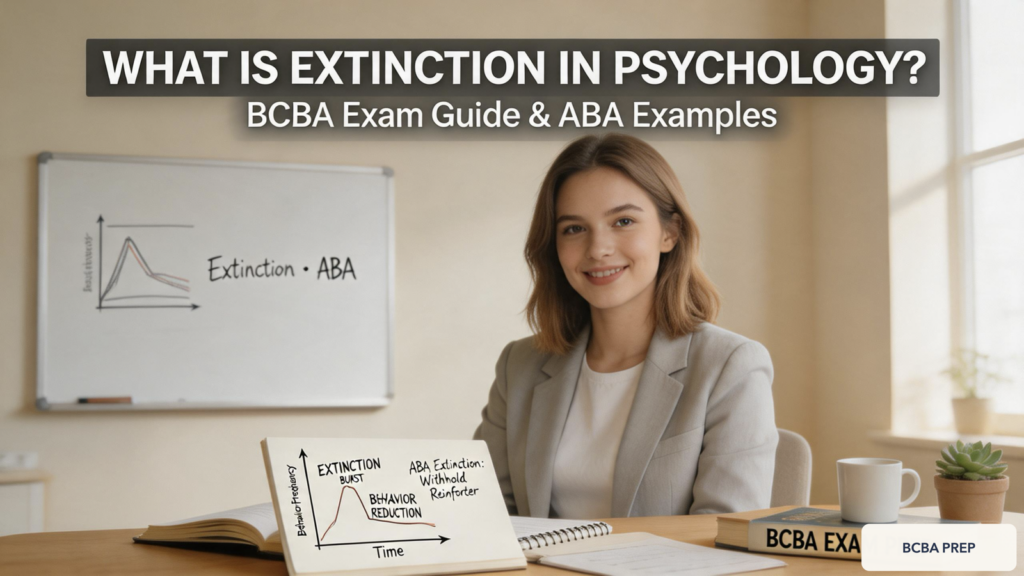
What Does Extinction Mean in Psychology? A BCBA Perspective
In psychology, extinction refers to the reduction or elimination of a behavior when the reinforcing consequence is no longer delivered. This concept originated from classical conditioning research by Pavlov, where a conditioned response diminishes when the conditioned stimulus is repeatedly presented without the unconditioned stimulus. In operant conditioning, Skinner demonstrated that behaviors stop when they no longer produce reinforcement. For BCBA candidates, understanding extinction is essential because it is a core behavior reduction procedure used in Applied Behavior Analysis (ABA). The key is that extinction is not simply ignoring behavior; it must be implemented based on the function of the behavior.
Table of Contents
- What Does Extinction Mean in Psychology? A BCBA Perspective
- How Extinction Works in Applied Behavior Analysis (ABA)
- 3 Worked ABA Examples: ABC Analysis with Hypothesized Function
- Extinction Burst, Spontaneous Recovery, and Other Exam Traps
- Quick Checklist: Applying Extinction in Your BCBA Practice
- Summary: Extinction in Psychology for the BCBA Exam
Key Terminology: Operant vs. Respondent Extinction
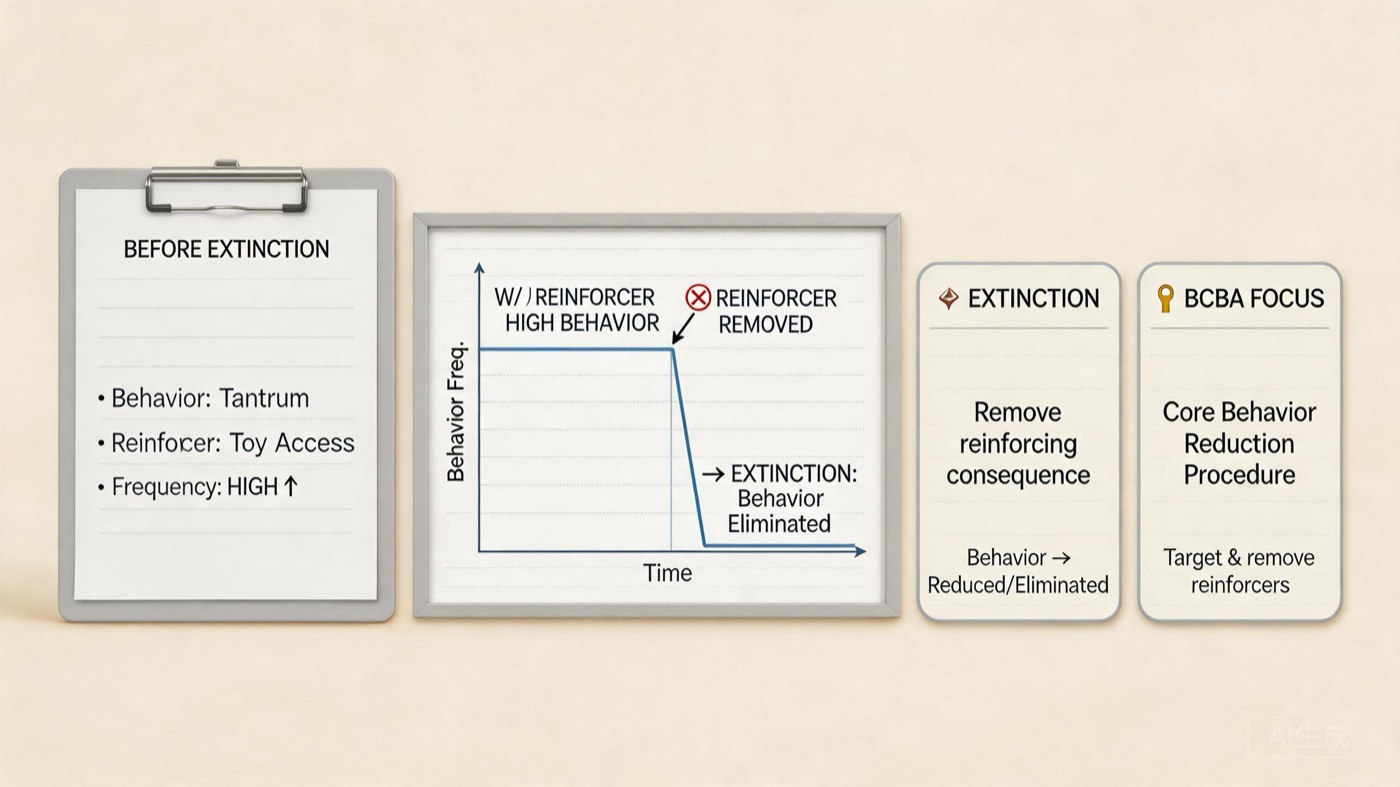
There are two types of extinction: operant extinction and respondent extinction. Operant extinction occurs when a previously reinforced behavior no longer produces the reinforcer, leading to a decrease in that behavior. For example, if a child’s tantrum previously resulted in getting a toy, and now the tantrum is ignored (no toy), the tantrum will eventually stop. Respondent extinction involves repeatedly presenting a conditioned stimulus without the unconditioned stimulus, which reduces the conditioned response. For instance, if a dog has been conditioned to salivate to a bell (conditioned stimulus) paired with food (unconditioned stimulus), presenting the bell alone without food will eventually eliminate the salivation. For the BCBA exam, operant extinction is the most relevant, but you should be familiar with both. Two notable side effects are extinction burst (a temporary increase in behavior) and spontaneous recovery (the reappearance of behavior after extinction). These phenomena are critical to understand because they can mislead practitioners into thinking extinction is not working.
How Extinction Works in Applied Behavior Analysis (ABA)
In ABA, extinction involves withholding the reinforcer that maintains a behavior. This procedure is always based on a functional assessment: you must know the hypothesized function of the behavior to implement extinction correctly. For example, if a child screams for attention (attention function), extinction means ignoring the scream (no eye contact, no verbal reprimand). If the behavior is maintained by escape from demands (escape function), extinction means not allowing the individual to escape the task. Extinction can be challenging because it often leads to an initial increase in behavior (extinction burst) and can evoke aggression or emotional responses. Therefore, it is crucial to have a plan in place to ensure safety and consistency.
Extinction is often combined with reinforcement of alternative behaviors (like differential reinforcement) to increase appropriate behavior. For instance, while ignoring a child’s scream for attention, you might reinforce raising a hand or saying “excuse me.” This combination, called differential reinforcement of alternative behavior (DRA), is more effective and ethical than extinction alone. It is not the same as punishment because extinction does not involve adding an aversive stimulus; it simply removes the reinforcer. For more on differential reinforcement, see our guide on differential reinforcement.
3 Worked ABA Examples: ABC Analysis with Hypothesized Function
Example 1: Attention-Maintained Screaming (Preschool Classroom)
Antecedent: Teacher is busy with another student. Behavior: Child screams. Consequence: Teacher looks at child and says “Shh” (attention). Function: Obtain attention. Extinction: Planned ignoring: no eye contact, no verbal response. The teacher may also teach the child to raise a hand (functional communication training). Extinction burst: The child may scream louder temporarily before decreasing. It is important to monitor for any escalation that could harm the child or others, and to ensure all staff consistently apply the extinction procedure.
Example 2: Escape-Maintained Whining (Homework Time)
Antecedent: Parent gives a math worksheet. Behavior: Child whines. Consequence: Parent takes the worksheet away (escape). Function: Escape from demand. Extinction: Keep the worksheet present; prompt compliance; do not allow escape via whining. The parent may provide a break after a set amount of work (e.g., after completing three problems). This is an example of extinction combined with a reinforcement schedule for compliance.
Example 3: Tangible-Maintained Aggression (Snack Time)
Antecedent: Peer has a cookie. Behavior: Child hits peer. Consequence: Peer drops cookie; child grabs it (access to tangible). Function: Access to cookie. Extinction: Do not allow child to obtain the cookie after aggression; return cookie to peer. Teach child to request the cookie appropriately (e.g., saying “cookie please”). This example highlights the importance of teaching an alternative behavior to replace the maladaptive one.
Extinction Burst, Spontaneous Recovery, and Other Exam Traps
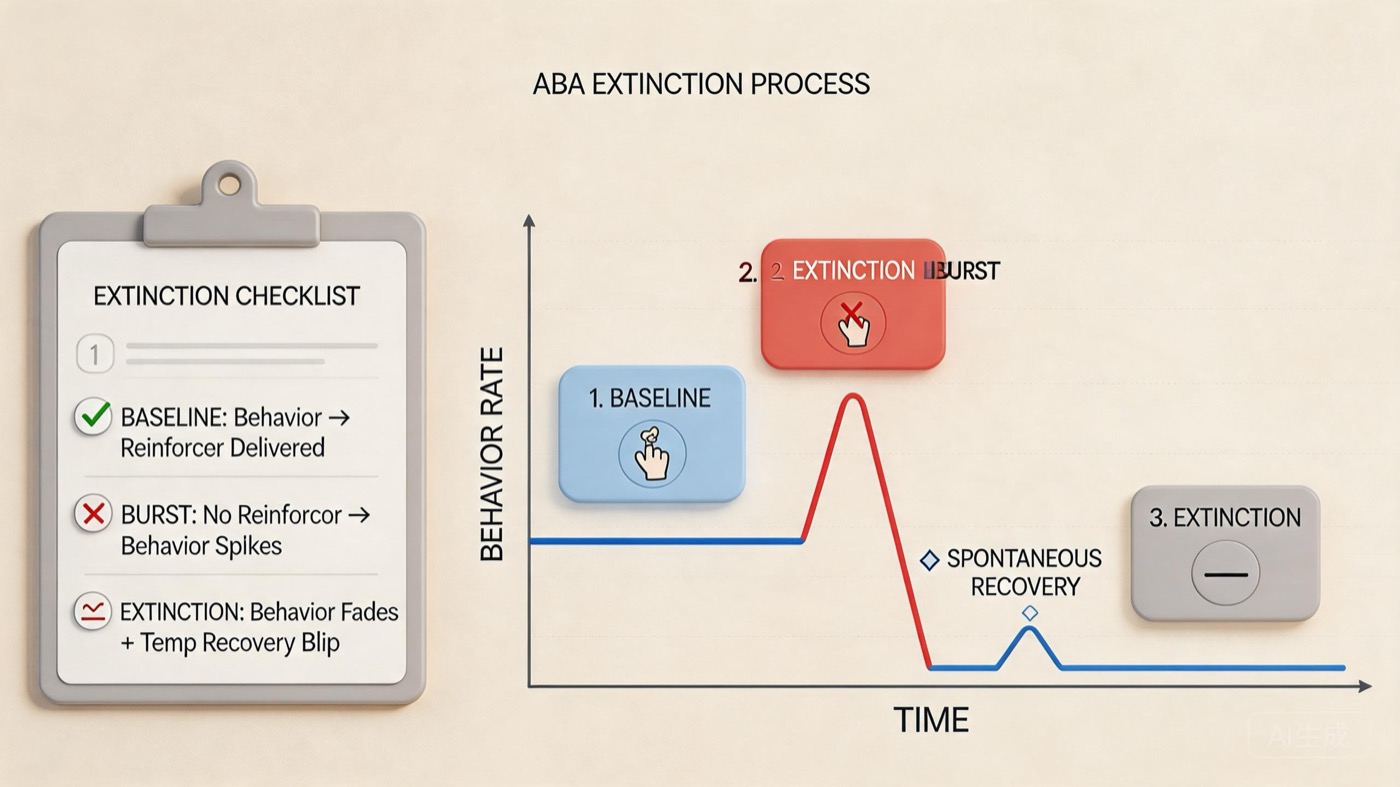
The BCBA exam often tests your understanding of extinction phenomena that can mislead practitioners. Extinction burst is a temporary increase in the frequency, intensity, or duration of the behavior when extinction is implemented. For example, a child who previously screamed for 30 seconds may scream for 2 minutes when extinction first begins. Spontaneous recovery is the sudden reappearance of an extinguished behavior after a time without reinforcement. For instance, after the tantrum has stopped for a week, the child may tantrum again one day; if the behavior is again placed on extinction, it will likely decrease quickly. Resurgence occurs when a previously reinforced behavior reappears after extinction of a more recently reinforced behavior. This is common when a new alternative behavior is reinforced but then placed on extinction; the old behavior may return. These effects are normal but can be mistaken for failure of the procedure.
Another trap: confusing extinction with punishment. Extinction removes reinforcement; punishment adds or removes something to decrease behavior. Also, some candidates forget that extinction must be applied to the function of the behavior. For a deeper look at functions, visit our guide on four functions of behavior.
Common exam traps include:
- Thinking extinction works immediately (it often involves a burst first)
- Applying extinction without a functional assessment
- Assuming extinction burst means the procedure is not working
- Confusing spontaneous recovery with lack of treatment integrity
- Misidentifying the function of behavior (e.g., treating attention-maintained behavior as escape-maintained)
Quick Checklist: Applying Extinction in Your BCBA Practice
Use this checklist to ensure you are applying extinction correctly in practice and on the exam:
- Conduct a functional behavior assessment (FBA) to identify the maintaining reinforcer
- Ensure the extinction procedure matches the function (e.g., ignore for attention, do not remove demand for escape)
- Plan for extinction burst and prepare staff and caregivers
- Combine extinction with differential reinforcement of an alternative behavior (DRA)
- Monitor treatment integrity: everyone must consistently withhold the reinforcer
- Be prepared for spontaneous recovery and avoid re-implementing reinforcement
- Document all sessions, including any bursts or recovery, to track progress and adjust the plan if needed
Summary: Extinction in Psychology for the BCBA Exam
Extinction is a fundamental behavior reduction procedure that relies on withholding the reinforcing consequence. It is not punishment; it is function-based. Key terms to remember include extinction burst, spontaneous recovery, and resurgence. Practice applying extinction to different functions using ABC analysis. For more exam preparation, explore our BCBA mock exams. For authoritative reading, see the BACB’s Behavior Analyst Certification Board guidelines.



