

What is an Interval Graph in ABA?
An interval graph is a type of line graph used in applied behavior analysis to display behavior that is measured using interval recording methods. Each data point represents the occurrence or non-occurrence of a behavior within a specific time interval, rather than a continuous count or duration. This type of graph is essential when behaviors are too frequent, brief, or sporadic to be counted reliably in real time—common in settings like classrooms, clinics, or homes where observation is periodic.
Understanding interval graphs is critical for the BCBA exam because they appear in scenario-based questions requiring you to evaluate intervention effectiveness. Interval recording methods—such as partial interval, whole interval, and momentary time sampling—each produce slightly different graph characteristics, but the visual output is always the percentage of intervals in which the behavior was observed. The exam often asks you to identify measurement procedures from the graph structure or to determine if the recorded data matches the intended operational definition.
Table of Contents
- What is an Interval Graph in ABA?
- How to Interpret an Interval Graph: ABC Examples
- Common Exam Traps When Analyzing Interval Graphs
- Quick Checklist for Interval Graph Questions on the BCBA Exam
- Advanced Tips for Interval Graph Interpretation
- Summary: Why Interval Graphs Matter for Your BCBA Exam
Key Components of an Interval Graph
- X-axis: Represents time intervals (e.g., sessions or days). Each interval is a unit of measurement.
- Y-axis: Represents the percentage of intervals in which the behavior occurred, ranging from 0% to 100%.
- Data points: Each point reflects the proportion of intervals with behavior during that session.
- Trend lines: Visual analysis focuses on level, trend, and variability across intervals.
Interval graphs are commonly used for behaviors that are difficult to count continuously, such as disruptive behavior or social interactions. They help clinicians and BCBAs evaluate intervention effectiveness over time. A key distinction to remember: interval graphs show percentages, not raw frequencies. This is a common point of confusion on the exam.
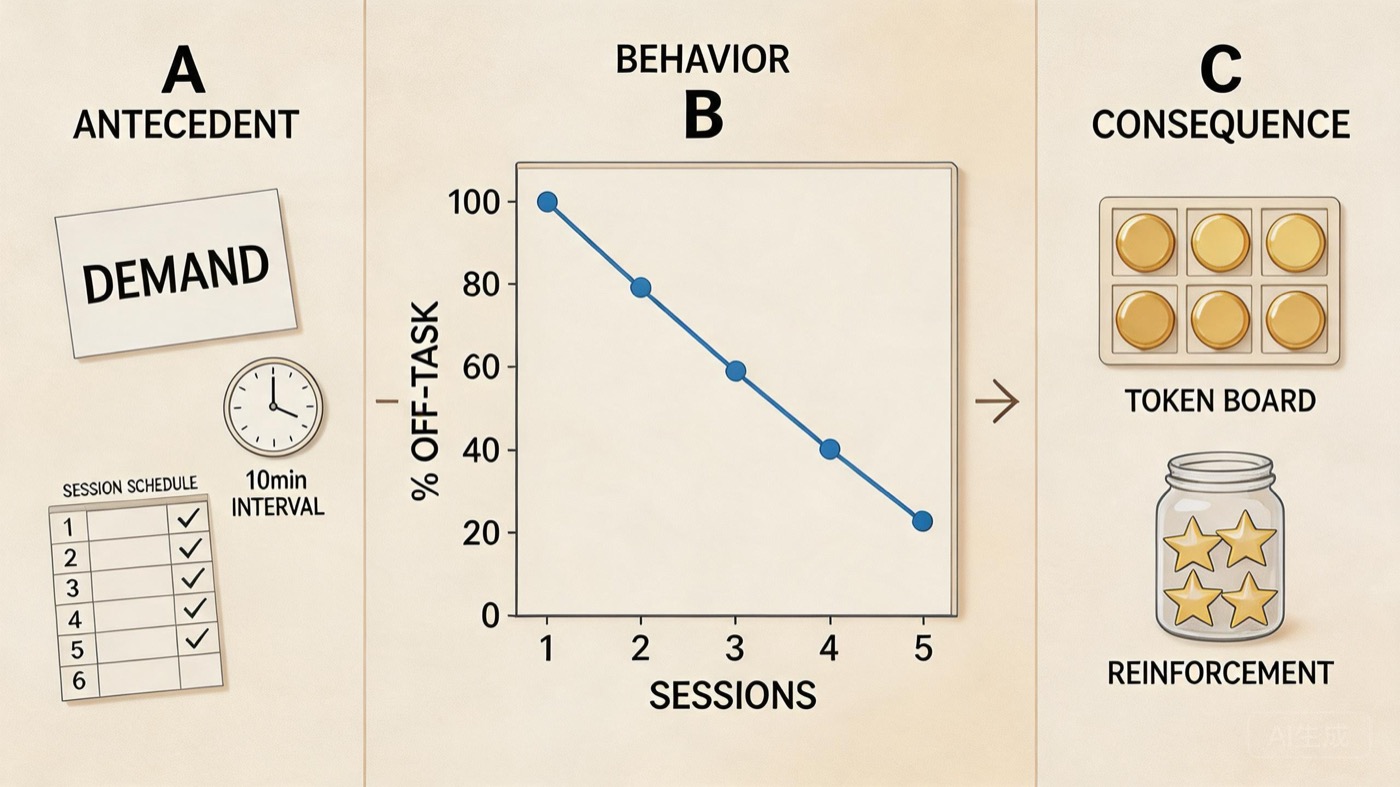
How to Interpret an Interval Graph: ABC Examples
Understanding an interval graph requires linking the visual data to the ABC (antecedent-behavior-consequence) model. Below are three exam-relevant examples that illustrate how data patterns can guide function-based decisions.
Example 1: Decreasing Off-Task Behavior with DRA
A student shows off-task behavior during demands. The graph depicts a clear decreasing trend from 80% to 20% of intervals over 10 sessions. The ABC data indicates: antecedent (demand), behavior (off-task), consequence (teacher attention). Hypothesized function: attention. The interval graph reflects successful reduction through differential reinforcement of alternative behavior (DRA). Notice the gradual slope—intervention effects often appear slowly in interval data due to the measurement method’s sensitivity.
Example 2: Increasing Hand Raising with Differential Reinforcement
A child raises hand more often when the teacher is near. The interval graph shows an increasing trend from 30% to 85% of intervals. ABC: antecedent (teacher proximity), behavior (hand raise), consequence (praise). Function: access to attention. Note the variability in early sessions, a common feature of interval data. The upward trend confirms that differential reinforcement for hand raising is effective, even though day-to-day fluctuations exist.
Example 3: Stable Self-Injurious Behavior with Function-Based Intervention
A client engages in self-injurious behavior (SIB) during alone time. The interval graph remains stable around 60% despite intervention. ABC: antecedent (alone condition), behavior (SIB), consequence (automatic reinforcement). Function: automatic. A stable graph suggests the intervention may not match the function; further assessment is needed. This example emphasizes that a flat graph does not necessarily mean no problem—it may indicate a mismatch between intervention and reinforcement function.
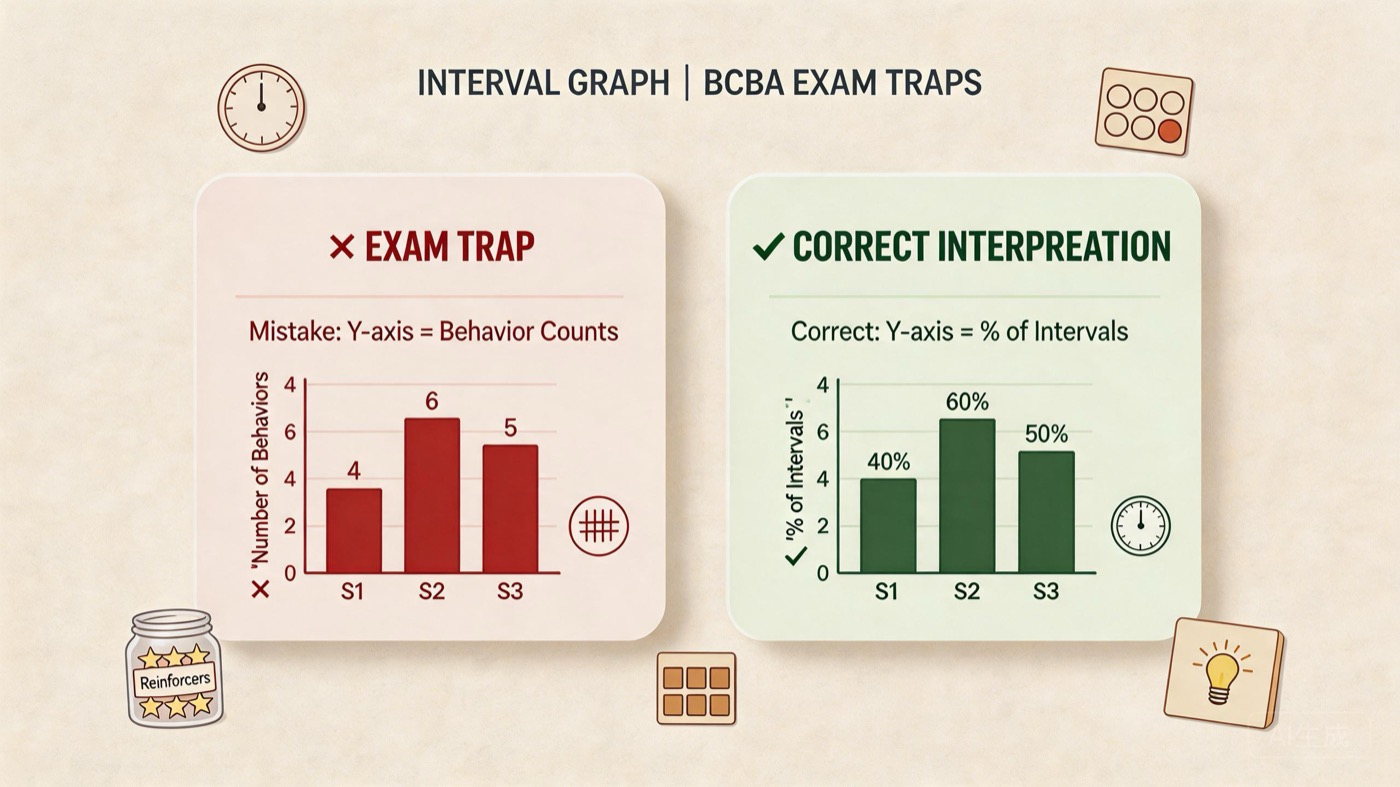
Common Exam Traps When Analyzing Interval Graphs
BCBA exam questions often test your ability to avoid these pitfalls:
Confusing Interval Graphs with Continuous Recording Graphs
Remember that the y-axis on an interval graph shows percentage of intervals, not exact frequency or duration. A common exam trap is assuming the y-axis represents counts of behavior, leading to misinterpretation. For example, a stable line at 50% does not mean the behavior occurred 50 times—it means it occurred in half of the intervals observed.
Misinterpreting Variability as No Trend
Interval data often contain variability. The exam may test whether you can identify an underlying trend despite fluctuations. For instance, a dataset with highs and lows might still show a clear increasing pattern when viewed holistically. Use the “split-middle” line method or visual approximation to confirm direction.
Ignoring the Role of Interobserver Agreement (IOA)
Low interobserver agreement can compromise graph validity. If an exam question presents a graph without IOA data, consider whether the results are trustworthy. Always check for adequate IOA before drawing conclusions. On the exam, if a graph shows erratic data points without IOA reported, a recommended next step might be to assess IOA rather than change the intervention.
Overlooking the Effects of Measurement Bias
Different interval recording methods can bias data. Partial interval recording tends to overestimate occurrence, while whole interval recording often underestimates it. An exam question might present a graph with a sudden drop in behavior; the correct interpretation could point to a switch from partial to whole interval recording, not a true behavior change. Always consider measurement changes when interpreting level shifts.
Quick Checklist for Interval Graph Questions on the BCBA Exam
- Identify the measurement type — is it interval recording or continuous?
- Check the y-axis label — it should say % of intervals, not count or duration.
- Look for trend direction — increasing, decreasing, or stable despite variability.
- Assess level — are data points consistently high or low?
- Note variability — is it typical for interval data or a sign of intervention issues?
- Link the graph to ABC data to hypothesize function.
- Evaluate IOA scores if provided to ensure data quality.
- Use visual inspection rules: focus on changes in trend, level, and latency after intervention.
- Consider measurement bias — could a change in recording method explain a sudden level shift?
For additional practice, explore our guide on graphing and visual analysis to strengthen your skills.
Advanced Tips for Interval Graph Interpretation
To excel on the BCBA exam, go beyond basic trend identification. Understand that interval graphs can also display latency if the X-axis includes conditions before and after intervention. A sudden drop in level immediately after intervention indicates an immediate treatment effect, whereas a gradual slope suggests a slower shaping process. Additionally, look for contrast effects—if baseline data are highly variable, the subsequent intervention phase may require more sessions to establish a stable pattern. Another advanced point: interval graphs with a high percentage (e.g., above 80%) may indicate ceiling effects, making it difficult to see improvement. In such cases, the exam may ask you to recommend a more sensitive measurement method.
Summary: Why Interval Graphs Matter for Your BCBA Exam
The interval graph is a foundational tool in ABA for tracking behavior that occurs within time bins. On the BCBA exam, you must be able to interpret these graphs accurately, avoid common traps, and link findings to function-based interventions. Mastering interval graphs will help you analyze data effectively and answer scenario-based questions with confidence. For more exam prep, visit the BACB website for official resources.


