
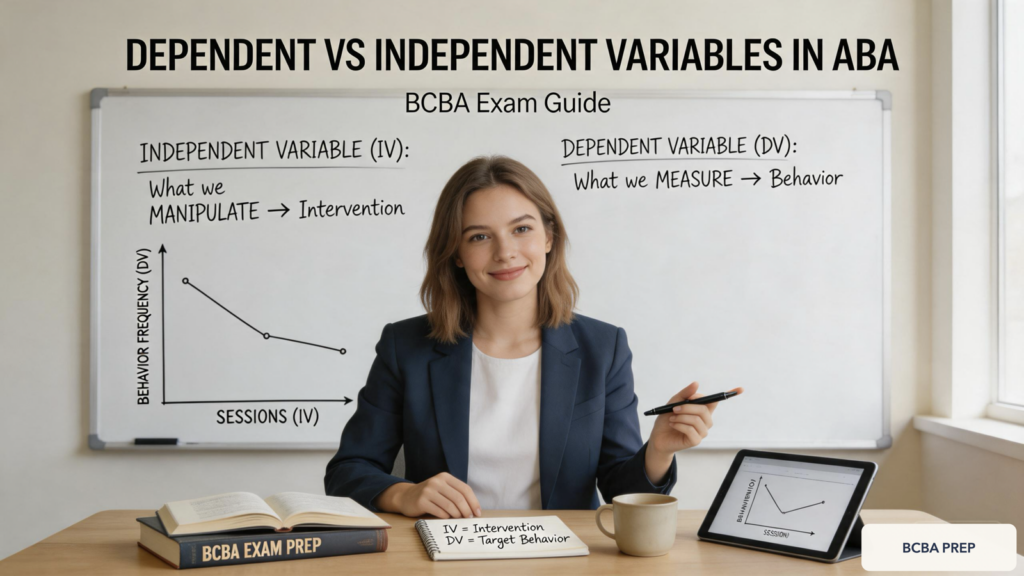
Understanding Dependent and Independent Variables in ABA
If you are preparing for the BCBA exam, you need a solid grasp of dependent and independent variables. These concepts form the foundation of experimental design and data analysis in applied behavior analysis. In this guide, we will define each variable, walk through practical ABA examples, highlight common exam traps to avoid, and provide a comparison with everyday analogies to solidify your understanding.
Table of Contents
- Understanding Dependent and Independent Variables in ABA
- What Do Dependent and Independent Variables Mean in ABA?
- ABA Examples Connecting Dependent and Independent Variables to ABC Data
- Everyday Analogies to Reinforce the Distinction
- Exam Relevance: Common Traps to Avoid
- Quick Checklist: Identifying Dependent and Independent Variables
- Summary
What Do Dependent and Independent Variables Mean in ABA?
Independent Variable: The Intervention You Control
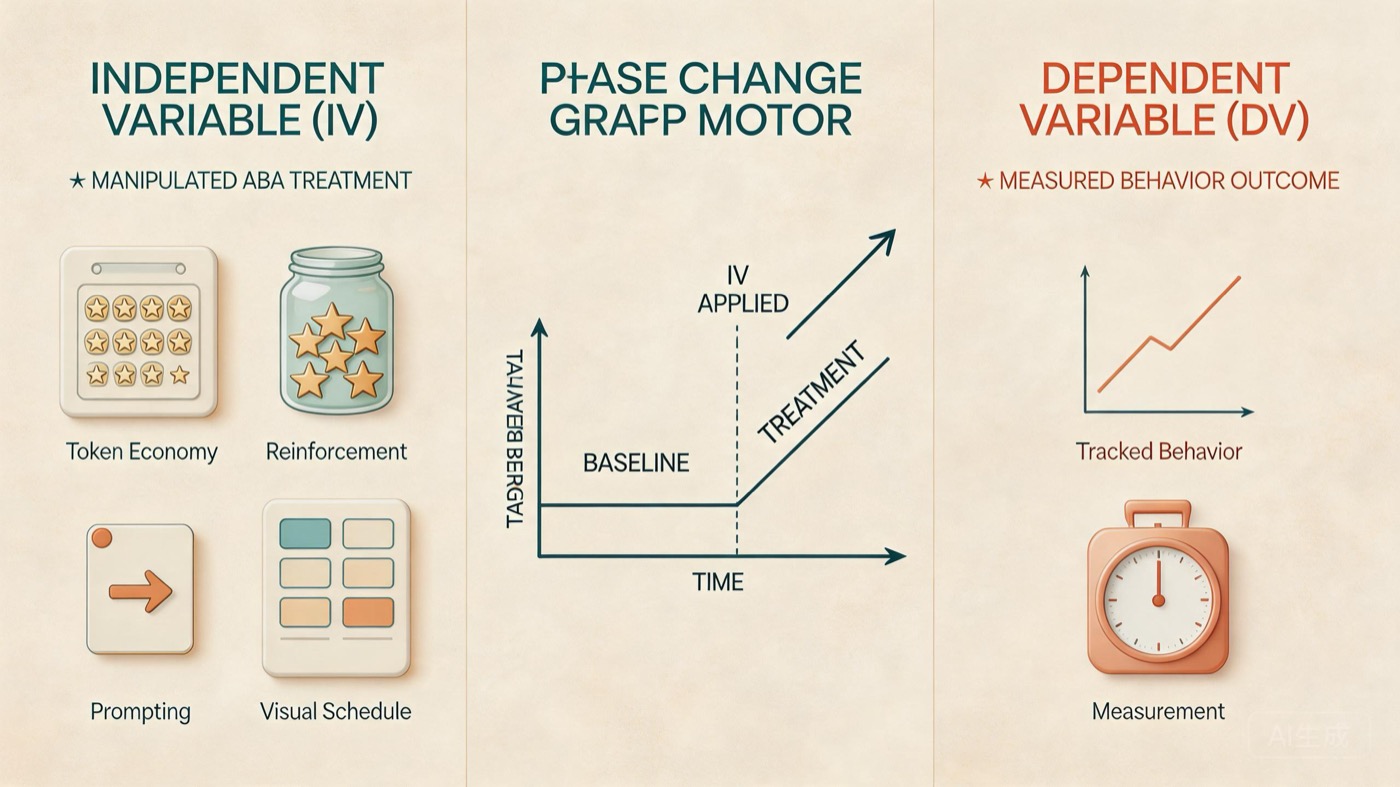
The independent variable (IV) is the environmental change or intervention that the practitioner manipulates. In ABA, it is often the treatment condition, such as a token economy, extinction procedure, or prompting strategy. The IV is under the experimenter’s control and is hypothesized to affect behavior. Importantly, the IV must be implemented with fidelity to ensure that any changes in behavior can be attributed to the intervention rather than extraneous factors. For example, if you are using a token system, you need to consistently deliver tokens contingent on the target behavior; otherwise, the IV is not truly under control.
Dependent Variable: The Behavior You Measure
The dependent variable (DV) is the measurable behavior or response that is expected to change as a result of the IV. In ABA, the DV must be observable and quantifiable, like frequency of aggression or percentage of on-task intervals. The DV is the primary outcome of interest. When defining the DV, behavior analysts must create an operational definition that allows for reliable measurement across observers. For instance, “aggression” might be defined as “any instance of hitting, kicking, or biting another person,” ensuring that data collection is consistent. The DV is always the behavior that is being targeted for change, and it should be directly related to the IV.
ABA Examples Connecting Dependent and Independent Variables to ABC Data
Example 1: Reducing Aggression with a Token Economy
Scenario: A student hits others when given difficult tasks. The independent variable is the token economy (e.g., earning tokens for appropriate behavior). The dependent variable is the frequency of hitting. ABC data: Antecedent: demand presented; Behavior: hitting peer; Consequence: token loss (or escape from demand). Hypothesized function: escape from demands. The practitioner manipulates the token system (IV) and measures the hitting behavior (DV). A common exam question may ask you to identify which variable is manipulated; here, the token economy is the independent variable.
Example 2: Increasing On-Task Behavior with a Timer
Scenario: A client wanders during independent work. The independent variable is a timer with self-monitoring (e.g., set timer for 5 minutes). The dependent variable is the percentage of intervals on-task. ABC data: Antecedent: difficult task; Behavior: leaves seat; Consequence: redirection. Function: avoidance of task. The IV (timer and self-monitoring) is introduced to increase on-task behavior, while the DV (percentage of intervals on-task) is measured. Note that the DV must be measured repeatedly across baseline and intervention phases to demonstrate experimental control.
Example 3: Teaching Manding with a Delay Procedure
Scenario: A child with limited vocal requests points to items. The independent variable is a delay to reinforcement after pointing (e.g., wait 5 seconds). The dependent variable is the number of vocal mands per session. ABC data: Antecedent: item out of reach; Behavior: pointing; Consequence: item delivered after a delay. Function: access to desired items. In this case, the IV is the delay procedure, and the DV is the vocal mands. The practitioner expects that as the delay increases, the child will begin to vocalize to request the item.
Everyday Analogies to Reinforce the Distinction
To help remember the difference between IV and DV, consider a simple non-behavioral example: If you are baking a cake, the amount of sugar you add is the independent variable (you decide how much), and the sweetness of the cake is the dependent variable (it depends on the sugar). In ABA, the intervention (IV) is like the sugar, and the behavior (DV) is like the sweetness—you change one to see an effect on the other. This analogy can help when you encounter tricky exam items that ask you to identify variables in novel scenarios.
Exam Relevance: Common Traps to Avoid
Confusing the Variable with Its Values
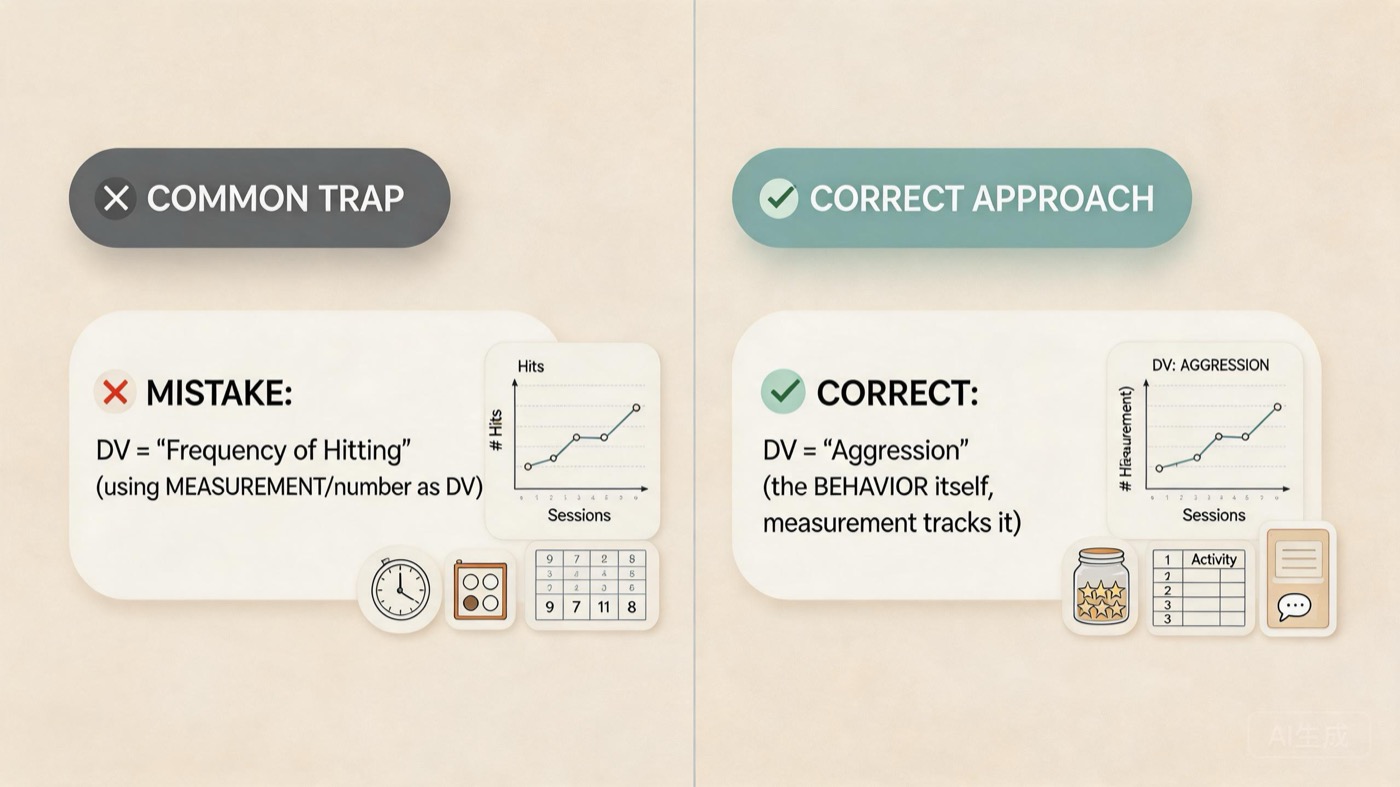
Many BCBA candidates mistakenly identify the measurement (e.g., ‘frequency of hitting’) as the dependent variable itself. Remember: the dependent variable is the behavior, not its numerical value. For example, ‘aggression’ is the DV, not ‘rate of aggression per hour’. The rate is a measurement dimension; the behavior is the construct. Exams often phrase questions like “What is the dependent variable in this study?” and provide options that include the measurement type. Always look for the behavior name.
Misidentifying the Intervention as the Dependent Variable
A frequent error is confusing what you change with what you measure. The independent variable is the intervention you implement; the dependent variable is the behavior you track. If you are manipulating a token system, that is the IV, not the DV. Similarly, if the question asks for the independent variable, look for the procedure or treatment being applied. Practice by rephrasing the scenario: “What did the practitioner do?” (IV) versus “What did the practitioner measure?” (DV).
Ignoring the Role of Confounding Variables
Another exam trap is forgetting that the IV must be isolated from confounding variables. Confounds are extraneous factors that could influence the DV, making it unclear whether the IV caused the change. For example, if you change the token system and also provide additional praise simultaneously, you cannot be sure which change affected behavior. In exam scenarios, always ask yourself whether the IV is cleanly manipulated.
Quick Checklist: Identifying Dependent and Independent Variables
- What is being manipulated? That is the independent variable.
- What behavior is being measured? That is the dependent variable.
- Does the DV change in response to the IV? This demonstrates experimental control.
- Is the DV observable and measurable? It must be defined operationally.
- Is the IV under the practitioner’s control? The practitioner must be able to implement it consistently.
- Are there any confounding variables? Always check for extraneous factors that might threaten internal validity.
Summary
Mastering dependent and independent variables is essential for the BCBA exam and for effective ABA practice. Remember: the IV is what you change, the DV is what you measure. Use the ABC framework to disentangle them. For more exam practice, explore our free BCBA mock exam questions and review additional variables guidance. Also, check the BACB website for official resources.


