
What Are ABA Antecedent Strategies?
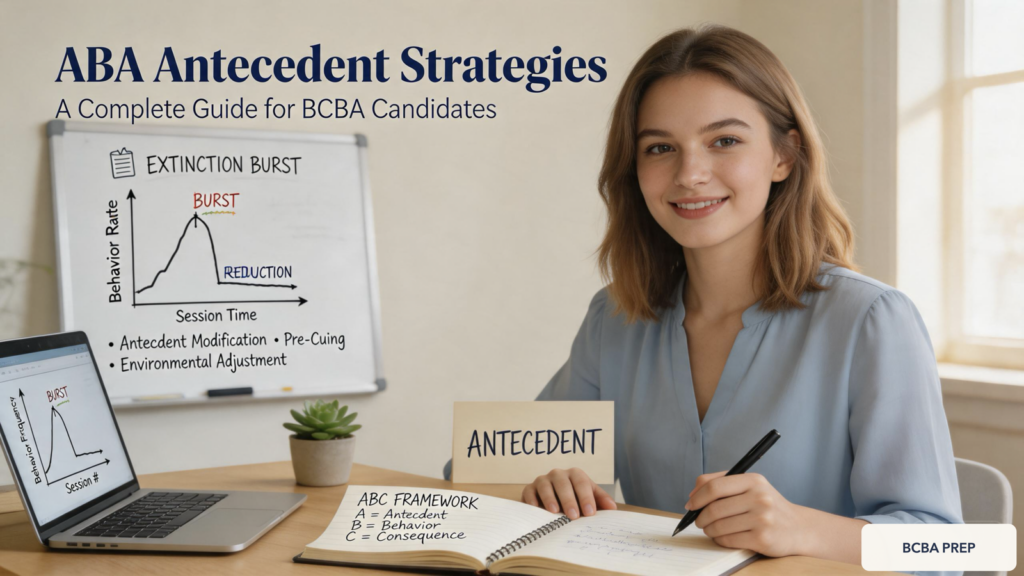
An ABA antecedent strategy is a proactive intervention that modifies the environment or context before a behavior occurs. Rather than reacting to a behavior after it happens, antecedent strategies aim to make desired behaviors more likely and problem behaviors less likely from the start.
Table of Contents
- What Are ABA Antecedent Strategies?
- Types of Antecedent Interventions for Behavior Change
- ABC Examples of Antecedent Strategies in Practice
- BCBA Exam Relevance and Common Traps
- Quick Checklist for Antecedent Strategies
- Summary and Next Steps
These strategies are rooted in the three-term contingency, also known as the ABC framework: Antecedent-Behavior-Consequence. In this model, the antecedent is the event or condition that immediately precedes a behavior and sets the occasion for it.
The Role of Antecedents in the ABC Framework
In the ABC framework, the antecedent triggers or signals that a particular behavior will lead to a specific consequence. For example, a teacher instructs students to raise their hands (antecedent), a student raises their hand (behavior), and the teacher calls on them (consequence). The antecedent here is the instruction, which sets the stage for the desired hand-raising behavior.
Understanding antecedents helps BCBAs design interventions that prevent challenging behaviors and promote skill acquisition. By altering what happens before a behavior, you can change the behavior itself without relying solely on consequences.
Types of Antecedent Interventions for Behavior Change
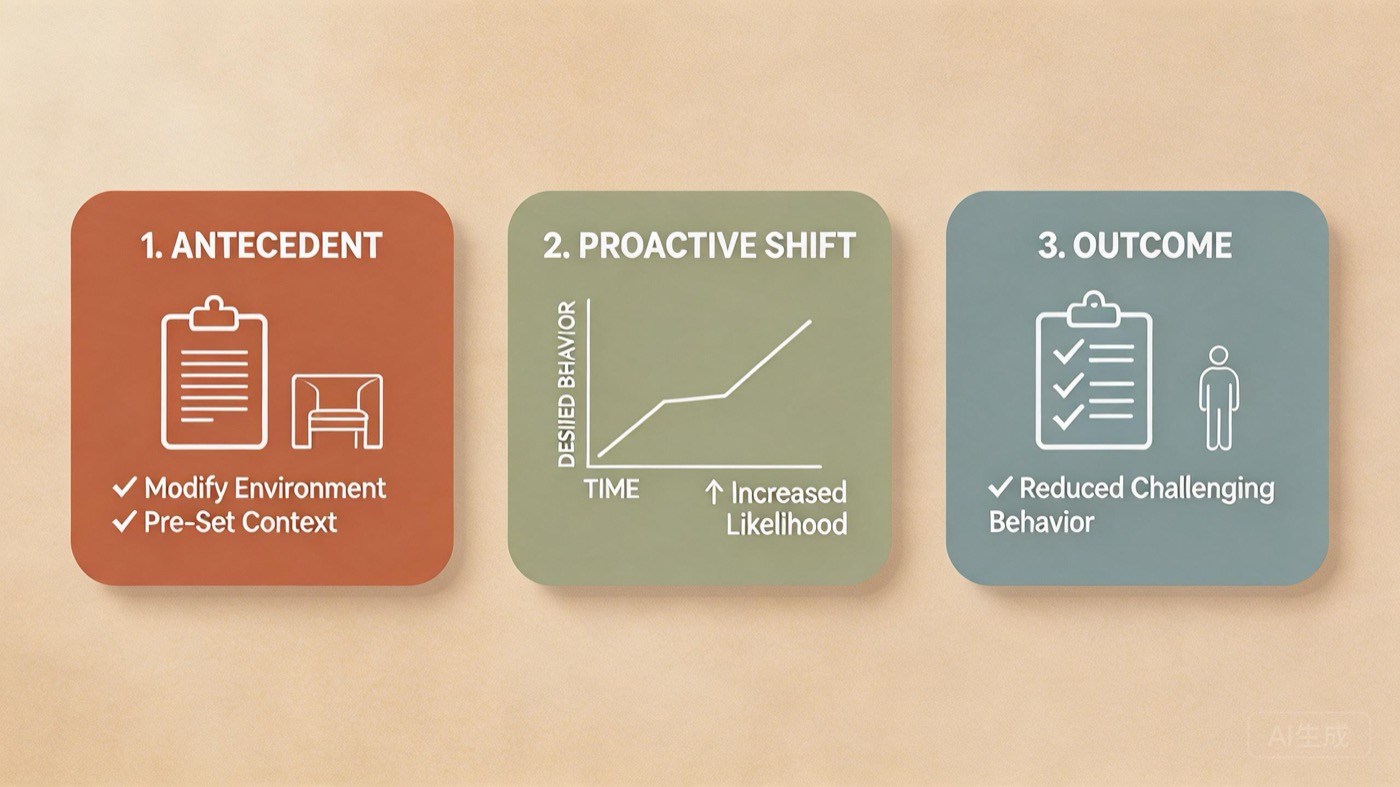
Antecedent interventions fall into several categories, each with a different mechanism. The goal is always proactive support: making the right behavior easier and the wrong behavior harder.
Environmental Modifications
Changing the physical or social environment can reduce triggers for problem behavior. Common modifications include rearranging seating to minimize distractions, reducing noise levels, or providing a quiet workspace. For example, a student who is easily distracted by peers might benefit from a study carrel. Environmental changes are often the simplest and most powerful antecedent strategies.
Prompting and Cueing
Prompts are supplementary stimuli that increase the likelihood of a correct response. Types include verbal prompts (e.g., saying ‘Look at the board’), gestural prompts (e.g., pointing to the correct answer), and physical prompts (e.g., guiding a hand to write). Effective use requires prompt fading to avoid prompt dependency. For instance, a teacher might start with full physical guidance and gradually reduce to a light tap.
Noncontingent Reinforcement (NCR)
NCR delivers reinforcement on a fixed or variable time schedule, independent of the learner’s behavior. This reduces motivation for problem behavior by providing the reinforcer freely. For example, if a child engages in attention-seeking behavior, the teacher might give attention every 5 minutes regardless of the child’s actions. NCR is especially useful for behaviors maintained by automatic or social reinforcement.
Video Study: Antecedent Intervention
Watch: Antecedent Intervention Explained | 6th ed. | BCBA Exam Prep
Use this lesson as a visual study companion, then return to the definitions and examples below to apply the same concept to BCBA® exam questions.
Prefer a second pass? Open this lesson on YouTube.
ABC Examples of Antecedent Strategies in Practice
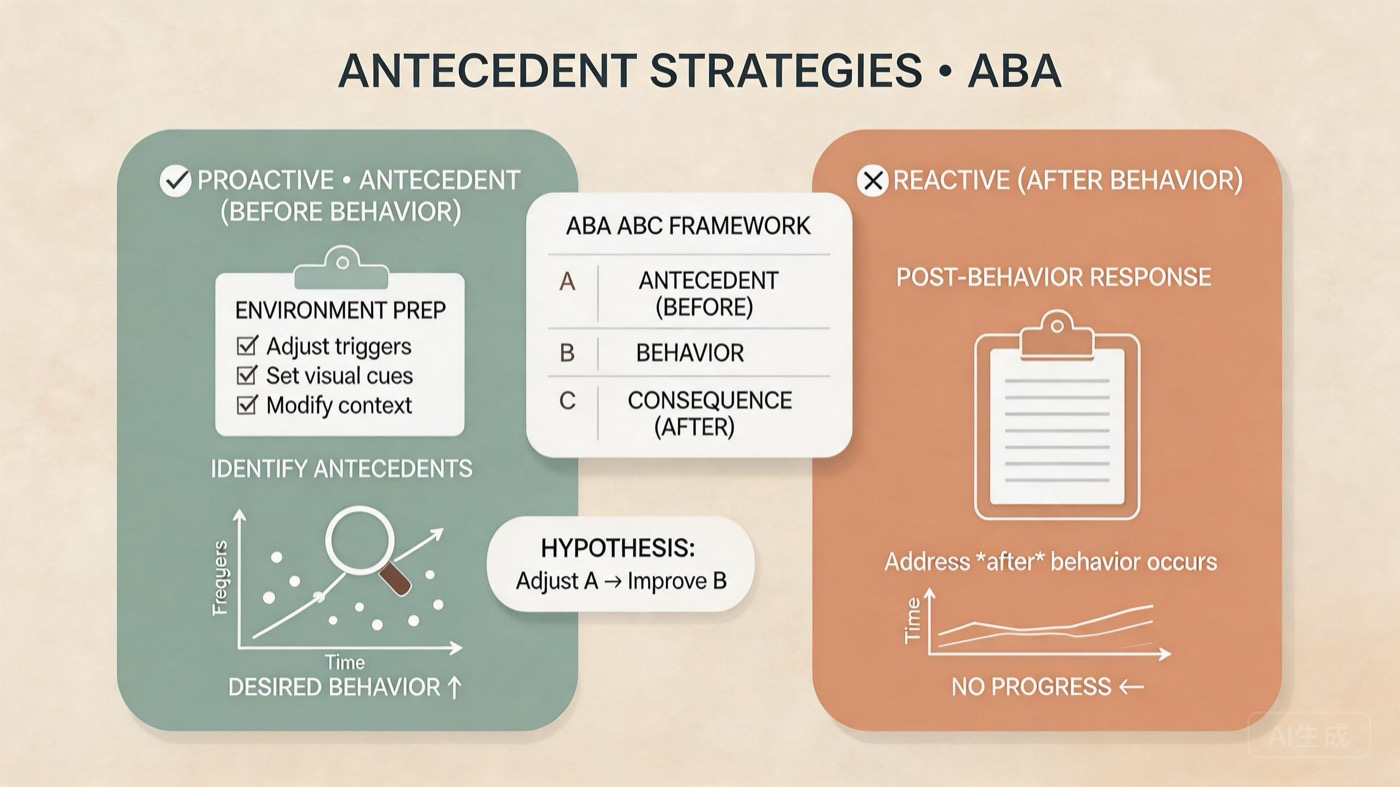
Let’s apply the ABC framework to real-world scenarios. Each example shows how identifying the antecedent can lead to effective antecedent strategies.
Example 1: Reducing Tantrums During Transitions
ABC analysis: Teacher says ‘Clean up your toys’ (antecedent) → student throws a tantrum (behavior) → teacher extends playtime (consequence). The function is escape from transition. An antecedent strategy could be using a visual schedule showing the upcoming transition and giving a 5-minute warning. This makes the transition predictable and reduces the aversiveness of the sudden change.
Example 2: Increasing Task Initiation
ABC analysis: Teacher assigns a math worksheet (antecedent) → student starts working (behavior) → teacher provides praise (consequence). The function is access to attention or tangible reward. An antecedent strategy is offering a choice board with task options plus a timer. For instance, ‘You can do the easy sheet first or the hard one, and we’ll set a timer for 10 minutes.’ This increases motivation and reduces avoidance.
BCBA Exam Relevance and Common Traps
Antecedent strategies appear frequently on the BCBA exam, often in scenario-based questions. Look for opportunities to intervene before the behavior occurs.
Common Misconception: Confusing Antecedents with Setting Events
A common error is confusing immediate antecedents with setting events. Setting events are distal factors (e.g., medication, lack of sleep, previous conflict) that alter the value of reinforcers but are not directly tied to the behavior. In contrast, antecedents are immediate and temporally close. For example, a child who slept poorly (setting event) may be more sensitive to a teacher’s instruction (antecedent). Exam questions often test this distinction.
Trap: Selecting Consequences Instead of Antecedent Interventions
Another trap is choosing a consequence-based intervention when an antecedent strategy is more appropriate. The exam expects you to prioritize proactive approaches. If a behavior is triggered by a predictable environment, modifying that environment is often the best first step. For instance, rather than reprimanding a student for calling out, you might post a visual rule about raising hands.
For more exam-style practice, check out our Antecedent ABA Exam Traps guide.
Quick Checklist for Antecedent Strategies
Use this checklist when designing interventions or reviewing for the exam. Each item is a key action to consider.
- Identify the function of the behavior before selecting an antecedent strategy.
- Modify the environment to remove triggers or add discriminative stimuli.
- Use prompts with a plan for fading to promote independence.
- Consider NCR if the behavior is maintained by attention, escape, or automatic reinforcement.
- Teach replacement behaviors through functional communication training or other skill-building.
- Monitor fidelity to ensure the intervention is implemented as designed.
Summary and Next Steps
ABA antecedent strategies are essential tools for proactive behavior change. By understanding the ABC framework, you can identify the immediate triggers and design interventions that prevent problem behavior and promote skill acquisition. Remember to distinguish antecedents from setting events, and always prioritize antecedent modifications before consequences.
For deeper learning, visit the BACB website for official guidelines and review our BCBA Exam Prep Guide for more resources. Practice with mock questions at bcbamockexam.com to build your exam confidence.
Next step for BCBA exam prep
Turn this topic into exam-day practice
Use this topic as a focused review, then test it in exam-style conditions with a free mock before deciding whether five full-length mocks are the right next step.
Start the Free BCBA Mock ExamContinue with Five Full-Length Mocks — $99
Review the included materials and access details before ordering. No pass guarantee is implied.



