

The 7 dimensions of ABA were first outlined by Baer, Wolf, and Risley in 1968 to define applied behavior analysis as a scientific discipline. These dimensions ensure that interventions are meaningful, measurable, and replicable. On the BCBA exam, you will encounter questions that test whether you can identify or apply each dimension. This guide provides clear explanations, real-world examples, and common traps to help you succeed.
Table of Contents
- Why the Dimensions of ABA Matter for Practice and the BCBA Exam
- Breaking Down Each of the 7 Dimensions of ABA
- Worked ABC Examples with Hypothesized Functions
- Common Exam Traps and How to Avoid Them
- Quick Study Checklist for the 7 Dimensions
Why the Dimensions of ABA Matter for Practice and the BCBA Exam
The 7 dimensions serve as a quality-control checklist. When an intervention meets all seven, it qualifies as applied behavior analysis rather than a generic teaching strategy. Exam questions often require you to evaluate a scenario and decide which dimension is missing or violated.
The Origins of the 7 Dimensions
Baer, Wolf, and Risley published their seminal article in 1968 to differentiate ABA from other behavioral sciences. They wanted to ensure that ABA research was applied, behavioral, analytic, technological, conceptually systematic, effective, and generality-oriented. These dimensions remain the standard today.
Breaking Down Each of the 7 Dimensions of ABA
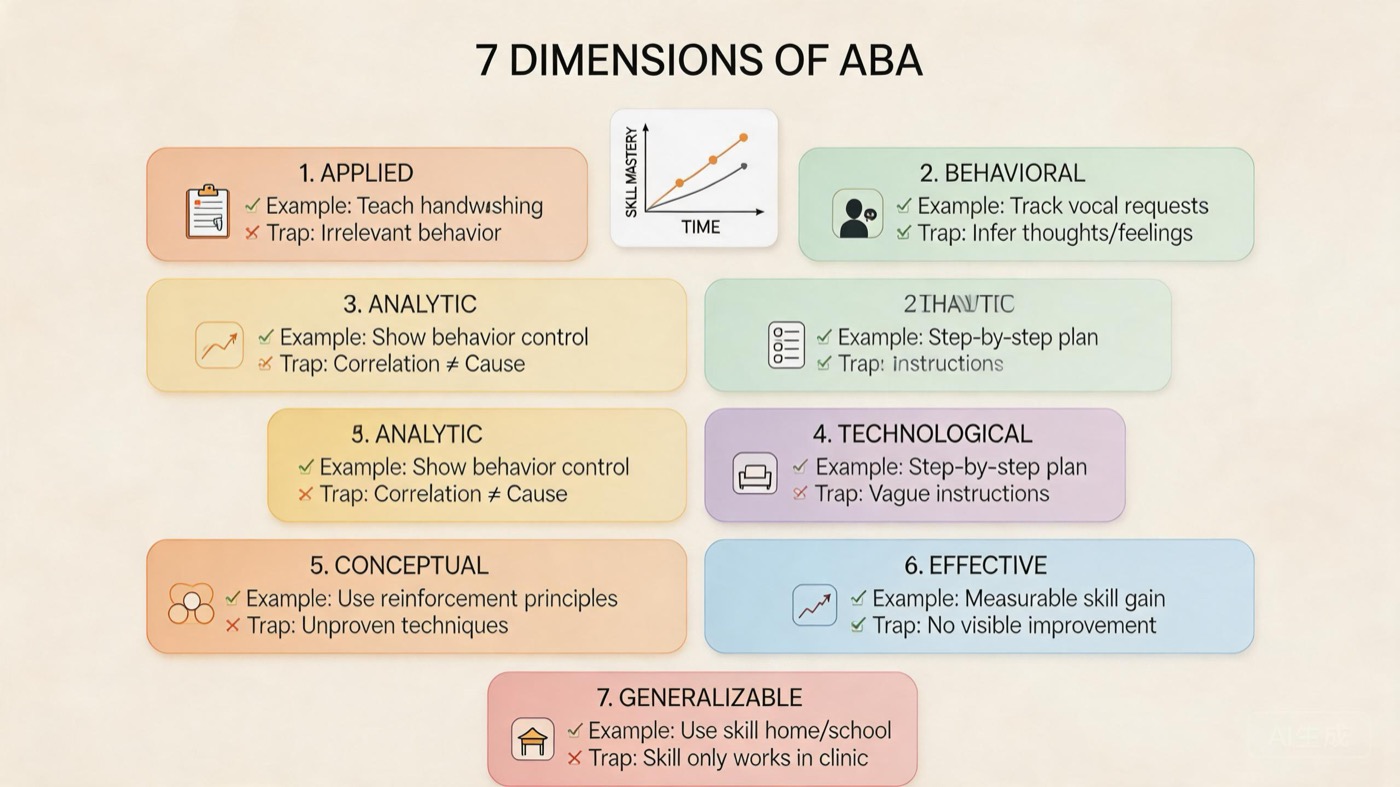
Below we define each dimension with a brief example and a typical exam trap. Master these distinctions to avoid losing points.
Applied: Addressing Socially Significant Behaviors
ABA targets behaviors that improve quality of life. The focus is on skills like communication, social interaction, and daily living, not trivial behaviors. Example: teaching a child to request a break instead of tapping a pencil. Common trap: confusing applied with generality. Remember, applied is about social significance, not lasting change.
Behavioral: Focusing on Observable and Measurable Actions
The target must be an actual behavior that can be seen and counted. Example: measuring ‘hitting’ rather than labeling ‘aggressive’. Common trap: choosing a non-behavioral target like ‘feeling anxious’. If you cannot measure it reliably, it is not behavioral.
Analytic: Demonstrating a Functional Relation
Data must show that the intervention caused the behavior change, often through experimental designs (e.g., reversal, multiple baseline). Example: a reversal design showing that tantrums decreased only when FCT was implemented. Common trap: claiming causation without replication or experimental control.
Technological: Procedures Are Described Clearly and Replicably
All procedures must be detailed enough for another behavior analyst to replicate the intervention. Example: ‘Deliver praise every 30 seconds for on-task behavior’ rather than ‘use reinforcement’. Common trap: omitting critical parameters like schedule, intensity, or duration.
Conceptually Systematic: Interventions Are Grounded in ABA Principles
Procedures must be linked to basic behavioral principles (e.g., reinforcement, extinction, motivating operations). Example: describing a procedure as ‘differential reinforcement of alternative behavior (DRA)’ rather than ‘reward good behavior’. Common trap: using non-behavioral jargon like ‘building rapport’ without connecting to principles.
Effective: Produces Practical and Meaningful Change
The change must be large enough to be socially important. Example: on-task behavior increased from 20% to 80% of intervals. Common trap: focusing on statistical significance rather than clinical or practical significance.
Generality: Behavior Change Lasts and Transfers
The new behavior should maintain over time and appear across settings, people, and stimuli. Example: a child says ‘please’ at home, school, and the grocery store. Common trap: reporting only intervention data without follow-up or generalization probes.
Worked ABC Examples with Hypothesized Functions
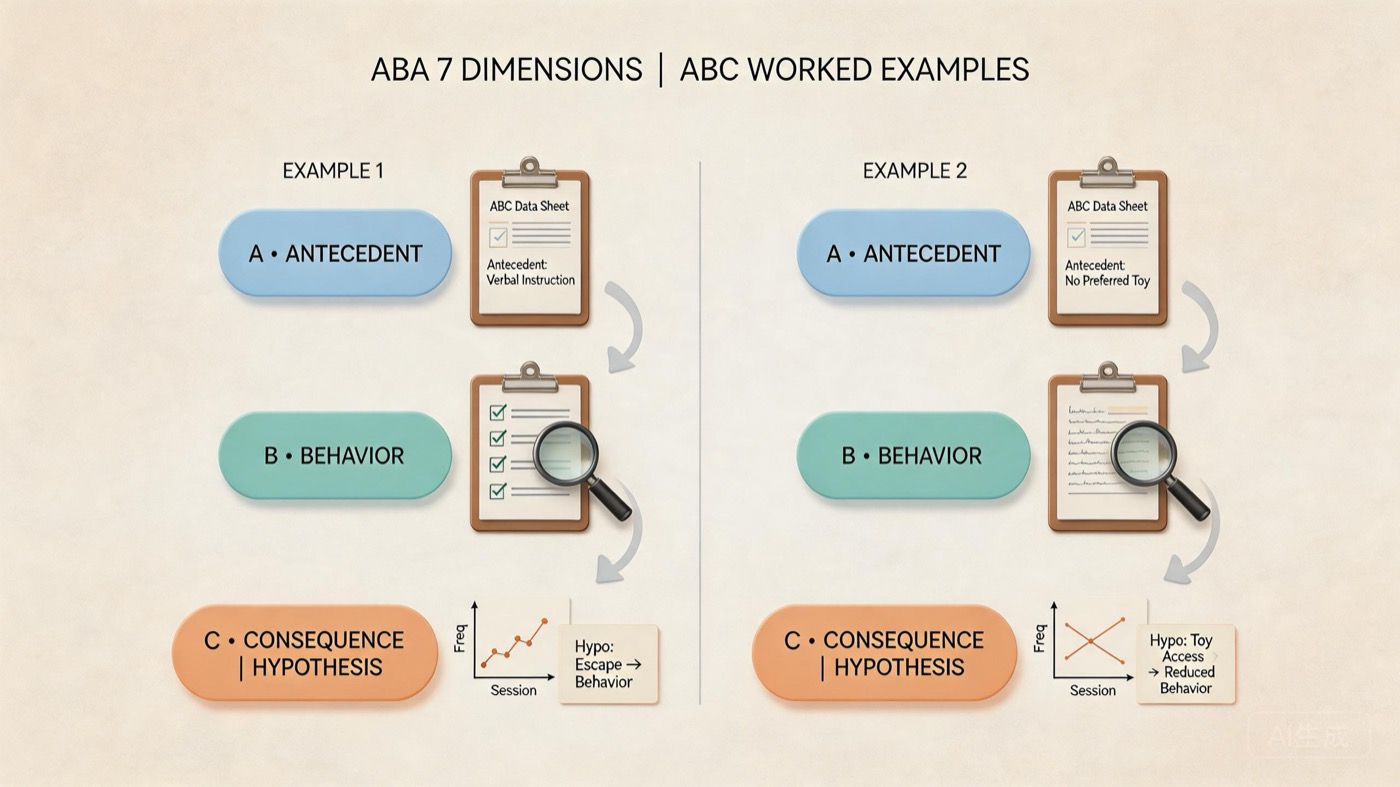
These two examples demonstrate how the 7 dimensions apply to common clinical scenarios.
Example 1: Reducing Aggression with FCT
- Antecedent: Therapist presents a demand
- Behavior: Hitting the therapist
- Consequence: Therapist removes the demand (escape)
- Hypothesized function: Escape from demands
- How it meets the dimensions: Applied (reducing aggression improves social interactions); Behavioral (hitting is observable); Analytic (reversal design shows function); Technological (exact FCT steps described); Conceptually systematic (uses extinction + DRA); Effective (aggression drops to near zero); Generality (probes across therapists and settings)
Example 2: Increasing On-Task Behavior Using Token Economy
- Antecedent: Worksheet presented
- Behavior: Working on the worksheet
- Consequence: Token delivered every 2 minutes
- Hypothesized function: Positive reinforcement (access to backup reinforcers)
- How it meets the dimensions: Applied (on-task behavior is socially significant); Behavioral (defined as writing/marking); Analytic (ABAB design shows control); Technological (token exchange schedule specified); Conceptually systematic (token economy based on conditioned reinforcement); Effective (on-task increases from 30% to 90%); Generality (tokens thinned, behavior maintained)
Common Exam Traps and How to Avoid Them
BCBA candidates often confuse similar-sounding dimensions. Here are the most frequent mistakes.
- Confusing Technological with Conceptually Systematic: Technological describes how the procedure is written (clear/replicable). Conceptually systematic describes why it works (linked to principles).
- Labeling a Non-Behavioral Target as Behavioral: Targets like ‘feeling calm’ or ‘understanding’ are not observable. Always ask: can two people independently record the same occurrence?
- Confusing Effective with Analytic: Effective means the change is meaningful. Analytic means you have experimental proof that the intervention caused the change. Both are required.
Quick Study Checklist for the 7 Dimensions
Use this checklist to verify that your interventions (and exam answers) cover all seven.
- Applied: Target a socially significant behavior.
- Behavioral: Ensure the target is observable and measurable.
- Analytic: Demonstrate experimental control (e.g., reversal, multiple baseline).
- Technological: Write procedures so another person can replicate them.
- Conceptually Systematic: Link procedures to basic behavioral principles.
- Effective: Show socially important change (not just statistical).
- Generality: Plan for maintenance and generalization across settings, people, and time.
For more practice, check out our 7 dimensions of ABA exam guide and review real-life case examples. Also, see the original article by Baer, Wolf, and Risley (1968) for foundational reading: Baer et al., 1968.



