

What Is Incidental Teaching?
Incidental teaching is a naturalistic teaching strategy rooted in applied behavior analysis (ABA). It capitalizes on a learner’s spontaneous interests to create teachable moments. Unlike highly structured methods, incidental teaching embeds instruction within the natural environment, using the learner’s initiation as the starting point for learning.
Table of Contents
- What Is Incidental Teaching?
- Incidental Teaching vs. Other Naturalistic Teaching Methods
- Worked Examples with ABC Analysis
- BCBA Exam Relevance and Common Traps
- Quick Checklist for Incidental Teaching
- Summary
The core idea is simple: arrange the environment to encourage the learner to request or comment, then provide a natural consequence that reinforces the behavior. This approach is particularly effective for building communication and social skills.
Key Components of Incidental Teaching
Three essential components must be present for a teaching episode to qualify as incidental teaching:
- Environmental arrangement: The environment is set up to prompt the learner to initiate. For example, placing a favorite toy on a high shelf where the child can see it but not reach it.
- Learner initiation: The learner must start the interaction, typically by pointing, reaching, vocalizing, or using an augmentative device. This initiation is the critical first step that distinguishes incidental teaching from teacher-directed methods.
- Natural consequence: The teacher delivers a consequence that is directly related to the learner’s initiation. If the child requests a cookie, they receive a cookie (not praise alone). This natural reinforcement strengthens the behavior.
These components work together to create a learning opportunity that feels organic and motivating for the learner. Research shows that incidental teaching promotes generalization because skills are practiced in the context where they are naturally needed.
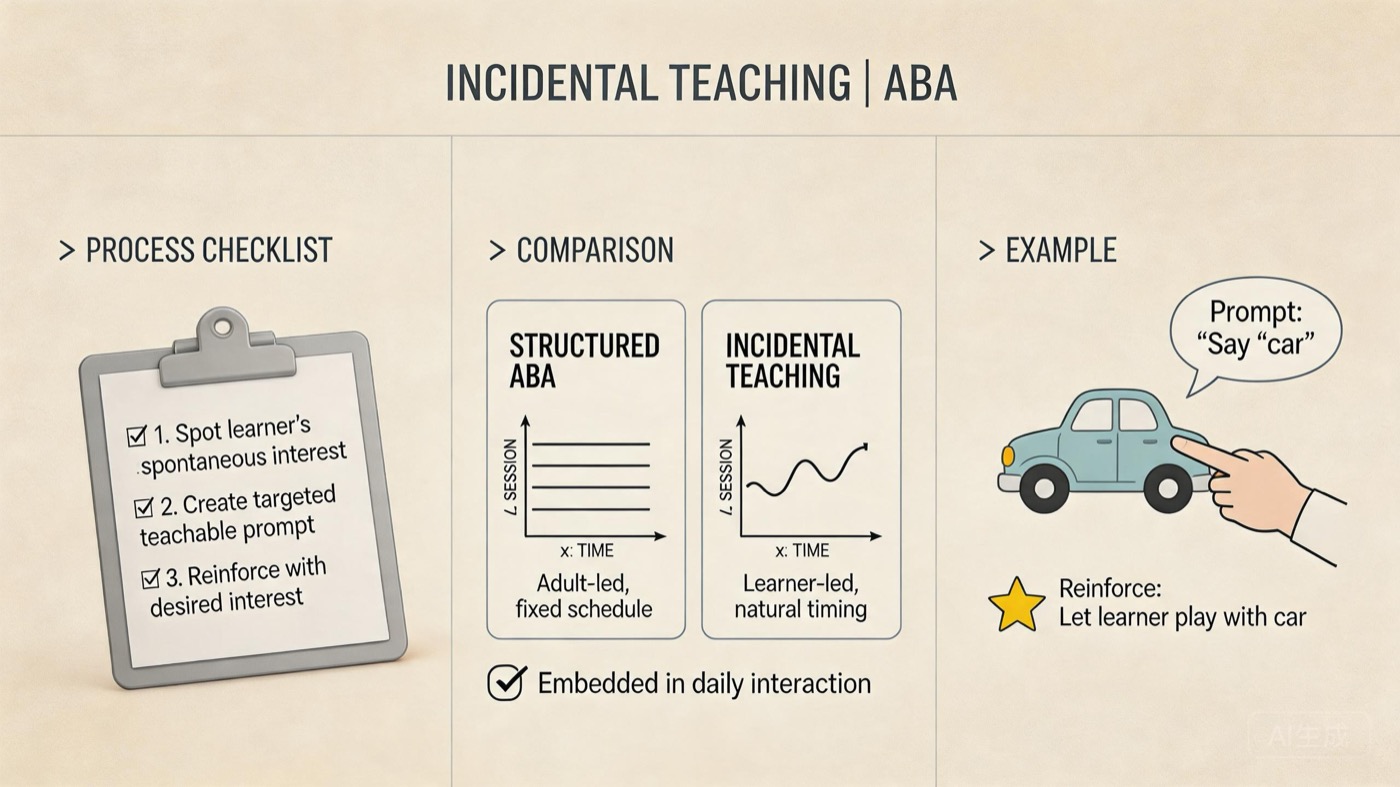
Incidental Teaching vs. Other Naturalistic Teaching Methods
Incidental teaching is often compared with natural environment teaching (NET) and mand training. While they share similarities, key differences exist.
| Feature | Incidental Teaching | NET | Mand Training |
|---|---|---|---|
| Initiation | Learner-initiated | Can be teacher- or learner-initiated | Learner-initiated |
| Setting | Natural environment | Natural environment | Any setting |
| Focus | Expanding language and skills | Teaching in context | Requesting (mands) |
| Prompting | Minimal, time-delayed | Flexible | Can be intrusive |
The main distinction is that incidental teaching always begins with the learner’s initiation. In NET, the teacher may arrange trials without a prior initiation. Mand training focuses specifically on requesting, while incidental teaching targets a broader range of verbal operants.
Worked Examples with ABC Analysis
Understanding the ABC (antecedent-behavior-consequence) model in real contexts is crucial. Below are three examples of incidental teaching with hypothesized functions.
Example 1: Requesting a Snack
- Antecedent: A cookie is placed in a clear jar on a high shelf within view but out of reach.
- Behavior: The child points and says “cookie.”
- Consequence: The teacher immediately hands the child the cookie.
- Hypothesized function: Access to tangible (the cookie).
Example 2: Commenting During Play
- Antecedent: The teacher holds up a toy car and looks expectantly at the child.
- Behavior: The child says “car.”
- Consequence: The teacher says “Yes, it’s a red car!” and rolls it to the child.
- Hypothesized function: Attention/social (the teacher expands language and engages).
Example 3: Asking for Help
- Antecedent: The child is trying to place a puzzle piece that doesn’t fit; the piece is partially jammed.
- Behavior: The child looks at the teacher and says “help.”
- Consequence: The teacher guides the child’s hand to fit the piece correctly.
- Hypothesized function: Escape from frustration (the help removes the aversive task).
Each example follows the same pattern: a carefully arranged antecedent, a learner initiation, and a natural consequence that matches the initiation. The hypothesized function helps guide reinforcement.
BCBA Exam Relevance and Common Traps
Incidental teaching appears frequently on the BCBA exam, often in questions that assess your ability to distinguish it from other teaching strategies. The exam may present a scenario and ask you to identify whether incidental teaching is being used or to describe the next step in the procedure.
Here are the most common traps candidates fall into:
Trap 1: Confusing Incidental Teaching with Discrete Trial Training
In discrete trial training (DTT), the teacher controls the pace and the discriminative stimulus (SD). In incidental teaching, the learner initiates, and the environment sets the occasion. Many exam questions hinge on this distinction. If the scenario describes the teacher presenting an SD first, it is likely DTT, not incidental teaching.
Trap 2: Forgetting to Reinforce Initiation
The learner’s initiation is the crucial first step. If the initiation does not occur, the trial cannot proceed. Some questions describe a teacher who waits for an initiation but then gives a non-contingent reinforcer or uses an unnatural consequence. Always ensure that the consequence is directly tied to the initiation and is natural (e.g., giving the requested item).
Trap 3: Over-prompting
Another common mistake is to immediately prompt the learner before giving them an opportunity to initiate. Incidental teaching relies on a time delay to allow the learner to start the interaction. Prompting too quickly turns the episode into a teacher-directed trial.
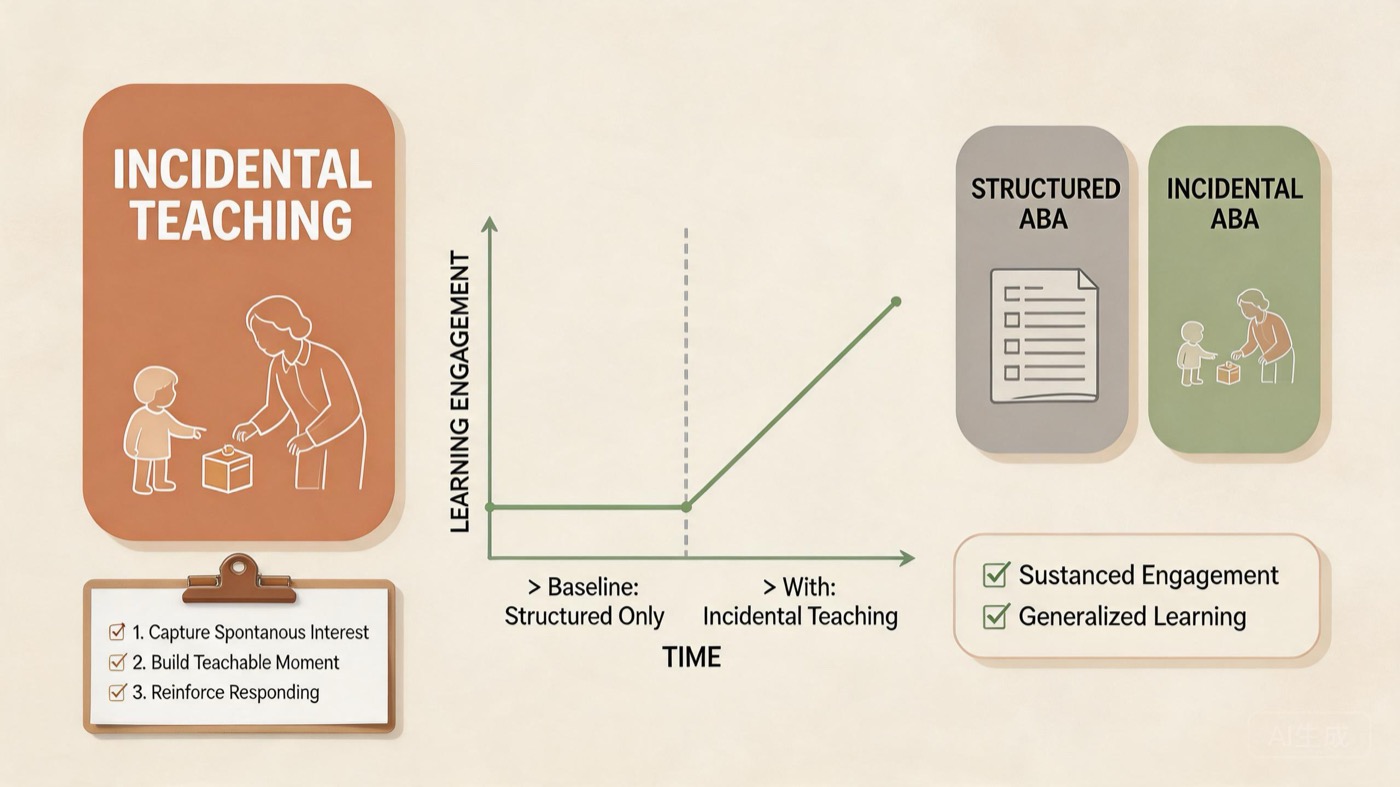
Quick Checklist for Incidental Teaching
Use this checklist when reviewing a scenario or implementing incidental teaching:
- Is the environment arranged to entice an initiation?
- Did the learner initiate the interaction (point, vocalize, gesture)?
- Did you wait at least 3–5 seconds before prompting?
- Was the consequence natural and directly related to the initiation?
- Did you expand on the learner’s response (e.g., model a longer phrase)?
- Is the skill being taught functional in the learner’s daily routine?
- Are you collecting data on correct vs. prompted initiations?
This checklist can help you quickly evaluate whether a teaching episode meets the definition of incidental teaching. For more ABA test-taking strategies, see our BCBA test questions guide.
Summary
Incidental teaching is a powerful, naturalistic ABA strategy that relies on learner initiation and natural consequences. On the BCBA exam, you need to recognize its key components and differentiate it from other methods like DTT and NET. Remember the three-part structure: environmental arrangement, learner initiation, and natural consequence. Avoid the traps of confusing it with DTT, forgetting to reinforce the initiation, and over-prompting. Use the checklist to guide your analysis. For a deeper dive into ABA strategies, check out our post on natural environment training.
For authoritative reading, see the BACB’s Ethics Code and research articles on incidental teaching in the Journal of Applied Behavior Analysis.
Complete BCBA Exam Prep
Turn this topic into exam-day practice
Practice concepts in context with five full-length 6th Edition mock exams, two bonus practice exams, a 6th Edition study guide, and key-term flashcards—all in one $120 USD package.
Get the $120 All-in-One Prep Pack
Review everything included on the product page before ordering. No pass guarantee is implied.



