
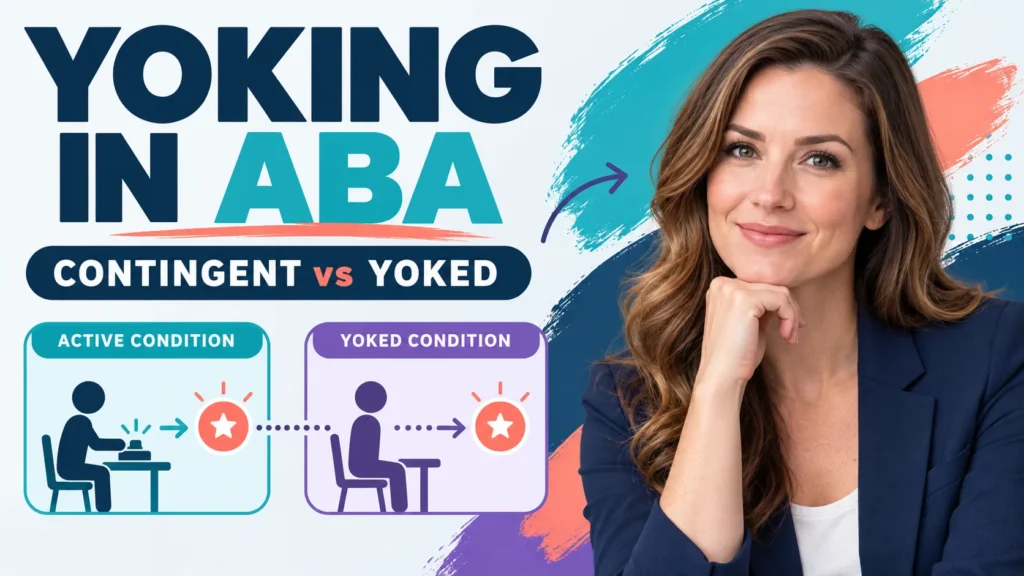
Short answer: yoking ABA is a way to create a comparison condition by linking the timing or amount of an outcome in one condition to the outcome delivered in another condition. In a common yoked-control arrangement, an active or experimental condition earns reinforcement through its own responses, while the yoked condition receives a matched sequence or rate of reinforcement without that same response–reinforcer contingency. The purpose is to isolate a question such as, “Did responding change because of the contingency, or simply because reinforcement was available at that rate?”
Table of Contents
- What does Yoking ABA mean?
- How does a yoked-control design work?
- What is the difference between active and yoked conditions?
- What does a bounded yoking example look like?
- What can yoking show about reinforcement?
- What are the limits and common confounds of yoking?
- What ethical safeguards apply to a yoked comparison?
- How does yoking connect to BCBA exam questions?
- What is a 15-minute yoking study method?
- Yoking in ABA FAQ
- Take the Free BCBA Mock Exam
Yoking is a research and experimental-design arrangement, not a stand-alone ABA treatment, certification, or BACB credential. For BCBA exam questions, do not stop when you see the word “matched.” Identify what is matched, what is made noncontingent, what variable is being tested, and what alternative explanations remain. Table of Contents
What does Yoking ABA mean?
Yoking means that one condition is tied to the events produced by another condition. Think of the first condition as the source of a schedule and the second condition as the linked comparison. If the active condition produces five reinforcers at particular times, the yoked condition may receive five reinforcers at those same times, even when the person in the yoked condition has not made the response that produced them in the active condition.
The design changes the response–consequence relation while attempting to hold another feature constant. Depending on the study, the researcher may match reinforcement rate, timing, number of reinforcers, duration, or another measurable outcome. “Yoked” therefore describes the relationship between conditions; it does not identify one universal schedule or one universal clinical procedure. A careful definition includes four questions:
- What is the active response? State the behavior that can produce the outcome in the active condition.
- What outcome is being linked? Specify whether the match concerns rate, timing, amount, duration, or a sequence of events.
- What contingency is removed? In the yoked condition, the linked outcome is commonly delivered independently of the participant’s own target response.
- What question is being isolated? The comparison should test a defined variable, not merely make two groups look similar.
This is why yoking is easy to misclassify. A time-based reinforcement procedure may be noncontingent, but it is not automatically a yoked procedure. There must be a specified link to another condition or participant. Likewise, two learners receiving the same token board are not in yoked conditions unless one learner’s recorded outcomes determine the other learner’s delivery.
- Yoking links a defined outcome to another condition’s record.
- The yoked learner’s own response does not control the linked delivery.
Use the Yoking ABA and experimental design review to keep the measured relation explicit.
How does a yoked-control design work?
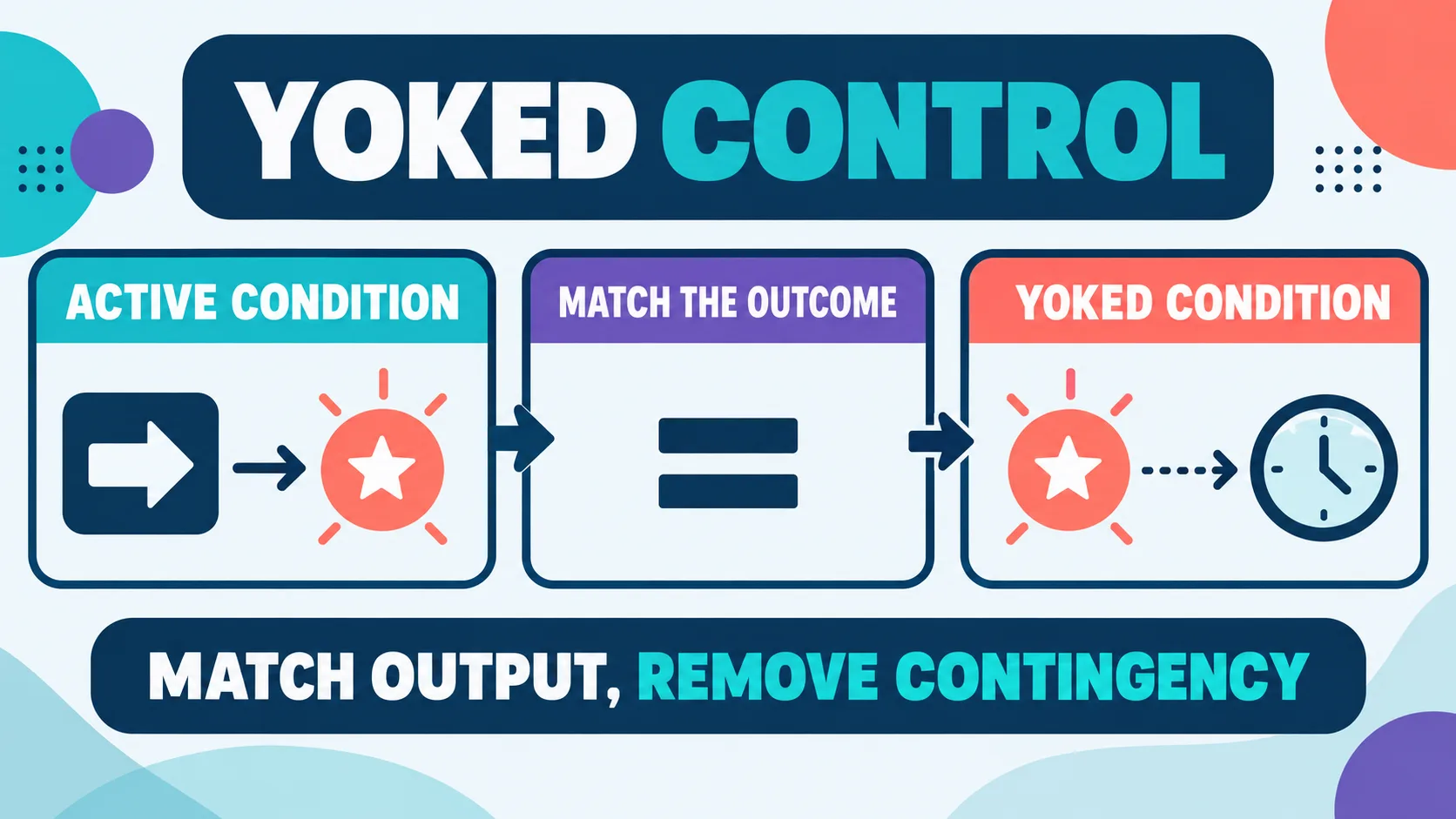
A yoked-control design usually starts by recording the relevant outcomes in an active condition. The researcher then arranges the yoked condition so that it receives a comparable outcome pattern while the defining contingency is altered. The design may be between participants, within a participant across conditions, or embedded as a component of a larger single-subject arrangement. The exact mechanics matter more than the label.
For example, imagine an active condition in which a learner earns a token after a correct tact. The researcher records when tokens are earned. In the yoked condition, tokens are delivered according to the recorded sequence, but the learner’s current tact response does not determine whether the token arrives. If responding is higher in the active condition, the difference is consistent with an effect of response-contingent reinforcement beyond the matched availability and timing of tokens.
That conclusion is deliberately modest. Yoking can improve a comparison, but it cannot repair every weakness in a design. The active and yoked conditions may differ in response effort, attention, instructions, reinforcement quality, delay, or stimulus control. A strong analysis states which variables were matched and which were not. Behavior-analysis studies use yoked controls to match a measurable outcome while testing whether response contingency adds an effect.
What is the difference between active and yoked conditions?
The fastest way to analyze a yoking question is to compare the response–outcome relation line by line. The table below keeps the cells visibly bordered so that the contrast is easy to review.
| Feature | Active or experimental condition | Yoked-control condition | Exam question to ask |
|---|---|---|---|
| Source of the outcome | The participant’s defined response can produce the programmed consequence. | The outcome is linked to the active condition’s record rather than to the participant’s current response. | Is the consequence contingent on this participant’s behavior? |
| What may be matched | The recorded rate, timing, amount, or sequence becomes the comparison reference. | The selected outcome feature is arranged to resemble the active condition. | What exactly is being held constant? |
| What changes | Response–reinforcer contingency is present. | The matched outcome is commonly noncontingent with respect to the target response. | Which independent variable is different? |
| Interpretation | Higher responding may reflect sensitivity to the contingency, among other possibilities. | Responding under matched but noncontingent outcomes provides a comparison for the contingency effect. | What alternative explanation is still possible? |
Do not reduce the comparison to “reinforcement versus no reinforcement.” A yoked participant may receive the same number of reinforcers as the active participant. The key difference is often whether the person’s own response controls delivery. That is the contingency distinction.
What does a bounded yoking example look like?
Suppose a researcher wants to study whether response-contingent reinforcement affects correct tacting more than the mere availability of reinforcement. During an active session, a learner answers tact trials. When the learner meets the programmed criterion, the learner earns a brief token exchange. The researcher records the time and amount of each earned outcome.
In a yoked session, the researcher replays the recorded token events for a matched condition. The token deliveries follow the active record, but the current learner’s tact response does not produce them. The researcher measures correct tacts per minute, errors, latency, and the obtained token schedule in both conditions.
A reasonable interpretation might be: “The active condition produced more correct tacting than the yoked condition while the planned token pattern was similar. The difference is consistent with a contribution from response contingency.” An unreasonable interpretation would be: “Yoking proves that tokens are always effective,” or “The yoked condition proves the learner did not understand the task.” The design supports a narrower comparison than those statements claim. The example is bounded: it describes a research arrangement rather than a client-specific intervention, does not authorize a treatment-plan change, and still requires attention to preference, delay, response effort, fatigue, and match quality.
What can yoking show about reinforcement?
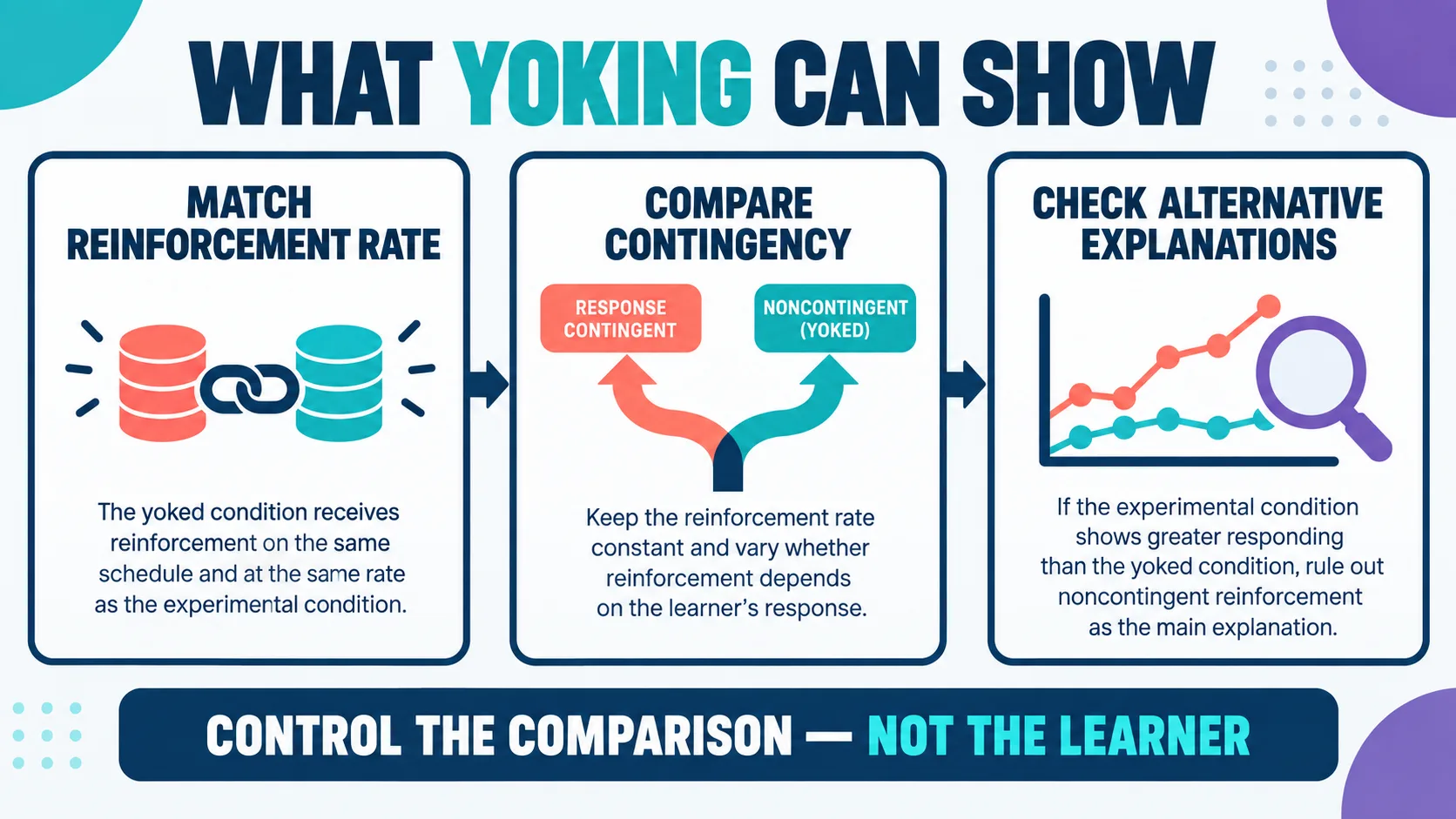
Yoking can help separate an outcome’s availability from the contingency that connects it to behavior. Depending on the design, it may help a researcher ask whether:
- response-contingent reinforcement produces more responding than a matched noncontingent pattern;
- response cost affects behavior because of the contingency or because overall earnings are reduced;
- choice, effort, or instructional arrangements matter after reinforcement density is held comparable;
- the temporal distribution of consequences explains part of an observed effect.
The word “can” is important. Yoking does not prove that contingency is the only causal difference. Different delay, prompts, attention, or order may still affect the result. Measure the variables that make the interpretation credible:
- Response measure: rate, frequency, percentage correct, latency, or another operationally defined measure.
- Outcome measure: obtained reinforcement rate, timing, magnitude, and delay.
- Contingency check: whether the participant’s response actually controlled the consequence in the active condition and did not control it in the yoked condition.
- Context measure: prompts, attention, task difficulty, response effort, and procedural fidelity.
- Social validity: whether the arrangement is acceptable and meaningful to the people affected.
What are the limits and common confounds of yoking?
The most common mistake is assuming that “matched” means “identical.” Matching reinforcement rate does not necessarily match reinforcer quality, delay, effort, attention, stimulus conditions, or learning history. A yoked-control design can reduce one confound while introducing another. Watch for these limits:
- Rate is not timing. Two conditions may receive five reinforcers per session but receive them at very different moments.
- Amount is not value. The same number of tokens may not have the same motivating value across people or sessions.
- Replay can be insensitive. An outcome pattern generated by one participant may not fit another participant’s responding or preferences.
- Noncontingent does not mean consequence-free. The yoked participant still contacts consequences, attention, prompts, and the broader context.
- Clinical generalization is limited. A controlled comparison may answer a mechanism question without telling a clinician which procedure is acceptable for a particular client.
When the article or exam vignette does not tell you what was matched, do not invent the missing detail. State that the conclusion is limited by the unspecified feature. Strong behavior-analytic reasoning is precise about uncertainty.
What ethical safeguards apply to a yoked comparison?
A research comparison involving reinforcement, response cost, delay, or withholding must be reviewed within the applicable ethical and institutional framework. The BACB Ethics Code for Behavior Analysts provides current professional expectations for competence, informed consent, protection of clients and stakeholders, and responsible research-related conduct. It does not turn the keyword “yoking” into permission to arrange an intervention. At a practical level, ask:
- Has the purpose, procedure, risk, and alternative been explained to the people whose participation is affected?
- Is the match necessary to answer the question, or is a less restrictive comparison available?
- Are safety, assent, dignity, privacy, and communication needs being protected?
- Who has authority to approve, monitor, pause, or modify the arrangement?
- Are data and deviations documented rather than hidden to preserve a preferred result?
For a clinical team, do not impose a yoked schedule simply because it appears in a research article. A treatment decision requires assessment, a defined goal, stakeholder collaboration, and appropriate supervision. If a BCBA exam question adds a safety or assent concern, that concern may control the best answer even when the experimental comparison sounds elegant.
How does yoking connect to BCBA exam questions?
The current BCBA Test Content Outline is the right boundary for exam preparation. “Yoking ABA” is a narrow search phrase, so an exam item may describe the arrangement without using the label. Look for the functional pattern: one condition’s outcomes are used to arrange a linked comparison, and the response–consequence relation differs across conditions. Use this five-step exam routine:
- Underline the response. What behavior is the learner emitting, and how is it measured?
- Circle the consequence. What event follows the response, and what feature is being matched?
- Mark contingency. Does the learner’s own response control the consequence, or is the event replayed independently?
- Name the comparison. Is the question testing reinforcement rate, contingency, response cost, choice, or another variable?
- Limit the conclusion. Choose the answer that claims only what the arrangement and data support.
Common traps include confusing yoking with a simple fixed-time schedule, treating a matched reinforcement rate as proof of equal reinforcer value, and selecting an answer that changes the treatment plan when the vignette only asks you to identify an experimental control feature. If the option says “the yoked condition receives no reinforcement,” check the stem: that may describe extinction or a control condition, not a yoked condition. The site’s experimental-design review and noncontingent reinforcement guide can support broader study. This article keeps the focus on the narrower yoking question: what is matched, what is contingent, and what remains uncertain?
What is a 15-minute yoking study method?
Draw two columns labeled active and yoked. Under each, write the target response, consequence, delivery rule, and data measure. Add a matched feature row—rate, timing, amount, or sequence. Then complete: “The conditions differ because ______; the design holds ______ constant; the strongest conclusion is ______.” Add one remaining alternative explanation.
Once you can classify the arrangement without guessing, use a free BCBA mock exam for timed practice. It is an independent study resource, not an official BACB examination and not a guarantee of a passing result.
Bottom line: Yoking in ABA links a comparison condition to a measurable outcome from an active condition while changing the response–consequence relation. It can sharpen a question about contingency, reinforcement density, or response cost, but only when the matched feature and remaining confounds are clearly described. On the BCBA exam, identify the contingency first, then state the narrowest conclusion the data support.
Yoking in ABA FAQ
What does yoking mean in ABA? Yoking means that an outcome in one condition is linked to an outcome recorded in another condition. A yoked condition may receive the same timing, amount, rate, or sequence of reinforcement while the participant’s own response no longer controls delivery.
Is yoking the same as noncontingent reinforcement? No. A noncontingent schedule delivers a consequence independently of the target response. A yoked arrangement adds a link to another condition or participant. A yoked condition may be noncontingent with respect to its own response, but not every noncontingent schedule is yoked.
What is a yoked control condition? It is a comparison condition arranged to match a specified outcome from an active condition while changing a key relation, often response contingency. The exact match must be identified before interpreting the data.
What can a yoked-control design show? It can help compare response-contingent and matched noncontingent outcomes, such as whether responding differs when reinforcement is earned versus replayed. It cannot automatically rule out differences in delay, quality, attention, effort, order, or learning history. Does yoking describe a treatment for clients? Not by itself. Yoking is an experimental or comparison arrangement. A clinical procedure requires an assessment-based rationale, appropriate authorization, ethical safeguards, and supervision.
How should I recognize yoking on the BCBA exam? Look for one condition generating a reinforcement or consequence record and another condition receiving a matched record independently of its own response. Then ask what was matched and what contingency was removed.
Take the Free BCBA Mock Exam
When you are ready to apply the idea, use the free practice resource below for additional feedback. Take the Free BCBA Mock Exam



