

Short answer: An ABA trainer teaches other people how to implement defined behavior-analytic procedures, often by using behavioral skills training (BST): instructions, modeling, rehearsal, and feedback. The title alone does not establish certification, supervision authority, or permission to practice independently. A useful ABA trainer role is defined by the skill being taught, the trainer’s competence, the supervisor’s accountability, the implementer’s performance, and data showing whether the training transferred to practice.
Table of Contents
- What is an ABA trainer?
- How does behavioral skills training support ABA training?
- How are trainer, supervisor, and implementer roles different?
- What does a bounded ABA trainer example look like?
- How should an ABA trainer measure fidelity and feedback?
- What ethical boundaries apply to ABA trainers?
- How does ABA trainer role clarification connect to the BCBA exam?
- What ABA trainer mistakes should candidates avoid?
- What is a 15-minute ABA trainer study method?
- ABA trainer FAQ
- Take the Free BCBA Mock Exam
For BCBA exam study, separate three questions: Who teaches the skill? Who is responsible for clinical oversight and the plan? Who performs the procedure with the client? One person may hold more than one role, but the responsibilities should still be explicit. Training is not the same as supervision, and a person who can model a procedure is not automatically qualified to design or authorize it. Table of Contents
What is an ABA trainer?
An ABA trainer is a person who provides structured instruction and performance support for a behavior-analytic skill. The trainee might be a behavior technician, caregiver, teacher, paraprofessional, supervisee, or another professional. The skill might involve data collection, prompting, reinforcement delivery, environmental arrangement, communication support, or implementation of a plan that has already been clinically approved.
The phrase “ABA trainer” is a role description, not a universal credential. Some trainers are BCBAs, some are BCaBAs or experienced technicians working under appropriate oversight, and some are educators or organizational trainers who have been specifically prepared for the skill they teach. The relevant question is whether the trainer has the competence, authority, and support required for the task—not whether the title sounds senior. A well-defined training assignment states:
- the trainee and the performance that must be learned;
- the conditions and materials used during training;
- the trainer’s scope and the supervisor’s role;
- the criterion for competent performance;
- how fidelity, trainee questions, and follow-up support will be documented.
This definition protects the learner and the client. It avoids treating “training” as a slide deck or a one-time explanation. The objective is competent, ethical performance under the conditions in which the skill will actually be used.
How does behavioral skills training support ABA training?
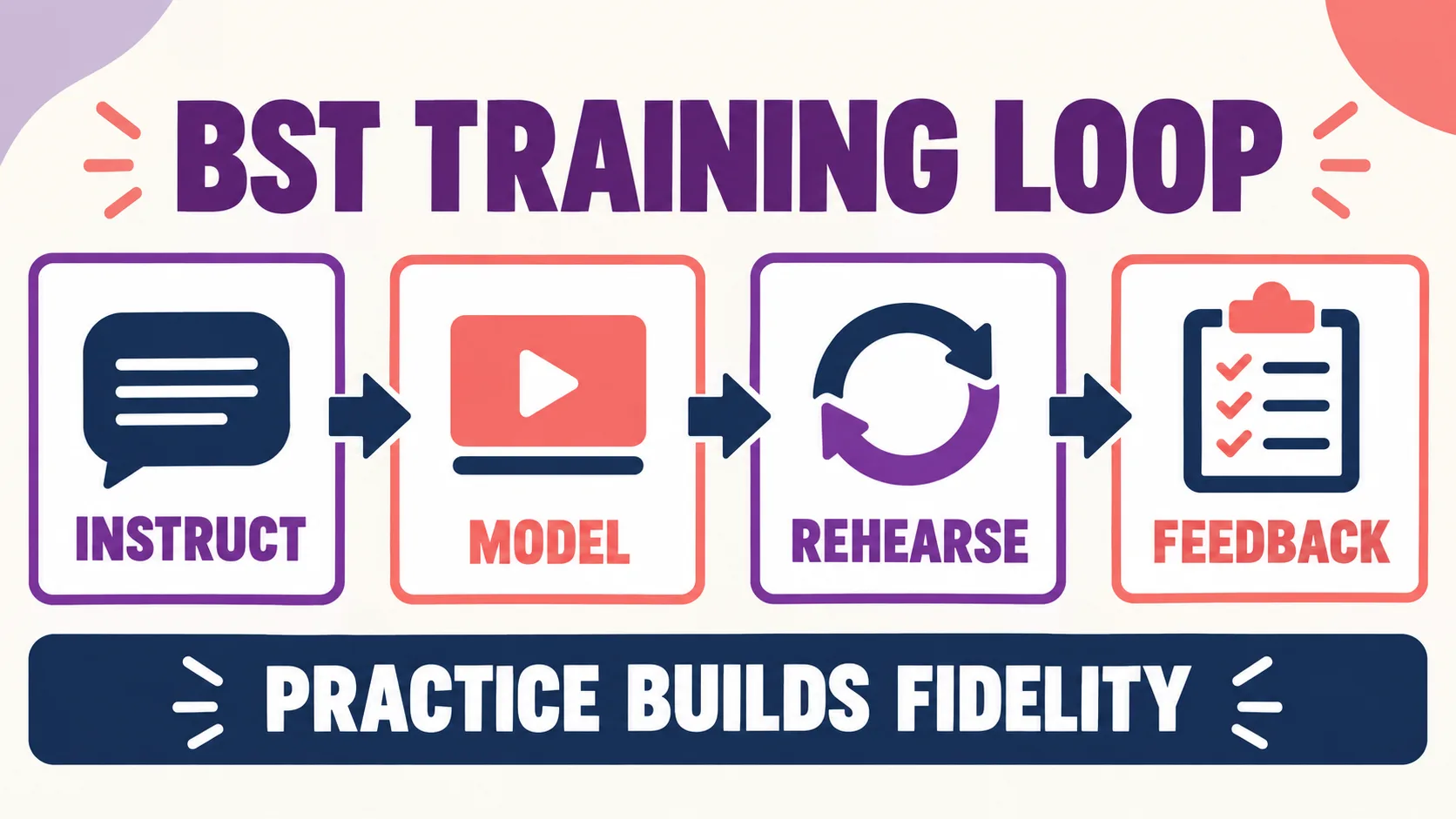
Behavioral skills training, usually abbreviated BST, is commonly described through four components: instructions, modeling, rehearsal, and feedback. Instructions describe what to do and when; modeling demonstrates the response; rehearsal gives the trainee a chance to perform; and feedback identifies what was correct and what should change. The components can be repeated until the performance meets a defined criterion.
The sequence is more than a convenient training slogan. A 2024 scoping review of BST studies for discrete-trial teaching examined training conditions such as instructions, modeling, rehearsal, feedback, and training outcomes. The practical lesson is that a trainer should plan for performance, not merely exposure to information. A trainee who can recite a definition may still need practice, observation, and feedback before implementing the skill accurately.
BST should also be individualized. Use accessible language, relevant examples, communication supports, and practice conditions that resemble the real setting. If the trainee’s role requires responding to a child’s communication, practice should include the materials, timing, prompts, and decision points that occur in that setting. If a task is safety-sensitive, the trainer should specify what requires direct supervision and what the trainee must not do independently.
Instructions and modeling alone can create an illusion of competence. Rehearsal reveals what the trainee actually does, while feedback makes the next response more likely to match the written procedure. The site’s behavioral skills training BCBA guide can be used as a related study page, but this article keeps the canonical focus on the ABA trainer role and its boundaries.
How are trainer, supervisor, and implementer roles different?
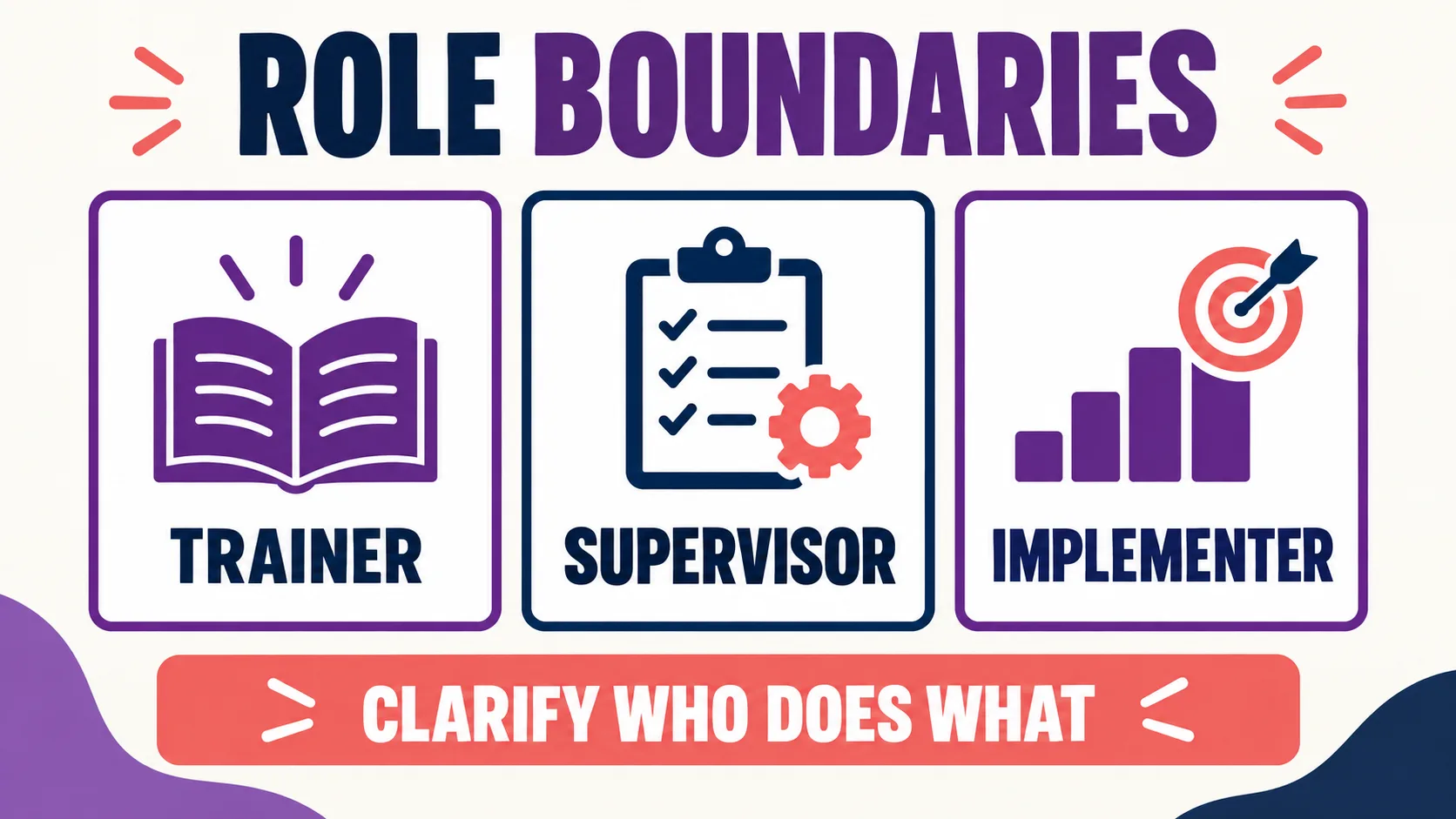
Role confusion is one of the most important ABA trainer topics. A trainer may teach a procedure without owning the client’s full clinical plan. A supervisor may be responsible for oversight, assessment, treatment decisions, and performance monitoring. An implementer may deliver the procedure and record data in the natural setting. The roles can overlap, but the overlap should be documented rather than assumed.
| Role | Primary responsibility | Evidence of readiness | Boundary to remember |
|---|---|---|---|
| Trainer | Teach and evaluate a specified skill using an appropriate training format. | Competence with the skill, accurate instructions, modeling, practice, feedback, and documentation | Training someone does not automatically authorize independent clinical decisions. |
| Supervisor | Provide role-appropriate oversight, feedback, review, and accountability for the work. | Defined supervision relationship, competency, records, and access to the information needed for decisions | A trainer should not silently replace required supervision or authorization. |
| Implementer | Carry out the defined procedure and record relevant performance or client data. | Direct observation, rehearsal, feedback, and performance at the stated criterion | Implementation questions and client signals should be reported, not hidden to appear competent. |
The exact requirements depend on the setting, employer, payer, state rules, and the professional’s credential. The BACB Ethics Code applies to behavior analysts’ professional activities, including training and supervision, but it does not turn every person who trains another worker into a BCBA. Use current BACB documents and applicable jurisdictional rules for authority questions.
What does a bounded ABA trainer example look like?
Suppose a supervisor has approved a simple data-collection procedure and asks an ABA trainer to prepare a new technician. The trainer first explains the operational definition and shows how to record an event using the same materials the technician will use on the job. The trainer then models one example and one nonexample, asks the technician to rehearse several scenarios, and gives immediate, specific feedback.
The trainer records whether the technician identifies the target event, records it in the correct location, and follows the planned timing. If an error occurs, the trainer identifies the step, provides a correction, and arranges another rehearsal. The supervisor reviews the competency criterion and observes implementation in the service setting before treating the technician as ready for independent performance within the scope allowed by the organization.
This is a bounded example because it does not suggest that the trainer changes the treatment plan, diagnoses a client, or makes an independent clinical decision. If the technician notices that the operational definition does not fit what is occurring, the ethical response is to pause or report the concern through the defined chain of supervision. A trainer’s job is not to coach people to conceal uncertainty.
The example also shows why training outcome and client outcome should be distinguished. A technician can meet a rehearsal criterion while the client’s data later show that the procedure is not effective or acceptable. That finding belongs in the supervisory and clinical decision process; it is not automatically proof that the trainer failed.
How should an ABA trainer measure fidelity and feedback?
Use a performance checklist that describes the critical steps, then define how fidelity will be calculated. A simple percentage might be the number of correctly completed steps divided by the number of applicable steps, multiplied by 100. The formula is only useful when the steps are observable, the scoring rules are clear, and the checklist matches the approved procedure. Measure more than whether the training session occurred. Useful indicators may include:
- trainee accuracy during rehearsal;
- prompt level and prompt fading across practice;
- time to complete the critical steps;
- implementation fidelity during a natural session;
- trainee questions, confidence, acceptability, and requests for support;
- maintenance of the skill after a delay or across settings.
Treatment integrity matters because conclusions about an intervention can be distorted when the independent variable is implemented inaccurately. A review of treatment-integrity reporting in behavior-analytic practice found that many studies did not report integrity data, even though implementation accuracy affects interpretation. For an ABA trainer, the practical message is simple: document what was taught, what was practiced, what was observed, and what support is still needed.
Feedback should be specific and actionable. “Good job” may be encouraging but does not tell the trainee which response to repeat. “You delivered the instruction after the learner oriented to the materials; next time, record the response immediately after the defined event” gives a clearer performance cue. Feedback should preserve dignity, invite questions, and be delivered in a form the trainee can use.
What ethical boundaries apply to ABA trainers?
The BACB Ethics Code for Behavior Analysts includes responsibilities related to competence, clients and stakeholders, supervisees and trainees, and professional conduct. An ABA trainer should use only skills within the trainer’s competence, represent qualifications accurately, protect confidential information, and make sure the training arrangement does not put a client or trainee at unreasonable risk. Important safeguards include:
- State who authorized the procedure and who can change it.
- Use examples that protect client privacy and remove unnecessary identifying information.
- Provide a meaningful way for trainees to ask questions, report errors, and request additional practice.
- Escalate safety, assent, consent, and scope concerns through the appropriate supervisor.
- Review whether the training is culturally responsive, accessible, and acceptable to the people affected.
Training should not be framed as a contest in which the trainee must appear perfect. An honest error caught in rehearsal is useful data. A concealed error in a natural session can affect the client and the validity of later decisions. Good feedback makes accurate performance more likely while maintaining respect.
How does ABA trainer role clarification connect to the BCBA exam?
The current BCBA Test Content Outline is the official boundary for exam preparation. The keyword “ABA trainer” is not a claim that the BACB uses one universal trainer credential. Exam questions are more likely to test competency-based training, supervision, treatment integrity, feedback, ethics, or role distinctions than the job title itself. When you see a training vignette, ask:
- What skill is being trained? Identify the observable response and the conditions under which it matters.
- Which BST components are present? Look for instructions, modeling, rehearsal, and feedback rather than a lecture alone.
- Who owns the clinical decision? Separate training the implementer from modifying the plan or changing the target.
- How is competence shown? Prefer direct performance data, not attendance or a signed checklist alone.
- What ethical or safety signal is present? A correct-looking response is not enough if consent, dignity, privacy, or scope is ignored.
For a deeper related review, the scoping review of BST for discrete-trial teaching summarizes training components and outcomes, while the large-scale BST study shows why group training and peer feedback still require attention to performance and social validity.
What ABA trainer mistakes should candidates avoid?
- Confusing a title with a credential. “Trainer” does not automatically mean BCBA, supervisor, or independent practitioner.
- Stopping at instructions. Information exposure is not the same as demonstrated performance.
- Using modeling without rehearsal. Watching someone else perform does not show that the trainee can do the skill.
- Giving vague feedback. Feedback should identify the response to repeat or change.
- Scoring attendance as competence. Presence, a quiz, and a signature may be useful records, but direct performance still matters.
- Hiding the supervisor. Training should make decision authority and escalation paths clear.
- Ignoring implementation context. A skill mastered in role-play may fail when materials, time pressure, or client communication changes.
- Promising certification or employment. Training completion does not by itself establish BACB eligibility, licensure, or a job outcome.
What is a 15-minute ABA trainer study method?
Choose one training vignette and draw four boxes labeled instruction, model, rehearsal, and feedback. Fill in the exact behavior that appears in each box. If a box is missing, write what evidence would be needed before concluding that the trainee is competent.
Then add a second row with role, criterion, data, and escalation. This forces you to identify who trains the skill, what performance counts, how it is measured, and where a question or safety concern goes. Finish by writing one sentence that separates the trainer’s task from the supervisor’s clinical authority. Use a free BCBA mock exam for timed practice once you can apply the role distinction. It is an independent study resource, not an official BACB examination or a guarantee of a passing result.
Bottom line: An ABA trainer creates competent performance through clear instruction, modeling, rehearsal, feedback, and follow-up measurement. The title does not replace supervision or define certification authority. Strong training makes responsibilities visible, protects the client and trainee, and uses data to decide what support comes next.
ABA trainer FAQ
What does an ABA trainer do? An ABA trainer teaches a defined behavior-analytic skill to staff, caregivers, trainees, or other implementers. The work may include instructions, modeling, rehearsal, feedback, and performance checks. The trainer’s exact authority depends on credentials, competence, setting, and supervision.
Does an ABA trainer have to be a BCBA? Not every training role is identical, and the title alone does not answer the question. The organization and applicable rules should define who may train, supervise, modify a plan, or make clinical decisions. A trainer should never represent a credential they do not hold.
What is the difference between an ABA trainer and a BCBA supervisor? A trainer may teach a specified skill, while a supervisor has broader role-appropriate oversight and accountability. One person may perform both functions, but the responsibilities and documentation should still be clear.
What is BST in ABA training? BST usually refers to instructions, modeling, rehearsal, and feedback. The trainee practices the skill and receives information that helps improve performance. A lecture or video alone is not necessarily a complete BST package.
How do you measure ABA training success? Define observable steps and measure performance during rehearsal and, when appropriate, in the natural setting. Accuracy, prompts, latency, fidelity, maintenance, generalization, and trainee acceptability may be relevant. Attendance alone does not demonstrate competent implementation. Is ABA trainer an official BACB certification? No universal BACB credential should be inferred from the job title. Check current BACB documents, employer requirements, and applicable jurisdictional rules for certification, supervision, and practice questions.
Take the Free BCBA Mock Exam
If you want a low-pressure way to check your recall, use the free practice resource below. Take the Free BCBA Mock Exam



