

Short answer: praise ABA usually refers to praise used in applied behavior analysis, especially praise that describes the behavior a learner just demonstrated. The important technical distinction is that praise is a verbal or social stimulus, while a reinforcer is defined by its effect: if praise increases the future likelihood of the behavior after it is delivered, it is functioning as reinforcement for that person, in that context, under those conditions. “Good job” may be pleasant and professionally appropriate, but it is not automatically a reinforcer.
Table of Contents
- What does Praise ABA mean?
- How does behavior-specific praise differ from general praise?
- What does a bounded praise example look like?
- When does praise function as a reinforcer?
- What should a BCBA measure about praise?
- Why might praise not work as expected?
- How can teams improve praise delivery?
- What ethical safeguards apply to praise?
- How does praise ABA connect to BCBA exam questions?
- What is a 15-minute praise study method?
- Bottom line: what should you remember about praise ABA?
- Praise ABA FAQ
- Take the Free BCBA Mock Exam
A strong ABA answer therefore asks: Was the praise contingent and specific, and did the target response change over time? Its effect can be individual and history-dependent, so no praise script is a universal intervention. Table of Contents: Use the points below as a quick study guide.
What does Praise ABA mean?
Praise ABA is not the name of a single procedure. It is a useful search phrase for a cluster of behavior-analytic questions about verbal approval, behavior-specific feedback, social consequences, and reinforcement. In practice, praise may be delivered after a response, paired with another consequence, used as feedback during teaching, or measured as part of staff implementation. The phrase becomes clinically meaningful only when the behavior, delivery rule, and outcome are defined.
In behavior analysis, praise is best described by its observable features. It may be a statement such as “Nice waiting quietly,” a brief social reaction, or a more general statement such as “Great job.” The statement itself does not tell us whether it is reinforcing. A reinforcer is identified functionally: after the consequence is arranged, the relevant behavior occurs more often, at a higher rate, with shorter latency, or with better persistence under comparable conditions. Four boundaries for reading praise ABA research: Use this point as a focused exam-review label rather than a separate major section.
- Identify the target response. “Praise improved behavior” is too vague. Specify the response, such as requesting help, completing a task, or waiting for a turn.
- Describe the praise. Record the words, timing, tone, speaker, and whether the statement names the behavior.
- Check the contingency. Was praise delivered after the defined response, independently of it, or on a mixed schedule?
- Look at the effect. Did the target response change compared with an appropriate baseline or comparison?
Praise may also serve as attention, a conditioned reinforcer, a signal for another consequence, or have no measurable effect. The label describes stimulus form; it does not settle function without data across comparable opportunities in every setting.
For a broader review of reinforcement concepts, see the Praise ABA and reinforcement review. The linked page covers a different, broader reinforcement intent; this article keeps its canonical focus on praise as verbal feedback and the evidence needed before calling it a reinforcer.
How does behavior-specific praise differ from general praise?
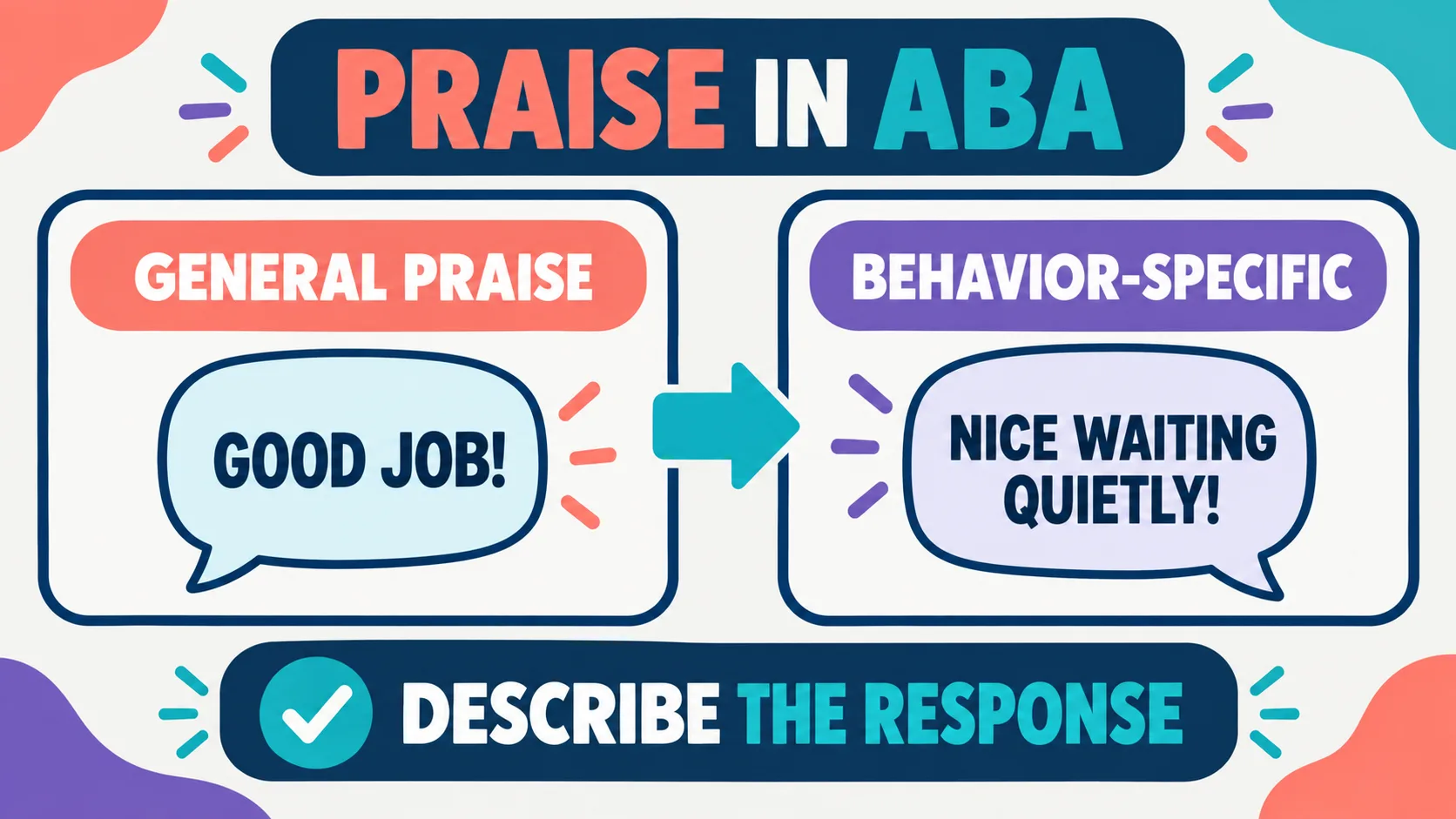
Behavior-specific praise names the response or its relevant feature. General praise communicates approval without identifying what was effective. “You followed the first step and then asked for help” is behavior-specific; “Good job” is general. Both statements can be socially meaningful, and neither is automatically superior in every context. The useful distinction is whether the learner can contact clear information about which behavior produced the feedback.
Behavior-specific wording may improve the instructional value of feedback because it identifies the response that a teacher or caregiver is acknowledging. It can also make staff fidelity easier to measure: an observer can score whether the statement included an observable behavior. But specificity alone does not demonstrate reinforcement. A learner can understand the feedback and still not prefer it, or the response may be controlled by another variable.
| Feature | General praise | Behavior-specific praise | Data question |
|---|---|---|---|
| Example | “Good job!” | “Nice waiting quietly for your turn.” | Can an observer identify the praised response? |
| Information | Signals approval but may leave the relevant response unclear. | Names an observable response or response feature. | Does the learner receive usable performance feedback? |
| Possible function | Attention, social approval, feedback, or reinforcement. | Feedback plus possible social reinforcement, depending on effect. | What changes after the statement is delivered? |
| Implementation score | Count the occurrence and timing of praise. | Count occurrence, timing, and whether the named behavior matches the target. | Is the delivery consistent with the plan? |
Do not turn this table into a rule that behavior-specific praise must always be selected. Specificity may answer a feedback question, but a reinforcement question requires behavioral evidence, not wording alone for every learner or context.
What does a bounded praise example look like?
Imagine a learner is practicing waiting for a turn during a structured activity. The team defines waiting as remaining in the designated area, keeping hands to self, and orienting toward the activity until the turn signal occurs. After an instance that meets the operational definition, a staff member says, “Nice waiting quietly until the signal,” and records the event. A different session may include the general statement “Good job.”
The useful comparison is not simply which sentence sounds warmer. The team would decide in advance what to measure: waiting duration, successful opportunities, latency to begin the next step, and the rate of praise delivered after defined responses. If behavior-specific praise is paired with a preferred activity, the team should also record that consequence rather than attributing the entire outcome to the sentence. A careful conclusion might be: “Behavior-specific praise was followed by improved waiting duration under these conditions.” “It is a reinforcer for every learner” would ignore preference, history, context, and alternative consequences across settings.
When does praise function as a reinforcer?
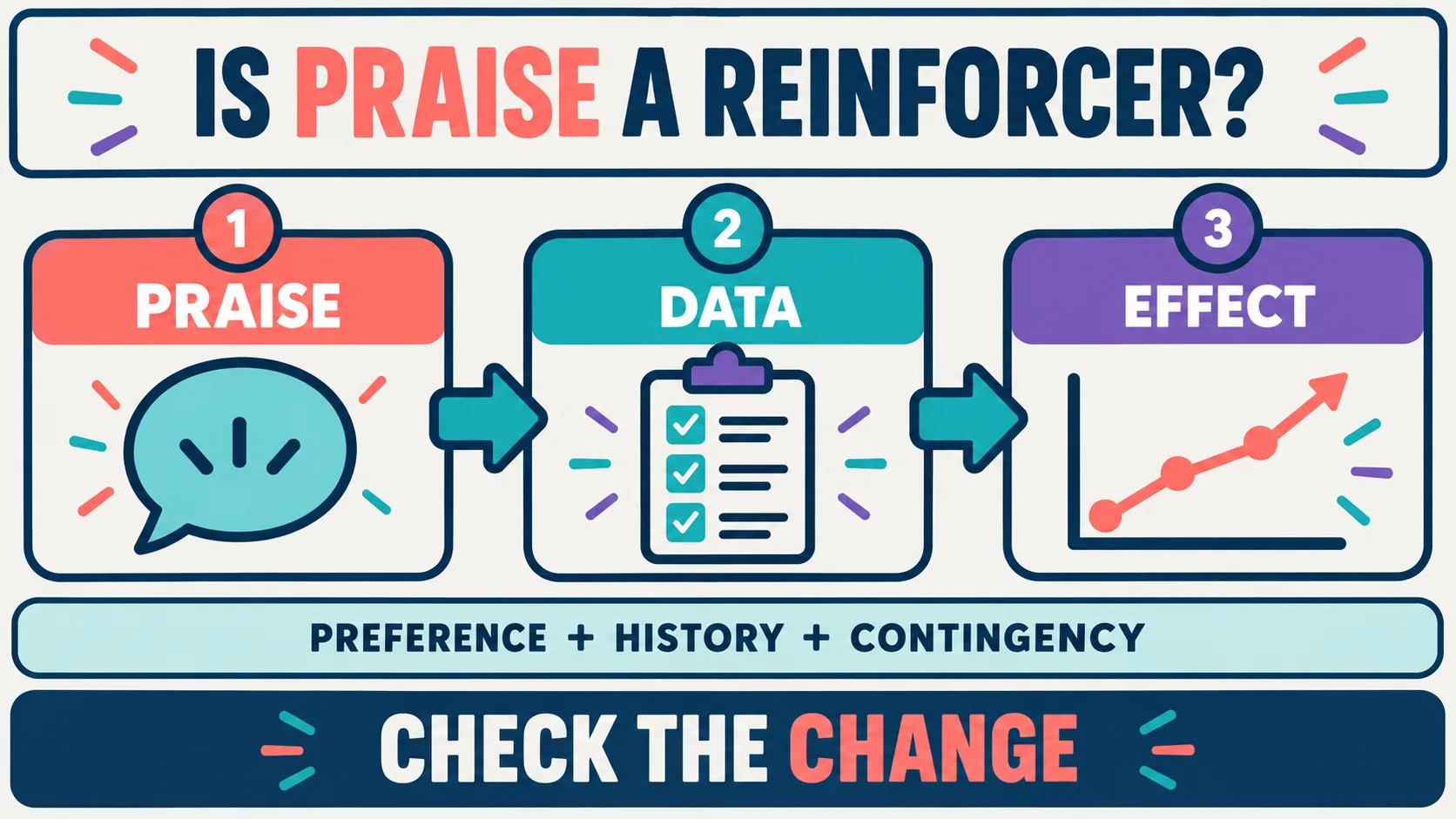
Praise functions as a reinforcer when its delivery produces an increase in the future probability of the behavior it follows, under specified conditions. That definition is intentionally more demanding than “the learner smiled” or “the adult liked the statement.” A momentary reaction may indicate social engagement, but reinforcement is evaluated by a change in future responding.
Studies have found individual differences. In one preschool evaluation, praise functioned as a reinforcer for only some participants under the tested conditions. Research with children diagnosed with autism likewise cautions that praise may maintain an existing response without automatically teaching an untaught response. The point is not that praise is ineffective; its function must be demonstrated rather than assumed. Four checks before calling praise reinforcement: Use the points below as a quick study guide.
- Preference and history: Has this person previously contacted praise as a valuable social event?
- Contingency: Does praise reliably follow the defined response, or is it delivered too broadly to evaluate?
- Effect: Does the target response increase, persist, or generalize when other relevant conditions are comparable?
- Competing variables: Did task difficulty, prompts, escape, tangible access, attention, or schedule changes occur at the same time?
The compact rule is: praise is a stimulus; reinforcement is a demonstrated relation. Specific wording can still fail to reinforce, while general praise may reinforce one person and not another. The data—not the emotional tone—settle the claim.
What should a BCBA measure about praise?
A practical measurement plan separates staff behavior from learner behavior. If a team only counts how often adults say “good job,” it cannot determine whether praise was contingent, specific, or effective. If it only measures learner performance, it may miss a fidelity problem. A small but well-defined data set is more useful than a large collection of impressions.
- Define the target response. Use observable boundaries, such as the number of independent requests or the percentage of completed steps.
- Record praise frequency. Count how often praise occurs and how many target responses were followed by praise.
- Score specificity. Mark whether the statement names the response or response feature accurately.
- Measure timing. Record the delay between the response and praise, especially when immediacy matters for teaching.
- Measure learner change. Choose rate, duration, latency, percentage, fluency, maintenance, or generalization based on the target.
- Check procedural fidelity. Determine whether staff followed the agreed delivery rule and recorded other consequences.
Do not use a single post-session impression as proof. Compare appropriate sessions or conditions, and if praise is paired with a preferred activity, describe the combined contingency rather than assigning the effect to praise alone.
Why might praise not work as expected?
Praise may fail to increase behavior for many reasons, and “the learner is unmotivated” is not an adequate analysis. The praise may not be preferred, may be delayed, may follow the wrong response, or may compete with a more powerful consequence. The task may also be too difficult, the response definition may be unclear, or the behavior may already be at a ceiling.
- Wrong response: The statement follows an approximation or an unrelated action rather than the target.
- Low value: The learner does not currently prefer the social statement under those conditions.
- Weak contingency: Praise is delivered so frequently or unpredictably that its relation to the response is unclear.
- Competing reinforcement: Another event, such as escape from a difficult task, controls the behavior more strongly.
- Insufficient measurement: The team sees a short-term reaction but does not measure future responding.
These possibilities call for assessment, not a universal escalation of praise. A change should remain within the person’s plan, authorization, and ethical safeguards, with the target and outcome defined before implementation and review.
How can teams improve praise delivery?
Behavior-specific praise is also a staff-performance target. Classroom research has used coaching and self-monitoring to increase the rate of statements that name the student behavior. That approach is useful because it treats staff delivery as observable behavior: define the response, provide feedback, and monitor change. It does not require assuming that every praise statement reinforces the learner. Short coaching loop for praise delivery: Use the points below as a quick study guide.
- model one concise behavior-specific statement;
- practice it in a realistic opportunity;
- record whether the target response was named and whether delivery was timely;
- review data privately and respectfully;
- check whether the learner’s response changes before claiming an effect.
Feedback should fit the setting and the people involved. A technically specific statement is not automatically socially valid; measure implementation, acceptability, and whether the learner can communicate a preference about the form of feedback in context.
What ethical safeguards apply to praise?
Praise is often low risk, but “positive” does not mean ethically self-justifying. The BACB Ethics Code for Behavior Analysts sets expectations for competence, client dignity, informed consent, stakeholder protection, and responsible professional conduct. A praise plan should respect communication preferences, assent, privacy, and the learner’s right not to perform for public approval. Ethical questions for the praise plan: Use this point as a focused exam-review label rather than a separate major section.
- uses a meaningful, observable goal rather than demanding compliance for its own sake;
- allows the learner to communicate discomfort, decline, or request a different form of feedback;
- avoids infantilizing language, public comparison, embarrassment, or excessive attention;
- includes stakeholder input about what respectful feedback looks like;
- records unintended effects and is revised when the arrangement is not acceptable.
A study summary is not permission to change a client’s treatment. The next step may be consultation, assessment, or review of the existing plan with the relevant people and safeguards before implementation.
How does praise ABA connect to BCBA exam questions?
The current BCBA Test Content Outline provides the exam boundary, but the phrase “praise ABA” may appear indirectly in an item about reinforcement, measurement, preference, or staff training. Look for the relation among response, consequence, and future behavior rather than choosing the answer with the most enthusiastic wording. Five-step BCBA exam routine: Use this point as a focused exam-review label rather than a separate major section.
- Define the behavior. What exactly is expected to increase or decrease?
- Label the stimulus. Is the consequence praise, attention, a tangible, escape, or a combination?
- Check the contingency. Does the consequence follow the target response according to a defined rule?
- Check the effect. What data show a change in future responding?
- Choose the narrowest claim. Do not call praise a reinforcer merely because it was delivered or because the learner looked pleased.
Common traps include treating “positive” as synonymous with “reinforcing,” assuming specificity guarantees effectiveness, and confusing a staff intervention with a learner intervention. Teacher-delivery data do not replace learner-outcome data or establish a preference for the learner.
What is a 15-minute praise study method?
Draw four boxes labeled response, praise, data, and alternative explanation. Put one observable target in the first box. In the second, write the exact statement and when it is delivered. In the third, write the measure that would show a future change. In the fourth, list one competing consequence or context variable.
Complete this sentence: “Praise is functioning as reinforcement only if ______ increases after ______ under ______ conditions.” If you cannot fill in all three blanks, the evidence is not yet sufficient for a functional claim.
When you are ready to test the distinction under time pressure, use the free BCBA mock exam. It is an independent study resource, not an official BACB examination and not a guarantee of a passing result.
Bottom line: what should you remember about praise ABA?
Praise ABA is best understood as a question about verbal feedback, social consequences, and function. Behavior-specific praise can make the acknowledged response clearer, but clarity is not the same as reinforcement. To make the functional claim, define the response, describe the praise, verify the contingency, measure future behavior, and account for preference and competing variables. The most defensible BCBA answer is usually the one that respects individual differences and claims only what the data support.
Praise ABA FAQ
What is praise in ABA? Praise is a verbal or social stimulus delivered as feedback or a consequence after behavior. Its function depends on what happens to future responding, not on the label alone. How do I measure behavior-specific praise? Define the target response, count praise opportunities and deliveries, score whether the statement names the behavior accurately, record timing, and measure the learner’s future response using an appropriate dimension.
What should I choose on a BCBA exam question about praise? Choose the answer that distinguishes stimulus form from function. Look for a defined response, a contingent consequence, and evidence of a future behavior change. Avoid assuming that positive wording or a brief smile proves reinforcement.
Take the Free BCBA Mock Exam
When you are ready to apply the idea, use the free practice resource below for additional feedback. Take the Free BCBA Mock Exam



