
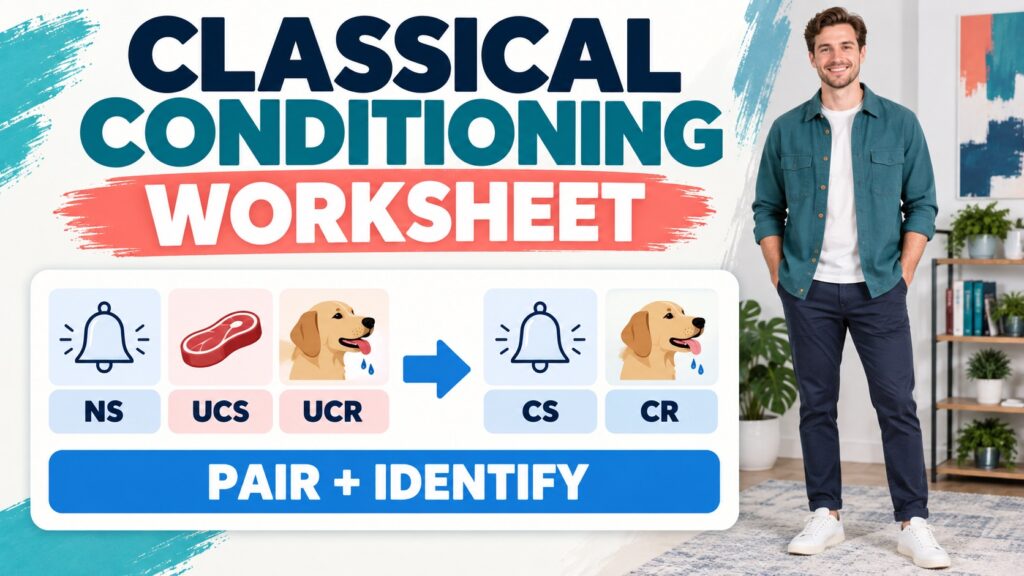
What belongs on a classical conditioning worksheet? A useful worksheet helps you label the neutral stimulus (NS), unconditioned stimulus (UCS), unconditioned response (UCR), conditioned stimulus (CS), and conditioned response (CR) across a pairing scenario. It should make you explain what changed before and after learning, not simply match five abbreviations from memory.
Table of Contents
- How should you use a classical conditioning worksheet?
- What do NS, UCS, UCR, CS, and CR mean?
- How does the conditioning sequence work?
- Classical conditioning worksheet: practice scenarios
- Classical conditioning worksheet answer key
- How is classical conditioning different from operant conditioning?
- What mistakes should BCBA candidates avoid?
- Classical conditioning worksheet FAQ
- Take the Free BCBA Mock Exam
For BCBA candidates, a classical conditioning worksheet is most useful when it also distinguishes respondent conditioning from operant conditioning, identifies the elicited response, and tests whether a stimulus was actually neutral before pairing. This page gives a printable-style study format with original scenarios, a worked answer key, and exam traps. It is educational practice material, not a client record or individualized clinical form.
The current BCBA Test Content Outline treats respondent and operant conditioning as distinct areas of competency. Use that boundary as a check while you complete each scenario, especially when a story includes both an elicited response and an action that contacts consequences. Table of Contents
How should you use a classical conditioning worksheet?
Use the worksheet to trace a stimulus-stimulus relation across time. Before conditioning, a neutral stimulus does not reliably elicit the target reflexive response. During conditioning, the neutral stimulus is paired with an unconditioned stimulus that already elicits an unconditioned response. After repeated or meaningful pairing, the previously neutral stimulus can function as a conditioned stimulus and evoke a conditioned response.
The most reliable method is to write the event sequence before naming the terms. Ask: What happened first? What naturally produced the response? Which stimulus was initially neutral? What response occurred before learning? What did the neutral stimulus become after pairing? This prevents a common error in which the learner labels the most noticeable event rather than analyzing the learning history.
- Underline the stimuli. Mark sounds, objects, locations, smells, or other environmental events.
- Circle the responses. Separate an elicited reflexive response from an action that produces a consequence.
- Mark the time point. Identify what was true before pairing and what was true after pairing.
- Check the relation. Ask whether the scenario describes stimulus-stimulus pairing or a behavior-consequence contingency.
What do NS, UCS, UCR, CS, and CR mean?
The labels describe different parts of a respondent-conditioning process. Some textbooks use US and UR instead of UCS and UCR. The wording differs slightly, but the functional distinction is the same: an unconditioned stimulus elicits an unconditioned response without requiring the relevant learning history, while a conditioned stimulus acquires its eliciting function through pairing.
| Label | Meaning | Worksheet question | Typical timing |
|---|---|---|---|
| NS | Neutral stimulus | What stimulus did not yet elicit the target response? | Before pairing |
| UCS | Unconditioned stimulus | What event naturally elicited the response? | Before and during pairing |
| UCR | Unconditioned response | What response did the UCS naturally produce? | Before and during pairing |
| CS | Conditioned stimulus | What did the NS become after pairing? | After conditioning |
| CR | Conditioned response | What response did the CS elicit after learning? | After conditioning |
The response may look similar before and after conditioning, but its controlling stimulus is different. For example, food may elicit salivation before learning, while a bell paired with food may later elicit salivation. The response form can be similar, but the UCR is controlled by the UCS and the CR is controlled by the CS.
How does the conditioning sequence work?
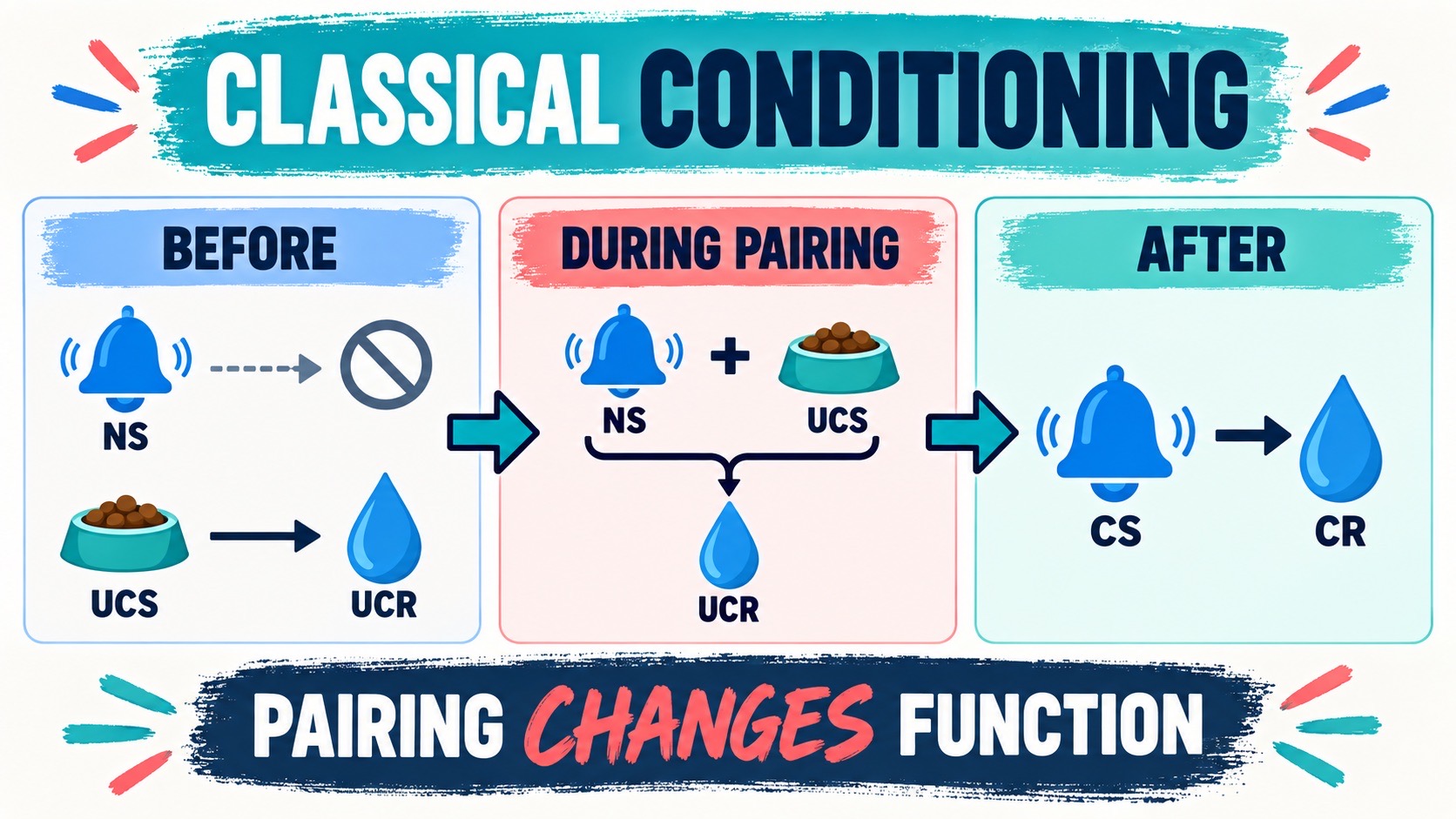
A worksheet is easier to complete when you draw three phases. In the first phase, the NS occurs without the target reflexive response, while the UCS produces the UCR. In the second phase, the NS and UCS are paired, and the UCR follows the UCS. In the third phase, the former NS is presented alone and now functions as the CS, eliciting the CR.
The sequence is about elicitation, not a person choosing a response because of its consequence. That is why classical or respondent conditioning is often associated with reflexive or involuntary responding. A learner can also engage in operant behavior in the same setting, but the worksheet should identify which relation the question is testing.
- Before: NS does not reliably elicit the target response; UCS elicits UCR.
- During: NS is paired with UCS, and the UCS continues to elicit UCR.
- After: CS, formerly NS, elicits CR when presented alone.
- Extension: extinction, generalization, discrimination, or higher-order conditioning may change the later pattern.
Classical conditioning worksheet: practice scenarios
Try to complete each scenario before reading the answer key. For each one, identify the NS, UCS, UCR, CS, and CR. Then write one sentence explaining whether the scenario is primarily respondent conditioning or operant conditioning. Do not assume that an object is neutral simply because it appears early in the story; check what it already predicted for the learner.
Scenario 1: The coffee-machine chime: At a new office, Maya initially does not react when the coffee machine makes a short chime. Each morning, the chime is immediately followed by the smell and taste of strong coffee, which makes her mouth water. After several weeks, Maya begins to salivate and feel ready for coffee when she hears the chime before any coffee is present.
- NS: ____________________
- UCS: ____________________
- UCR: ____________________
- CS: ____________________
- CR: ____________________
Scenario 2: The clinic door: Before a medical procedure, Jordan does not feel anxious when hearing a particular clinic door close. Several appointments involve the door closing immediately before an uncomfortable procedure, and Jordan begins to tense during the procedure. Later, the sound of the door closing alone produces visible tension before the procedure starts.
- NS: ____________________
- UCS: ____________________
- UCR: ____________________
- CS: ____________________
- CR: ____________________
Scenario 3: The notification tone At first, a new phone notification tone has no consistent effect on Lee. The tone is repeatedly followed by messages from a close friend, and Lee smiles and feels excited when reading the messages. Later, the tone alone produces a smile and excited anticipation. Lee also chooses to pick up the phone, which may be an operant response maintained by access to messages.
- NS: ____________________
- UCS: ____________________
- UCR: ____________________
- CS: ____________________
- CR: ____________________
Classical conditioning worksheet answer key
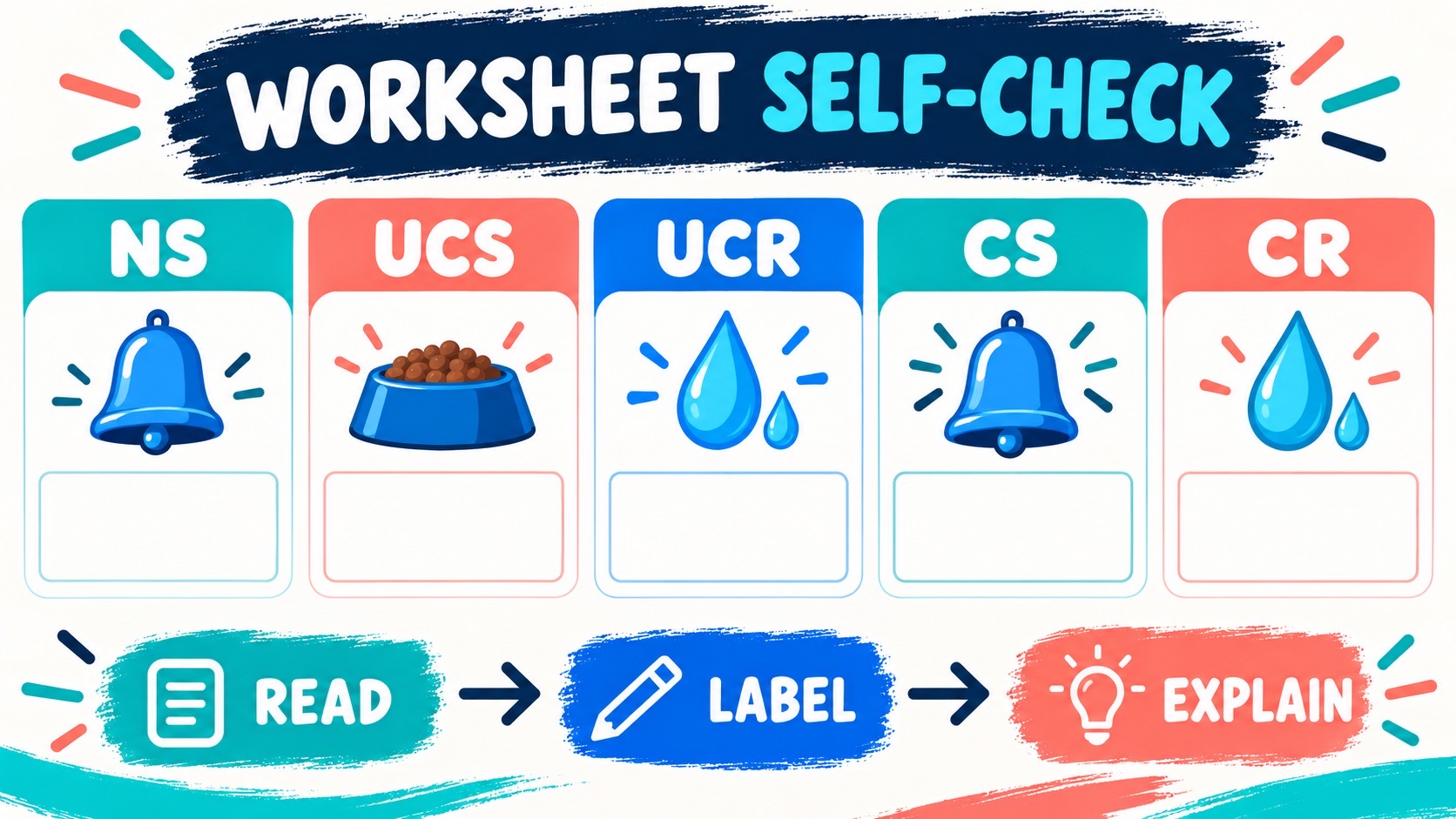
Use the answer key to check the relation, not only the abbreviation. A correct answer should identify the stimulus or response at the correct phase and explain why it has that function. If you selected the phone pickup as the CR in Scenario 3, revisit the distinction: picking up the phone is an operant response, while the smile and excited anticipation are the respondent responses described in the pairing.
| Scenario | NS → CS | UCS → UCR | CR after pairing |
|---|---|---|---|
| Coffee chime | Office coffee-machine chime → coffee-machine chime | Coffee taste/smell → mouth watering | Salivation and readiness for coffee to the chime |
| Clinic door | Door-closing sound → door-closing sound | Uncomfortable procedure → tension or distress | Tension when the door closes |
| Phone tone | New notification tone → notification tone | Messages from a close friend → excitement or smiling | Excited anticipation and smiling to the tone |
The table uses the same event as the NS and CS because the stimulus changes function through pairing; it does not need to change its physical form. The coffee, procedure, and messages are the events that provide the unconditioned or biologically significant relation in each scenario. The later respondent response is controlled by the CS, while any approach, phone pickup, or other behavior may also be analyzed as operant if a consequence changes its future probability.
How is classical conditioning different from operant conditioning?
Classical conditioning involves a stimulus-stimulus relation in which a stimulus acquires eliciting power through pairing. Operant conditioning involves a behavior-consequence relation in which consequences change the future probability of behavior. A single story can contain both processes, so identify the exact sentence the question asks you to classify.
| Question | Respondent/classical | Operant |
|---|---|---|
| Main relation | Stimulus paired with another stimulus | Behavior followed by a consequence |
| Typical effect | A stimulus elicits a conditioned response | A behavior becomes more or less likely |
| Worksheet clue | NS, UCS, UCR, CS, CR | Antecedent, behavior, consequence, and future response probability |
What mistakes should BCBA candidates avoid?
Most worksheet errors come from ignoring the learning history or labeling an action as a respondent response. Use these checks before finalizing an answer:
- Do not confuse the CS with the CR. The CS is a stimulus; the CR is the response it elicits.
- Do not call the paired event the CR. The UCS is an event or stimulus, while the UCR is the response it naturally evokes.
- Do not assume a stimulus was neutral. The story must support that it did not previously have the relevant eliciting function.
- Do not treat every choice as respondent conditioning. Picking up a phone or moving toward an item may be operant behavior.
- Do not invent a diagnosis or treatment plan. A study worksheet labels relations; it does not justify an individualized intervention.
For additional unofficial BCBA study practice, use the free BCBA mock exam after completing the worksheet. The practice resource is not an official BACB product, does not reproduce official exam questions, and cannot guarantee exam performance.
Classical conditioning worksheet FAQ
What five terms belong on a classical conditioning worksheet?: The common five labels are neutral stimulus (NS), unconditioned stimulus (UCS), unconditioned response (UCR), conditioned stimulus (CS), and conditioned response (CR). Some materials use US and UR instead of UCS and UCR.
Does the NS always become the CS?: In the basic worksheet pattern, the neutral stimulus becomes a conditioned stimulus after it is paired with the unconditioned stimulus and acquires eliciting function. In real learning histories, a stimulus may already have a function, so the scenario must be read carefully.
Can one scenario include both classical and operant conditioning?: Yes. A notification tone may elicit excitement through respondent conditioning, while picking up the phone may be strengthened by access to messages through an operant contingency. Classify each relation separately.
What is the main BCBA exam takeaway?: Trace the pairing history first. Then label the stimulus that naturally elicits the response, the response itself, the former neutral stimulus after learning, and the response it later elicits. Keep stimulus-stimulus pairing separate from behavior-consequence effects.
A good classical conditioning worksheet turns memorization into functional analysis. If you can explain why each label belongs at that point in the sequence—and identify when an operant response is mixed into the story—you are practicing the reasoning the BCBA exam actually tests.
Take the Free BCBA Mock Exam
When you are ready to apply the idea, use the free practice resource below for additional feedback. Take the Free BCBA Mock Exam



