
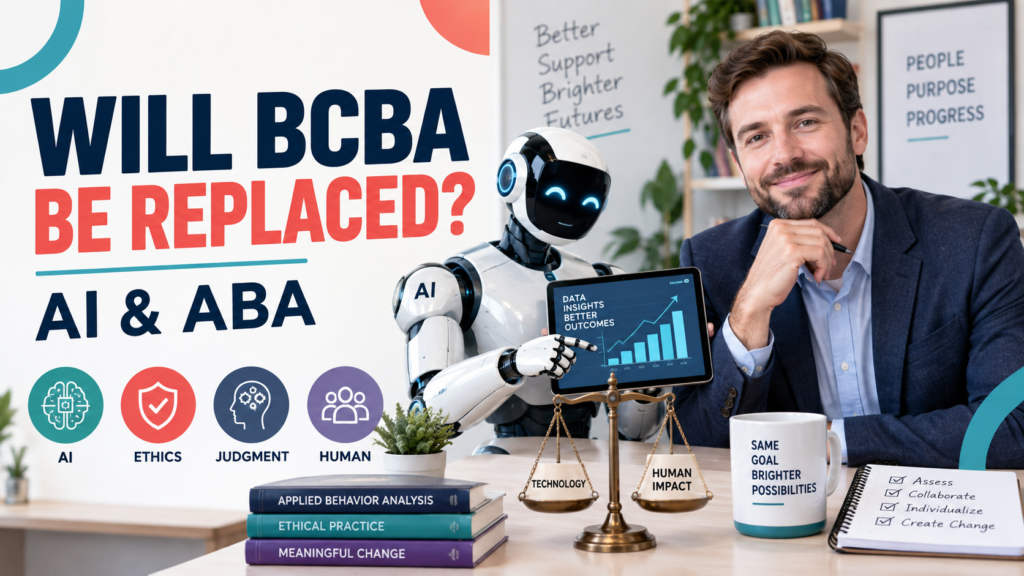
AI will probably change parts of BCBA work, but a tool that organizes data is not the same thing as a professional who carries clinical, ethical, and human responsibility. Here is how to reason about the difference.
Table of Contents
- Will BCBA Be Replaced by AI?
- What Can AI Assist With in BCBA Work?
- Which BCBA Responsibilities Still Need Human Judgment?
- Why Does Individualization Matter?
- What Are the Main AI Risks for Behavior Analysts?
- How Should a BCBA Review an AI Output?
- Does AI Change What BCBA Candidates Should Study?
- What Does an AI-Ready BCBA Skill Set Look Like?
- What Should Employers and Supervisors Put in Place?
- What Is the Practical Answer for a Future BCBA?
- Sources and Further Reading
- Quick Review Checklist
- Take the Free BCBA Mock Exam
If you are studying for the credential, it is reasonable to ask: will BCBA be replaced by AI? The most defensible answer is that AI is more likely to automate or assist selected tasks than to replace the full role of a Board Certified Behavior Analyst. That is not a promise about employment, salaries, or any particular technology. It is a distinction between task automation and accountable clinical practice.
A BCBA does more than produce text or detect a pattern. The role includes defining behavior, assessing context, selecting socially meaningful goals, interpreting data, collaborating with people, making individualized decisions, supervising implementation, and responding to ethical and legal constraints. AI may support pieces of that workflow. It does not become the responsible professional merely because its output sounds confident.
Will BCBA Be Replaced by AI?
There is no reliable basis for a simple “yes” or “no” forecast. AI capabilities, regulations, reimbursement rules, employer practices, and public expectations can change. Current research instead supports a more useful question: which parts of behavior-analytic work can be assisted, and which decisions require accountable human judgment?
Recent ABA-focused research has examined clinician agreement with AI responses, practitioner attitudes, and possible uses of machine learning for data collection. These studies can inform a cautious discussion, but they do not establish that an AI system can independently perform the BCBA role across clients, settings, cultures, and risk levels. A result from a benchmark or survey is not a scope-of-practice authorization.
What Can AI Assist With in BCBA Work?
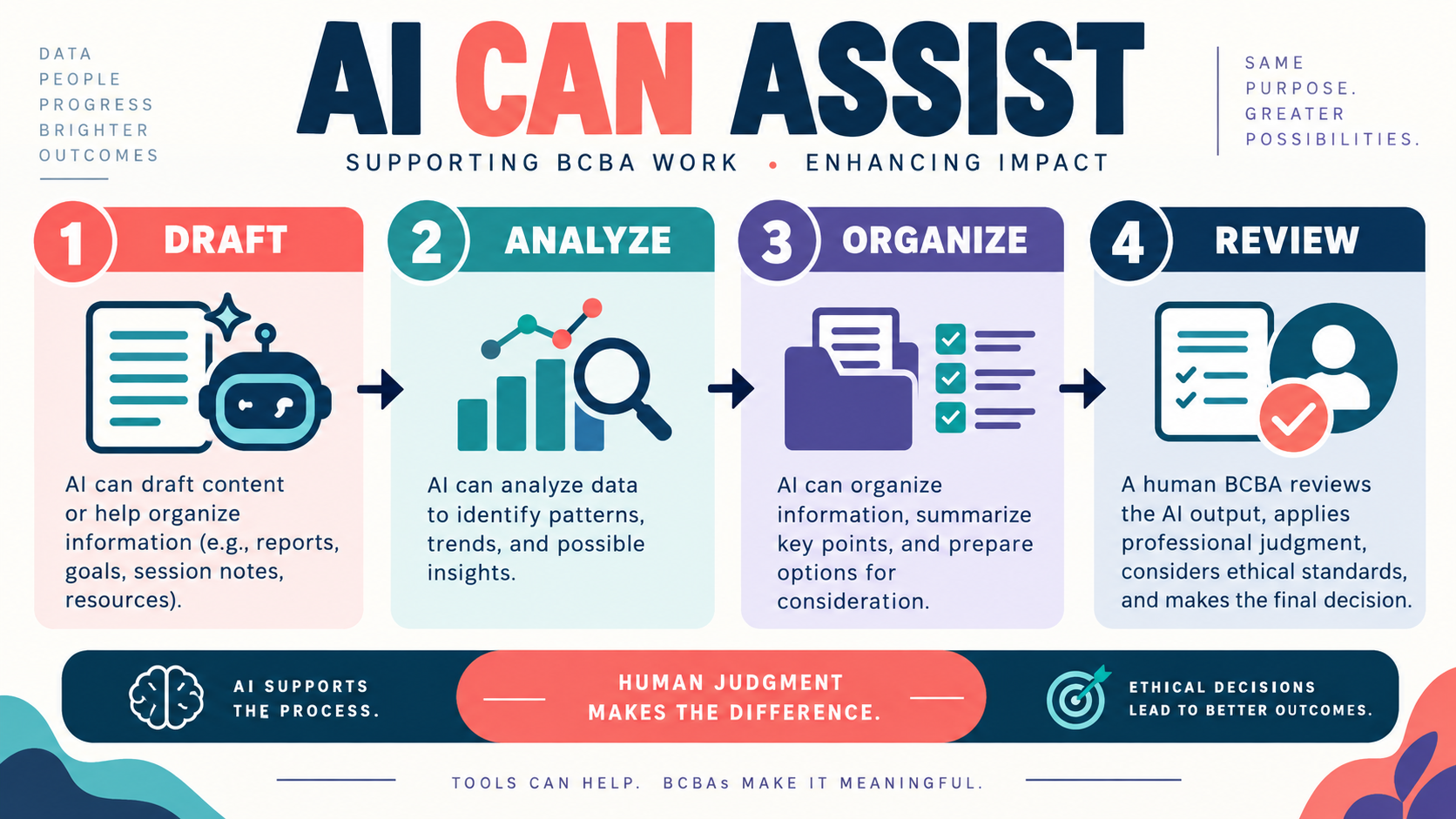
AI may be useful for low-risk support tasks when a qualified professional verifies the result. Examples include organizing de-identified data, flagging missing fields, summarizing a meeting draft, generating alternate wording for a caregiver handout, finding patterns for a clinician to inspect, or helping a team schedule observations. These uses can reduce administrative friction and return time to direct observation, teaching, coaching, and collaboration.
“Assist” is the important verb. A BCBA should be able to explain what data entered the tool, what the tool did, what limitations were present, and how the professional checked the output. If no one can answer those questions, the workflow is not transparent enough for a high-stakes clinical decision.
Which BCBA Responsibilities Still Need Human Judgment?
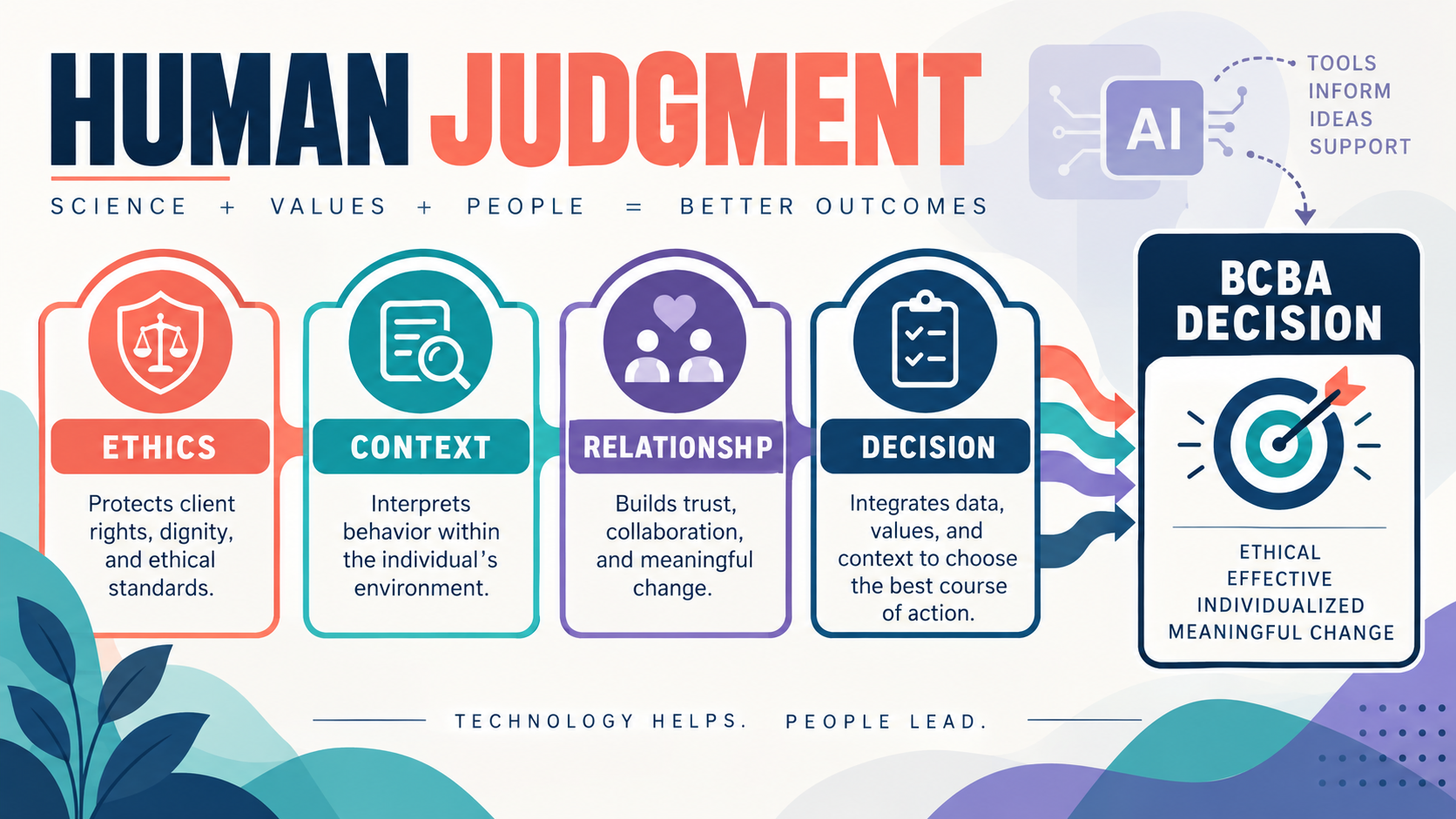
Many responsibilities are contextual and relational. A BCBA must decide whether a target is socially meaningful, whether a measurement definition captures what matters, whether a plan respects assent and dignity, whether a change in behavior suggests a health or environmental issue, and whether a treatment is safe and appropriate for the person in front of the team. Those decisions require information that may not exist in a data table.
Human accountability also includes the duty to notice when a plan is not working, listen to the learner and family, coordinate with other professionals, supervise staff competently, protect confidential information, and document the reasoning behind clinical choices. An AI tool may prompt a question, but it cannot transfer that duty to a different entity.
| Workflow area | Possible AI assistance | BCBA accountability |
|---|---|---|
| Data organization | Sort, label, or flag incomplete records | Define valid measures and verify the record represents the behavior |
| Pattern review | Surface possible trends or outliers | Interpret context, threats to validity, and meaningful change |
| Documentation support | Create a draft or alternate plain-language wording | Check accuracy, confidentiality, authorship, and clinical rationale |
| Treatment decisions | Offer questions or options for review | Select, implement, monitor, revise, and take responsibility for the plan |
Why Does Individualization Matter?
Behavior is not just a label attached to a person. It occurs in a context with a history, a function, a communication repertoire, preferences, relationships, and environmental conditions. A model may generate a plausible program for “refusal” or “aggression,” but the same topography can have different functions or different risks. Treating a generic output as a client-specific plan can hide the very variables a behavior analyst is expected to analyze.
Individualization also includes goals. A technically measurable target can still be a poor goal if it primarily trains appearance, suppresses harmless self-expression, ignores the learner’s priorities, or creates an unnecessary burden. AI can help a team phrase a goal after the team has chosen it; it should not decide what a person ought to become.
What Are the Main AI Risks for Behavior Analysts?
Privacy is one risk. Clinical notes, videos, identifiers, and health information should not be placed into a tool without an approved, secure workflow and a clear understanding of storage, access, retention, and vendor terms. De-identification is not a magic word; combinations of details can still identify a person.
Accuracy is another risk. AI can invent citations, misread a graph, confuse terms, or produce a polished recommendation that does not fit the case. Bias, loss of context, automation complacency, and unclear authorship add further concerns. Official BACB guidance has emphasized that certificants remain responsible for ethical, regulatory, privacy, and legal obligations when using AI-related tools.
How Should a BCBA Review an AI Output?
Use a review sequence rather than a vague “human in the loop” label. First, verify that the input was permitted and appropriately de-identified. Second, check the factual content against the original record and reliable sources. Third, ask whether the recommendation fits the individual’s assessment, goals, preferences, communication, and risk profile. Fourth, inspect the measurement and decision rule. Fifth, document who reviewed the output, what was changed, and why.
If the tool proposes a treatment change, the review must be more than proofreading. A typo correction and a new consequence procedure are not the same level of risk. The higher the potential impact on health, safety, rights, or access to services, the more direct professional assessment and oversight are required.
Does AI Change What BCBA Candidates Should Study?
It makes fundamentals more valuable, not less. A candidate who understands measurement, functional assessment, experimental logic, reinforcement, prompting, generalization, ethics, and supervision can question an AI output. A candidate who memorizes fluent explanations without understanding the underlying concepts may be more vulnerable to confident errors.
Study the current BACB materials and learn to explain why an answer is supported by the scenario. Practice identifying the target behavior, the relevant antecedent and consequence, the function, the measurement, the ethical constraint, and the next data-based decision. Those reasoning skills remain useful whether a workplace uses paper forms, software, or an AI assistant.
What Does an AI-Ready BCBA Skill Set Look Like?
- Measurement literacy: know what a measure means, how it can fail, and what the graph actually shows.
- Assessment reasoning: distinguish a hypothesis from evidence and recognize when direct observation is needed.
- Communication: explain choices to learners, families, technicians, and other professionals in plain language.
- Ethical technology use: protect privacy, verify outputs, disclose relevant use, and follow current policy.
- Clinical flexibility: revise a plan when data, context, or the learner’s priorities change.
What Should Employers and Supervisors Put in Place?
A responsible implementation should define approved tools, prohibited data, access controls, review expectations, incident reporting, and training. Supervisors should model verification instead of rewarding fast but opaque documentation. Teams also need a way to report a bad output without being blamed for a tool’s confident error.
AI should be evaluated by whether it improves meaningful service quality, not only by whether it saves minutes. A faster note that is inaccurate, non-individualized, or insecure is not an improvement. A tool that reduces repetitive formatting while giving a BCBA more time for observation and coaching may be useful, provided the accountability boundary remains clear.
What Is the Practical Answer for a Future BCBA?
Prepare for a field in which technology may change how work is organized. Build skills that let you inspect data, recognize weak reasoning, communicate with people, and make individualized decisions. Learn enough about AI to use it cautiously, but do not let a tool replace your understanding of behavior analysis or your responsibility to the learner.
The question “will BCBA be replaced by AI?” is therefore less useful than “which tasks can be supported, under what safeguards, and who remains responsible?” That framing is more honest, more useful for exam preparation, and more consistent with professional accountability.
- AI may assist with organization, pattern flagging, scheduling, and draft formatting.
- AI output requires verification; fluent wording is not evidence of accuracy.
- Individualized assessment, ethical judgment, collaboration, supervision, privacy, and clinical responsibility remain central.
- Current BACB rules, ethics materials, employer policies, and applicable law control the real-world workflow.
Want to practice the reasoning that technology cannot replace? Try the free BCBA mock exam and review why each answer fits the scenario. Practice can support preparation, but no tool or mock exam can guarantee an examination or employment outcome.
Sources and Further Reading
For current context, review the study on BCBAs’ attitudes, concerns, and needs, the JABA comparison of ChatGPT and clinician responses, the national survey of machine-learning perceptions, the AI practice parameters, and the BACB newsletter discussion of AI-related obligations. Always check current official BACB ethics and certification materials before applying a policy.
For targeted review, use our will BCBA be replaced by AI practice questions to apply the concept in exam-style scenarios.
Quick Review Checklist
Use this final checklist to turn will BCBA be replaced by AI into exam-ready reasoning. The goal is not to memorize a label in isolation; it is to identify the relevant evidence and explain why the best answer fits the scenario. Key ideas to review:
- State the central definition or decision point for will BCBA be replaced by AI in your own words.
- Identify the detail that makes will BCBA be replaced by AI different from its closest related ABA term.
- Separate the observable facts in a scenario from assumptions that are not supported by the facts.
- Write one example and one nonexample so you can recognize the concept in a new setting.
Exam application checks:
- Ask what the question is actually requesting before comparing the answer choices.
- Mark the antecedent, response, consequence, or other evidence that supports the selected answer.
- Look for a distractor that describes a related process but does not answer the specific question.
Final self-check:
- Explain how you would verify the interpretation with clear observations or data.
- Change one detail in the scenario and decide whether your answer should change.
- Give a one-sentence rationale that a supervisor or study partner could evaluate.
Take the Free BCBA Mock Exam
If you want a low-pressure way to check your recall, use the free practice resource below. Take the Free BCBA Mock Exam



