
DTT · STIMULUS CONTROL · PROMPT FADING The answer to why is stimulus control transfer considered pivotal in DTT is independence: the learner should respond to the intended discriminative stimulus, not remain dependent on the prompt that made the correct response possible during teaching.
Table of Contents
- What Is Stimulus Control Transfer?
- Why Is Stimulus Control Transfer Pivotal in DTT?
- Where Does Transfer Appear in a DTT Trial?
- Which Procedures Can Transfer Control?
- What Does a Transfer Example Look Like?
- How Do You Measure Transfer and Prompt Dependence?
- What Common Errors Confuse the Concept?
- What Are the BCBA Exam Takeaways?
- Frequently Asked Questions
- Sources for Further Study
- Take the Free BCBA Mock Exam
What Is Stimulus Control Transfer?
Stimulus control transfer is the process of arranging teaching so that a response that initially occurs because of a prompt comes under control of the intended stimulus. In a DTT example, an instructor may present an instruction, picture, object, or other discriminative stimulus (SD), then add a prompt so the learner can respond correctly. The prompt is useful at the beginning, but it should not become the permanent reason the learner responds.
Transfer is therefore about the relation among stimulus, response, prompt, and consequence. At first, the prompt may be more salient or more reliable than the SD. A fading or transfer procedure gradually changes the arrangement so the learner responds when the SD is present and the prompt is absent or unnecessary. Reinforcement for the correct response remains part of the contingency, but the controlling antecedent changes.
This is not the same as generalization. Generalization asks whether the skill transfers across people, materials, settings, or examples. Stimulus-control transfer asks whether the response is controlled by the intended stimulus rather than an instructional aid. A learner can respond independently to the teacher’s picture in one room and still need explicit generalization programming elsewhere.
Why Is Stimulus Control Transfer Pivotal in DTT?
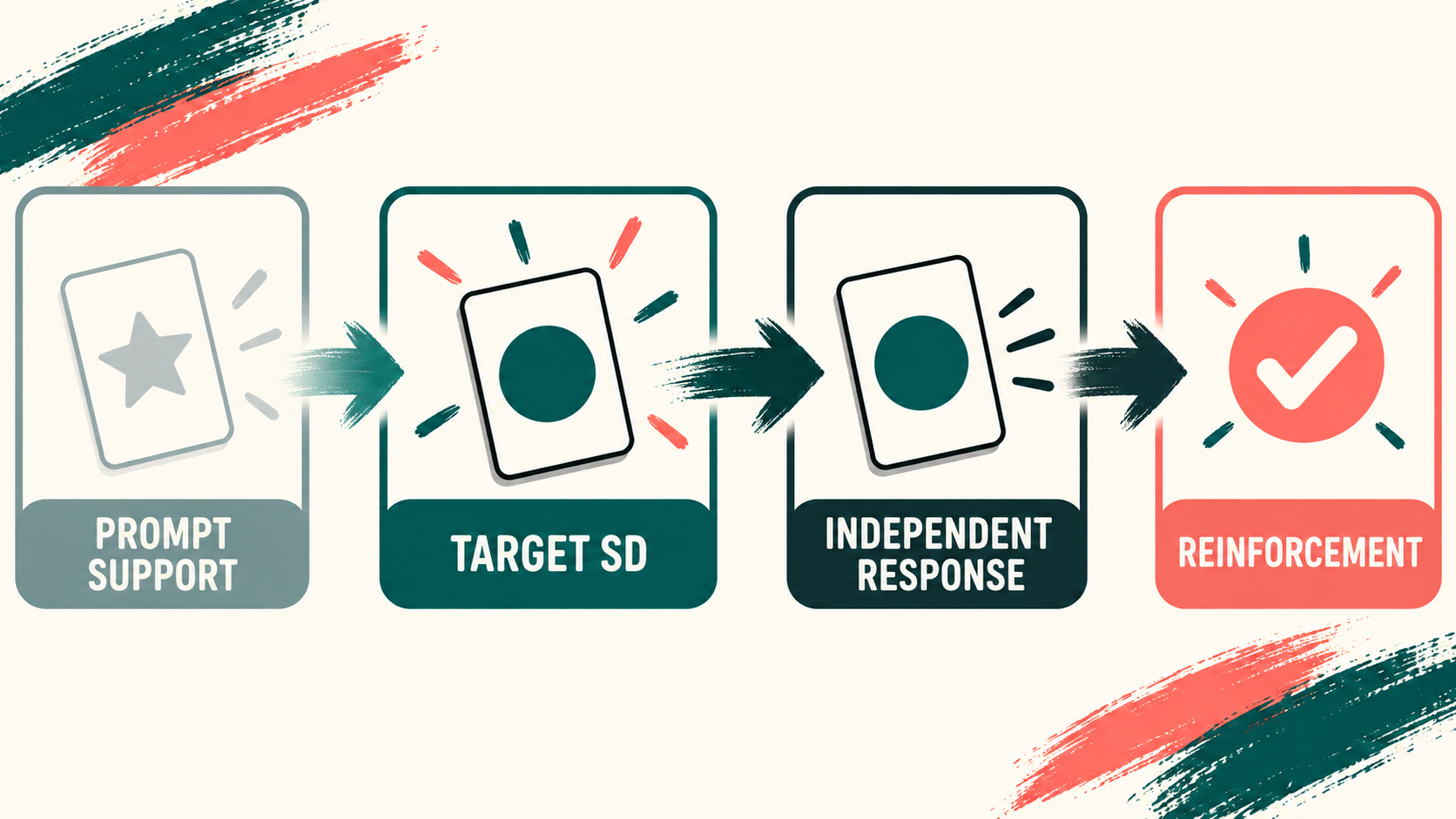
DTT is often organized as a repeated sequence: an antecedent or SD, a learner response, and a consequence. If the prompt controls the response, the sequence may look successful while the actual teaching objective remains unmet. The learner may wait for a verbal model, follow a pointing gesture, copy the instructor’s position, or respond only when a particular prompt is delivered. Transfer is pivotal for four reasons:
- Independence: The learner can respond when the natural or instructional SD is presented without an adult cue that will not be available later.
- Instructional efficiency: Prompting can prevent repeated errors, but planned fading prevents the prompt from becoming a new prerequisite for every response.
- Meaningful use: A skill is more useful when it occurs in response to the cue that matters in school, home, work, or community life.
- Interpretability: Data can show whether the learner has acquired the target relation rather than simply learned to follow a prompt.
“The learner got it right” is not enough. Ask what stimulus was present, which prompt was used, whether the prompt was faded, and whether the response occurred independently. The answer to the query’s “why” is not that every prompt is bad. It is that a prompt is a teaching support, not the terminal stimulus control for the target skill.
Where Does Transfer Appear in a DTT Trial?
Consider a receptive-identification trial. The instructor presents an array and says, “Touch cup.” If the learner does not respond, the instructor may provide a model, gesture, position prompt, or other assistance according to the approved teaching plan. The learner touches the cup and receives the planned consequence. To demonstrate transfer, later trials arrange the instruction and array while the prompt is delayed, reduced, or removed, and the learner’s independent response is measured.
The exact prompt hierarchy depends on the skill, learner, error history, communication, assent, and supervisor-approved program. A DTT trial should not be treated as a generic recipe. The key analysis is whether the learner’s response is occasioned by the intended SD and whether the prompt is being systematically faded.
Transfer also applies to verbal behavior. A learner might initially say “cup” after an echoic model. A transfer trial can present the original tact or other relevant SD after the prompt-supported response, then reinforce the response under the target condition. The research literature includes transfer-trial and prompt-fading procedures, but one study result does not establish a universal best procedure for every learner.
Which Procedures Can Transfer Control?
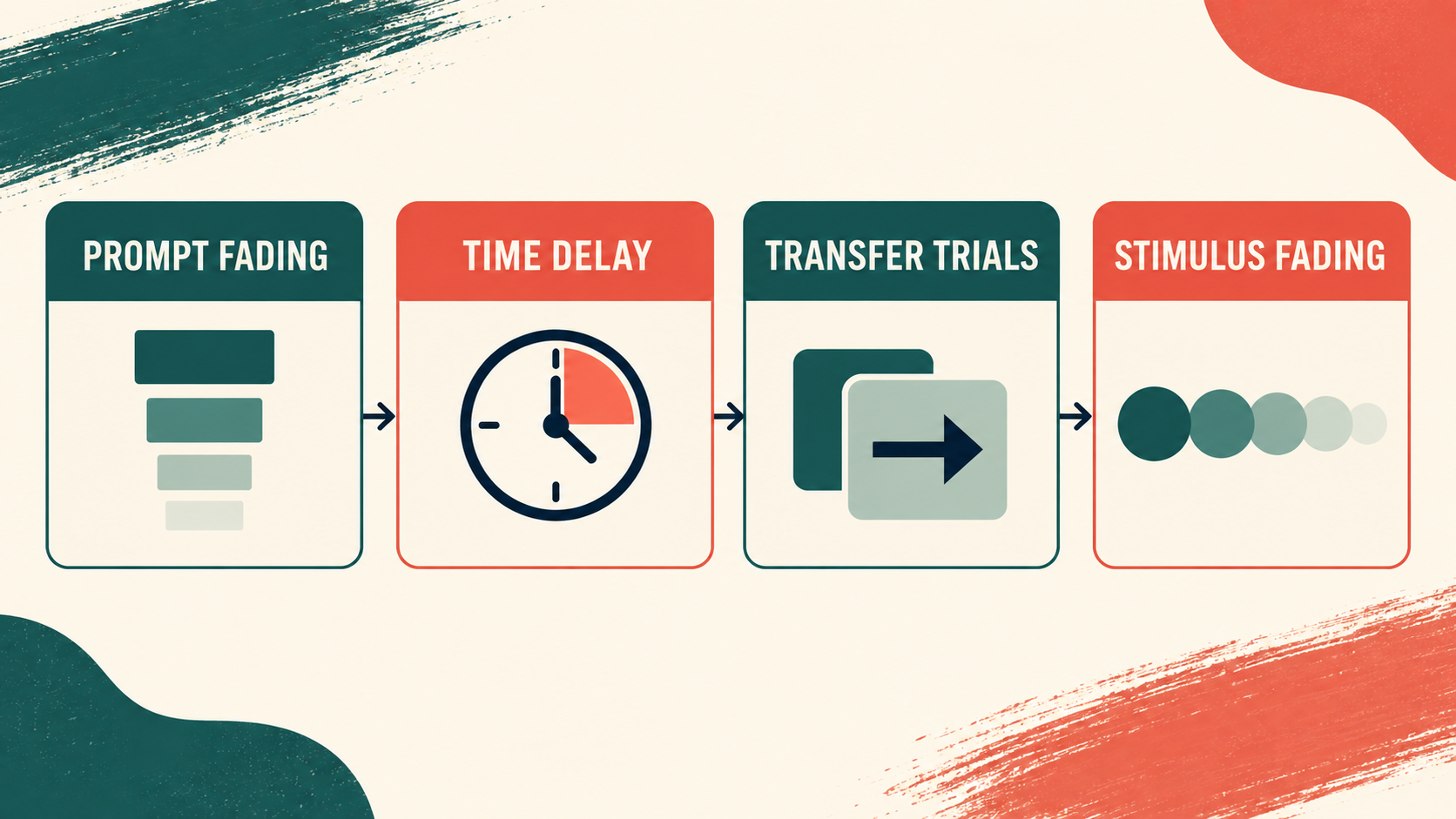
Several procedures can support transfer. They are related, but they manipulate different parts of the teaching arrangement:
| Procedure | What changes | What to monitor |
|---|---|---|
| Prompt fading | The prompt becomes less intrusive, less salient, or less available across trials or steps. | Independent accuracy, prompt level, errors, and whether the learner waits for the prompt. |
| Time delay | The interval between the SD and the prompt changes so the learner has an opportunity to respond to the SD first. | Latency, independent response, errors, and whether the delay is appropriate for the learner. |
| Transfer trial | A prompted response is followed by a trial arranged to evoke the response under the target SD without the original prompt. | Correct responding under the target SD, prompt history, reinforcement, and error patterns. |
| Stimulus fading or shaping | A salient stimulus feature or extra stimulus support is gradually changed so the target stimulus controls the response. | Discrimination, stimulus salience, errors, and whether control has shifted to the intended feature. |
The word “pivotal” does not mean selecting the most aggressive fading schedule. It means planning for the terminal relation from the beginning. A less intrusive prompt, a delay, or a transfer trial may be appropriate; the procedure must fit the learner and be evaluated with data.
What Does a Transfer Example Look Like?
Suppose an instructor is teaching a learner to identify a picture of a spoon from an array. On early trials, the instructor gives the instruction and immediately uses a gesture toward the spoon. The learner touches it correctly. The data show prompted accuracy, but they do not yet show that the verbal SD controls the response.
A transfer arrangement could present the instruction again after the prompted trial while removing the gesture and providing the programmed consequence for an independent selection. The instructor records whether the learner responds, how long the response takes, and what prompt was required if the response is incorrect. As the learner responds independently, the team can vary arrays and examples according to the plan. If performance falls apart, the team reviews the prompt, stimulus arrangement, discrimination difficulty, and reinforcement rather than simply repeating a stronger prompt forever.
This example illustrates the reasoning, not a universal protocol. The learner may communicate a preference, need a break, or show that the task is too difficult. A qualified practitioner should monitor assent, error patterns, and the functional value of the target. Independence is not produced by forcing a learner through an arbitrary trial; it is supported by an accessible, meaningful teaching arrangement.
How Do You Measure Transfer and Prompt Dependence?
Track independent and prompted performance separately. Useful measures may include independent accuracy, prompted accuracy, prompt level, latency to respond, error type, number of transfer trials, and maintenance or generalization probes. A percentage that combines prompted and independent correct responses can hide prompt dependence.
- Define the target SD and response in observable terms.
- Record the least intrusive prompt that produced the response, not just “prompted.”
- Plot independent responding across sessions and across relevant stimulus examples.
- Look for waiting, scanning for the prompt, position bias, or responding to an irrelevant feature.
- Probe without the prompt only when the teaching plan and safety context make it appropriate.
Prompt dependence is not diagnosed from one missed trial. It is a pattern in which the learner’s performance remains tied to the prompt or the prompt is not fading as planned. Review the teaching arrangement, reinforcer, response effort, stimulus discrimination, and prompt-fading decision with the supervisor.
What Common Errors Confuse the Concept?
Several exam distractors sound close:
- Calling a correct prompted response independent because the learner contacted reinforcement.
- Confusing transfer of control with generalization across people or settings.
- Fading a prompt without identifying the SD that should control the response.
- Changing several prompts and stimuli at once, making the source of improvement impossible to interpret.
- Using a more intrusive prompt whenever errors occur instead of reviewing discrimination, motivation, and task difficulty.
In a scenario, underline the stimulus that should evoke the response, the prompt that currently helps, and the data that show independence. Then ask whether the proposed procedure changes prompt availability, prompt delay, stimulus features, or the learner’s response requirement.
What Are the BCBA Exam Takeaways?
For the question why is stimulus control transfer considered pivotal in DTT, the answer is that teaching should result in responding to the intended SD rather than a prompt. Prompting can establish successful responding, but systematic fading, delay, transfer trials, or stimulus manipulation may be needed to shift control.
- Separate prompted accuracy from independent accuracy.
- Identify the intended SD before choosing a fading or transfer procedure.
- Do not confuse stimulus-control transfer with generalization.
- Measure prompt level, latency, errors, and independent responding.
- Choose the least intrusive, learner-appropriate procedure and revise it from data.
For additional practice with DTT, prompting, fading, and stimulus-control scenarios, the site’s free BCBA mock exam is an independent study resource. It is not official BACB content and does not guarantee certification.
Frequently Asked Questions
Is stimulus-control transfer the same as prompt fading?: Prompt fading is one way to help transfer control, but the broader concept is the change in what stimulus controls the response. Time delay, transfer trials, and stimulus-fading procedures can also support that change.
Why can a learner be accurate but not independent?: A prompt may be controlling the response. If the learner responds only after a gesture, model, or verbal answer, record the response as prompted and plan how control will be transferred to the intended SD.
Does transfer automatically produce generalization?: No. Transfer and generalization are related but different. After the response is controlled by the intended SD, the team may still need to program variation across people, materials, settings, or examples.
Sources for Further Study
- BACB BCBA Test Content Outline, 6th edition — current behavior-change and stimulus-control study context.
- Assessing Transfer of Stimulus Control Procedures Across Learners With Autism — peer-reviewed transfer-procedure research.
- Using Transfer Trials to Teach Tacting — peer-reviewed DTT transfer-trial study.
- Errorless Discrete-Trial Teaching — prompting, fading, and instructor-fidelity context.
- Effective and Efficient Procedures for the Transfer of Stimulus Control — review of response-prompting and stimulus-manipulation procedures.
Take the Free BCBA Mock Exam
If you want a low-pressure way to check your recall, use the free practice resource below. Take the Free BCBA Mock Exam



