
When did ABA start? There is no single date that answers every version of that question. The roots of behavior analysis reach back to early behaviorism and the experimental analysis of behavior; applied behavior analysis became recognizable as a distinct applied field through work in the 1950s and 1960s; and the 1968 publication of “Some Current Dimensions of Applied Behavior Analysis” gave the field a durable framework. The BACB came much later, in 1998, as professional certification infrastructure.
Table of Contents
- What Does “Start” Mean in ABA History?
- A Timeline: Which ABA Date Answers Which Question?
- How Did Behaviorism Lead Toward Applied Behavior Analysis?
- Why Is 1968 So Important?
- What Happened After the 1968 Formalization?
- When Did the BACB and BCBA Credential Begin?
- What Common Answers Get the History Wrong?
- How Should You Study ABA History for the BCBA Exam?
- What Should You Verify in Current Sources?
- FAQ: When Did ABA Start?
- Final Takeaway
- Quick Review Checklist
- Take the Free BCBA Mock Exam
- References
That distinction matters for BCBA exam study. A question may be asking when the applied label became formal, when the seven dimensions were published, when a professional association formed, or when certification began. Treating all of those as one date creates a confident but inaccurate answer. This guide uses the phrase when did ABA start as a timeline question, not as an invitation to name one founder.
What Does “Start” Mean in ABA History?
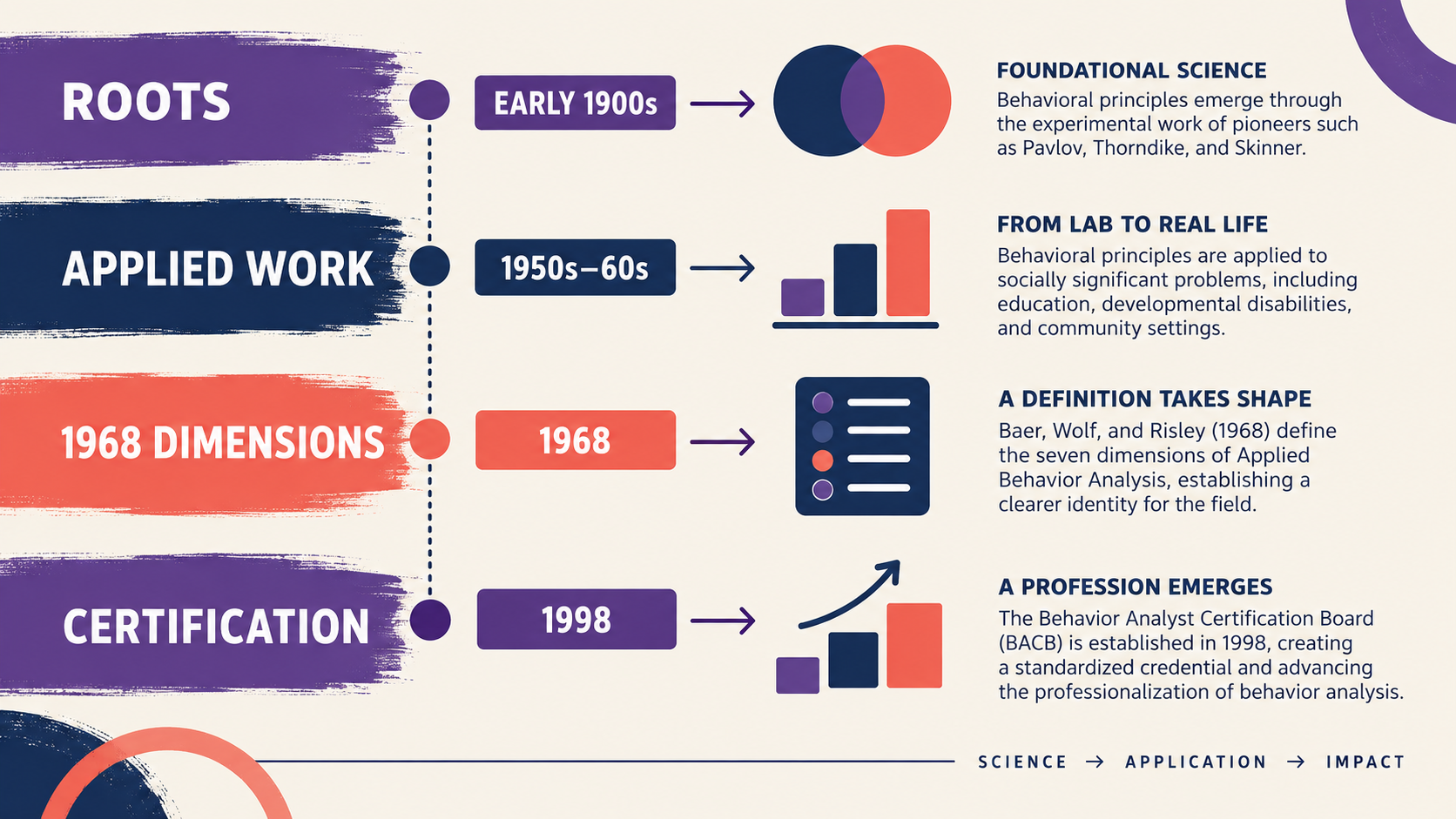
Before choosing a year, identify the layer of history being discussed. “Behavior analysis” can refer to a scientific discipline, while “applied behavior analysis” refers to applying behavioral principles to socially important behavior and evaluating the effects of that application. A professional credentialing board is a separate layer again.
The safest short answer is: ABA developed over several decades, with important applied work before 1968 and a major formalization milestone in 1968. The 1968 paper by Baer, Wolf, and Risley is often used as the anchor date because it described seven dimensions that still shape how students recognize applied behavior analysis. It did not create every idea in the field, and it does not erase earlier work.
A Timeline: Which ABA Date Answers Which Question?
Use the timeline below to match a date to the question it can actually answer. The wording is deliberately cautious: historical milestones are not interchangeable.
| Milestone | What it represents | Exam-safe wording |
|---|---|---|
| Early 20th century behaviorism | Scientific and conceptual roots for studying observable behavior and environmental relations. | A root of behavior analysis, not a single “ABA founding” date. |
| 1950s–1960s applied work | Researchers increasingly applied behavioral principles to socially important problems and settings. | The applied field was developing before the 1968 paper. |
| 1968 JABA paper | Baer, Wolf, and Risley described the seven dimensions commonly used to characterize applied behavior analysis. | A major formalization and teaching milestone, not the beginning of every applied practice. |
| 1970s and later professional growth | Journals, associations, training programs, and practice communities expanded the field. | Institutional development and dissemination, not a replacement for the 1968 milestone. |
| 1998 BACB establishment | A nonprofit certification organization was established to support professional standards and certification. | The start of BACB certification infrastructure, not the start of ABA. |
How Did Behaviorism Lead Toward Applied Behavior Analysis?
Behavior analysis did not appear as a finished profession. It developed from a scientific interest in how behavior changes in relation to environmental conditions. Early behaviorism encouraged researchers to focus on observable behavior and measurable relations rather than relying only on private explanations. Later work in experimental analysis examined how consequences, antecedents, schedules, and stimulus conditions affected responding.
Applied work added a different test: does the behavior matter to the person and the community, can it be measured directly, can the environmental relation be demonstrated, and does the change improve a meaningful outcome? That is why “ABA” should not be reduced to a list of techniques. The applied label describes a way of selecting problems, measuring behavior, evaluating change, and connecting procedures to behavioral principles.
For exam purposes, keep the layers separate. Behaviorism is a broader intellectual movement. Behavior analysis is a discipline with basic, applied, and conceptual dimensions. Applied behavior analysis is the applied branch or approach. A certification board is professional infrastructure. A question can connect these layers, but one term should not be used as a substitute for all the others.
Why Is 1968 So Important?
In 1968, Donald Baer, Montrose Wolf, and Todd Risley published “Some Current Dimensions of Applied Behavior Analysis” in the first volume of the Journal of Applied Behavior Analysis. The article identified seven dimensions: applied, behavioral, analytic, technological, conceptually systematic, effective, and generality.
The paper is important because it gave students and practitioners a compact way to evaluate whether an intervention or study reflects applied behavior analysis. The dimensions connect social importance to observable measurement, experimental demonstration, procedural description, behavioral principles, meaningful outcomes, and generalization. They are not a historical claim that nothing applied existed before 1968.
A useful exam distinction is this: if a question asks for the publication associated with the seven dimensions, 1968 is the anchor. If it asks when ABA began in the broadest historical sense, explain that the field developed through earlier behaviorism, experimental analysis, and applied work. If it asks when the BACB was established, answer 1998. Read the task before choosing the date.
What Happened After the 1968 Formalization?
The field continued to develop through journals, professional associations, university programs, service systems, and debates about the scope and ethics of intervention. The Association for Behavior Analysis International traces its own professional history to 1974, while other organizations and communities supported practice, research, training, and advocacy at different times. Those dates describe the growth of professional infrastructure, not the birth of the underlying science.
This history also explains why a modern learner may see several different timelines online. One source may focus on scientific roots; another on the first applied journal; another on a professional association; and another on credentialing. A good study guide names the frame rather than pretending the sources disagree about a single fact.
When Did the BACB and BCBA Credential Begin?
The Behavior Analyst Certification Board says it was established in 1998 to meet professional certification needs identified by behavior analysts, governments, and consumers of behavior-analytic services. That is a meaningful date for the profession and for BCBA candidates, but it is not the date ABA started. The Board created certification infrastructure after the scientific and applied field had already been developing for decades.
Keep credential history in its own study lane. Questions about the BCBA application, current handbook, test content outline, fieldwork, or the 2027 requirements are current pathway questions. They should be answered with current BACB documents, not with a general history paragraph. Conversely, a history question should not be answered by saying only “1998” because that confuses the Board with the field it helps regulate.
What Common Answers Get the History Wrong?
- “ABA started in 1968.” Better: 1968 was a major formalization milestone associated with the seven dimensions, while applied work existed before then.
- “One person founded ABA.” Better: acknowledge the contributions of behaviorist, experimental, applied, and professional communities rather than reducing a field to one founder.
- “The BACB created ABA.” Better: the BACB was established in 1998 to support certification and professional standards after the field had developed.
- “ABA and behaviorism are the same thing.” Better: describe behaviorism as a broader historical and conceptual movement and ABA as an applied behavior-analytic approach.
- “A technique defines ABA.” Better: ask whether the work is applied, behavioral, analytic, technological, conceptually systematic, effective, and capable of generality.
These distinctions are not just historical housekeeping. They prevent a common study error: selecting an answer because it contains a familiar name or year rather than because it matches the question’s level of analysis.
How Should You Study ABA History for the BCBA Exam?
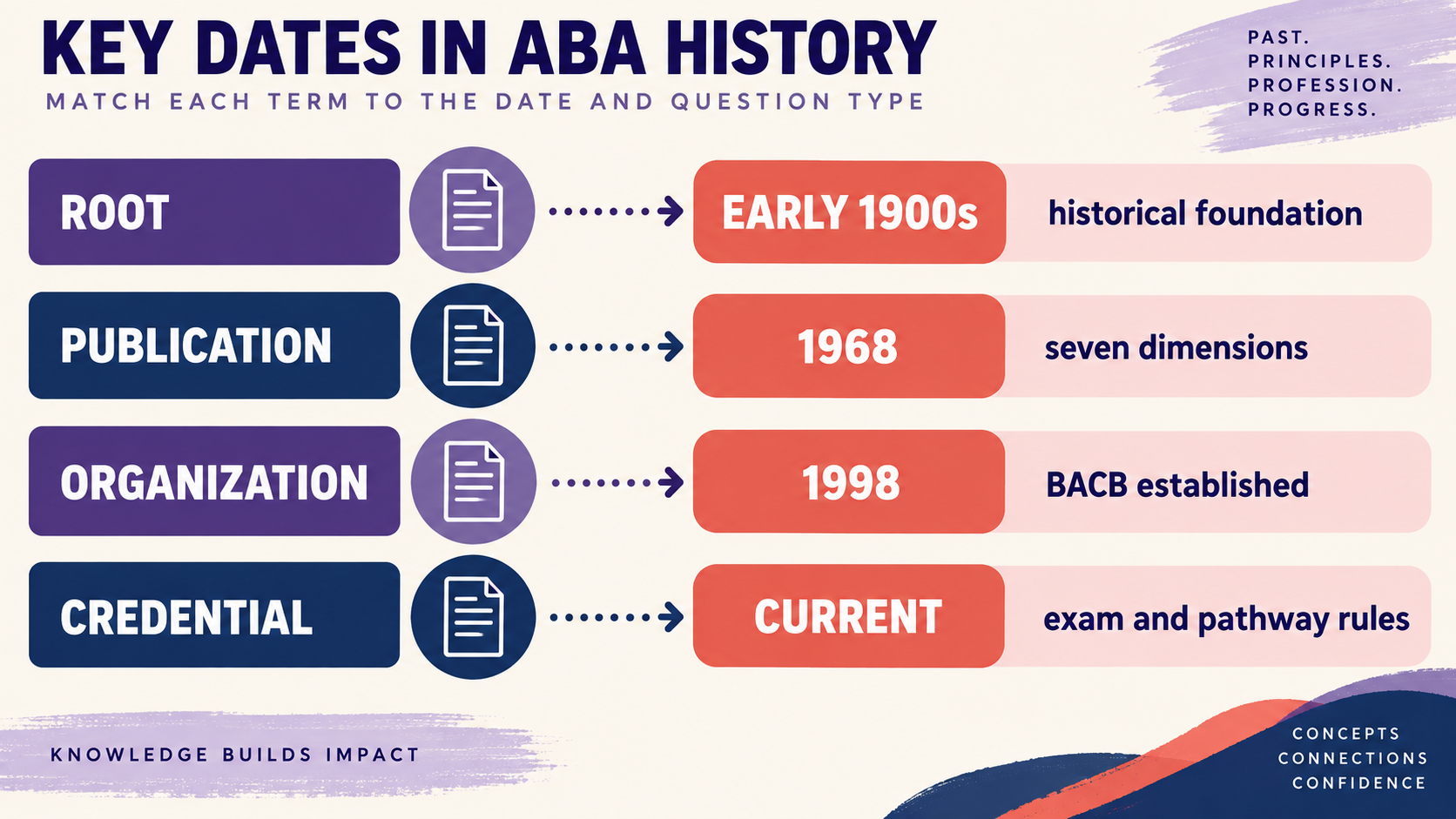
Build a layered timeline instead of memorizing isolated trivia. Put the scientific roots, applied-field formation, 1968 dimensions, professional-association growth, and certification infrastructure on separate lines. Then write the question each milestone can answer. This makes it easier to reject a distractor that gives a true year for the wrong question.
- Underline the noun in the question: behaviorism, behavior analysis, applied behavior analysis, association, BACB, or BCBA.
- Identify whether the question asks for a root, publication, organization, credential, or current requirement.
- Use 1968 for the Baer, Wolf, and Risley seven-dimensions milestone when that is what the stem describes.
- Use 1998 for the BACB establishment question, while remembering that certification history is not ABA’s full history.
- Explain why the nearest alternative answers a different historical layer.
For scenario practice, try our free BCBA mock exam. The useful habit is not merely remembering dates; it is matching a date to the wording and scope of the question.
What Should You Verify in Current Sources?
Historical sources explain how the field developed, but current BACB materials control certification and exam questions. Review the BCBA Test Content Outline for the current exam frame, and use the BACB’s About page for the Board’s professional role. The 1968 JABA article is the primary source for the seven-dimensions milestone. If a current requirements question involves the 2027 transition, read the official transition information separately. Do not infer a current application rule from a historical timeline.
FAQ: When Did ABA Start?
Is 1968 the official founding year of ABA?: No. It is a major formalization and teaching milestone because Baer, Wolf, and Risley published the seven dimensions in 1968. ABA developed through earlier scientific and applied work as well.
Who is considered the founder of ABA?: There is no single answer that captures the field accurately. Multiple researchers and professional communities contributed to behavior analysis and its applied development. A BCBA exam question should be answered from the specific wording and source frame.
Did the BACB start ABA?: No. The BACB was established in 1998 as certification and professional-standard infrastructure. Its history is important for BCBA candidates, but it follows the earlier development of behavior analysis and applied behavior analysis.
Final Takeaway
The best answer to when did ABA start is a qualified one: the field has roots in behaviorism and experimental analysis, applied behavior analysis developed through applied work before 1968, the 1968 JABA paper formalized the seven dimensions commonly used to describe the field, and the BACB was established in 1998 to support professional certification. Match the milestone to the question, and you will avoid turning one useful date into an inaccurate origin story. For targeted review, use our when did ABA start practice questions to apply the concept in exam-style scenarios.
Quick Review Checklist
Use this final checklist to turn when did ABA start into exam-ready reasoning. The goal is not to memorize a label in isolation; it is to identify the relevant evidence and explain why the best answer fits the scenario. Key ideas to review:
- State the central definition or decision point for when did ABA start in your own words.
- Identify the detail that makes when did ABA start different from its closest related ABA term.
- Separate the observable facts in a scenario from assumptions that are not supported by the facts.
- Write one example and one nonexample so you can recognize the concept in a new setting.
Exam application checks:
- Ask what the question is actually requesting before comparing the answer choices.
- Mark the antecedent, response, consequence, or other evidence that supports the selected answer.
- Look for a distractor that describes a related process but does not answer the specific question.
Final self-check:
- Explain how you would verify the interpretation with clear observations or data.
- Change one detail in the scenario and decide whether your answer should change.
- Give a one-sentence rationale that a supervisor or study partner could evaluate.
Take the Free BCBA Mock Exam
If you want a low-pressure way to check your recall, use the free practice resource below. Take the Free BCBA Mock Exam



