
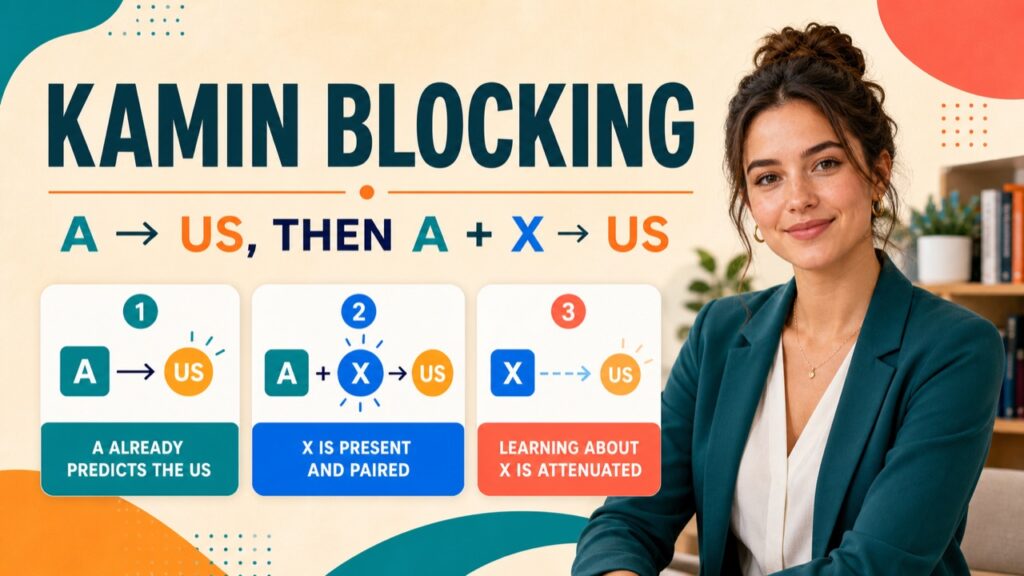
Blocking conditioning is a respondent-conditioning effect in which prior learning about one cue reduces learning about a newly added cue when both cues are later presented together before the same outcome. In applied behavior analysis, understanding Kamin blocking helps practitioners recognize how established stimulus-outcome relations can attenuate conditioning to new stimuli. This guide provides a comprehensive overview of Kamin blocking, its procedure, the role of prediction error, and key distinctions from similar phenomena and from response blocking.
Table of Contents
- What Is Kamin Blocking?
- The Canonical Two-Stage Procedure
- Mechanisms: Prediction Error and Beyond
- Distinguishing Blocking From Similar Phenomena
- Distinguishing Kamin Blocking From Response Blocking in ABA
- Common Traps and Study Checklist for BCBA Exam Prep
- Practical Implications for ABA
- Test Your Knowledge with a Free BCBA Mock Exam
What Is Kamin Blocking?
Kamin blocking is a respondent-conditioning effect first demonstrated by Leon Kamin in 1969. The effect describes how prior conditioning of one cue reduces learning about a newly added cue when the established cue and the new cue are later presented together before the same outcome. It is important to note that the established predictor does not literally block exposure to the unconditioned stimulus; rather, learning about the new stimulus is attenuated because the outcome is already predicted. The result is attenuated conditioned responding to the new stimulus relative to a control condition where no prior training occurred. This phenomenon is commonly discussed in terms of surprise or prediction error: if the outcome is already fully predicted, little is learned about the new cue.
Kamin blocking is a respondent-conditioning effect, not an ABA intervention or a label that can be assigned from one teaching error. It illustrates that prior predictive learning can alter conditioning to a cue that is later added to a compound. Applying that interpretation outside a controlled preparation requires direct evidence and an appropriate comparison; weak responding to a new cue alone does not identify blocking or establish why learning differed.
The Canonical Two-Stage Procedure
The Kamin blocking procedure involves three phases: pretraining, compound conditioning, and testing. During pretraining, one group (the blocking group) receives pairings of a conditioned stimulus (CS A) with an unconditioned stimulus (US) until CS A reliably elicits a conditioned response. A control group receives either no stimulus or an irrelevant stimulus paired with the US to equate total US exposure. In the second phase, both groups receive pairings of a compound stimulus AX (A plus a new stimulus X) with the same US. During the test phase, X is presented alone, and the strength of the conditioned response to X is measured.
- Blocking group result: X elicits a weak conditioned response, indicating attenuated learning.
- Control group result: X evokes more conditioned responding than in the blocking group under an appropriately matched test; the absolute response magnitude may vary.
- Critical comparison: The difference between groups demonstrates blocking—prior conditioning to A reduces learning about X.
Key procedural details include that the US must be identical in both phases, the compound AX must be presented repeatedly, and the test of X must occur in the absence of A to isolate learning about X. The control condition is essential because it rules out alternative explanations such as US habituation or general exposure effects. Because X is physically present and paired with the US during compound training, any reduction in conditioning cannot be attributed to simple omission of pairing.
Mechanisms: Prediction Error and Beyond
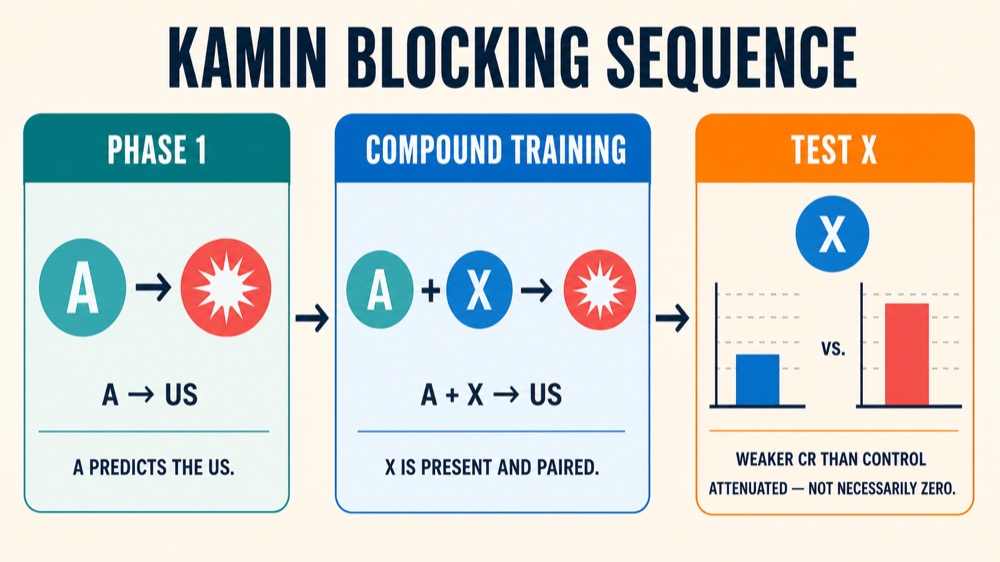
A highly influential account of Kamin blocking is the prediction error framework formalized by Rescorla and Wagner (1972). In that model, change in associative strength depends on the discrepancy between the outcome predicted by the currently present cues and the outcome that occurs. After A predicts the US, the A + X compound may generate relatively little prediction error, so less associative change is allocated to X. In an appropriate control without prior A-US training, the same outcome may generate a larger prediction error and more learning about X. This is a model-based explanation of the group difference, not a claim that surprise is the only possible mechanism.
While prediction-error models are influential, they are not the only account. Attentional theories (e.g., Mackintosh, 1975) suggest that organisms learn to ignore stimuli that are redundant predictors. Other models emphasize changes in stimulus associability or the role of retrospective revaluation. Contemporary research indicates that blocking may not be absolute and that multiple mechanisms can operate simultaneously depending on parameters such as stimulus salience, number of compound trials, and temporal arrangement. For BCBA candidates, understanding that prediction error is a leading but not exclusive explanation helps in flexibly applying the concept to novel scenarios.
Distinguishing Blocking From Similar Phenomena
Kamin blocking is often confused with other respondent conditioning effects. Below are key distinctions based on training history and test results.
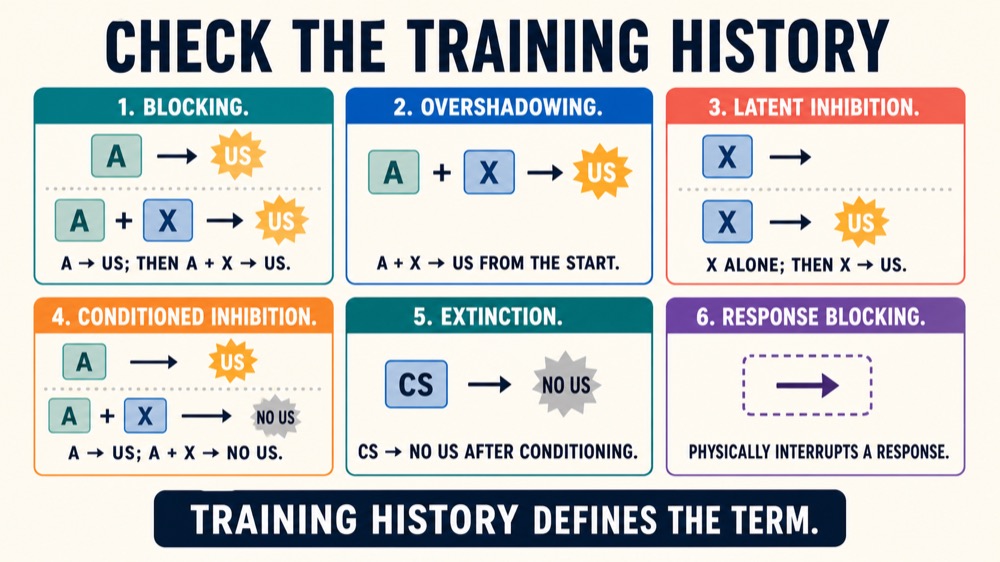
Overshadowing: In overshadowing, two novel stimuli (e.g., A and X) are presented together as a compound and paired with a US. The more salient stimulus acquires stronger control, but both can be learned simultaneously. In blocking, prior training to A reduces learning about X. Procedure: A-US then AX-US vs. AX-US with no pretraining. Both result in weak responding to X, but the training histories differ.
Latent Inhibition: Latent inhibition occurs when preexposure to a stimulus alone (without US) retards later conditioning to that stimulus when paired with a US. In blocking, the preexposed stimulus (A) is paired with the US before compound training. Latent inhibition involves no prior US pairing, whereas blocking does. Procedure: X alone then X-US vs. A-US then AX-US.
Conditioned Inhibition: Conditioned inhibition is commonly arranged with reinforced A trials and nonreinforced A + X trials, so X predicts omission of the US in that context. Blocking instead uses A-US training followed by reinforced A + X-US compound trials. Reduced responding to X after blocking does not by itself demonstrate that X is inhibitory; inhibitory function requires evidence from appropriate tests such as summation and retardation. The procedures and conclusions are therefore different.
Extinction: Extinction is the reduction in CR when the CS is presented without the US after conditioning. Blocking is not extinction because X never acquired a strong CR to begin with. Procedure: Extinction: CS-alone after conditioning; blocking: prior conditioning to A reduces acquisition to X.
Higher-Order Conditioning: In higher-order conditioning, a new cue is paired with an established conditioned stimulus without presenting the original US during that higher-order pairing. In blocking, A and X are presented together as a compound and followed by the same US. Procedure: higher-order conditioning uses A-US followed by X-A without the US; blocking uses A-US followed by A + X-US.
Sensory Preconditioning: Sensory preconditioning involves pairing two neutral stimuli (e.g., A-X) before one is paired with a US; later, the other elicits a CR. In blocking, A is already a CS before compound training. Procedure: Sensory preconditioning: A-X then A-US; blocking: A-US then AX-US.
Distinguishing Kamin Blocking From Response Blocking in ABA
Kamin blocking and response blocking refer to different arrangements. Kamin blocking is a respondent-conditioning effect evaluated through the A-US, A + X-US, and later X-test history. Response blocking is a procedure in which an implementer physically interrupts or prevents completion of a response. Its behavioral function and effect cannot be inferred from the word blocking alone, and it should not automatically be labeled punishment or extinction. Clinical use requires appropriate competence, assessment, authorization, safeguards, and ongoing data review. The terms should not be used interchangeably. The current BCBA Test Content Outline (6th ed.) does not explicitly name Kamin blocking as a task item, so broader respondent-conditioning content should not be turned into a claim that this exact term is guaranteed on the examination.
Common Traps and Study Checklist for BCBA Exam Prep
Below are common misunderstandings about Kamin blocking and a checklist to solidify your knowledge.
- Trap: Blocking means the new stimulus is never paired with the US. Fact: X is physically present and paired with the US during compound training; learning is attenuated, not prevented.
- Trap: Blocking always results in zero learning about X. Fact: Blocking is reduced conditioning relative to a control; some learning may occur under certain conditions.
- Trap: Blocking and overshadowing are the same procedure. Fact: In blocking, prior training to A reduces learning about X; in overshadowing, both cues are novel and simultaneously compete for salience.
- Trap: Preexposure to X alone is blocking. Fact: That is latent inhibition, not blocking.
- Trap: Blocking is a form of extinction. Fact: Extinction involves presenting the CS without US after conditioning; blocking involves impaired acquisition.
- Trap: Response blocking = Kamin blocking. Fact: Response blocking is an operant intervention; Kamin blocking is a respondent conditioning effect.
Study Checklist:
- Can you diagram the two-phase blocking procedure (A-US then AX-US)?
- Can you explain the control condition and why it is necessary?
- Can you articulate the prediction-error mechanism in your own words?
- Can you distinguish blocking from overshadowing, latent inhibition, conditioned inhibition, extinction, higher-order conditioning, and sensory preconditioning by comparing training histories and test results?
- Can you give an original everyday example (e.g., a child learns that a bell predicts snack; later, a bell+light both predict snack; the child learns little about the light)?
- Can you verify terms against the current BCBA Test Content Outline? Kamin blocking is not explicitly named, so do not infer exam frequency or a guarantee from broader respondent-conditioning domains.
Practical Implications for ABA
Clinical relevance should be stated cautiously. The blocking preparation demonstrates that prior predictive learning can alter later conditioning to an added cue, but it does not by itself explain prompt dependence, missed instructional cues, or any individual learner’s performance. Do not diagnose blocking from one observation or turn a prediction-error account into a teaching prescription. A defensible evaluation would require clearly defined stimuli and responses, repeated measurement, an ethically appropriate comparison, and consideration of alternative explanations. Blocking also varies with procedural and inferential conditions, as discussed in recent experimental work, a review of attentional models, and a broader review. The current BCBA Test Content Outline should be used for explicit exam-content claims.
Test Your Knowledge with a Free BCBA Mock Exam
Ready to practice? Take our free BCBA mock exam at https://bcbamockexam.com/free-bcba-mock-exam/ to test your understanding of respondent conditioning, stimulus control, and other foundational concepts. The exam provides instant feedback and detailed explanations to help you identify areas for improvement. While the mock exam covers a broad range of topics, it does not guarantee inclusion of this exact topic. Use it as a supplement to your structured study plan. Good luck!



