

If you see the question “Which of the following best defines operant behavior?”, look for the answer that connects behavior to its consequences. Operant behavior is behavior whose future probability, form, or distribution is influenced by consequences that have followed it. In a typical multiple-choice item, the best answer is the one that describes behavior shaped or maintained by consequences, not a reflex that is elicited by a preceding stimulus.
Table of Contents
- Which of the Following Best Defines Operant Behavior?
- Why Consequences Are the Clue
- Operant Versus Respondent Behavior
- How to Work Through the Answer Choices
- Common Operant Behavior Exam Traps
- Quick Review Checklist
- Take the Free BCBA Mock Exam
- References
The key word is not simply “voluntary.” People often use that shortcut, but a behavior is identified as operant by its functional relation with consequences. A response may be emitted without being forced by a particular antecedent, and its future pattern can be selected by what happens after it. Reinforcement can increase a response’s future probability, while punishment can decrease it when the relevant conditions are present.
This guide breaks down the definition, compares the closest distractors, and gives you a repeatable way to solve an operant-behavior question without relying on a memorized sentence. The wording here is an educational explanation, not an official or recalled BACB exam item. Table of Contents
Which of the Following Best Defines Operant Behavior?
The strongest definition is: behavior whose future probability is affected by its consequences. An operant is not defined only by how the response looks. Two different topographies can belong to the same functional response class when they produce a common effect or are strengthened by a common consequence. Conversely, identical-looking responses can serve different functions in different contexts.
Consider a student who raises a hand, says “excuse me,” or types a message to obtain teacher attention. The forms differ, but the responses may be part of a functional communication class if attention reliably follows them and that consequence changes future responding. The important analysis is the relation between the response and its consequence, not whether the movement appears voluntary to an observer.
| Possible answer idea | How to evaluate it | Best judgment |
|---|---|---|
| Behavior shaped by its consequences | Names the defining consequence relation | Best answer |
| A reflexive response elicited by a stimulus | Describes respondent behavior more directly | Distractor |
| Behavior unaffected by reinforcement or punishment | Removes the consequence relation instead of defining it | Incorrect |
| Any behavior that happens after a stimulus | Confuses an antecedent sequence with a functional definition | Too broad |
Why Consequences Are the Clue
In operant conditioning, consequences select future responding. A consequence is not defined by whether it feels positive or negative to an outside observer. Reinforcement is identified by an increase in the future frequency or probability of behavior, while punishment is identified by a decrease under the relevant conditions. The labels describe functional effects, not the person’s intention or the consequence’s appearance.
For example, a learner completes a difficult task and then receives a preferred break. If completing the task becomes more likely in similar situations, the break may have functioned as reinforcement for that behavior. The same event would not automatically be a reinforcer just because it was intended as a reward. The future change in behavior is the evidence that matters.
- Identify the response that occurred.
- Identify what immediately followed the response.
- Ask whether the response becomes more or less likely in comparable conditions.
- Separate the functional effect from the consequence’s everyday label.
Operant Versus Respondent Behavior
The most common distractor for an operant-behavior question describes respondent behavior. Respondent behavior is elicited by antecedent stimuli and is often discussed in relation to reflexes and respondent conditioning. Operant behavior is emitted and is selected by consequences. An antecedent can still matter for an operant response because it may signal that a consequence is available, but the antecedent alone is not the defining feature.
Imagine a loud noise that produces a startle response. The startle is a useful respondent example because the stimulus elicits a reflexive reaction. Now imagine a learner asks for help and receives assistance; the future likelihood of asking can change because of that consequence. That is the pattern the question is looking for when it asks about operant behavior.
| Feature | Operant pattern | Respondent pattern |
|---|---|---|
| Typical wording | Emitted, followed by, maintained by, selected by consequences | Elicited by, reflexive response, stimulus pairing |
| Main relation to notice | Future probability changes as a function of consequences | A stimulus evokes or elicits a response |
| Study cue | Ask what happened after the response and what changed later | Ask what stimulus immediately elicited the reaction |
How to Work Through the Answer Choices
Do not choose an answer because it contains a familiar word such as “stimulus,” “voluntary,” or “learning.” Read the entire relation described. A response can occur in the presence of an antecedent and still be operant if the question emphasizes its consequence-based selection. Conversely, the presence of a consequence word is not enough if the answer describes a respondent reflex or an unrelated event.
- Find the response: name the behavior that the question is asking you to classify.
- Find the relation: look for what happens after the behavior and whether future responding changes.
- Screen for reflex language: “elicited,” “evoked,” or “reflexive” often signals respondent behavior.
- Reject absolute wording: “never affected by consequences” is the opposite of the operant definition.
- Choose the most functional answer: prefer the option that describes the behavior–consequence relation precisely.
A question may describe a response that is initially prompted or occasioned by an antecedent. That detail does not automatically turn it into respondent behavior. The classification depends on the functional relation the stem asks you to identify. Look for the evidence that consequences alter future responding, and do not let the mere presence of a preceding stimulus decide the answer.
Common Operant Behavior Exam Traps
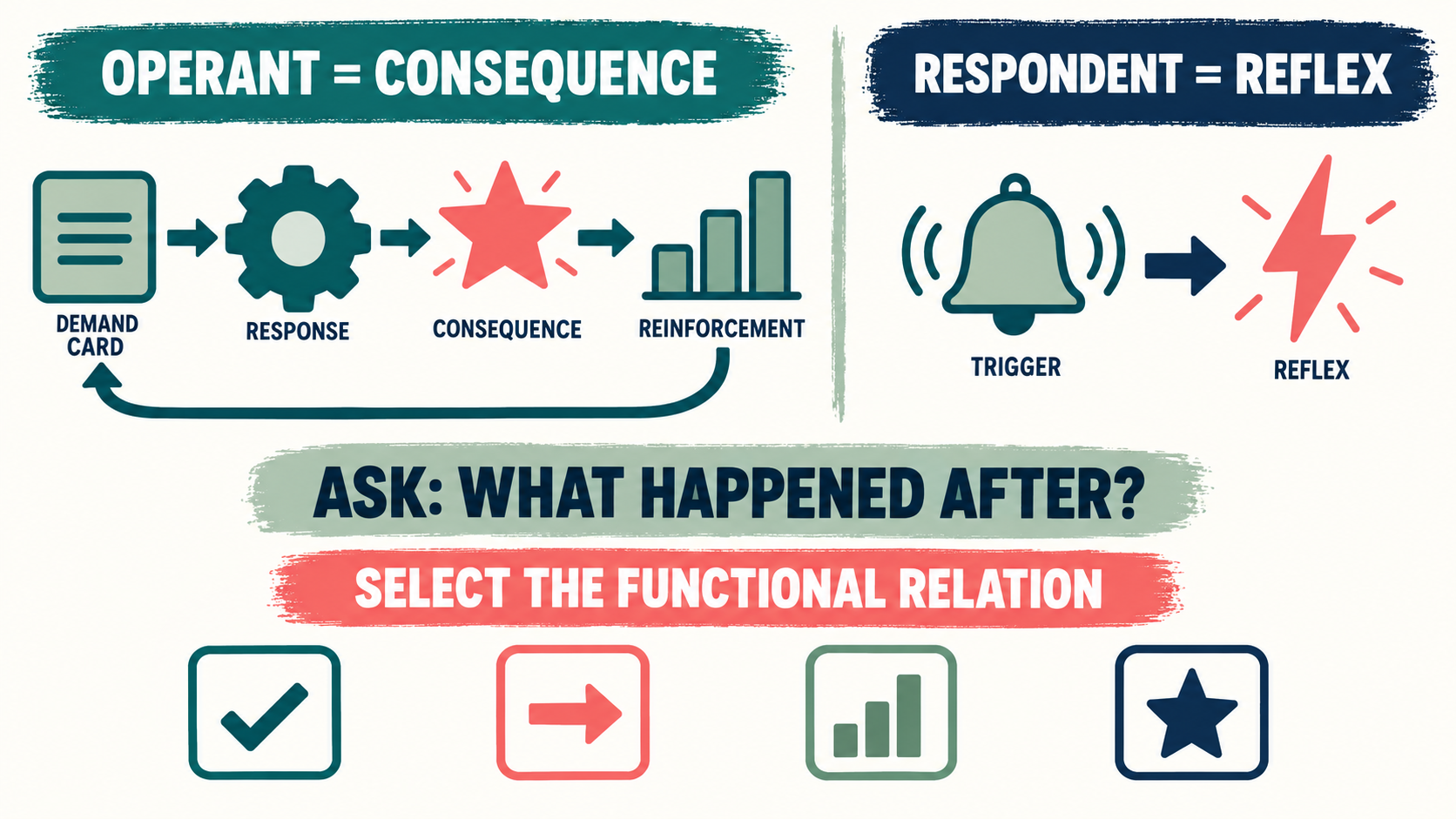
These traps are useful because they reveal what the question writer is testing. The best answer usually preserves the functional relation while the distractors substitute topography, intention, or a different conditioning process.
- Choosing “voluntary behavior” without checking whether the answer explains consequences.
- Calling every behavior that follows a stimulus respondent behavior.
- Confusing an antecedent that signals reinforcement with the consequence that changes future responding.
- Treating a consequence as a reinforcer because someone intended it as a reward.
- Assuming two responses with different forms cannot belong to one functional response class.
Quick Review Checklist
Before you lock in an answer, ask:
- Does the option describe a behavior–consequence relation?
- Does it explain a change in future probability, form, or distribution?
- Is the answer using “elicited” or reflex language that points to respondent behavior?
- Am I relying on topography or intention instead of function?
- Can I state in one sentence why the closest distractor is a different concept?
Take the Free BCBA Mock Exam
After learning the definition, practice discriminating operant and respondent patterns inside short scenarios. Our which of the following best defines operant behavior practice questions can help you identify the consequence clue, screen out reflex distractors, and explain why the selected answer is the best fit. Use practice to build reasoning; it does not guarantee a passing score or replace official BACB materials. Take the Free BCBA Mock Exam
References
- BACB BCBA Test Content Outline (6th ed.)
- BACB About Behavior Analysis
- APA Dictionary: Operant Behavior



