
When a BCBA study question asks how to calculate total duration IOA, compare the two observers’ total durations for the same behavior and the same observation period. Divide the shorter duration by the longer duration, then multiply by 100. The result is a percentage describing how closely the two total-duration measurements agree.
Table of Contents
- How to Calculate Total Duration IOA
- Worked Total Duration IOA Example
- What Total Duration IOA Measures—and What It Hides
- Compare Total Duration and Mean Duration-Per-Occurrence IOA
- How to Interpret the Percentage
- Common Total Duration IOA Mistakes
- Quick Review Checklist
- Take the Free BCBA Mock Exam
- References
The formula is different from total count IOA. Count IOA compares how many responses each observer recorded; total duration IOA compares how long the target behavior lasted in total. Keeping the measurement dimension visible is the easiest way to avoid choosing the wrong formula on an exam.
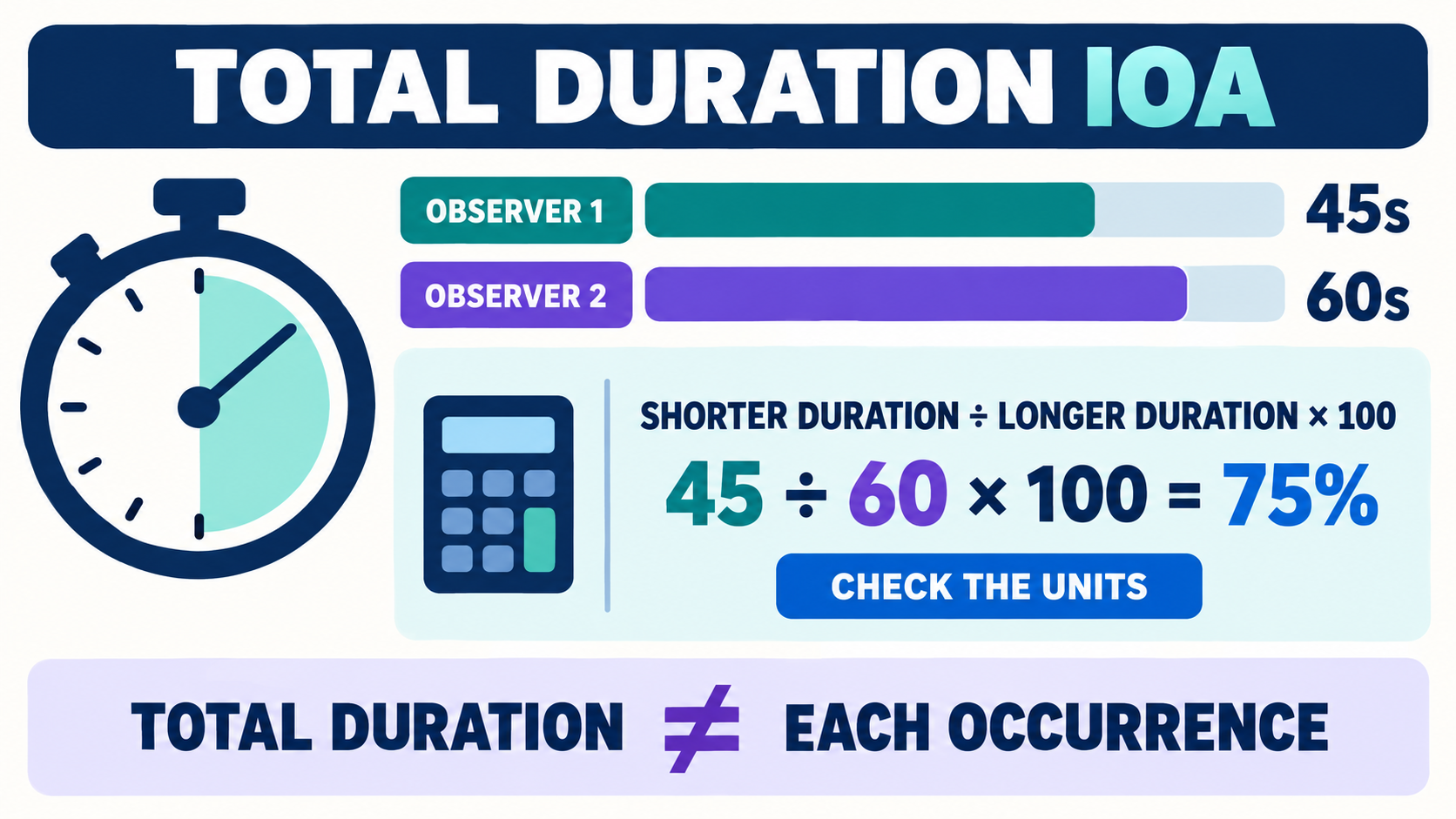
For example, if Observer 1 records 45 minutes and Observer 2 records 60 minutes, total duration IOA is 45 ÷ 60 × 100 = 75%. This page explains the calculation, shows what the percentage can hide, and compares it with mean duration-per-occurrence IOA. Table of Contents
How to Calculate Total Duration IOA
Use this formula: Total duration IOA (%) = shorter total duration ÷ longer total duration × 100 “Shorter” and “longer” refer to the numerical values, not necessarily to the observer’s identity. If Observer A records 12 minutes and Observer B records 10 minutes, use 10 as the numerator and 12 as the denominator. The result is 83.3%, after rounding to one decimal place. Putting the larger number on top would produce a value above 100%, which is a clear sign that the ratio was reversed.
Keep the word “total” attached to the full observation period. If the stem gives several separate episode durations, do not automatically add them unless it asks for a total-duration measure. If it asks you to compare each episode, pause and consider mean duration-per-occurrence IOA instead.
| Observer A | Observer B | Formula | Result |
|---|---|---|---|
| 45 minutes | 60 minutes | 45 ÷ 60 × 100 | 75% |
| 10 minutes | 12 minutes | 10 ÷ 12 × 100 | 83.3% |
| 30 minutes | 30 minutes | 30 ÷ 30 × 100 | 100% |
Worked Total Duration IOA Example
Imagine that two observers measure the duration of vocal stereotypy during the same 90-minute session. Observer 1 records 18 minutes, and Observer 2 records 24 minutes. Start by confirming that both numbers refer to the same target behavior and the same session. Then identify 18 as the shorter duration and 24 as the longer duration.
- Write the smaller value: 18 minutes.
- Write the larger value: 24 minutes.
- Divide: 18 ÷ 24 = 0.75.
- Convert to a percentage: 0.75 × 100 = 75%.
- Label the result: total duration IOA = 75%.
Do not add the durations and divide by two. That would calculate an average duration, not agreement. Do not subtract 18 from 24 and call the six-minute difference the IOA. A difference can describe disagreement, but it is not the total-duration agreement ratio requested by the formula.
Also check units. If one observer reports seconds and the other reports minutes, convert them to the same unit before dividing. The ratio is unitless only after both measurements describe the same quantity in the same scale. On a multiple-choice item, underline the measurement word before touching the numbers. That single step keeps a duration problem from turning into a count problem.
What Total Duration IOA Measures—and What It Hides
Total duration IOA compares the aggregate time each observer recorded across the session. It is useful when the overall amount of time engaged in the behavior is the measurement question. However, two observers can obtain the same total duration while disagreeing about when the behavior occurred. One observer might record a long episode early while another records shorter episodes spread throughout the session.
That limitation is not an arithmetic error. It is a property of the method. If timing, episode boundaries, or individual occurrences matter, a more detailed duration agreement method may provide better information. Match the method to the decision you need the data to support.
- Use the same target definition and observation period.
- Confirm both observers used the same start and stop rules.
- Keep the unit consistent before calculating.
- Interpret the aggregate percentage together with the raw durations.
Compare Total Duration and Mean Duration-Per-Occurrence IOA
Total duration IOA uses one total from each observer. Mean duration-per-occurrence IOA is more granular: it calculates agreement for individual occurrences and then summarizes those occurrence-level ratios. A question that mentions each episode, each occurrence, or average duration is signaling a different method.
| Method | Unit compared | Clue in a question |
|---|---|---|
| Total duration IOA | Whole-session duration total | Shorter total ÷ longer total × 100 |
| Mean duration-per-occurrence IOA | Each matched occurrence’s duration | Average the agreement ratios for occurrences |
| Total count IOA | Whole-session response count | Smaller count ÷ larger count × 100 |
How to Interpret the Percentage
A total duration IOA percentage is a description of observer correspondence, not a universal pass-or-fail rule. Whether 75% is acceptable depends on the measurement plan, the purpose of the observation, the behavior being measured, and the decisions that will be made from the data. A study question may ask only for the arithmetic result, but real data interpretation also requires looking at the raw records and the consequences of disagreement.
For instance, a six-minute difference might be relatively small in a long observation when the goal is a broad estimate of total engagement. The same six-minute difference could be important when the target behavior is brief, safety-relevant, or used to make a time-sensitive decision. Do not invent a threshold simply because a percentage feels high or low. Name the method, report the raw values, and follow the relevant protocol.
Observer agreement can also be affected by how the operational definition describes episode onset and offset. If one observer starts timing when a sound begins and another starts only after a full vocal response, their totals may diverge even though both are applying the same broad label. Before recalculating the formula, check whether the definition and timing rules are precise enough for independent observers to use consistently.
- Read the raw durations alongside the percentage.
- Check the target definition and start/stop rules.
- Consider what decision the agreement data will support.
- Follow the measurement plan instead of creating an unsupported cutoff.
Common Total Duration IOA Mistakes
- Using the total count formula because the word “total” appears in both methods.
- Putting the longer duration in the numerator and getting a value above 100%.
- Mixing seconds and minutes without converting them to one unit.
- Using an average duration when the question asks for agreement.
- Assuming matching totals prove that episode timing also matched.
Quick Review Checklist
Before answering a total-duration IOA question, ask:
- Are the two numbers total durations from the same session?
- Which value is shorter and which is longer?
- Are both measurements expressed in the same unit?
- Did I divide the shorter duration by the longer duration?
- Does the stem actually ask about total duration rather than individual occurrences?
Take the Free BCBA Mock Exam
Once the arithmetic feels familiar, practice identifying the measurement dimension before calculating. Our how to calculate total duration IOA practice questions can help you separate duration, count, interval, and occurrence-level agreement in BCBA-style scenarios. Practice supports study, but it does not replace an approved measurement plan or official BACB guidance. Take the Free BCBA Mock Exam
References
- BACB BCBA Test Content Outline (6th ed.)
- BACB Test Content Outlines and Task Lists
- Worked IOA calculation reference



